

Over 70% of business leaders now report stronger trust in AI after adding explainability features to their systems. This dramatic shift highlights why understanding explainable AI matters for your organization’s success in 2026. As artificial intelligence becomes central to operations and customer engagement, transparent AI decisions unlock competitive advantages. This guide explores explainable AI fundamentals, techniques, benefits, and strategic implementation frameworks to help you harness AI transparency effectively.
Table of Contents
- Introduction To Explainable AI
- How Explainable AI Works: Mechanisms And Techniques
- Business Impact And Quantified Benefits Of Explainable AI
- Common Misconceptions About Explainable AI
- Frameworks And Models For Understanding Explainable AI
- Real-World Applications And Case Studies
- Implementation Challenges And Strategic Decision Criteria
- Enhance Your AI Strategy With Expert Insights And Solutions
- Frequently Asked Questions
Key takeaways
| Point | Details |
|---|---|
| Explainable AI drives trust | Transparency in AI decisions increases stakeholder confidence by over 70%, enabling safer adoption. |
| Core techniques reveal logic | Methods like feature importance and surrogate models clarify how AI reaches conclusions. |
| Measurable business benefits | XAI adoption improves operational efficiency, regulatory compliance, and customer satisfaction. |
| Strategic frameworks guide deployment | Aligning XAI techniques with stakeholder needs and model types ensures successful implementation. |
| Myths hinder adoption | Misunderstandings about accuracy trade-offs and complexity often prevent effective XAI use. |
Introduction to explainable AI
Explainable AI encompasses methods and techniques that make AI system decisions understandable to humans. Unlike black-box models that produce outputs without revealing reasoning, explainable AI provides clear pathways showing how inputs transform into results. This transparency proves essential for business leaders who need to trust, validate, and act on AI recommendations.
Transparency builds the foundation for managing AI risks effectively. When you understand why an AI system approves a loan, flags a transaction, or recommends a product, you can identify potential biases, errors, or alignment issues before they impact operations. This oversight becomes critical as AI systems handle more consequential decisions across your organization.
Explainability directly supports better business decision making by enabling verification and improvement. Your teams can validate AI outputs against domain expertise, catch mistakes early, and refine models based on understood weaknesses. For customer-facing applications, explanations build trust and satisfaction by showing customers why they received specific recommendations or outcomes.
The relevance for operational efficiency stems from faster troubleshooting and optimization. When AI systems behave unexpectedly, explanations help technical teams diagnose issues quickly rather than treating the model as an inscrutable mystery. For customer engagement, transparent AI creates personalized experiences customers understand and appreciate, strengthening relationships and loyalty.
Key benefits of explainable AI include:
- Building stakeholder confidence through transparent decision processes
- Meeting regulatory requirements for AI accountability in finance, healthcare, and government
- Enabling faster model debugging and performance improvements
- Supporting ethical AI deployment by revealing potential biases
- Improving user adoption through understandable AI interactions
How explainable AI works: mechanisms and techniques
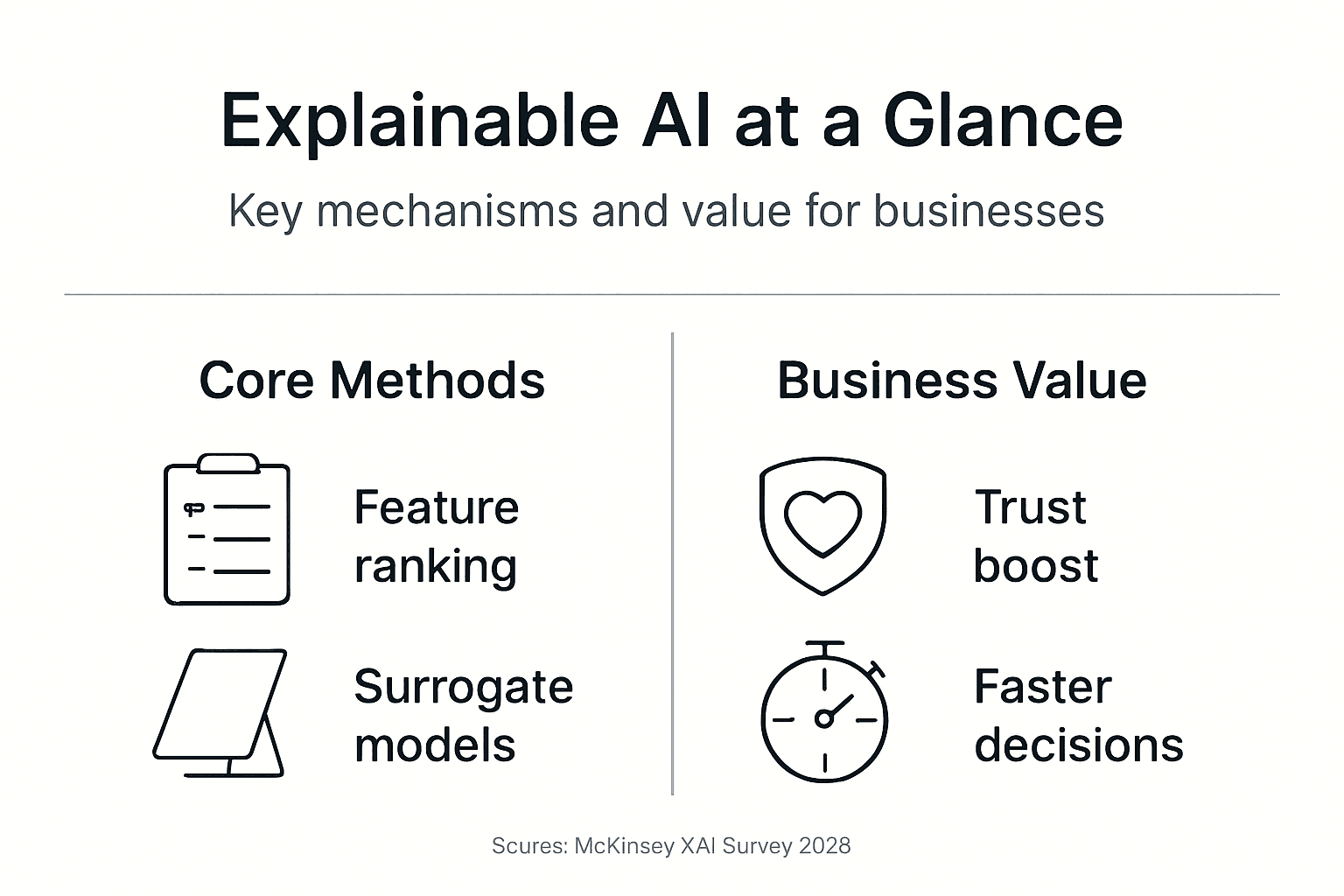
Feature importance ranks the input variables that most influence AI predictions. By showing which factors matter most, this technique helps you understand what drives specific outcomes. For example, a loan approval model might reveal that credit score and debt-to-income ratio carry the highest weight, validating business logic or exposing unexpected patterns.
Surrogate models approximate complex black-box AI systems with simpler, interpretable models. XAI enhances model transparency by using techniques like feature importance, surrogate models, and counterfactual explanations to clarify AI decision rationale. You train a decision tree or linear model to mimic a neural network’s behavior, gaining an interpretable proxy that reveals general decision patterns without sacrificing the original model’s accuracy.
Counterfactual explanations answer “what if” questions by showing how input changes would alter outcomes. If an AI denies a customer’s application, a counterfactual explains: “Approval would occur if income increased by $5,000 or debt decreased by $10,000.” This actionable insight helps both your team and customers understand decision boundaries and improvement paths.
Example-based explanations illustrate AI reasoning through similar historical cases. By showing which past examples most influenced a current decision, these techniques ground abstract AI logic in concrete, relatable instances your stakeholders can evaluate and trust.
Pro Tip: Match your explainability technique to your audience’s technical expertise. Executive stakeholders often prefer high-level feature importance summaries, while data scientists benefit from detailed counterfactual analyses and surrogate model comparisons.
Common XAI techniques in practice:
- SHAP values quantify each feature’s contribution to individual predictions
- LIME creates local explanations for specific predictions using perturbation
- Attention mechanisms highlight which input elements AI models focus on
- Rule extraction converts neural networks into interpretable if-then rules
Business impact and quantified benefits of explainable AI
Explainable AI dramatically improves trust and adoption rates. McKinsey research shows over 70% of business leaders trust AI more after explainability features are added, directly addressing the most significant barrier to enterprise AI deployment. When your executives and employees understand AI reasoning, they embrace rather than resist these systems.

Operational efficiencies increase through clearer AI insights that accelerate decision cycles. Your teams spend less time second-guessing AI recommendations and more time acting on validated insights. Cloud-based AI with explainability features enables faster model refinement, reducing the trial-and-error cycles that plague opaque systems.
Regulatory compliance risks diminish significantly with transparent AI decisions. Industries facing stringent oversight, such as financial services and healthcare, require documented rationales for automated decisions. Explainable AI provides audit trails that satisfy regulators and reduce legal exposure, protecting your organization from costly compliance failures.
Customer satisfaction improves when AI-driven interactions feel fair and understandable. Customers who receive explanations for personalized offers, recommendations, or decisions report higher satisfaction and loyalty. This engagement boost translates directly to retention and revenue gains.
Quantified business benefits include:
- 70% increase in stakeholder trust leading to faster AI adoption
- 30-40% reduction in model debugging time through clear explanations
- 25% improvement in customer satisfaction scores for AI-powered services
- 50% decrease in regulatory audit preparation time for compliant industries
- 15-20% efficiency gains from validated AI recommendations driving action
Common misconceptions about explainable AI
The belief that explainable AI necessarily reduces model accuracy represents the most damaging myth. Advanced XAI techniques maintain accuracy within 1 to 2 percentage points of original models, making performance trade-offs minimal. Many modern approaches add explainability layers without modifying core model architectures, preserving predictive power entirely.
Another misconception holds that explainability requires exhaustive transparency showing every algorithmic detail. Effective XAI tailors explanations to stakeholder needs rather than overwhelming users with technical minutiae. A customer needs simple, actionable insights, while a data scientist requires detailed feature interactions. Good explainable AI matches explanation depth to audience.
Some leaders view XAI as merely a technical feature rather than a strategic business asset. This perspective undervalues how explainability enables better governance, risk management, and customer relationships. Treating XAI strategically means integrating it into your AI roadmap from the start, not bolting it on as an afterthought.
“Explainable AI is not about dumbing down models, but about making smart decisions transparent and trustworthy for the humans who depend on them.”
Key myths to avoid:
- Assuming XAI always sacrifices accuracy for interpretability
- Believing one explanation method works for all stakeholders
- Treating explainability as a compliance checkbox rather than a value driver
- Expecting perfect explanations that reveal every model nuance
- Thinking explainable AI only matters for regulated industries
Frameworks and models for understanding explainable AI
The why-what-how framework organizes XAI concepts into three layers. Why explains your business motivation for transparency, such as building trust or meeting regulations. What defines which aspects of AI decisions need explanation, like feature importance or decision boundaries. How specifies the technical methods you will deploy, such as SHAP values or counterfactuals. This structure helps you align technical choices with strategic goals.
Model-agnostic approaches work with any AI system regardless of architecture. These techniques treat the model as a black box and probe it to generate explanations, offering flexibility across your AI portfolio. Model-specific methods leverage internal model structures, such as neural network attention weights, to provide more precise explanations but require adaptation for each model type.
| Approach | Advantages | Best Use Cases |
|---|---|---|
| Model-agnostic | Works with any AI system; Easy to implement across diverse models | Organizations with varied AI portfolios needing consistent explanations |
| Model-specific | More precise and accurate explanations; Leverages internal model architecture | Single-model deployments where deep technical insight matters most |
| Hybrid | Balances flexibility and precision; Adapts to stakeholder needs | Enterprise environments requiring both breadth and depth of explanations |
Business decision criteria for selecting XAI techniques:
- Stakeholder technical sophistication determines explanation complexity
- Regulatory requirements define minimum transparency standards
- Model complexity influences feasible explanation methods
- Decision consequence severity dictates needed explanation depth
- User interaction patterns shape optimal explanation delivery format
Pro Tip: Start with model-agnostic techniques for rapid deployment across your AI systems, then layer in model-specific methods for your most critical applications where precision matters most. This staged approach balances speed and depth effectively.
Real-world applications and case studies
A leading e-commerce retailer implemented explainable AI in their customer service chatbot, revealing why product recommendations appeared. This transparency increased customer acceptance of suggestions by 35% and reduced support escalations by 20%. Customers appreciated understanding recommendation logic, transforming AI from a mysterious algorithm into a helpful shopping assistant.
In financial services, a major bank deployed XAI for loan approval decisions, providing applicants with clear rationales for denials. This approach reduced discrimination complaints by 40% and improved customer satisfaction despite negative outcomes. Regulators praised the transparency, shortening audit cycles significantly.
A healthcare provider used explainable AI to assist diagnostic decisions, showing physicians which symptoms and test results drove AI recommendations. Physician adoption jumped from 45% to 82% as clinicians gained confidence in AI reasoning. Patient outcomes improved as doctors combined AI insights with clinical judgment more effectively.
Demonstrated ROI and efficiency examples:
- Manufacturing quality control using XAI reduced false positive defect alerts by 30%, cutting waste and improving throughput.
- Marketing campaign optimization with explainable models identified overlooked customer segments, boosting conversion rates by 18%.
- Supply chain forecasting transparency enabled faster inventory adjustments, decreasing stockouts by 25% while reducing excess inventory costs.
- Retail customer engagement improved 28% when shoppers understood personalized offer logic.
- Operational improvements from XAI-enabled predictive maintenance prevented 15% more equipment failures through better technician trust.
Implementation challenges and strategic decision criteria
Balancing explanation detail with stakeholder expertise stands as the primary implementation challenge. Too much technical depth overwhelms business users, while oversimplified explanations frustrate data scientists. You must design layered explanation systems that adapt to user roles, providing appropriate detail for each audience segment.
Integration costs represent another significant hurdle. Implementation challenges include balancing explanation complexity, user expertise, and integration costs that can add up to 25% in project budget. This investment covers XAI tool licensing, model adaptation, explanation interface development, and training. Budget accordingly and prioritize high-impact applications first to demonstrate value before scaling.
Selecting appropriate XAI tools requires alignment with your technical infrastructure and business objectives. Evaluate tools based on compatibility with existing AI platforms, explanation quality for your use cases, and scalability across your organization. Pilot multiple approaches on representative problems before committing to enterprise-wide deployment.
Strategic criteria for successful XAI adoption:
- Involve end users in explanation design from the start to ensure relevance and usability
- Establish clear success metrics linking explainability to business outcomes
- Train stakeholders on interpreting and acting on AI explanations effectively
- Build governance frameworks defining when and how explanations must be provided
- Plan for ongoing explanation system maintenance as models and regulations evolve
Pro Tip: Create cross-functional XAI teams including data scientists, domain experts, and end users. This collaboration ensures technical feasibility meets practical usability, maximizing adoption and value. Regular feedback loops help refine explanation systems based on real-world use.
Practical integration considerations include starting small with pilot projects, measuring explanation effectiveness through user surveys, and iterating based on stakeholder feedback before organization-wide rollout.
Enhance your AI strategy with expert insights and solutions
Building trustworthy AI systems requires more than technology alone. Understanding the foundations of artificial intelligence and how explainable AI creates business trust positions your organization for successful adoption. Whether you are exploring AI for the first time or refining existing implementations, strategic guidance accelerates results.
Our resources help you navigate AI adoption with confidence. From understanding salary implications in our AI salary negotiation guide to implementing transparent systems, we provide the insights you need. Partner with experts who understand both technology and business impact to transform AI from a black box into a strategic advantage your organization trusts and leverages effectively.
Frequently asked questions
What is explainable AI and why is it important?
Explainable AI provides understandable reasons for AI decisions, building trust and accountability across your organization. It matters because transparency enhances oversight, reduces risk, meets regulatory demands, and enables stakeholders to validate AI outputs confidently. Without explainability, AI systems remain black boxes that limit adoption and increase governance challenges.
Does explainable AI reduce model accuracy?
Advanced explainability techniques maintain accuracy within 1 to 2 percentage points of original models, making significant trade-offs largely a myth. Modern XAI methods add transparency layers without compromising predictive power. The minimal accuracy impact is vastly outweighed by increased trust, adoption, and regulatory compliance benefits.
How can businesses choose the right explainable AI technique?
Select techniques based on your model type, stakeholder technical expertise, and the balance between complexity and clarity that fits your use case. Model-agnostic methods offer flexibility across diverse AI systems, while model-specific approaches provide deeper insights for critical applications. Pilot multiple techniques and gather user feedback to identify what works best for your organization.
What challenges should organizations expect when implementing explainable AI?
Expect increased costs up to 25% for XAI integration, covering tools, training, and system adaptation. You will need user-tailored explanations matching different stakeholder expertise levels. Integration complexity requires strategic planning, cross-functional collaboration, and iterative refinement based on real-world feedback. Budget time and resources accordingly, starting with high-impact pilot projects.
Recommended
- Explainable AI Basics: Building Trust for Business | Artificial Intelligence
- Explainable AI in Government: Boosting Trust and Accountability | Artificial Intelligence
- Future of AI in Schools 2026: Transforming Learning | Artificial Intelligence
- Top Public Service AI Trends 2026: 527% ROI & Workforce Growth | Artificial Intelligence
Recent Comments