

Every American operations manager knows the constant challenge of juggling daily business demands while aiming for higher efficiency. Artificial Intelligence is emerging as a powerful ally, moving beyond simple automation to actively enhance how Small and Medium Enterprises analyze data, make decisions, and optimize daily operations. By harnessing intelligent systems that support everything from real-time analytics to predictive planning, this guide explores actionable strategies to help transform ordinary workflows into drivers of tangible business results.
Table of Contents
- Defining AI’s Operational Impact
- Major Types of AI for Business Processes
- How AI Enhances Daily Operations
- Industry-Specific AI Use Cases
- Key Challenges and Implementation Risks
Key Takeaways
| Point | Details |
|---|---|
| AI Enhances Operational Efficiency | AI revolutionizes how Small and Medium Enterprises streamline tasks and improve decision-making, leading to significant efficiency gains. |
| Diverse AI Technologies for SMEs | SMEs can utilize various AI types, such as Machine Learning, NLP, and RPA, each offering unique advantages tailored to specific operational needs. |
| Industry-Specific Solutions | Targeted AI applications in sectors like Healthcare and Finance address unique challenges, driving more effective organizational strategies. |
| Implementation Challenges | SMEs face financial, cultural, and technical obstacles in AI adoption, necessitating a strategic approach to overcome these barriers. |
Defining AI’s Operational Impact
Artificial Intelligence is fundamentally reshaping how Small and Medium Enterprises (SMEs) approach operational efficiency. By transforming routine tasks and decision-making processes, AI introduces a revolutionary paradigm for business optimization. Advanced operational research frameworks are emerging that demonstrate AI’s potential to enhance organizational performance across multiple dimensions.
The operational impact of AI extends far beyond simple task automation. Modern AI systems function as intelligent collaborators, augmenting human capabilities through sophisticated analytics and predictive modeling. These systems can:
- Analyze complex datasets faster than human teams
- Identify hidden operational inefficiencies
- Generate real-time strategic recommendations
- Automate repetitive administrative workflows
- Provide predictive insights for strategic planning
AI’s transformative potential becomes particularly evident when examining how generative technologies interact with existing business processes. Intelligent agents are increasingly becoming interactive counterparts that don’t merely execute tasks but actively contribute to strategic decision-making.
Pro tip: Start small by identifying one specific operational bottleneck where AI could provide immediate, measurable improvements in efficiency or accuracy.
Major Types of AI for Business Processes
Small and Medium Enterprises (SMEs) can leverage several distinct types of artificial intelligence to transform their operational capabilities. Business process AI technologies offer nuanced solutions across different organizational needs, with each type providing unique strategic advantages.
The primary categories of AI for business processes include:
- Machine Learning (ML): Enables predictive analytics and intelligent data interpretation
- Robotic Process Automation (RPA): Automates repetitive administrative tasks
- Natural Language Processing (NLP): Facilitates advanced customer interaction and communication
- Deep Learning: Supports complex decision-making through sophisticated neural network analysis
- Computer Vision: Allows visual data processing and intelligent image recognition
Each AI type serves a specific operational function, transforming how businesses approach traditional workflows. Generative AI technologies are particularly revolutionary, enabling SMEs to create dynamic content, simulate scenarios, and generate innovative solutions that were previously impossible.
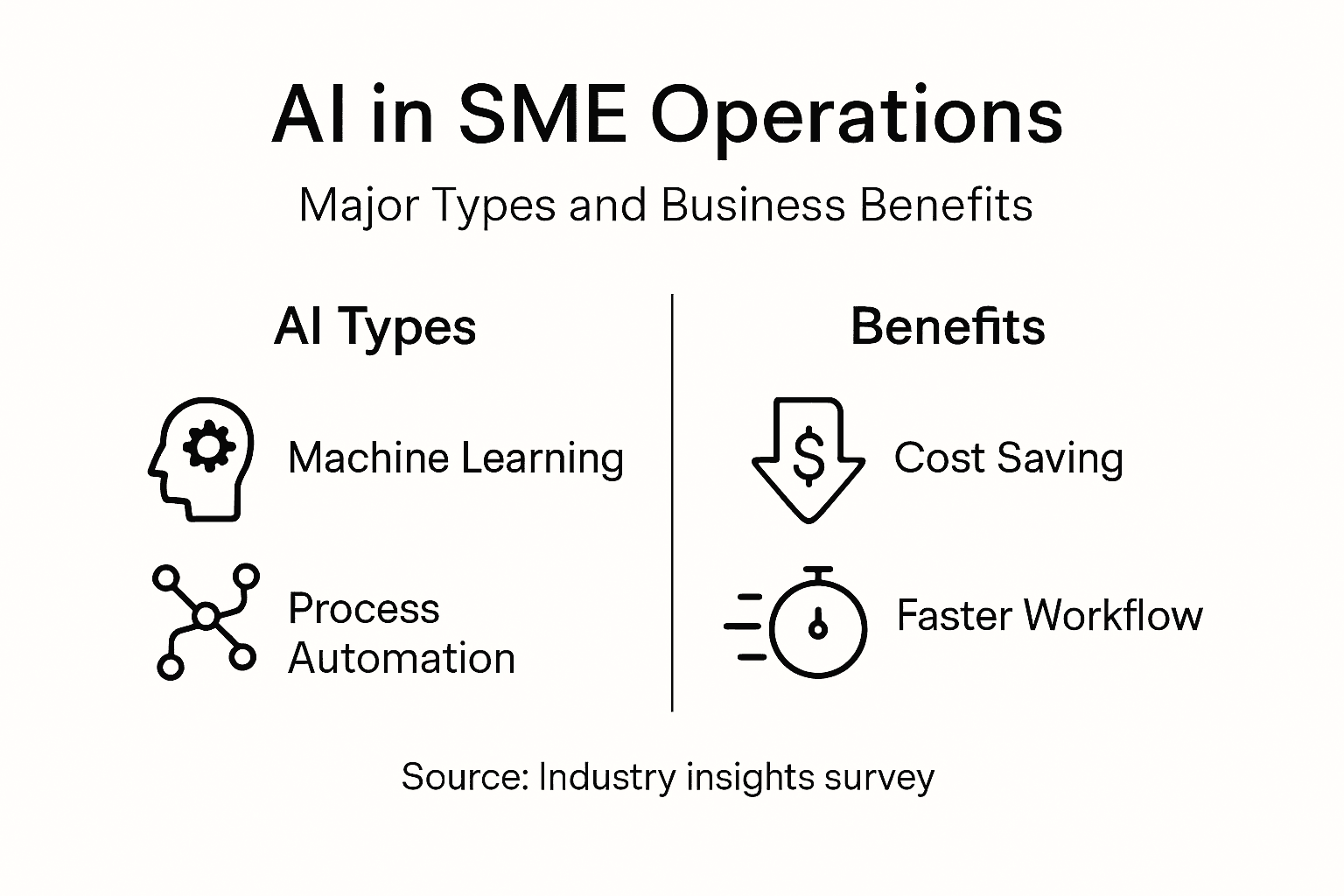
Here’s a summary comparing the main AI technology types for SMEs and their unique business impacts:
| AI Type | Core Function | Strategic Advantage | Example Application |
|---|---|---|---|
| Machine Learning | Predictive analytics | Enhances forecasting accuracy | Demand prediction |
| Natural Language Processing | Language interpretation | Improves customer communication | Automated support chatbots |
| Robotic Process Automation | Automates workflows | Reduces manual workload | Invoice processing |
| Deep Learning | Complex data analysis | Solves highly intricate problems | Quality control in manufacturing |
| Computer Vision | Visual data recognition | Enables real-time safety monitoring | Defect detection |
Pro tip: Conduct a comprehensive audit of your current business processes to identify which AI technology could provide the most immediate and impactful efficiency improvements.
How AI Enhances Daily Operations
Artificial Intelligence is revolutionizing how Small and Medium Enterprises (SMEs) manage their daily operational tasks, offering unprecedented levels of efficiency and productivity. Generative AI tools significantly boost workplace productivity by automating complex workflows and supporting critical decision-making processes.
The key operational enhancements brought by AI include:
- Intelligent task automation
- Real-time performance analytics
- Predictive resource allocation
- Enhanced customer interaction capabilities
- Continuous process optimization
- Reduced human error rates
- Streamlined communication channels
AI’s transformative impact extends beyond simple task completion. Industrial operational technologies demonstrate how intelligent systems can optimize resource allocation, predict maintenance needs, and create more flexible organizational structures. By integrating AI, SMEs can develop more responsive and adaptive operational frameworks that dynamically adjust to changing business environments.

Modern AI solutions enable businesses to transform routine processes into strategic advantages. Employees can focus on high-value creative tasks while AI handles repetitive, time-consuming administrative work, ultimately driving innovation and competitive edge.
The table below highlights how AI transforms daily operations for SMEs, demonstrating specific areas of improvement and their resulting benefits:
| Operational Area | AI Enhancement | Business Benefit |
|---|---|---|
| Resource Management | Predictive allocation | Reduced waste |
| Communication | Automated message routing | Faster customer response |
| Performance Analytics | Real-time monitoring | Improved decision speed |
| Error Reduction | Automated task validation | Increased process reliability |
| Customer Interaction | Personalized responses | Higher satisfaction rates |
Pro tip: Start with pilot AI implementations in one specific department to demonstrate tangible productivity gains and build organizational confidence.
Industry-Specific AI Use Cases
Artificial Intelligence is revolutionizing operations across diverse industries, offering targeted solutions that transform traditional business approaches. AI applications span multiple industry sectors with remarkable precision and strategic impact.
Key industry-specific AI use cases include:
- Healthcare: Diagnostic assistance and personalized treatment planning
- Finance: Fraud detection and advanced risk assessment
- Agriculture: Predictive crop management and yield optimization
- Retail: Personalized shopping experiences and inventory management
- Manufacturing: Predictive maintenance and quality control
- Energy: Smart grid optimization and resource allocation
- Automotive: Autonomous vehicle development and safety monitoring
These applications demonstrate how AI transcends generic technological solutions, instead offering domain-specific intelligent systems that address unique industry challenges. Strategic AI deployment focuses on business value creation through carefully designed technology integration that aligns with organizational goals and performance metrics.
Successful AI implementation requires understanding each industry’s unique ecosystem, technological infrastructure, and specific operational requirements. Small and Medium Enterprises can leverage these insights to develop targeted AI strategies that drive meaningful organizational transformation.
Pro tip: Conduct comprehensive industry-specific research to identify AI use cases most relevant to your organization’s unique operational challenges.
Key Challenges and Implementation Risks
Artificial Intelligence integration presents complex challenges for Small and Medium Enterprises (SMEs), requiring strategic navigation of technological, organizational, and economic barriers. SMEs face multiple critical challenges during AI adoption that demand careful, nuanced approaches to implementation.
The primary implementation risks and challenges include:
- Limited financial resources for technological investment
- Workforce resistance and fear of job displacement
- Skill and talent acquisition difficulties
- Data privacy and security concerns
- Complex regulatory compliance requirements
- Technological infrastructure limitations
- Cultural adaptation challenges
- Lack of clear ROI measurement frameworks
- Cybersecurity vulnerability risks
- External technological disruption pressures
Technological governance becomes critical in managing these challenges. Strategic AI adoption frameworks recommend comprehensive approaches that address organizational readiness, technological capabilities, and potential transformation risks.
Successful AI implementation requires more than technological investment. It demands a holistic strategy that considers human factors, organizational culture, and long-term strategic alignment. SMEs must develop adaptive implementation models that balance innovation with responsible, ethical technological integration.
Pro tip: Develop a phased AI implementation roadmap that includes comprehensive employee training, gradual technology integration, and continuous risk assessment.
Transform Your SME Operations with Strategic AI Solutions
The article highlights critical challenges SMEs face in operational efficiency such as workflow automation, predictive analytics, and overcoming workforce resistance. If you want to move beyond simple task automation and tap into powerful AI technologies like generative AI and robotic process automation to gain real-time insights and eliminate costly inefficiencies you are in the right place. At AIRITUAL, we specialize in tailored AI integration that aligns with your unique operational bottlenecks and strategic goals.
Explore expert-led Classes | Artificial Intelligence and insightful Webinars | Artificial Intelligence designed to help SME leaders understand and apply AI technologies that elevate daily business functions. Don’t let implementation risks hold you back. Take the next step now to schedule a personalized strategy session and experience measurable improvements in efficiency and productivity with AIRITUAL.
Frequently Asked Questions
What are the primary benefits of integrating AI into SME operations?
Integrating AI into SME operations enhances efficiency through intelligent task automation, real-time performance analytics, predictive resource allocation, and improved customer interaction capabilities, ultimately streamlining business processes.
How can SMEs start utilizing AI for operational improvements?
SMEs can start utilizing AI by identifying specific operational bottlenecks and implementing AI solutions such as machine learning for predictive analytics or robotic process automation for routine tasks. Beginning with pilot projects can help demonstrate the potential impact before scaling up.
What types of AI technologies are most effective for SMEs?
The most effective AI technologies for SMEs include Machine Learning (for predictive analytics), Robotic Process Automation (for automating tasks), Natural Language Processing (for customer interactions), Deep Learning (for complex decisions), and Computer Vision (for visual data processing).
What challenges do SMEs face when implementing AI?
SMEs often face challenges such as limited financial resources, workforce resistance, skill acquisition difficulties, data privacy concerns, and regulatory compliance issues. Addressing these challenges requires a strategic and holistic approach to AI adoption.
Recommended
- AI Strategy Guide for SMEs: Boost Efficiency Step-by-Step | Artificial Intelligence
- What Is Artificial Intelligence and Why It Matters | Artificial Intelligence
- Cloud-Based AI: Transforming Business Efficiency | Artificial Intelligence
- 7 Essential Steps for an Effective AI Automation Checklist | Artificial Intelligence
- AI in Digital Transformation – Driving Business Value
Recent Comments