

Transparency concerns can stall even the most promising artificial intelligence initiatives in public service. For local government leaders across the United States and Canada, the question is no longer just how to apply AI but how to make its decisions understandable and trustworthy. By adopting explainable AI, officials can offer citizens clear insight into complex automated processes, strengthening both accountability and confidence in government solutions.
Table of Contents
- What Is Explainable AI in Government?
- Types and Key Approaches to Explainability
- How Explainable AI Enables Transparency and Trust
- Legal, Ethical, and Regulatory Requirements
- Mitigating Risks and Common Implementation Pitfalls
Key Takeaways
| Point | Details |
|---|---|
| Explainable AI Enhances Trust | By providing transparent decision-making processes, explainable AI helps build public confidence in automated systems. |
| Critical Accountability Mechanisms | Governments should implement audit trails and clear documentation to ensure accountability in algorithmic decisions. |
| Adopt Appropriate Explainability Techniques | Selection of explainability strategies should align with the complexity of AI models to promote transparency. |
| Robust Regulatory Frameworks Are Essential | Establishing clear legal and ethical guidelines enhances responsible AI use while protecting citizen rights. |
What Is Explainable AI in Government?
Explainable AI represents a critical technological approach enabling government systems to make artificial intelligence decision-making transparent and comprehensible to human stakeholders. Unlike traditional “black box” AI models that generate outcomes without clear reasoning, explainable AI provides clear pathways to understanding how specific conclusions were reached.
At its core, explainable AI in government serves several fundamental purposes:
- Enhancing public trust in automated decision systems
- Ensuring accountability for algorithmic choices
- Enabling human oversight of AI-driven processes
- Identifying potential biases within computational models
- Supporting ethical governance of technological solutions
Governments worldwide are increasingly recognizing the importance of transparent AI decision frameworks. These systems allow policymakers and citizens to trace the specific logic and data points that contribute to an AI’s recommendation or conclusion, which is essential for maintaining democratic accountability.
The technical mechanism behind explainable AI involves creating algorithms that can not only generate accurate predictions but also articulate the reasoning behind those predictions. This might include generating human-readable explanations, highlighting the most influential input factors, or providing statistical confidence intervals for decisions.
Accountability Mechanisms in explainable AI typically include:
- Detailed audit trails of decision-making processes
- Statistical significance reporting
- Visualization of algorithmic reasoning
- Clear documentation of training data and model parameters
Pro tip: Local government leaders should mandate explainability requirements in all AI procurement contracts to ensure transparency and public trust.
Types and Key Approaches to Explainability
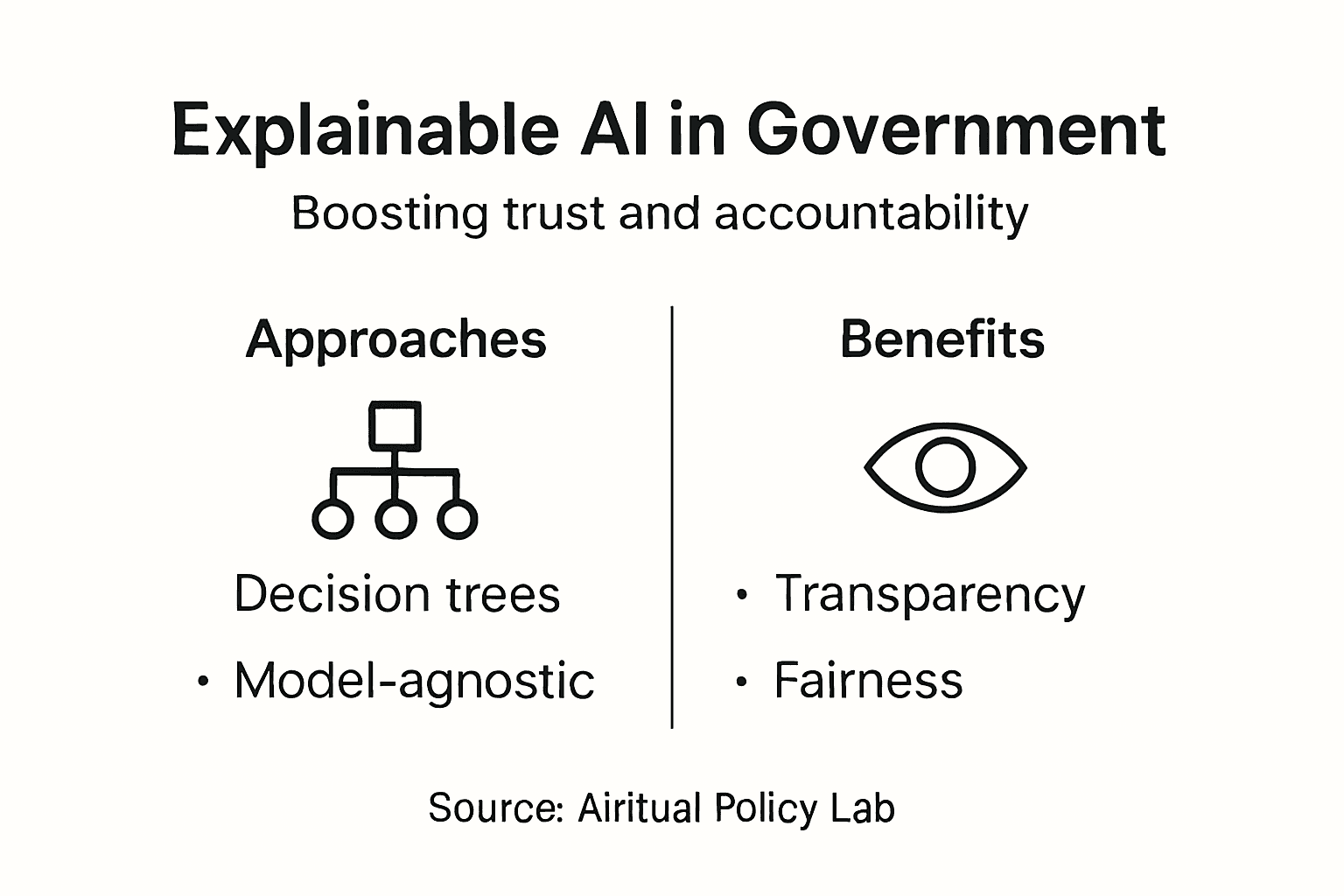
Explainable AI employs diverse approaches to demystify complex algorithmic decision-making processes, categorized primarily into model-specific and model-agnostic techniques. Explainability strategies range from intrinsic interpretability to sophisticated post-hoc explanation methods, designed to enhance transparency across different computational models.
The primary categories of explainability approaches include:
-
Model-Agnostic Techniques
- Feature importance analysis
- Surrogate modeling
- Permutation importance
- Partial dependence plotting
-
Model-Specific Techniques
- Linear model coefficients
- Decision tree visualizations
- Attention mechanism tracking
- Layer-wise relevance propagation
Government AI systems typically leverage interpretable machine learning methods that provide clear, comprehensible insights into algorithmic reasoning. These approaches help transform complex computational processes into understandable narratives that policymakers and citizens can readily comprehend.

The spectrum of explainability ranges from inherently interpretable models like decision trees to more complex deep learning approaches requiring advanced explanation techniques. Advanced methods such as SHAP (SHapley Additive exPlanations) and LIME (Local Interpretable Model-agnostic Explanations) offer nuanced ways to decode intricate AI decision pathways.
Here’s a summary of common explainability approaches used in government AI systems:
| Approach Type | Main Methods | Suitable For |
|---|---|---|
| Model-Agnostic | SHAP, LIME, Permutation | Complex black-box models |
| Model-Specific | Decision trees, Linear models | Simple interpretable models |
| Hybrid Techniques | Surrogate modeling | Mixed-model environments |
| Visualization Tools | Feature importance plotting | Policy review and auditing |
Explanation Complexity Levels:
- Simple linear models with direct interpretability
- Rule-based systems with explicit decision logic
- Probabilistic models with confidence intervals
- Advanced deep learning models with sophisticated explanation frameworks
Pro tip: Select explainability techniques that match your specific AI model’s complexity and transparency requirements.
How Explainable AI Enables Transparency and Trust
Transparency in government AI systems fundamentally transforms how citizens understand and interact with automated decision-making processes. Explainable AI builds public confidence by providing clear, comprehensible insights into how algorithmic decisions are generated, effectively bridging the gap between complex technological systems and human understanding.
The key mechanisms for building trust through explainable AI include:
- Breaking down complex algorithmic processes
- Providing clear rationales for automated decisions
- Demonstrating fairness and non-discrimination
- Enabling meaningful human oversight
- Supporting regulatory compliance
Government AI systems increasingly recognize that transparency reduces user skepticism by offering contextually relevant explanations. This approach allows policymakers and citizens to understand the underlying reasoning, logic, and potential limitations of AI-driven recommendations.
Transparency manifests through several critical strategies:
- Detailed decision pathway documentation
- Visualization of key influencing factors
- Probabilistic confidence interval reporting
- Contextual explanation of algorithmic reasoning
- Clear identification of potential biases
Explainable AI transforms mysterious “black box” systems into comprehensible, trustworthy decision-making tools that empower citizens and government officials alike.
Transparency Levels range from basic interpretability to sophisticated, nuanced explanations that provide deep insights into complex computational processes. By implementing robust explainability frameworks, government agencies can dramatically enhance public trust and demonstrate a commitment to ethical, accountable technological governance.
Pro tip: Develop standardized explanation templates that consistently communicate AI decision logic across different government departments and services.
Legal, Ethical, and Regulatory Requirements
The landscape of AI governance is rapidly evolving, with governments worldwide developing comprehensive frameworks to ensure responsible technological implementation. Regulatory frameworks for AI are increasingly focusing on transparency, accountability, and protecting fundamental human rights in automated decision-making processes.
Key legal and ethical requirements for government AI systems include:
- Mandatory transparency in algorithmic decision-making
- Clear mechanisms for human oversight
- Protection of individual privacy rights
- Non-discrimination and fairness principles
- Explicit documentation of AI system capabilities and limitations
- Mechanisms for challenging AI-generated decisions
Governments are adopting nuanced approaches to AI policy development that balance innovation with robust ethical safeguards. These frameworks aim to create standardized guidelines that prevent potential misuse while supporting technological advancement in public services.
Compliance Dimensions of AI regulatory requirements typically involve:
- Risk assessment and classification of AI systems
- Mandatory explainability standards
- Regular independent audits
- Clear liability and accountability protocols
- Continuous monitoring of potential bias
Ethical AI governance requires a proactive approach that prioritizes human rights, transparency, and democratic values over technological expediency.
The emerging regulatory landscape demonstrates a sophisticated understanding that AI technologies must be developed and deployed with careful consideration of their broader societal implications. By establishing clear legal frameworks, governments can foster public trust and ensure that technological innovations serve the collective good.
Compare the focus of legal, ethical, and technical requirements for AI in government:
| Requirement Type | Focus Area | Examples |
|---|---|---|
| Legal | Regulatory compliance | Privacy policies, audits |
| Ethical | Fairness and transparency | Bias mitigation, oversight |
| Technical | System robustness | Risk assessment, documentation |
Pro tip: Develop a comprehensive AI governance checklist that maps internal processes against current regulatory requirements and ethical standards.
Mitigating Risks and Common Implementation Pitfalls
Government AI implementation presents a complex landscape of potential challenges that require strategic and proactive management. Governmental AI deployment challenges stem from operational, cultural, and technical barriers that can significantly undermine the effectiveness of artificial intelligence initiatives.
Critical risk areas for government AI systems include:
- Insufficient data quality and management
- Inadequate staff training and AI literacy
- Lack of robust governance frameworks
- Potential algorithmic bias and discrimination
- Incomplete understanding of AI system limitations
- Resistance to organizational change
- Cybersecurity and privacy vulnerabilities
Governments are increasingly recognizing the importance of human-centered AI risk management that goes beyond technical safeguards. This approach emphasizes continuous monitoring, transparent communication, and inclusive stakeholder collaboration.
Risk Mitigation Strategies typically involve:
- Comprehensive AI literacy programs
- Regular independent audits
- Establishing clear accountability mechanisms
- Implementing robust testing protocols
- Creating feedback loops for continuous improvement
Effective AI risk management requires a holistic approach that balances technological innovation with human oversight and ethical considerations.
Successful implementation demands a nuanced understanding of both technological capabilities and potential organizational barriers. By anticipating and proactively addressing these challenges, government agencies can develop more resilient and trustworthy AI systems that genuinely serve public interests.
Pro tip: Develop a comprehensive AI risk assessment matrix that identifies potential vulnerabilities across technical, operational, and ethical dimensions.
Unlock Transparency and Trust in Government AI with Expert Guidance
Governments face growing challenges achieving explainability, accountability, and ethical AI governance when deploying complex artificial intelligence systems. This article highlights key pain points such as navigating transparency requirements, mitigating bias, and implementing human oversight to build public trust. If you want to transform opaque “black box” AI into clear, actionable insights that stakeholders can understand and trust, strategic support is essential.
At Airitual, we specialize in delivering tailored AI solutions focused on explainable AI that align with public sector demands. Leverage our expertise through custom consulting and specialized Classes | Artificial Intelligence that empower your teams with critical AI literacy and governance best practices. Explore advanced AI integration strategies designed to meet legal and ethical standards outlined in the article by visiting our Uncategorized | Artificial Intelligence resources.
Don’t let complex AI systems erode public confidence. Take the first step toward transparent, trustworthy government AI by scheduling your free strategy session now. Discover how Airitual can help you implement explainable AI frameworks today. Visit Airitual.com to learn more.
Frequently Asked Questions
What is Explainable AI and why is it important in government?
Explainable AI (XAI) refers to AI systems that provide clear, understandable insights into how decisions are made. In government, it enhances public trust, ensures accountability, and allows for human oversight of automated decisions, making the decision-making process transparent and ethical.
What techniques are used for Explainable AI in government?
Government employs various techniques for Explainable AI, including model-agnostic methods like SHAP and LIME, and model-specific approaches like decision tree visualizations and linear model coefficients. These techniques help break down complex algorithms into understandable narratives.
How does Explainable AI foster transparency in government programs?
Explainable AI fosters transparency by making the decision pathways of automated systems clear. It provides users with insights into the rationale behind decisions, promotes fairness, and ensures compliance with regulatory standards, thereby reducing skepticism and building public confidence.
What are the legal and ethical requirements for implementing AI in government?
Legal and ethical requirements for government AI systems include mandatory transparency, mechanisms for human oversight, protection of privacy rights, and non-discrimination principles. These guidelines ensure responsible use of AI in public policies and decision-making processes.
Recent Comments