

TL;DR:
- Small and medium enterprises can achieve efficiency, savings, and improved customer experience through targeted BPA.
- Effective automation involves assessing needs, mapping processes, piloting solutions, and scaling gradually.
- Common pitfalls include automating chaotic processes, poor data quality, and neglecting human oversight.
Business process automation is no longer a tool reserved for large enterprises with deep pockets and dedicated IT teams. Small and medium enterprises (SMEs) are discovering that well-targeted automation delivers real efficiency gains, better customer experiences, and measurable cost savings without requiring massive investments. Many business leaders assume BPA is too complex or expensive to implement at their scale. That assumption is costing them time, money, and competitive ground. This guide will clarify exactly what BPA is, how it works step by step, how to avoid the traps that derail most initiatives, and which strategies consistently produce results for SMEs ready to move forward.
Table of Contents
- What is business process automation?
- How business process automation works: Step-by-step overview
- Common BPA challenges and how to avoid them
- Best practices for SMEs: Maximizing success with BPA
- Why most SMEs get automation wrong—and how you can do it better
- Accelerate your BPA journey with proven solutions
- Frequently asked questions
Key Takeaways
| Point | Details |
|---|---|
| Clear process mapping is critical | Automating without understanding your workflows will amplify problems instead of solving them. |
| Start small for quick wins | Focus on automating stable, repetitive tasks first to demonstrate value and build confidence. |
| Monitor and iterate | Continually track results and refine automations to maximize efficiency and avoid common pitfalls. |
| People remain essential | Even the best automation works best when combined with human oversight and judgment. |
What is business process automation?
Business process automation (BPA) is the use of technology to automate repeatable, multi-step business tasks that would otherwise require significant manual effort. Think of it as replacing the routine, predictable parts of your operations with software that runs those steps automatically, accurately, and consistently. The goal is not to eliminate your team. It is to redirect your team’s energy toward decisions and interactions that actually require human judgment.
BPA is often confused with two related concepts: Robotic Process Automation (RPA) and Business Process Management (BPM). Here is how they differ:
| Concept | Focus | Scope | Best used for |
|---|---|---|---|
| BPA | Automating end-to-end workflows | Strategic, cross-functional | Streamlining full processes |
| RPA | Automating specific, rule-based tasks | Tactical, task-level | Repetitive data entry, screen scraping |
| BPM | Managing and improving processes | Discipline/methodology | Process design and governance |
| AI | Learning and decision-making | Adaptive, predictive | Complex pattern recognition |
As noted by automation researchers, BPA is strategic, end-to-end, and distinct from both RPA and BPM, each of which operates at a different layer of your operations. Understanding this distinction matters because choosing the wrong approach wastes resources.
For SMEs, the benefits of automated processes are especially compelling when automation targets the right areas:
- Efficiency: Tasks that take hours get completed in minutes
- Consistency: Automated processes follow the same rules every single time, eliminating variability
- Scalability: You can handle more volume without proportional headcount increases
- Customer experience: Faster response times and fewer errors translate directly to higher satisfaction
- Data accuracy: Automation reduces human error in data capture and processing
“The most significant gains from BPA come not from automating everything, but from strategically targeting the processes where manual effort creates the most friction and risk.”
BPA works especially well for SMEs when applied to high-impact areas like order processing, invoicing, customer onboarding, and internal approvals. The key is identifying where repetitive effort is quietly draining your team’s capacity.

How business process automation works: Step-by-step overview
Understanding what BPA is helps, but seeing the steps involved gives clarity on how you can move from idea to implementation. Effective BPA does not happen by plugging in software and hoping for the best. It follows a deliberate sequence.
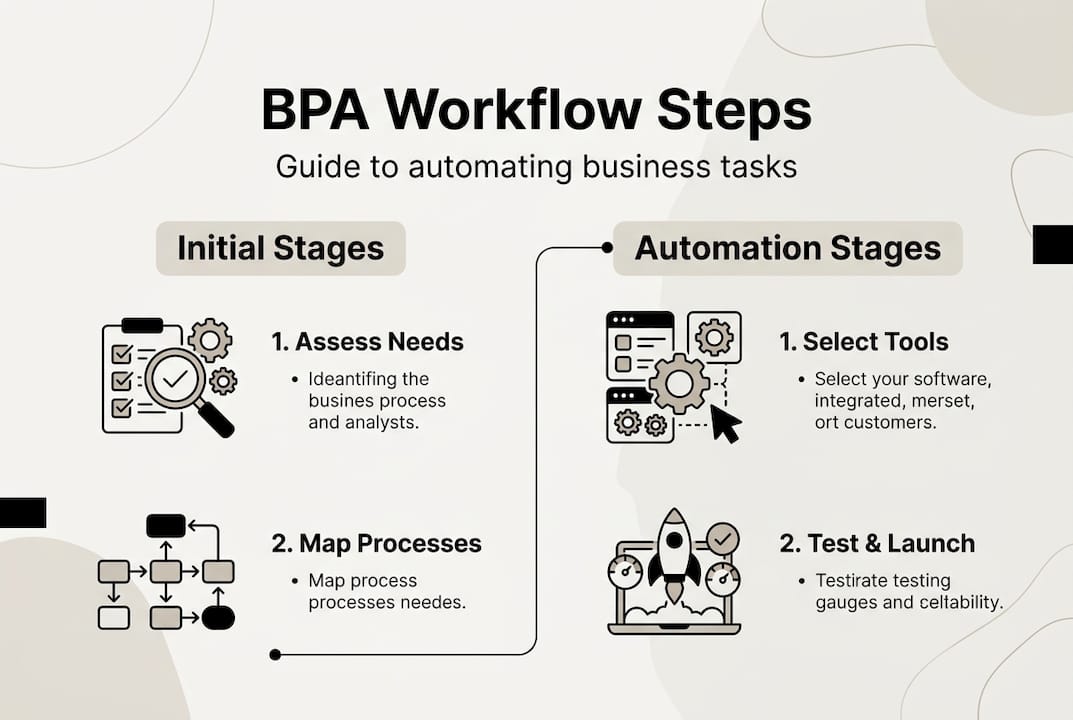
According to current BPA methodologies, effective implementation follows a clear sequence: assess, map, select tools, pilot, monitor, and scale. Here is what each stage looks like in practice:
- Assess your needs: Identify which processes consume the most time, produce the most errors, or create the biggest bottlenecks. Quantify the problem before you try to solve it.
- Map current processes: Document each step in the existing workflow. You cannot automate what you have not clearly defined. Use flowcharts or process mapping software to make this visual.
- Select automation tools: Choose tools that match your technical capacity. Many SMEs succeed with low-code or no-code platforms that require no software development expertise.
- Pilot the solution: Run your automation on a small scale first. Test it against real conditions with a controlled volume of transactions or requests.
- Monitor KPIs: Track processing time, error rates, and throughput before and after the pilot. Let data guide your next decision.
- Scale successes: Once a process is proven, expand the automation. Then repeat the cycle with the next candidate process.
| Stage | Common tools or examples |
|---|---|
| Assess needs | Process interviews, time-tracking tools |
| Map processes | Lucidchart, Miro, Microsoft Visio |
| Select tools | Zapier, Make, Microsoft Power Automate |
| Pilot solution | Sandbox environments, limited user groups |
| Monitor KPIs | Analytics dashboards, spreadsheet tracking |
| Scale | Phased rollout, staff training programs |
Refer to a detailed step-by-step automation guide if you want to go deeper on any individual stage. You can also explore automation workflow best practices to sharpen your implementation approach.
Pro Tip: Start with one high-volume, error-prone task, such as invoice processing or new client intake forms. Demonstrating early ROI builds internal confidence and creates the momentum you need to expand automation further.
Common BPA challenges and how to avoid them
Knowing the workflow is essential, but it is just as important to recognize the common obstacles that can derail efforts. BPA projects fail more often than most vendors admit, and for SMEs the consequences of a failed initiative are felt immediately.
The research is sobering. Project failure rates in automation reach between 70% and 95% when organizations skip process readiness. Additionally, 80% of AI-related failures stem from underrepresented edge cases and the absence of human oversight in exception handling. These are not small risks to dismiss.
Here are the most common mistakes SMEs make, and what to do instead:
- Automating a broken process: If your existing workflow is chaotic or poorly defined, automation amplifies the chaos. Fix the process first, then automate it.
- Ignoring data quality: Automation is only as good as the data feeding it. Inconsistent, incomplete, or duplicate data causes automated systems to produce wrong outputs at scale.
- No clear ownership: Every automated process needs a named owner who monitors it, catches exceptions, and drives improvements. Without ownership, problems go unnoticed.
- Skipping the pilot phase: Moving directly from design to full deployment is one of the fastest ways to create operational disruption. Always validate on a small scale first.
- Over-automating early: Trying to automate too many processes at once stretches your team thin and makes troubleshooting exponentially harder.
- Neglecting the human role: Automation handles the routine. Humans handle the exceptions. Systems that leave no room for human judgment fail when unusual scenarios arise.
For guidance on structuring workflows that avoid these pitfalls, seamless process automation resources can help you design smarter from the start.
Pro Tip: Involve your operations staff from day one, not just leadership. The people who run the process daily know where it actually breaks down. Their input is your most valuable design input.
Best practices for SMEs: Maximizing success with BPA
After avoiding common traps, it is time to focus on the winning strategies that separate automation leaders from laggards. The SMEs that get the most from BPA share a consistent set of practices.
Research focused on SME automation in 2025 confirms that the biggest gains come from starting small with high-volume repeatable tasks, using low-code tools, and ensuring team buy-in before scaling. This is not just theory. It reflects what works operationally.
Here are the core principles for sustained BPA success:
- Prioritize by volume, stability, and impact: Focus first on processes that run frequently, follow consistent rules, and have measurable outcomes. These deliver the fastest and clearest ROI.
- Secure staff buy-in early: Automation that employees view as a threat will face resistance that undermines adoption. Frame it as a tool that removes frustration, not jobs.
- Commit to clean data: Before automating, audit the data your processes rely on. Dirty data produces unreliable automation.
- Adopt an iterative mindset: Treat each automated process as version one. Review performance regularly, gather feedback, and refine. Automation is not a one-time project.
- Document everything: Maintain clear records of your automation logic, rules, and exceptions. This makes troubleshooting faster and onboarding new staff smoother.
- Expand gradually: Once a process is stable and proven, identify the next candidate. Use each success to build the capability and confidence for the next one.
Building an effective AI strategy for SMEs is the logical next layer once your BPA foundation is established. From there, exploring workflow automation strategies helps you systematically scale your gains across the organization.
“Start with the smallest possible automation that creates visible value, then let your results make the case for going further.”
Why most SMEs get automation wrong—and how you can do it better
To round out the guide, here is a hard-earned perspective on what actually determines BPA success for most SMEs. The conventional advice says: find your pain points, pick a tool, automate. That framing skips the part that actually matters.
Most SMEs we work with initially approach automation as a technology purchase. They evaluate platforms, compare features, and sign contracts before they have clearly defined a single process worth automating. The result is expensive software sitting underused while staff work around it.
The better approach starts with internal capability. Build the discipline of process documentation before you buy anything. Get your team comfortable with describing workflows in clear, step-by-step terms. That skill alone, developed before any tool is introduced, dramatically increases your odds of success.
Also resist the pressure to automate broadly and fast. Change fatigue is real. Tool overload is real. An organization that tries to automate ten processes at once often ends up with ten half-functioning automations and a frustrated team. Two or three well-executed automations create more lasting value.
Finally, never design automation that removes all human involvement. The best results come from systems where automation handles the predictable volume and humans handle the edge cases. A practical automation guide can help you structure that balance from the start. Build a culture of continuous improvement, not a culture of one-off projects.
Accelerate your BPA journey with proven solutions
Having learned the ins and outs of BPA, you are now in a strong position to start or accelerate your automation strategy. At Airitual, we work directly with SME leaders to identify the right processes, select the right tools, and build automation programs that actually deliver results. Whether you are just getting started or ready to scale what you have already built, our team brings both strategic guidance and hands-on implementation experience.
Explore our business automation workflow solutions to see how structured approaches translate into measurable operational gains. If you prefer a step-by-step entry point, our business automation guide for SMEs gives you a concrete path forward. Schedule a FREE Strategy Session to start building your automation advantage today.
Frequently asked questions
What are examples of business processes suitable for automation?
Repetitive tasks like invoicing, employee onboarding, data entry, and customer support requests are common candidates for business process automation. High-volume repetitive tasks such as invoicing and lead routing consistently deliver strong early ROI for SMEs.
How is BPA different from RPA and BPM?
BPA automates end-to-end processes strategically, while RPA automates specific, rule-based tasks, and BPM is the broader discipline for managing processes overall. Each plays a distinct role in a complete automation strategy.
How do you measure success in a BPA project?
Track key performance indicators like processing time, error rates, cost reduction, and employee or customer satisfaction before and after automation. Monitoring KPIs and scaling based on results is a foundational step in effective BPA implementation.
What are the biggest risks of automating business processes?
Automating unstable processes, poor data quality, and lack of team involvement often lead to automation failure. 80% of AI failures come from edge cases and insufficient human input during exception handling.
Recommended
- Master Business Automation Workflow for Higher Efficiency | Artificial Intelligence
- How to Automate Workflows for Efficient Business Operations | Artificial Intelligence
- Implement Process Automation Workflow for Seamless Efficiency | Artificial Intelligence
- Why automate admin tasks? Boost productivity by 40% | Artificial Intelligence
- Workflow Efficiency: Unlocking SaaS Growth Potential | Rule27 Design
- How automation transforms plumbing efficiency and revenue
Recent Comments