

TL;DR:
- AI enhances school operations, student learning, and decision-making through scalable, user-friendly tools.
- Leadership culture and strategic vision are crucial for successful AI adoption and long-term impact.
- Starting small with clear goals and transparency helps schools harness AI effectively.
AI is not a passing trend in education. It is already reshaping how schools operate, how students learn, and how administrators make decisions. Many school leaders still view artificial intelligence as a distant, technical concern best left to IT departments or outside vendors. That assumption is costly. From adaptive learning platforms to predictive analytics that identify at-risk students early, AI is producing measurable results in schools across the country. This article cuts through the noise, addresses common misconceptions, and gives you a practical, honest look at why AI fluency is now a core leadership competency.
Table of Contents
- The new reality: What AI brings to schools
- Why school leaders can’t ignore AI: Key benefits
- From classrooms to operations: Real-world impact of AI
- Navigating the challenges: Leadership strategies for AI adoption
- Rethinking school leadership in the age of AI
- Take the next step: AI integration support for your school
- Frequently asked questions
Key Takeaways
| Point | Details |
|---|---|
| AI transforms education | AI is already reshaping classroom practices and administrative processes to boost outcomes. |
| Leadership drives success | School leaders are the key to navigating challenges and unlocking AI’s full benefits. |
| Start with practical steps | Even non-technical leaders can make a big impact by piloting targeted AI solutions. |
| Focus on people | Building a culture of AI literacy and ethical awareness empowers lasting transformation. |
The new reality: What AI brings to schools
Artificial intelligence, in plain terms, refers to software systems that learn from data and make decisions or recommendations based on patterns. In schools, that means tools that recognize a struggling student before a teacher does, software that drafts administrative reports, and platforms that match each student’s pace to an individualized curriculum.
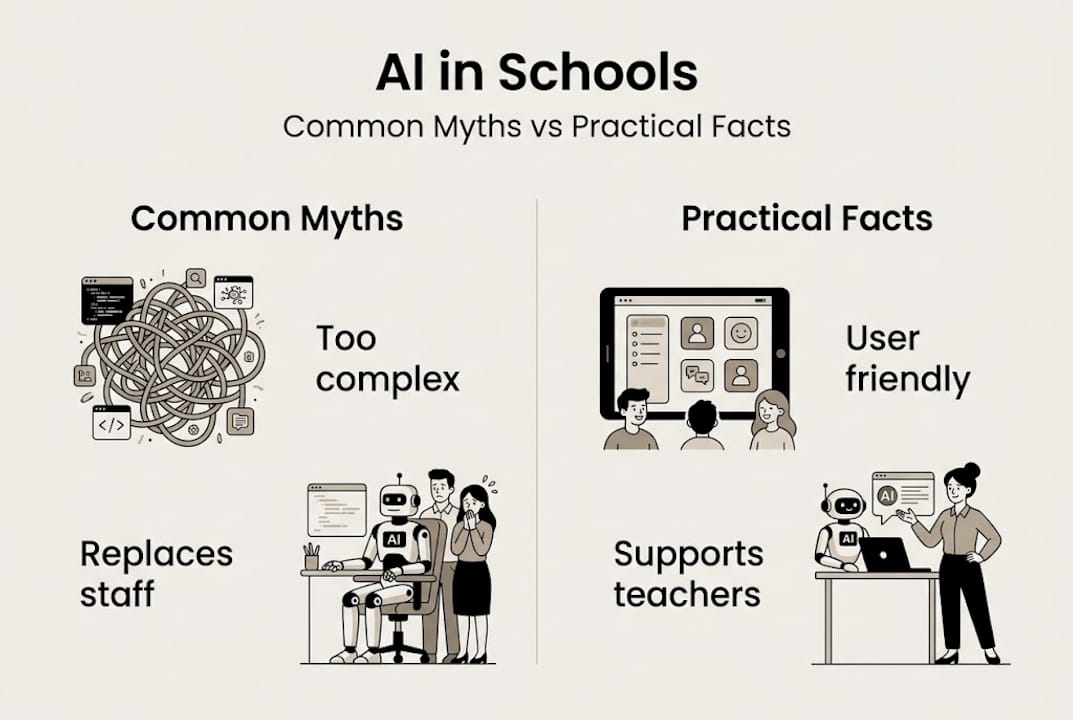
Many leaders carry assumptions about AI that simply do not hold up. The table below contrasts the most common myths with what research and practice actually show:
| Myth | Reality |
|---|---|
| AI will replace teachers | AI supports teachers, freeing time for direct student connection |
| AI is only for wealthy districts | Scalable tools are available for schools of all sizes and budgets |
| AI is too complex for administrators | Most modern AI tools are designed for non-technical users |
| AI raises all privacy risks | Responsible AI tools are built with privacy compliance at their core |
The major categories of AI applications making an impact in schools today include:
- Adaptive learning platforms that adjust content difficulty in real time for each student
- Smart scheduling tools that optimize class placement and resource use
- Automated grading and feedback systems that save hours per week per teacher
- Predictive analytics that flag students at risk of falling behind or dropping out
- Administrative automation that handles attendance, communications, and reporting
As AI-powered tools in education continue to mature, their impact on day-to-day school life is becoming undeniable. AI can automate routine administrative tasks, allowing educators to spend significantly more time where it counts: with students.
Pro Tip: Identify at least one repetitive administrative task your team handles weekly. Automating just that one task this semester can free up hours of staff time and build your team’s confidence in AI tools before scaling further.
Why school leaders can’t ignore AI: Key benefits
The advantages of AI for school leadership are not theoretical. They show up in real improvements across management efficiency, student outcomes, and institutional decision-making.

Consider this comparison of traditional versus AI-supported school management practices:
| Leadership Function | Traditional Approach | AI-Supported Approach |
|---|---|---|
| Attendance tracking | Manual daily check | Automated, real-time reporting |
| Student support | Teacher-driven referrals | Predictive risk identification |
| Resource allocation | Historical guesswork | Data-driven budget modeling |
| Communication | Reactive and delayed | Automated, scheduled outreach |
Effective AI practices help school leaders improve both operational efficiency and individual learning outcomes simultaneously. That dual impact is what makes AI genuinely strategic, not just convenient.
Here are three immediate ways your school can gain value from AI right now:
- Automate attendance and communication workflows. Tools that handle daily notifications and absence reports cut administrative burden significantly.
- Use adaptive learning software in at least one subject area. Even a pilot in math or reading can produce measurable student progress data within a semester.
- Implement a predictive analytics dashboard for student support teams to identify early warning signals and intervene before problems escalate.
Exploring AI integration strategies and staying current with current AI trends in education will help you prioritize the tools most likely to deliver results for your specific school context.
Pro Tip: Start with one AI tool, define clear success metrics before launching, and measure results at the 30-day and 90-day marks. Scaling AI adoption is far more sustainable when each step is grounded in evidence from your own school.
From classrooms to operations: Real-world impact of AI
Seeing AI at work makes the case more powerfully than any statistic alone. Across the country, schools are reporting tangible gains in both instructional quality and operational performance.
Here are the top four real-world AI use cases in schools and what they produce:
- Adaptive learning platforms adjust reading and math content per student in real time, improving test scores and reducing achievement gaps
- AI-powered tutoring tools provide instant written feedback on assignments, enabling students to revise work immediately rather than waiting for a graded return
- Predictive maintenance systems alert facilities teams to equipment issues before they become costly emergencies, cutting repair costs
- Safety monitoring tools use pattern recognition to flag unusual behavior or access events, improving campus security response times
The classroom impact of AI extends beyond test scores. AI for student engagement tools help teachers differentiate instruction without adding hours to their planning process. Students who previously disengaged due to pace mismatches are re-entering the learning process with personalized support built in.
“Schools leveraging AI see improved efficiency and more engaged students, creating a ripple effect that benefits administrators, teachers, and families alike.”
On the operational side, AI is also changing how curriculum is designed and delivered. Exploring AI curriculum ideas shows how data can inform course sequencing, pacing guides, and assessment timing to better align with actual student readiness. The result is a school that feels more responsive and less reactive.
Navigating the challenges: Leadership strategies for AI adoption
For school leaders ready to move forward, understanding the friction points in AI adoption is as important as knowing the benefits. The challenges are real, but they are manageable with the right leadership approach.
The main barriers you will likely encounter include:
- Data privacy and security: AI tools collect and process student data, requiring strict compliance with FERPA and district policies
- Staff resistance: Teachers and staff may fear being replaced or feel overwhelmed by new systems
- Equity gaps: Uneven access to devices and internet connectivity can widen disparities if AI adoption is not planned equitably
- Ethical concerns: Algorithmic bias in AI tools can inadvertently disadvantage already vulnerable student groups
Strong leadership is essential for responsible and effective AI adoption in education. Here is a practical numbered framework for addressing each barrier:
- Audit your data governance policies before selecting any AI vendor. Confirm that tools are compliant with student privacy law and that data storage is clearly documented.
- Involve teachers early. Create an AI advisory group with frontline educators so adoption feels collaborative, not imposed. Their buy-in determines whether tools actually get used.
- Assess device and connectivity equity across your student population before rolling out any student-facing AI tool. Build access infrastructure in parallel with AI adoption.
- Review vendor documentation on bias testing. Ask vendors directly how their algorithms are audited and what populations were used in training data.
- Communicate openly and regularly with parents, staff, and the school board. Transparent updates build community trust and reduce backlash.
Leveraging AI data analytics in education can support each of these steps by giving leadership teams factual, timely information rather than anecdotal impressions.
Pro Tip: Send a one-page AI update to parents and the board each semester. Transparency builds trust faster than any formal policy statement, and it positions you as a proactive, informed leader rather than a reactive one.
Rethinking school leadership in the age of AI
Here is what most conversations about AI in education miss: the technology is not the hard part. The hard part is leadership culture. We have seen school leaders invest in premium AI platforms, only to watch them go unused because the team never bought in. We have also seen modest, affordable tools transform schools where leaders prioritized vision and communication over sophistication.
The most common mistake is treating AI adoption as a technology project rather than a change management challenge. When principals delegate entirely to vendors or IT staff without setting a clear institutional vision, AI tools drift from their intended purpose and accountability disappears.
What separates schools that truly benefit from AI is not the size of their budget or the complexity of their tools. It is whether leadership has cultivated AI literacy at every level, from department heads to classroom teachers to support staff. Understanding the future of AI in schools means recognizing that critical thinking about AI, not just comfort with it, is the skill that matters most. Leaders who ask hard questions about their tools, demand evidence of impact, and model ongoing learning are the ones whose schools thrive long term.
Take the next step: AI integration support for your school
Your school does not have to figure this out alone. At AI Ritual, we work directly with educational institutions to design and implement AI strategies that fit your specific goals, budget, and community. Whether you are just beginning to explore what AI can do or you are ready to scale existing pilots, we bring both strategic guidance and practical tools to the table.
Our AI in education guide offers a structured starting point, while our resource on AI integration best practices walks through the efficiency and engagement gains schools are achieving right now. Schedule a FREE Strategy Session with our team and get a tailored plan built around your school’s unique needs and readiness level.
![cta_image]
Frequently asked questions
What is artificial intelligence in the context of schools?
Artificial intelligence in schools refers to software and tools that automate tasks and personalize student learning while supporting data-driven decision-making for administrators and teachers.
How can AI improve student outcomes?
AI enables tailored instruction, immediate feedback, and predictive analytics that inform targeted student support. AI-driven platforms raise both student engagement and measurable academic achievement.
What are the main challenges for school leaders adopting AI?
Leaders face hurdles like staff training, ethical concerns, privacy compliance, and resistance to change. Leadership is crucial for navigating these barriers responsibly and effectively.
Do smaller schools benefit from AI integration?
Yes, even small schools see real efficiency and engagement gains from scalable AI tools. AI tools improve efficiency across organizations of all sizes, making AI a practical investment regardless of enrollment numbers.
How can leaders start with AI if they lack technical expertise?
Begin by learning the basics, piloting a single tool with a defined goal, and prioritizing staff involvement from day one. A step-by-step implementation approach consistently outperforms large, rushed rollouts in both adoption rates and lasting impact.
Recommended
- Future of AI in Schools 2026: Transforming Learning | Artificial Intelligence
- How to Create an Effective AI Integration Strategy for Schools | Artificial Intelligence
- K-12 AI transformation guide: Lead with impact in 2026 | Artificial Intelligence
- How to Implement AI in Education for Enhanced Results | Artificial Intelligence
- Role of AI in Agency Growth: Transforming Operations
Recent Comments