

TL;DR:
- Most SMB AI project failures result from inadequate planning and poor data readiness assessment.
- Prioritize small, high-impact pilots on repetitive tasks with measurable outcomes.
- Success depends on human skills, leadership engagement, and ongoing change management strategies.
Between 60 and 80 percent of SMB AI projects fail due to missteps that could have been avoided with better planning. Most business leaders jump straight to tools and software without asking whether their data, processes, or teams are ready. The result is wasted budget, frustrated staff, and little to show for the investment. This guide gives you a practical, phased framework for AI integration that works in the real world. We will walk through readiness assessment, use case selection, piloting, scaling, and the often-overlooked human factors that separate successful projects from failed ones.
Table of Contents
- Laying the groundwork: Assessing readiness & defining goals
- Choosing your first AI use cases: Prioritizing value & quick wins
- Building and piloting your solution: Execution steps & frameworks
- Overcoming challenges: Data quality, integration, and scaling
- What most AI integration guides miss: Success requires human skills, not just tech
- Unlock more AI integration insights and support
- Frequently asked questions
Key Takeaways
| Point | Details |
|---|---|
| Assess readiness first | Successful AI integration starts by evaluating data, goals, and change readiness in your business. |
| Start small for impact | Pilot AI on repetitive, low-risk tasks to build confidence and measure value quickly. |
| Follow proven frameworks | Use structured approaches like the CRAFT Cycle and MLOps for smoother AI adoption and scaling. |
| Focus on data quality | Strong data governance and proactive training are crucial to avoid common AI pitfalls. |
| Human skills matter | Change management and clear team leadership often determine AI project success more than technology alone. |
Laying the groundwork: Assessing readiness & defining goals
The single most common mistake we see among SMBs is skipping the readiness phase entirely. Leaders get excited about AI potential, pick a tool, and start implementing before anyone has asked the hard questions. AI adoption fails most often when data quality is overlooked and readiness is not properly assessed. That is where every successful integration must start.
Before you contact any vendor or write any requirements, run an honest internal audit. Look at your current data infrastructure and ask whether the data you collect is clean, structured, and accessible. Ask which business problems are costing you the most time or money. Then ask whether AI could realistically address those problems given your current setup.
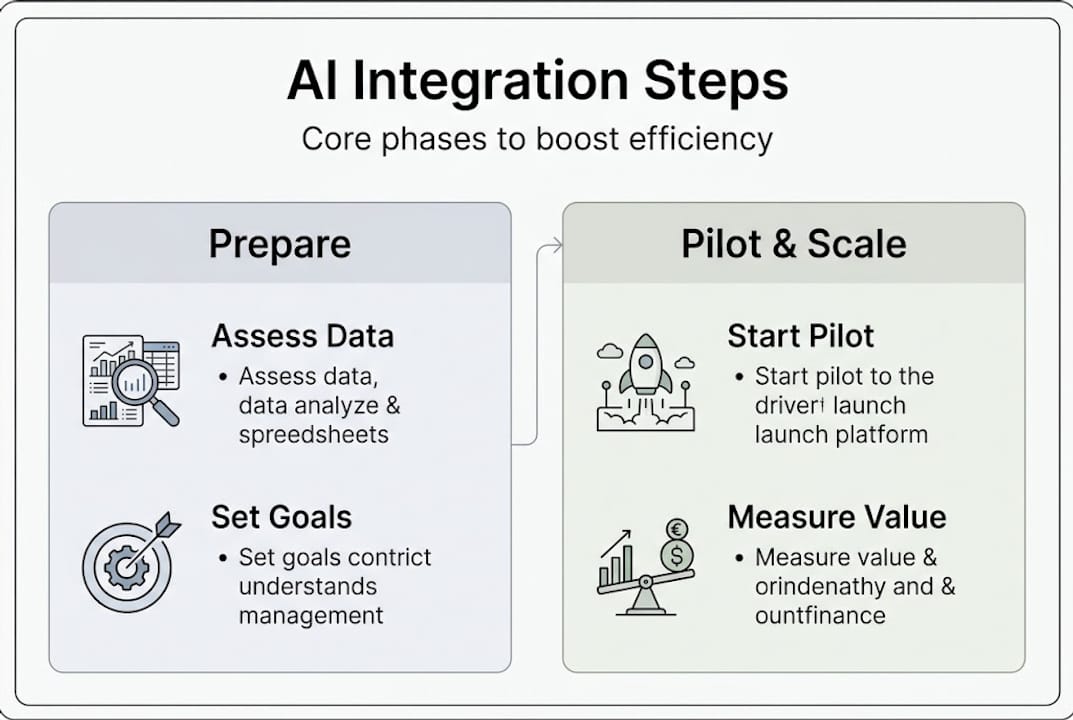
Here is a quick readiness snapshot to guide your initial assessment:
| Readiness area | Key question | Good sign | Warning sign |
|---|---|---|---|
| Data quality | Is data clean and consistent? | Structured, labeled data | Siloed, messy spreadsheets |
| Process clarity | Are current workflows documented? | Clear SOPs in place | Processes vary by person |
| Stakeholder alignment | Does leadership support AI goals? | Defined project owner | No sponsor identified |
| Budget & timeline | Are resources allocated? | Realistic budget set | No cost estimate done |
| Skills & talent | Do staff have relevant skills? | At least one internal champion | No technical support available |
Once you have reviewed these areas, prioritize specific business problems that AI could solve. Think in terms of measurable outcomes, not vague improvements. “Reduce customer support response time by 40%” is a goal. “Improve customer experience” is not.
For the phased approach to AI integration to work, you need defined stakeholders, clear success metrics, and a realistic cost and timeline estimate before a single line of code is written. Review AI readiness steps from the SBA to benchmark your preparation against established standards. It is also worth thinking about security early. AI penetration testing can identify vulnerabilities in your planned architecture before they become expensive problems.
Pro Tip: Build a simple readiness checklist and share it with staff before any formal project kickoff. Early involvement reduces resistance later and surfaces practical concerns that leaders may not see from the top down.
Choosing your first AI use cases: Prioritizing value & quick wins
Once readiness and goals are set, focus shifts to choosing where to apply AI for the best results. Not every business problem deserves AI attention first. The right use cases are those where repetitive tasks, human error, or time-intensive manual work create measurable drag on your operations.

High-performing SMBs start small with pilots on repetitive tasks because they generate faster value and clearer feedback. Think customer support automation, invoice data entry, inventory tracking, or appointment scheduling. These are areas where the cost of errors is visible and the value of automation is easy to quantify.
Here is how common SMB use cases compare across key decision factors:
| Use case | Impact | Est. cost | Risk level | Time to value |
|---|---|---|---|---|
| Customer support chatbot | High | $2,000-$5,000 | Low | 30-60 days |
| Data entry automation | Medium | $1,000-$3,000 | Low | 14-30 days |
| Inventory management | High | $3,000-$8,000 | Medium | 60-90 days |
| Sales forecasting | Medium | $4,000-$10,000 | Medium | 90-120 days |
| Document processing | Medium | $2,000-$6,000 | Low | 30-60 days |
A phased roadmap is the proven structure: Foundation phase runs 1-2 months with a budget of $2,000-$5,000, Expansion runs months 3-6, and full Integration runs months 7-12. This structure keeps risk manageable while building internal confidence. Review AI use case training resources from the U.S. Chamber of Commerce to see sector-specific examples that may apply to your business.
Key selection criteria for your first AI use case:
- High frequency: Tasks that happen daily or multiple times per week offer more ROI potential
- Low complexity: Start with tasks that have clear rules and defined outputs
- Measurable baseline: You should already have a performance number you want to beat
- Low disruption: Choose a task where failure does not put operations at risk
Your AI strategy guide should map each use case to a specific business outcome. Start with a 90-day pilot on one use case. Scope must be tight enough to measure success clearly, and results must be visible enough to secure ongoing buy-in from leadership. Review AI integration tips to strengthen your selection process before committing to a use case.
Building and piloting your solution: Execution steps & frameworks
After picking the right use case, it is time to build and test solutions for real-world results. This is where structure matters most. Without a defined methodology, even well-funded AI pilots drift into vague experiments that produce no actionable data.
Methodologies like the CRAFT Cycle and MLOps are essential for operationalizing AI and scaling successful pilots. MLOps, short for Machine Learning Operations, covers how you manage data pipelines, model testing, performance monitoring, and iterative feedback loops throughout the AI lifecycle.
Follow these numbered steps when moving from design to pilot:
- Clarify requirements — Document exactly what the AI system needs to do, what inputs it will use, and what outputs you expect
- Design the solution — Map the proposed workflow and identify where AI replaces or supports current manual tasks
- Build a minimum viable version — Create the simplest version that can be tested without full production deployment
- Test with real data — Run the system against a small, controlled dataset from your actual business environment
- Evaluate outcomes — Compare results against your baseline metric and document what worked and what did not
- Iterate before scaling — Fix identified issues before expanding scope or increasing data volume
Skipping the pilot stage is one of the top drivers behind the 60-80% failure rate seen in SMB AI projects. Do not rush to full deployment before the pilot delivers validated results.
90-day pilots with clear metrics are the validated standard for building confidence and catching problems before they become costly. You need to define success metrics on day one, not after the pilot is complete.
For guidance on AI integration best practices that cover the full build-to-deploy cycle, those resources will help you avoid the most common execution errors. If you need expert guidance during the build phase, AI consulting for SMEs can accelerate timelines and reduce costly trial and error.
Pro Tip: Assign one internal person as the project champion. This person owns accountability, communicates progress to leadership, and acts as the liaison between your team and any external vendor or developer. Without a champion, pilots lose momentum fast.
Overcoming challenges: Data quality, integration, and scaling
Now that pilots are running, the next hurdle is ensuring the solution scales and lasts. Most AI projects that survive the pilot phase still fall apart during scaling. The causes are predictable, and they are almost always preventable.
34% of SMBs cite data quality as the top barrier to scaling AI, making it the single most common technical obstacle. And 30% of GenAI projects fail post-pilot due to unaddressed scaling issues, according to Gartner research. These numbers tell us that most businesses treat data cleanup as optional. It is not.
The most common pitfalls at the scaling stage include:
- Poor data governance: No defined ownership of data quality, leading to inconsistent inputs as volume grows
- Unclear integration plans: AI tools that were not designed to connect with existing software create expensive manual workarounds
- Team resistance: Staff who were not involved early feel threatened rather than supported by AI changes
- Skills gaps: No internal knowledge to troubleshoot or optimize AI systems after the vendor leaves
- Absent monitoring: No metrics dashboard to detect when the model’s performance degrades over time
The practical fix for each of these is straightforward. Build data governance protocols in the first month, before the pilot even begins. Provide role-specific team training before and during rollout, not after. Formalize a change management plan that includes regular communication about what AI is doing and why.
For scaling to work, you need to document ROI from the pilot clearly. Track time saved, error rate reduction, and cost impact. Use those metrics to justify the next phase and to set expectations for subsequent rollouts. Explore AI adoption strategies that address both the technical and organizational dimensions of growth. For deeper process support, workflow optimization tips can help you build the operational backbone your scaling effort needs. The SBA also offers practical SMB AI scaling resources worth reviewing as you prepare for expansion.
What most AI integration guides miss: Success requires human skills, not just tech
Here is what most integration checklists leave out entirely: technology is not the hard part. People are.
We have worked with SMB leaders who followed every technical step correctly and still watched their AI projects collapse within six months. The reason was almost always the same. Leadership did not commit to a communication plan. Staff were told about the AI system, not involved in shaping it. And when the tool produced unexpected outputs, no one had the authority or training to respond.
In 2025 and into 2026, the organizations seeing the best AI results are not necessarily the ones with the most sophisticated models. They are the ones with central governance structures, clear ownership of AI systems, and ongoing investment in staff capability. Research shows that AI boosts in SMBs correlate strongly with leadership engagement, not just tool selection.
The uncomfortable truth is that most SMBs underspend on training and change management while overspending on software licenses. Flip that ratio, and your AI integration success rate improves dramatically. Invest in your people as deliberately as you invest in your platform.
Unlock more AI integration insights and support
If you are ready to take your AI journey further, the right resources and the right partner can make all the difference. At Airitual, we work directly with business leaders and decision-makers to build AI strategies that are practical, phased, and measurable. Whether you need a full integration plan or just a clearer starting point, we have the tools to support every stage of your process.
Explore our in-depth coverage of AI best practices to strengthen your approach, and review our library of integration tips for actionable guidance you can apply immediately. Schedule a FREE Strategy Session with our team to get personalized recommendations for your business.
Frequently asked questions
What is the first step for SMBs wanting to integrate AI?
The first step is assessing data readiness and defining clear, strategic goals to guide the AI project. Readiness and goal-setting are the foundation that reduces the risk of costly failure.
Which business functions should AI target first?
AI should target repetitive processes like customer support or data entry that offer quick, measurable value. Start with pilots in repetitive tasks to generate the fastest ROI and clearest feedback.
How long does the AI integration process usually take?
Integration typically begins with 1-2 month pilots, expanding in phases over 6-12 months based on results. Phased timelines are the validated standard for sustainable, low-risk AI adoption.
What is the most common reason AI projects fail in SMBs?
Poor data quality and unclear value are the top reasons for AI project failure. Data quality and value clarity must be addressed before any build phase begins.
How can SMBs overcome resistance to AI changes?
Early team involvement, training programs, and clear communication help overcome resistance to AI adoption. Change management and training are as important as the technical implementation plan itself.
Recommended
- AI integration best practices: drive efficiency & engagement | Artificial Intelligence
- Essential AI integration tips to boost business success | Artificial Intelligence
- How to integrate AI in small businesses for efficiency | Artificial Intelligence
- AI Strategy Guide for SMEs: Boost Efficiency Step-by-Step | Artificial Intelligence
Recent Comments