

Artificial intelligence shows up in everything from chatbots to business analytics tools, but the real meaning behind the term gets lost in confusion. For North American technology leaders, cutting through the hype matters because AI can mean different things depending on context, industry, and who is explaining it. This guide helps clarify what AI is—and is not—so you can make informed decisions, avoid common misconceptions, and spot solutions that truly fit your operational needs.
Table of Contents
- Artificial Intelligence Defined And Debunked
- Key Types Of Artificial Intelligence Today
- Real-World AI Applications Across Sectors
- Integration Steps For Businesses And Organizations
- Risks, Limitations, And Responsible AI Use
Key Takeaways
| Point | Details |
|---|---|
| Understanding AI | AI has multiple definitions; it’s crucial to ask vendors how their systems learn and adapt. |
| Practical Applications | AI should be viewed as a tool to automate mundane tasks, not as a replacement for human workers. |
| Data and Quality | Successful AI implementation relies on clean, organized data; companies must assess their current data capabilities. |
| Governance and Oversight | Clear governance and human oversight are necessary to manage AI systems responsibly and mitigate risks. |
Artificial Intelligence Defined and Debunked
Artificial intelligence gets thrown around so casually these days that it has become almost meaningless. You hear it attached to everything from your email spam filter to enterprise software, yet most people would struggle to define what it actually is. The problem is not that AI lacks a definition, but that it has too many. AI can mean different things depending on context, industry, and who is explaining it. Some definitions are narrow and technical, others broad enough to encompass nearly any automated system. For small and medium enterprise leaders, this ambiguity creates real challenges when evaluating whether AI solutions genuinely offer value or simply repackage existing technology with buzzwords.
At its core, AI refers to machines performing tasks that typically require human intelligence to accomplish. These tasks include problem-solving, pattern recognition, logical reasoning, and learning from experience. The distinction matters because not all automation is AI. A thermostat that turns on at a set temperature is not AI, even though it automates something. A system that learns your temperature preferences over weeks, adjusts for weather patterns, and predicts when you will arrive home—that moves into AI territory. The difference comes down to autonomy and adaptation. Real AI systems can adjust their behavior based on new data without someone reprogramming them.
The research on diverse definitions rooted in AI’s complexity reveals why confusion persists. On one end, you have narrow definitions treating AI as algorithms that mimic human cognition. On the other end, you have expansive definitions that include any system automating complex tasks. Business vendors sometimes exploit this ambiguity intentionally. A chatbot that follows predetermined scripts might be marketed as AI, when it is really just sophisticated automation. The key question to ask your vendor is this: Does the system learn and improve from new data, or does it follow fixed rules?
Here is what most small and medium enterprises get wrong. They assume AI means either pure science fiction (robots making independent decisions) or pure automation (rules-based processes). Reality sits between those extremes. Useful AI for your business means systems that handle specific, well-defined problems and improve with experience. You might deploy AI to analyze customer support tickets and route them to the right department, getting smarter about patterns in your data over time. You might use AI to predict which leads are most likely to convert, freeing your sales team from guesswork. You might automate invoice processing so your accounting team focuses on exceptions rather than data entry. These are not futuristic applications. They are practical tools that already deliver measurable results for companies like yours.
One persistent myth deserves clearing up immediately. AI requires massive data or advanced technical infrastructure. Smaller organizations often believe they cannot compete because they lack the resources of larger enterprises. That is not entirely accurate. While scale helps, many effective AI applications work with modest datasets and can run on standard cloud infrastructure. A manufacturing operation with 200 employees can implement AI-driven quality control. A service company can use AI to optimize scheduling. The limiting factor is not usually technology but clarity about what specific problem you want to solve.
Another common misconception is that AI automates away your people. The more useful frame is that AI automates away the boring parts of your people’s jobs. Someone spending three hours daily copying information from emails into spreadsheets is not providing real value. AI that eliminates that task frees that person to handle exceptions, think strategically, and engage with customers. Companies that view AI as a replacement tool tend to struggle. Companies that view it as a capability amplifier tend to succeed.
The practical takeaway for your organization is straightforward. When evaluating AI solutions, stop listening to marketing language about “machine learning” or “advanced algorithms.” Ask instead: What specific business problem does this solve? Can your team measure the impact? What happens when the data changes or conditions shift? Does the vendor focus on your operational reality or generic use cases? These questions cut through the hype and connect you with solutions that actually work.
Pro tip: Before investing in any AI solution, run a small pilot on one specific process your team finds repetitive or error-prone. Measure the current state, implement the tool for four weeks, then compare results. This 30-day test costs far less than a full deployment and gives you real evidence of whether the solution delivers value for your business.
Key Types of Artificial Intelligence Today
Not all AI works the same way. The systems handling your customer service are fundamentally different from the algorithms recommending products or analyzing financial data. Understanding the distinctions between AI types matters because it shapes what each system can and cannot do for your business. Some AI types exist only in research labs. Others power critical operations across thousands of companies daily. When vendors pitch solutions, they rarely explain which category their product falls into, leaving you to guess whether you are getting cutting-edge technology or mature, proven systems.

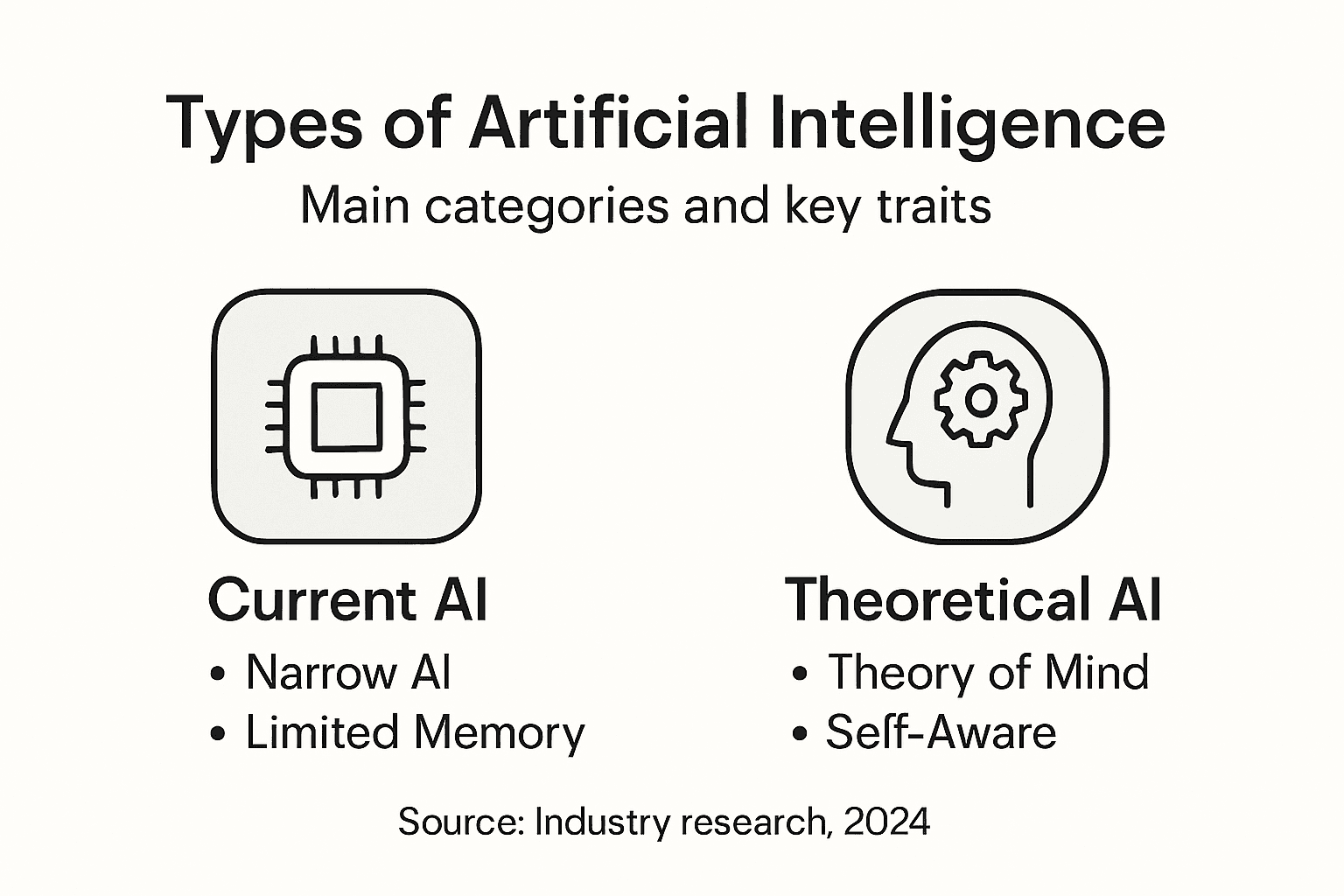
The most common and practical category is narrow AI, also called weak AI. This is what exists right now in the real world. Narrow AI handles specific, well-defined tasks. It plays chess. It recognizes faces in photos. It predicts customer churn. It transcribes speech to text. The defining characteristic is focus. A narrow AI system cannot transfer what it learned in one domain to another. An AI trained on medical imaging data cannot suddenly help you optimize warehouse logistics. It stays in its lane by design. Most AI applications your company would implement fall into this category because narrow AI is stable, measurable, and relatively straightforward to deploy. When Airitual helps organizations integrate AI to enhance efficiency and customer engagement, you are working with narrow AI systems that solve specific operational problems.
Another practical distinction involves how these systems use data. Reactive machines operate solely on current input without any memory of past interactions. These are the simplest AI systems, designed to respond to immediate inputs with predetermined outputs. A chess-playing AI that evaluates only the current board position without remembering how it got there exemplifies this approach. While reactive machines have real uses, they lack adaptability. They make the same decision given the same situation, regardless of context or history.
Most useful business AI operates with limited memory, meaning it incorporates historical data into its decisions. These systems learn from patterns in your past data and improve over time. A lead-scoring tool that gets smarter as it processes months of sales data is limited memory AI. An inventory forecasting system that adjusts predictions based on seasonal patterns from previous years is limited memory AI. This category represents the sweet spot for most organizations. The systems improve with more data, but they do not require decades of historical information to function effectively. They work with realistic datasets that your company likely already possesses.
Beyond the Practical: Theoretical AI Types
Two additional categories exist primarily in research settings and deserve mention for context. Theory of mind AI would understand emotions, beliefs, intentions, and desires the way humans do. Imagine customer service AI that genuinely comprehends why a customer is frustrated, not just recognizing the word “frustrated” in their message. This level of understanding does not exist yet in commercial applications. Researchers are exploring it, but the technical challenges remain substantial.
Self-aware AI, sometimes called artificial general intelligence, would possess consciousness and self-awareness comparable to human awareness. It exists only in science fiction and theoretical discussions. No one has built it. Many researchers question whether it is even possible. For your business strategy, this category is not relevant today or in the foreseeable future.
The practical reality for enterprise decision-makers is that you have two viable options. Either deploy narrow AI with limited memory to solve specific operational problems, or avoid AI entirely. There is no middle ground yet. The systems theoretically capable of broader reasoning and understanding do not exist. This actually works in your favor because it means AI investments are inherently constrained in scope. You cannot accidentally create something uncontrollable. You can only build tools designed to handle one specific task better than humans or existing systems can.
To clarify the differences among various types of AI described in the article, here’s a quick comparison:
| AI Type | Key Capability | Real-World Use | Limitation |
|---|---|---|---|
| Narrow AI | Solves specific tasks | Customer support | No broad learning |
| Reactive Machine | Responds to current input only | Chess engines | No memory or adaptation |
| Limited Memory AI | Learns from past data | Lead scoring, forecasting | Requires clean historical data |
| Theory of Mind AI | Understands emotions/intentions | Research only | Not yet practical |
| Self-Aware AI | Possesses consciousness | Fictional/theoretical | No proven existence |
When evaluating AI solutions, ask your vendor which type they are offering. If they cannot answer clearly or use vague language about general problem-solving, that is a red flag. A legitimate vendor explains exactly what data their system uses, what specific task it performs, and how it improves with new information. They set realistic expectations about what the AI can and cannot do. They understand the limitations of narrow AI and design their implementation accordingly.
One final point worth highlighting: the type of AI matters less than the problem you are solving. An average narrow AI system deployed against a real operational pain point generates more value than theoretical discussions about advanced AI capabilities you cannot use. A lead qualification system that correctly identifies high-value prospects 10 percent better than your current process immediately impacts revenue. A scheduling optimization tool that reduces overtime costs by 15 percent pays for itself. These are not futuristic applications. They are practical deployments of limited memory AI that work today.
Pro tip: When your vendor pitches an AI solution, ask them to show you the specific data the system uses and demonstrate how it improves with new information. If they cannot show you a learning mechanism tied to your actual data, you are looking at sophisticated automation, not AI, and should adjust your expectations accordingly.
Real-World AI Applications Across Sectors
Theory disconnects from reality fast. You can understand what AI is and how it works, but until you see it solving actual business problems, the concept remains abstract. The good news is that AI has moved far beyond labs and pilot programs. It operates across nearly every industry today, handling tasks that were impossible just five years ago. Manufacturing plants use AI to predict equipment failures before they happen. Hospitals deploy AI to catch diseases earlier than human radiologists. Banks process loan applications in hours instead of weeks. Retail companies know what customers want before they do. The transformations are not coming someday. They are happening now.
How Major Sectors Deploy AI Today
Healthcare stands as one of the most advanced AI adopters. Diagnostic systems analyze medical imaging faster and often more accurately than human specialists. A radiologist reviewing hundreds of scans daily catches some cancers and misses others. An AI system reviews the same images consistently, applying learned patterns from thousands of previous cases. Hospitals are not replacing radiologists. They are giving them AI assistance so radiologists focus on complex cases and patient interaction while routine screening happens faster. Beyond diagnostics, healthcare organizations leverage AI for fraud detection, predicting patient readmissions, and personalizing treatment recommendations based on individual genetics and medical history.
Financial services has transformed through AI-powered fraud detection and risk assessment. Banks process millions of transactions daily. Most are legitimate, but some represent fraud. Traditional rule-based systems catch obvious patterns but miss sophisticated schemes. Machine learning models learn from historical fraud cases and detect anomalies in real time. Credit decisions that once required human judgment and days of processing now happen in minutes because AI evaluates creditworthiness across thousands of variables simultaneously. Insurance companies use AI to assess claims faster and more accurately, reducing both legitimate claim processing time and fraudulent payouts.
Agriculture has embraced AI in ways many people never consider. Predictive analytics systems analyze weather patterns, soil quality, pest activity, and historical yield data to recommend optimal planting times and resource allocation. Farmers with limited resources can now farm more efficiently. They know which fields need more water, where insects are emerging, and when to harvest for maximum yield. Drones equipped with computer vision identify crop diseases in specific plants before they spread. This combination of data analysis and computer vision turns farming from guesswork into precision operation.
Retail personalization powered by AI generates measurable revenue increases. When you visit an online retailer and see product recommendations, that is AI learning from your browsing history, purchase patterns, and behavior similar to other customers with your profile. This is not random. Systems trained on millions of customer interactions predict what you will buy with surprising accuracy. In physical stores, AI analyzes foot traffic patterns, optimizes product placement, and manages inventory by predicting demand at specific locations. One major retailer reduced out-of-stock situations by 30 percent using AI-driven inventory forecasting.
Energy and utilities rely on AI for operational optimization. Power grids must balance supply and demand constantly. Too much supply wastes resources. Too little creates blackouts. AI predicts demand patterns based on weather, time of day, historical usage, and special events. Utilities adjust generation and distribution in real time, reducing waste and costs. Maintenance teams use AI to predict which equipment will fail soon, allowing preventive maintenance instead of emergency repairs that cost far more.
Manufacturing deploys AI to reduce downtime and defects. Sensors on equipment collect continuous data about vibration, temperature, and sound. Machine learning models trained on this data detect when equipment is degrading toward failure. Maintenance teams fix problems before production stops instead of responding to breakdowns. Quality control systems use computer vision to inspect products at speeds and consistency no human inspector could match. A automotive parts manufacturer reduced defects by 22 percent and equipment downtime by 40 percent using AI quality control and predictive maintenance.
Here is a summary showing how AI is currently transforming major industry sectors:
| Sector | Common AI Application | Example Benefit | Typical Challenge |
|---|---|---|---|
| Healthcare | Diagnostic imaging analysis | Faster, more accurate results | Data privacy |
| Finance | Fraud detection & risk scoring | Real-time filtering | Algorithmic bias |
| Agriculture | Predictive crop management | Higher yields, reduced waste | Data collection quality |
| Retail | Personalized recommendations | Boosted sales, less stockouts | Changing consumer habits |
| Manufacturing | Predictive maintenance | Reduced downtime, defects | Sensor data reliability |
Challenges That Every Sector Faces
Success with AI is not automatic. Organizations implementing AI across sectors encounter consistent challenges. Data quality issues undermine everything. Garbage data creates garbage predictions. Bias in training data means AI systems inherit historical discrimination. A hiring AI trained on past hiring decisions might discriminate against certain demographics because those biases existed in the historical data. Privacy concerns require careful handling when AI processes personal information. Workforce adaptation matters because AI changes job roles. Workers need training for new responsibilities. Organizations that treat AI implementation as purely technical and ignore the human side struggle more than those addressing workforce concerns directly.
Why This Matters for Your Organization
You do not need to work in healthcare or finance to benefit from AI. The applications that work in these massive sectors often scale down to smaller operations. A mid-size manufacturing company can implement the same predictive maintenance principles a global automaker uses. A regional healthcare provider can deploy diagnostic assistance AI. A growing retail chain can implement personalization engines. The technology has matured enough that implementation is less about innovation and more about choosing the right problem to solve with the right tool.
Pro tip: Identify one operational problem in your company where humans currently spend significant time on repetitive analysis or decision-making with imperfect consistency. Start your AI journey there rather than pursuing trendy applications. A company that reduces billing errors by 15 percent through AI gains more immediate value than one chasing advanced applications without clear business impact.
Integration Steps for Businesses and Organizations
Knowing that AI works and actually implementing it in your organization are two completely different challenges. You cannot simply purchase AI software, install it, and expect transformation. AI integration requires strategy, planning, clear objectives, and honest assessment of your current capabilities. Companies that approach AI as a technology purchase fail. Companies that approach it as an organizational change initiative succeed. The difference comes down to preparation and realistic expectations about what the process actually involves.
The journey begins not with technology but with clarity about your business problem. Before touching any software, your leadership team needs alignment on what you are trying to accomplish. Are you reducing operational costs? Improving customer experience? Increasing sales? Preventing equipment failures? These are fundamentally different objectives that require different AI solutions and different success metrics. A manufacturing company focused on predictive maintenance measures success by equipment uptime. A retail company focused on personalization measures success by conversion rate improvement. Your starting point determines everything downstream.
The Strategic Foundation Phase
Proper AI implementation requires strategic alignment and leadership commitment from the beginning. This is not something IT handles alone while the rest of the business continues unchanged. Your executive team must understand the problem being solved, the investment required, the timeline for results, and what organizational changes will happen. When leadership buys in genuinely, they remove obstacles. When they treat AI as a technical project outside their concern, obstacles multiply.
Your second step involves assessing your current data infrastructure. AI lives and dies by data quality. If you cannot access clean, organized historical data related to the problem you are solving, AI will struggle. A company wanting to improve credit decisions through AI needs historical loan data including outcomes. A manufacturer wanting predictive maintenance needs equipment sensor data going back months or years. A hospital wanting diagnostic assistance needs thousands of labeled medical images. Before committing budget, verify that the data you need actually exists, is accessible, and is reasonably clean.
Third, identify your cross-functional team. Successful AI integration requires collaboration between business stakeholders, data professionals, IT infrastructure teams, and the people whose workflows will actually change. A predictive maintenance implementation needs manufacturing engineers explaining maintenance challenges, data scientists building the model, IT ensuring the system runs reliably, and maintenance technicians whose daily work will change when the AI starts recommending preventive actions. When any group is excluded, integration stumbles.
The Proof-of-Concept Phase
After strategy and planning, start small. Most organizations benefit from a focused proof-of-concept project on a specific operational problem. This is not your full-scale implementation. It is a contained test with limited scope, defined success metrics, and a clear timeline, typically four to twelve weeks. You are answering a specific question: Does this AI approach actually work for our problem with our data?
Design your proof-of-concept carefully. Define what success looks like before you start. If you are testing AI for lead scoring, decide in advance whether a 10 percent improvement in conversion rate counts as success. If you are testing predictive maintenance, decide whether a 15 percent reduction in emergency repairs justifies the project. Clear metrics prevent arguments later about whether the test succeeded. Vague metrics guarantee disappointing outcomes.
Many organizations skip proof-of-concept and go straight to production implementation. This tends to be expensive. A failed full-scale deployment costs far more than a failed small test. The proof-of-concept also shows your team what AI actually involves. They learn what data preparation takes. They discover that predictions are probabilities, not certainties. They understand that the AI requires monitoring and adjustment over time. This learning prevents surprises during production deployment.
The Production Scaling Phase
Once your proof-of-concept demonstrates value, you move toward production implementation. This is where the AI system becomes part of your actual operations handling real decisions and real data. Scaling requires infrastructure investment, governance structures, and clear policies about how the AI system makes decisions or recommendations.
Governance structures address critical questions. Who monitors the AI system to ensure it keeps performing well? What happens when predictions drift from historical accuracy? Who has authority to update the AI model? How do you handle edge cases the AI was not trained on? These governance questions matter more than most organizations realize. An AI system running unmonitored degrades silently. A prediction model trained on data from 2023 may perform poorly on 2024 data patterns.
Workforce adaptation often determines success more than technology quality. When an AI system starts recommending which patients need urgent care, emergency room staff needs training on when to follow the recommendation and when to override it based on patient context the AI does not see. When a loan approval AI makes recommendations, your loan officers need clear guidance on their role. Some organizations treat staff as obstacles to automation. Others treat them as essential partners interpreting AI recommendations and handling exceptions. The second approach produces better outcomes.
Managing Real Implementation Challenges
Expect data quality issues. Your historical data probably contains errors, inconsistencies, and gaps. Preparing that data for AI often takes longer than people expect. Expect initial accuracy to disappoint. An AI system that is 82 percent accurate sounds good until you realize 18 percent error rate is higher than your current manual process. Expect pushback from staff whose jobs change. Expect technical challenges during production deployment that did not appear during proof-of-concept.
These are not reasons to avoid AI. They are reasons to expect them, budget for them, and plan around them. Organizations that pretend these challenges do not exist struggle. Organizations that acknowledge them and plan accordingly succeed.
Pro tip: During your proof-of-concept phase, measure not just whether the AI works, but how long data preparation took, what technical obstacles you encountered, and how your team reacted to the process. These real-world learnings inform your production timeline and budget far better than vendor estimates, which almost always underestimate implementation complexity.
Risks, Limitations, and Responsible AI Use
AI delivers genuine value, but it is not a magic solution. Every AI system has limitations and risks that responsible organizations acknowledge and manage proactively. Understanding these constraints separates realistic AI deployments from disappointing ones. Vendors emphasize what AI can do. They gloss over what it cannot. Your job as a decision maker is understanding both sides of that equation. An AI system that solves 80 percent of a problem is valuable only if you handle the remaining 20 percent intentionally.
Start with a fundamental limitation: AI operates on patterns. If your data contains patterns, AI finds them. If patterns do not exist or are inconsistent, AI struggles. A sales prediction AI trained on three years of historical data assumes the next year resembles those three years. When market conditions shift dramatically, the AI’s predictions degrade. A hiring AI trained on your company’s past hiring decisions learns your historical patterns, including any discrimination that existed in those decisions. This is not the AI being biased. It is the AI learning bias from your data. Another critical limitation is that AI produces probabilities, not certainties. A fraud detection system might flag 95 percent of actual fraud but also incorrectly flag 5 percent of legitimate transactions. Someone must decide whether that tradeoff is acceptable.
The Real Risks You Must Manage
Bias and discrimination represent perhaps the most serious risk. AI systems trained on historical data inherit historical prejudices. Algorithmic biases impact academic fairness in hiring, lending, and hiring decisions because the training data reflects human biases that existed when it was collected. If your company historically hired fewer women for engineering roles, an AI system trained on that data will recommend hiring fewer women. The solution is not ignoring AI. It is deliberately testing your AI systems for bias, adjusting training data, and monitoring for discriminatory outcomes after deployment.
Transparency challenges plague many AI systems. Some AI models operate as black boxes where nobody, including the developers, can fully explain why the system made a specific decision. This creates serious problems in regulated industries like healthcare and finance where decisions must be explainable. If an AI system denies a loan application, the applicant has a right to understand why. If the system cannot explain its reasoning, that is a regulatory problem. When implementing AI in your organization, prioritize systems that can explain their decisions, even if they are slightly less accurate than opaque alternatives.
Hallucinations occur when AI systems confidently produce false information. Generative AI systems sometimes invent facts, cite nonexistent sources, or describe scenarios that never happened, all while sounding authoritative. This is not intentional lying. It is a fundamental characteristic of how these systems work. They predict the next word statistically likely to follow previous words, sometimes producing plausible sounding but completely false outputs. Any organization using generative AI must verify outputs independently rather than trusting the system’s confident tone.
Privacy and data security risks emerge when AI systems process sensitive information. Training an AI system requires feeding it large amounts of data. That data might contain customer information, employee records, or proprietary business information. When you send data to cloud based AI systems, who has access? How long is it retained? What prevents unauthorized access? These are not hypothetical concerns. They are fundamental questions your legal and security teams must answer before deploying any AI system that touches sensitive data.
Workforce displacement presents a real but often overstated concern. AI will change jobs. Some roles will disappear entirely. Many roles will transform. An accounts payable specialist whose job is 80 percent processing invoices faces real disruption when AI handles that task. The honest response is helping that person transition to higher value work like vendor relationship management or exception handling. Companies that pretend AI will not displace anyone lose credibility. Companies that acknowledge the disruption and invest in retraining build loyalty and handle transitions better.
Responsible AI Use in Practice
Responsible AI means acknowledging limitations and managing risks deliberately. It means not deploying AI systems without understanding what could go wrong. It means monitoring systems after deployment rather than assuming they work correctly forever. It means being honest with stakeholders about what the AI can and cannot do.
Start by defining clear governance. Who is accountable for the AI system’s performance and outcomes? Who monitors it? Who has authority to adjust or shut it down? These governance questions often receive less attention than technology selection but matter more. An excellent AI system with no governance structure degrades silently until problems become obvious.
Second, establish testing protocols. Before deployment, test your AI system for bias, accuracy across different populations, and edge cases where the system might fail. A lending AI tested only on customers with excellent credit scores will perform poorly when it encounters borrowers with poor credit. Test the system on the actual population it will serve.
Third, plan for human oversight. Almost all AI systems benefit from human review of decisions, especially in early stages. A hiring recommendation from AI might be useful input, but humans should make final decisions. A fraud alert from AI might warrant investigation but not automatic action. Build human judgment into your workflow rather than treating AI decisions as final.
Finally, communicate clearly with affected stakeholders. Employees whose work changes due to AI need honest information and support. Customers whose experiences are shaped by AI recommendations deserve transparency about how those recommendations are made. This communication builds trust and surfaces concerns early.
Pro tip: Before deploying any AI system, run it through this accountability test: If this AI system makes a wrong decision and causes harm, who bears responsibility? Can you explain that answer to a regulator or customer? If the answer is unclear or unsatisfying, your governance structure needs work before deployment, not after.
Unlock Real Value from Artificial Intelligence with Airitual
The article highlights common challenges businesses face when integrating AI such as distinguishing real AI from advanced automation, managing data quality, and setting clear objectives focused on measurable operational gains. If you are tired of vague promises about “machine learning” and want practical AI solutions that learn and adapt to your unique data, Airitual is your trusted partner. We specialize in deploying narrow AI and limited memory AI systems designed to solve your specific business problems. Whether it is automating repetitive tasks, improving customer engagement, or optimizing operations, our consultative approach ensures you overcome implementation hurdles and achieve real, measurable results.
Don’t let confusion about AI slow your organization down. Take the step toward a strategic partnership that prioritizes your operational reality and workforce adaptation. Start today with a free strategy session to explore tailored AI-powered solutions. Discover how our AI-powered tools for business automation can amplify your team’s capabilities while addressing the human side of AI integration. Visit Airitual now and transform AI from buzzword to breakthrough for your organization.
Frequently Asked Questions
What is artificial intelligence (AI)?
AI refers to machines performing tasks that typically require human intelligence, such as problem-solving, pattern recognition, and learning from experience.
How does narrow AI differ from other types of AI?
Narrow AI, or weak AI, is designed to handle specific tasks, unlike general AI, which aims to possess cognitive abilities similar to humans. Narrow AI cannot transfer knowledge from one domain to another.
What are some common applications of AI in businesses?
Businesses commonly use AI for customer support, fraud detection, predictive maintenance, and personalized marketing to enhance efficiency and decision-making processes.
How can small and medium enterprises implement AI effectively?
Small and medium enterprises can start by identifying specific operational problems that AI can solve, running proof-of-concept projects, and ensuring leadership commitment and data quality before full-scale implementation.
Recent Comments