
TL;DR:
- AI reduces disciplinary actions by 72% and significantly increases student engagement.
- It employs connected technologies like machine learning for automated attendance, behavior monitoring, and predictive alerts.
- Ethical concerns such as privacy, bias, and digital divide require careful governance and responsible implementation.
A 72% reduction in disciplinary actions at schools piloting AI tools is not a forecast. It is already happening. For K-12 administrators who have spent years managing disruption, inconsistent engagement, and teacher burnout, that number signals something worth taking seriously. This guide cuts through the noise to show you exactly how AI functions in real classrooms, what the evidence actually supports, where the genuine risks live, and how to build an adoption strategy that works for your specific school community. Expect practical frameworks, honest data, and clear answers.
Table of Contents
- How AI transforms classroom management
- Evidence-backed outcomes: What the data says
- Navigating ethical concerns and risks
- Strategies for AI adoption in K-12 settings
- The real story: What most guides miss about AI in classroom management
- Next steps: Bring AI-powered classroom management to your school
- Frequently asked questions
Key Takeaways
| Point | Details |
|---|---|
| AI reduces discipline problems | Schools using AI see up to 72% fewer disciplinary actions, supporting safer learning environments. |
| Technology improves student engagement | AI tools help boost participation and self-directed learning for diverse classrooms. |
| Ethical risks require attention | Privacy, bias, and equitable access must be addressed with clear policies and audits. |
| Implementation is a leadership issue | Success depends on thoughtful piloting, teacher training, and adapting to unique local needs. |
| Personalization and inclusion | When used thoughtfully, AI supports neurodivergent students and can bridge resource gaps. |
How AI transforms classroom management
AI in classroom management is not one single tool. It is a collection of connected technologies working together to give teachers and administrators better information, faster. At the core, machine learning and deep learning power the most widely deployed systems, handling tasks like automated attendance tracking, behavior monitoring through video or audio feeds, real-time engagement assessment, and predictive analytics that flag students at risk before problems escalate.
The data on how these systems are built tells an important story. Deep learning architectures account for 57% of AI classroom tools, while 49% rely on raw video analysis and 28% use multimodal inputs combining voice, movement, and facial data. That level of technical sophistication means these systems can process far more signals than any single teacher can track in real time.
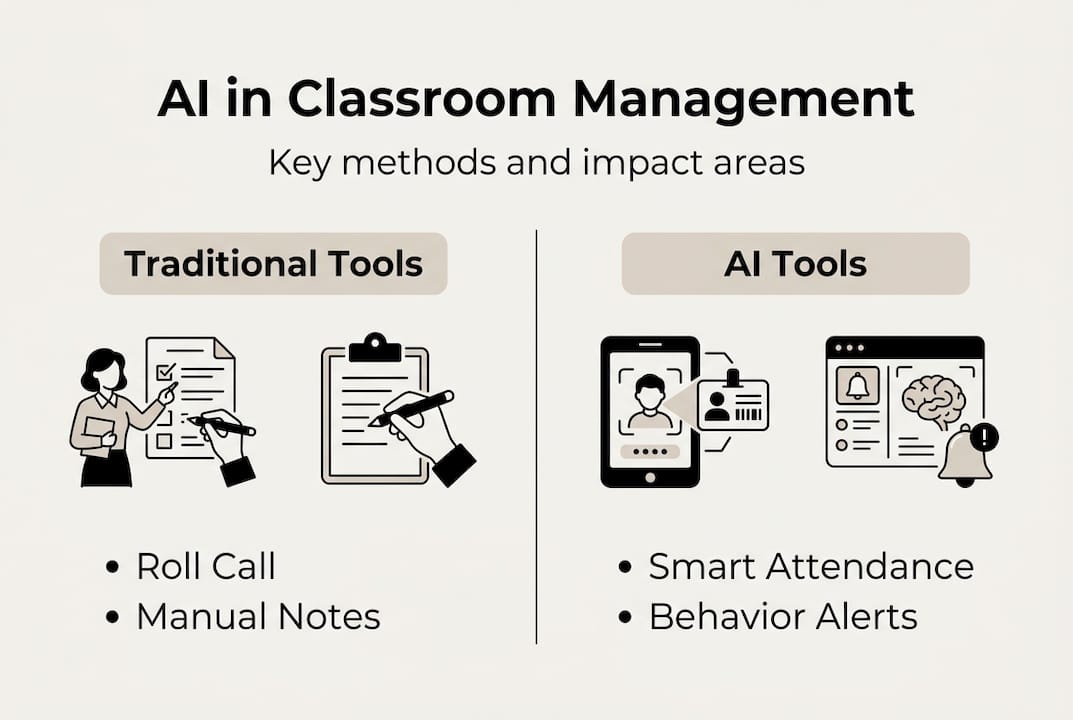
For context, here is how AI methods compare to traditional classroom management approaches:
| Factor | Traditional methods | AI-powered methods |
|---|---|---|
| Attendance tracking | Manual roll call | Automated, real-time |
| Behavior monitoring | Teacher observation | Continuous video/audio analysis |
| Engagement assessment | Periodic checks | Continuous, data-driven |
| Early intervention | Reactive | Predictive, proactive |
| Administrative load | High | Significantly reduced |
These differences matter for your daily operations. Teachers spend less time on administrative tasks and more time on instruction. Patterns that would otherwise go unnoticed, such as a quiet student gradually disengaging over several weeks, get surfaced automatically.
Key AI functions currently active in K-12 settings include:
- Automated attendance and tardiness logging
- Behavior pattern recognition across classrooms
- Sentiment and engagement scoring from facial expressions or participation data
- Predictive alerts for students showing early signs of disengagement or behavioral escalation
- Personalized learning pathway suggestions tied to engagement levels
You can see how these capabilities connect directly to AI engagement strategies that go beyond classroom control to actively improve learning. The parallel to how organizations use employee engagement tools is worth noting. The underlying logic is similar: use data to catch disengagement early and respond with precision.
Evidence-backed outcomes: What the data says
The numbers from recent studies are striking. A controlled study found a 72% drop in disciplinary actions in classrooms using AI-supported management systems, alongside measurable gains in critical thinking when Socratic AI methods were applied. These are not marginal improvements. They represent a genuine shift in classroom culture.

Here is a summary of key quantitative findings from recent research:
| Outcome area | Result | Tool/approach |
|---|---|---|
| Disciplinary incidents | 72% reduction | AI-supported classroom management |
| Student participation | 376% increase | Hawthorne effect via AI monitoring |
| Critical thinking scores | Significant gains | Socratic AI dialogue tools |
| Self-efficacy | Improved | AI-personalized feedback systems |
| Grade performance | Positive trend | Predictive analytics and early alerts |
That 376% participation boost linked to the Hawthorne effect, the phenomenon where students perform better simply because they know they are being observed, is one of the more surprising findings in recent education AI research. It suggests that even the presence of monitoring systems can shift student behavior positively.
How do these results translate into real school improvements? Follow this sequence:
- Fewer disruptions free up instructional time that was previously lost to behavioral correction.
- Higher engagement scores give teachers actionable signals to adjust pacing and content in real time.
- Predictive alerts allow counselors and administrators to intervene early, reducing the number of students who reach crisis points.
- Improved critical thinking outcomes follow from AI tools that prompt structured reasoning rather than passive consumption.
- Stronger teacher confidence builds when data supports their instincts and reduces guesswork.
Explore the AI strategies in education that align with these outcomes, and review what implementing AI in classrooms looks like in practice before you commit to any single approach.
Pro Tip: When evaluating AI tools, ask vendors to provide school-level performance data, not just platform-wide averages. Results vary significantly by context, grade level, and student population.
Navigating ethical concerns and risks
The outcomes data is compelling, but responsible administrators do not lead with enthusiasm alone. Ethical risks in AI classroom management are real and need to be addressed systematically before rollout.
The most common risk categories identified across the research include:
- Privacy invasion: Only 22% of studies formally address privacy safeguards, meaning most tools enter schools without adequate protection frameworks in place.
- Algorithmic bias: Systems trained on narrow datasets can misread behavior, particularly in students from cultural backgrounds underrepresented in training data.
- Student dependency: Over-reliance on AI feedback can reduce students’ capacity for self-regulation if not balanced with teacher-led instruction.
- Emotional disruption: Emotion recognition tools risk misinterpreting facial expressions across cultures, leading to false flags or inappropriate interventions.
- Digital divide: Low-resource districts often lack the infrastructure to implement AI equitably, widening existing gaps.
“Emotion AI risks misinterpretation across cultures, and without human oversight, automated responses to emotional data can do more harm than good.”
For neurodivergent students, AI tools that support routine management and predictable structure can be genuinely beneficial. However, the same systems need careful calibration to avoid penalizing atypical behavioral patterns that are not disruptive but may trigger false alerts.
Building strong AI privacy in schools starts with transparent data governance. You should know exactly what data is collected, how long it is stored, who can access it, and how it is used. Reviewing the future of AI in schools through a policy lens is just as important as reviewing it through a technology lens.
Pro Tip: Run a structured bias audit on any AI system before deployment. Ask vendors to document model training data sources and performance differences across demographic groups. If they cannot answer clearly, treat that as a warning signal.
Strategies for AI adoption in K-12 settings
Moving from interest to implementation requires a structured approach. The divide between administrators who see AI as an efficiency engine and those who see it as a surveillance risk often comes down to how thoughtfully the rollout was designed. Optimists focus on efficiency gains, while skeptics raise valid concerns about cheating detection overreach, surveillance creep, and embedded bias. Both perspectives deserve space in your planning process.
Follow these steps to build a responsible AI adoption plan:
- Conduct a needs assessment. Identify the specific classroom management problems you are solving. Vague goals produce poor technology choices.
- Inventory existing tools and infrastructure. AI adoption fails most often when it is layered onto inadequate systems.
- Define success metrics in advance. What does a 6-month win look like? Specify it before you start.
- Select tools against a clear criteria list. Prioritize transparency, explainability, and vendor accountability.
- Run a structured pilot. Choose two to three classrooms or grade levels for a controlled test before district-wide rollout.
- Train teachers thoroughly. Technology without teacher buy-in produces resistance, not results.
- Evaluate and scale deliberately. Use pilot data to inform expansion decisions, not vendor sales materials.
When selecting tools, apply these criteria consistently:
- Transparency: Can the vendor explain how decisions are made?
- Privacy by design: Is student data protection built in, not bolted on?
- Equity consideration: Has the tool been tested across diverse student populations?
- Teacher integration: Does the tool support teachers or attempt to replace their judgment?
- Measurable outcomes: Is there independent evidence of effectiveness?
Review the AI implementation steps in detail, and consider the education automation benefits that follow from well-structured adoption programs.
Pro Tip: A pilot program is your best risk management tool. It gives you real performance data from your own student population, reduces financial exposure, and builds teacher confidence before a full commitment.
The real story: What most guides miss about AI in classroom management
Most articles on this topic spend too much time on either hype or fear. The reality is more nuanced. Concerns about cognitive atrophy and pervasive surveillance are legitimate in poorly designed systems, but they are often overstated when applied broadly. A well-implemented AI tool does not replace teacher judgment. It sharpens it.
What drives genuine success is not the technology specification. It is leadership culture. Schools that see strong results share one trait: administrators who treated AI as a pedagogical decision, not an IT procurement task. They involved teachers early, communicated clearly with families, and built accountability structures before launch.
Research also shows that AI mitigates grading bias in ways that human systems often cannot. That is a meaningful equity win that rarely makes the headline coverage.
“AI’s greatest strength is personalization, but its greatest threat is one-size-fits-all thinking.”
For neurodivergent students and underserved communities, the future of AI in schools must be built around local context, not universal defaults. The technology is only as good as the decisions made around it.
Next steps: Bring AI-powered classroom management to your school
If this guide has clarified what AI can realistically deliver in your classrooms, the logical next step is building a structured plan. At Airitual, we work directly with K-12 institutions to design adoption strategies that fit your school’s specific goals, student population, and infrastructure. Start by reviewing our AI integration best practices to see what strong implementation looks like across districts. Then work through our detailed AI implementation guide to map your own path. Before selecting any tool, use our AI tools checklist to evaluate vendors against the criteria that matter. Schedule a FREE Strategy Session with our team to explore a tailored pilot program for your school.
Frequently asked questions
What types of AI are commonly used in classroom management?
Machine learning and deep learning are the most widely deployed, handling attendance tracking, behavior monitoring, and engagement prediction. Multimodal systems that combine video, audio, and movement data are also growing in use.
Does AI actually improve student engagement and reduce discipline problems?
Yes. Studies report a 72% reduction in disciplinary actions and significantly higher engagement levels when AI classroom management tools are properly implemented.
How can schools address privacy and bias concerns when using AI?
Schools should establish transparent data governance policies, require vendor bias documentation, and ensure privacy safeguards are built into the system architecture before any tool is adopted.
Are AI tools suitable for neurodivergent and underserved students?
AI can support neurodivergent students through structured routine management, but cultural calibration and resource equity must be addressed to avoid deepening existing gaps.
How should K-12 leaders start implementing AI for classroom management?
Begin with a thorough needs assessment, identify clear success metrics, and run a structured pilot. Optimists and skeptics both offer valid input, so include diverse voices in your planning process before scaling.
Recommended
- Step-by-step guide to implementing AI-powered education | Artificial Intelligence
- 10 AI-powered teaching tips that boost results in 2026 | Artificial Intelligence
- AI for student engagement: proven strategies for better learning | Artificial Intelligence
- Edtech adoption tips: 5 proven strategies for schools | Artificial Intelligence
Recent Comments