

TL;DR:
- AI-powered chatbots significantly improve customer satisfaction, with increases up to 84 percent.
- They support 24/7 availability, scalability, and personalized, proactive engagement.
- Chatbots enhance operational efficiency by automating repetitive tasks while human agents handle complex interactions.
Most business leaders assume chatbots are cold, robotic tools that frustrate customers rather than help them. The reality is far more compelling. Businesses that deploy AI-powered chatbots are seeing satisfaction improvements of 30 to 84%, depending on the industry and implementation approach. That is not a marginal gain. It is a structural shift in how companies build relationships with customers. This article walks you through the real mechanisms behind chatbot-driven engagement, practical frameworks for deployment, and the operational advantages that make chatbots one of the most impactful investments available to business leaders today.
Table of Contents
- Why chatbots matter for modern businesses
- Chatbots in action: Key business functions and examples
- How chatbots boost customer engagement and satisfaction
- Operational efficiency: The automation advantage
- Why human insight still matters: The limits of chatbot automation
- Accelerate your business with AI-driven chatbots
- Frequently asked questions
Key Takeaways
| Point | Details |
|---|---|
| Boost customer satisfaction | Chatbots can lift customer satisfaction scores by as much as 84% with personalization and proactive engagement. |
| Drive operational efficiency | Automating repetitive tasks with chatbots frees staff for high-value work and reduces overall support costs. |
| Balance automation and humans | The most effective businesses blend powerful chatbots with skilled human support for complex needs. |
Why chatbots matter for modern businesses
With the background set, let us look closer at why chatbots are becoming essential for today’s businesses. Customer expectations have shifted dramatically. People want immediate answers, around the clock, without waiting on hold or navigating complex phone trees. Traditional customer service models simply cannot scale to meet that demand without ballooning labor costs.
Chatbots address that gap directly. They operate 24/7, respond in seconds, and handle thousands of simultaneous conversations without degrading in quality. For business leaders focused on cost control and customer retention, that combination is hard to ignore.
The core drivers behind chatbot adoption include:
- 24/7 availability without staffing overhead
- Instant response times that reduce customer frustration
- Scalability to handle demand spikes without hiring
- Personalization through AI-driven sentiment analysis and behavioral data
- Consistency in messaging and service quality across every interaction
Personalization is where modern AI chatbots separate themselves from earlier rule-based systems. Today’s chatbots analyze user intent, past behavior, and emotional tone to tailor responses in real time. That is what drives measurable satisfaction gains.
“Chatbots drive customer engagement through personalization and proactive interactions, improving satisfaction scores significantly across industries.”
For decision-makers, the business case is straightforward. You reduce operational costs, improve response quality, and create more consistent customer experiences simultaneously. Explore AI customer engagement tips to understand how these principles translate into real strategy. The organizations seeing the strongest results are those that treat chatbots not as a cost-cutting shortcut, but as a genuine customer experience investment.
Scalability also matters beyond just handling volume. When your business grows or faces seasonal surges, a chatbot infrastructure scales instantly. You do not need to hire, train, and onboard new agents on a six-week cycle. That agility is a real competitive advantage, especially for mid-sized businesses competing against larger players.
Chatbots in action: Key business functions and examples
Now that we have discussed the value chatbots bring, it is time to see how they function within different business operations. Chatbots are no longer limited to answering FAQs on a homepage. They are embedded into core business workflows across multiple sectors.
Core use cases across industries:
- Customer service: Resolving common queries, processing returns, and escalating complex issues
- Lead generation: Qualifying prospects in real time through conversational flows
- Appointment booking: Automating scheduling for healthcare, legal, and service businesses
- HR support: Onboarding new employees, answering policy questions, and managing leave requests
- Order tracking: Providing real-time shipping updates in retail and e-commerce
The data behind these deployments is compelling. In healthcare, patient satisfaction improved by 30% in documented case studies where chatbots handled appointment scheduling and routine inquiry management. That freed clinical staff to focus on higher-value patient interactions.
| Industry | Chatbot function | Reported impact |
|---|---|---|
| Healthcare | Patient inquiries, scheduling | 30% satisfaction increase |
| Retail | Order tracking, returns | 24/7 resolution, reduced wait times |
| Financial services | Account queries, fraud alerts | Faster response, lower call volume |
| Education | Enrollment support, FAQs | Improved student experience |
The pattern is consistent. When chatbots handle structured, repetitive interactions, human agents are freed to focus on nuanced, high-stakes conversations. See how chatbots in education are reshaping student engagement, or review how AI in small business is making enterprise-level tools accessible to smaller teams.
Pro Tip: Chatbots add the most value in high-volume, structured interaction scenarios. For emotionally sensitive or legally complex situations, always design a clear handoff path to a human agent. The best chatbot deployments are those where customers never feel trapped in an automated loop.
How chatbots boost customer engagement and satisfaction
Beyond process automation, chatbots are transforming the way companies engage their customers. The word “personalization” gets used loosely in marketing, but in the context of AI chatbots, it has a specific and measurable meaning.
Modern chatbot systems use machine learning to analyze user history, purchase behavior, browsing patterns, and even the tone of a customer’s message. Based on that data, the chatbot tailors its response, adjusts its communication style, and anticipates what the customer needs next. That is a fundamentally different experience from a static FAQ page.

Traditional vs. AI-powered chatbots in customer engagement:
| Feature | Traditional chatbot | AI-powered chatbot |
|---|---|---|
| Response type | Scripted, rule-based | Dynamic, context-aware |
| Personalization | None | Behavior and sentiment-driven |
| Proactive outreach | Not available | Automated alerts and offers |
| Learning capability | Static | Continuously improves |
| Escalation handling | Manual or absent | Intelligent routing to agents |
Proactive outreach is one of the most underused capabilities in chatbot deployments. Instead of waiting for a customer to initiate contact, AI chatbots can reach out first. Common proactive use cases include:
- Sending shipping delay alerts before customers notice a problem
- Triggering re-engagement messages for dormant accounts
- Delivering personalized offers based on browsing behavior
- Reminding customers of upcoming appointments or renewals
- Following up after a support interaction to confirm resolution
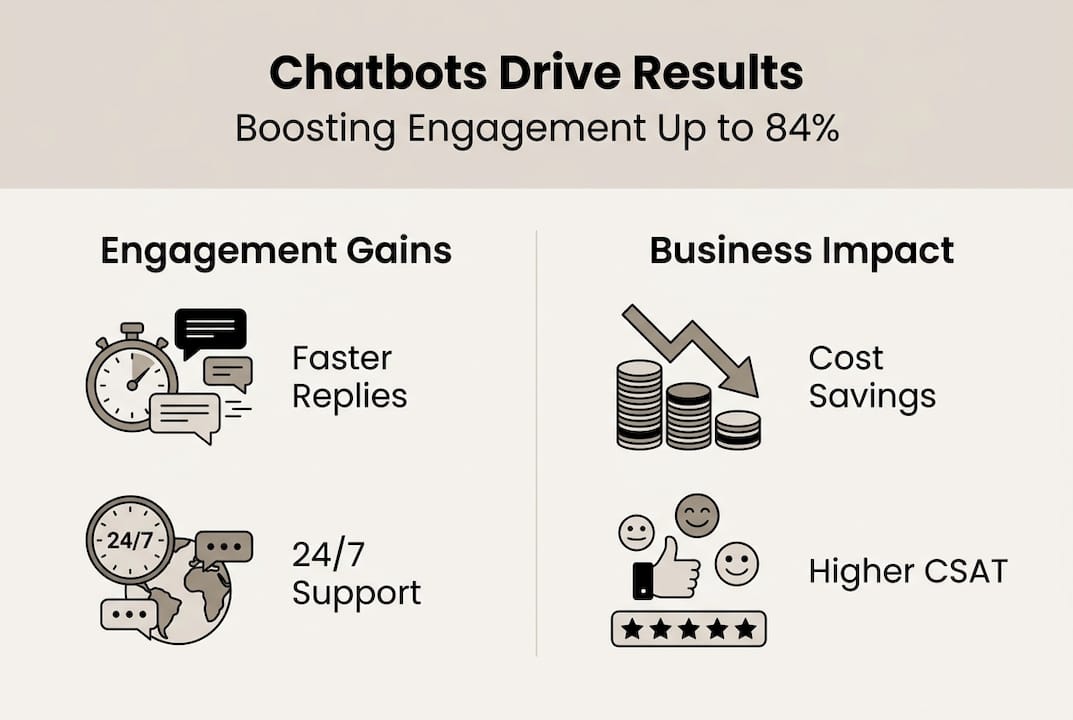
These proactive touchpoints drive higher CSAT scores by making customers feel seen and supported rather than ignored. The satisfaction improvements range from 30% to 84% depending on deployment quality and industry context. For business leaders evaluating ROI, those numbers represent real revenue retention. Review the AI advantages for SMEs to understand how smaller organizations are capturing these same gains without enterprise-level budgets.
Operational efficiency: The automation advantage
Building on engagement, chatbots also excel at boosting back-office and operational efficiency. The efficiency case for chatbots is just as strong as the customer experience case, and for many organizations, it is the primary driver of adoption.
Chatbots now handle a wide range of business processes that previously required dedicated staff time:
- FAQ resolution: Answering product, policy, and service questions without human involvement
- Order and shipment tracking: Providing real-time status updates across thousands of transactions
- Employee onboarding: Walking new hires through paperwork, policies, and system access
- Appointment setting: Scheduling and rescheduling without back-and-forth emails
- Billing inquiries: Resolving invoice questions and processing payment plan requests
The time savings are significant. Businesses that automate repetitive tasks with chatbots report meaningful reductions in support ticket volume and average handling time. When your team spends less time answering the same questions repeatedly, they redirect that capacity toward strategic work that actually grows the business.
Cost reduction is real too. Replacing or supplementing tier-one support with chatbots reduces per-interaction costs substantially. For organizations handling thousands of inquiries monthly, that compounds quickly into material savings.
Pro Tip: Start by auditing your top 20 most frequent support requests. If the majority follow a predictable pattern with structured answers, those are ideal candidates for chatbot automation. Prioritize processes where speed and consistency matter more than nuance. Use the workflow automation guide to map your highest-impact automation opportunities, and explore industry automation efficiency to benchmark your progress against sector peers.
The most effective deployments treat chatbot automation as a force multiplier for your existing team, not a replacement strategy. When your agents are freed from repetitive queue work, they become more effective in the interactions that require real judgment.
Why human insight still matters: The limits of chatbot automation
With the strengths of chatbot automation clear, it is crucial to address what many guides overlook. Chatbots are genuinely powerful, but they are optimized for structured, predictable interactions. When a customer is distressed, confused about a nuanced policy, or dealing with a situation that falls outside standard parameters, automation often makes things worse before it makes them better.
We have seen organizations over-automate and damage customer trust as a result. A chatbot that cannot recognize when a conversation has become emotionally charged, and fails to route it to a human agent quickly, creates frustration that is hard to recover from.
The leaders who get this right understand that chatbots and human agents are not competing resources. They are complementary. Chatbots handle volume and speed. Humans handle complexity and empathy. Your AI operations insights should reflect that balance explicitly, with clear escalation triggers built into every chatbot workflow. The goal is not maximum automation. It is optimal automation, where every customer gets the right type of support at the right moment.
Accelerate your business with AI-driven chatbots
Ready to take your automation and engagement to the next level? At AIritual, we work with business leaders across sectors to design and implement chatbot strategies that deliver measurable results, not just technical deployments. Whether you are starting from scratch or optimizing an existing system, our resources give you a practical path forward. Explore AI integration best practices to build a deployment framework that fits your operations, and review our AI integration tips for actionable guidance on maximizing your investment. Your next step toward better engagement and leaner operations starts here.
Frequently asked questions
What are the biggest benefits of using chatbots in business?
Chatbots provide 24/7 customer support, reduce operational costs, and improve satisfaction by up to 84% while freeing your team to focus on high-value work.
Can chatbots replace human customer service agents?
Chatbots handle routine, structured queries efficiently, but human agents remain essential for emotionally complex or nuanced situations that require judgment and empathy.
How do chatbots personalize customer interactions?
AI chatbots analyze behavioral data, past interactions, and message tone to tailor responses, and they drive engagement through proactive outreach based on predicted customer needs.
Are chatbots expensive to implement in business?
Implementation costs vary by complexity and scale, but most businesses recover their investment quickly through reduced support costs and measurable efficiency gains.
Recommended
- 7 Essential Customer Engagement Tips Using AI | Artificial Intelligence
- How to optimize customer engagement with AI in 2026 | Artificial Intelligence
- How chatbots transform education in 2026 | Artificial Intelligence
- AI Powered Customer Engagement for Retail Success | Artificial Intelligence
- Kundenmanagement Prozess digitalisieren: 87% mehr Effizienz
Recent Comments