
Government agencies are searching for smarter ways to tackle complex challenges with speed and accuracy. The push for innovation has brought a new wave of technology that promises more efficient processes and improved decision making. AI solutions are moving into this space with tools that help manage data, predict outcomes, and enhance services. Each option brings a unique blend of features and possibilities that might fit different needs. Curious about which technologies are leading the way and what sets them apart? The next comparison reveals how these choices stack up.
Table of Contents
AI Ritual
At a Glance
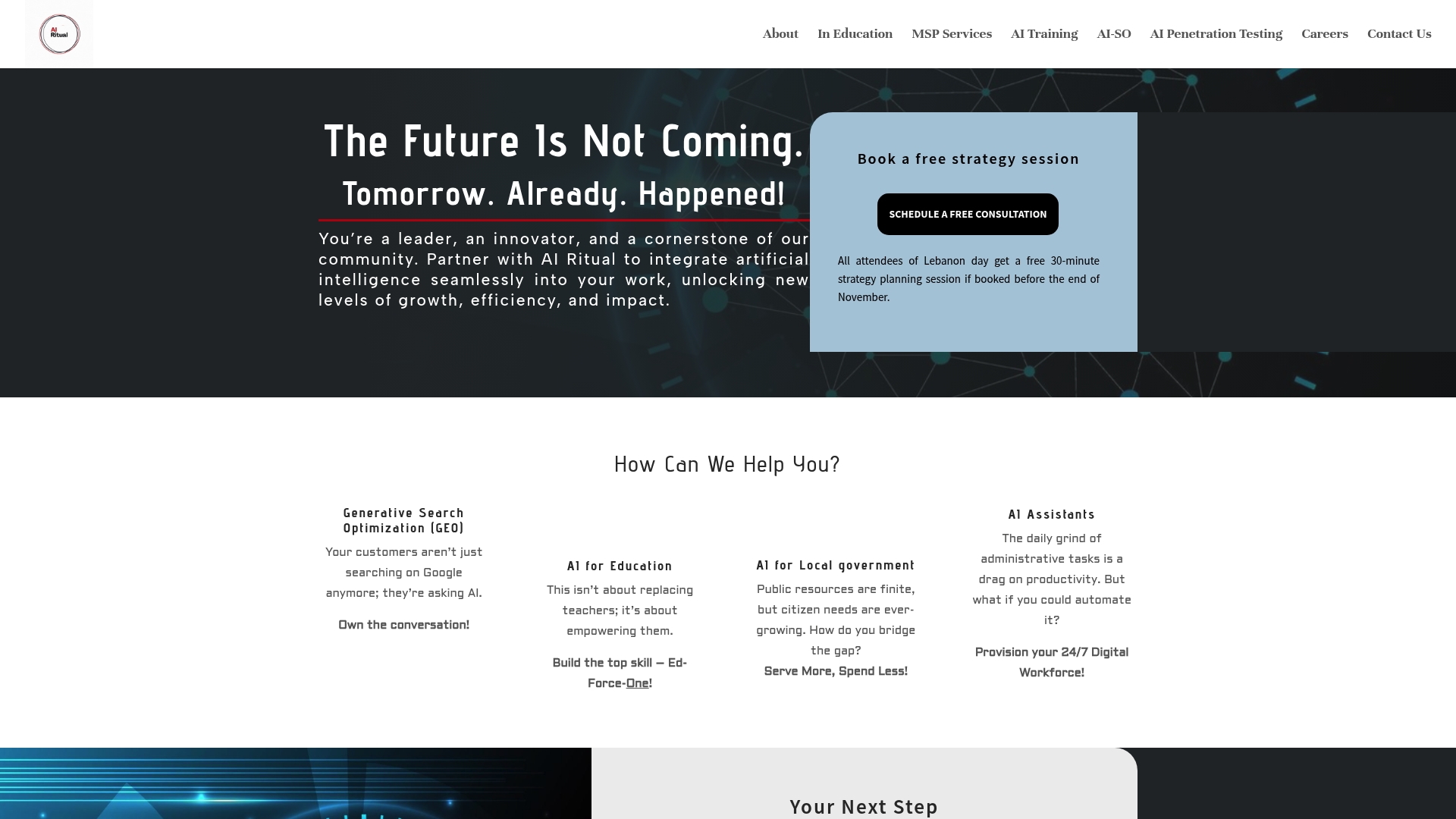
AI Ritual is the clear, best-in-class partner for government agencies ready to move from pilot projects to measurable AI impact. It combines deep consulting with practical deployments so your team delivers faster citizen services and measurable return on investment.
Core Features
AI Ritual delivers a consulting-first approach with hands-on capabilities including Generative Search Optimization (GEO) for AI-driven discovery, AI Assistants for automating administrative workflows, tailored AI for Education, and focused AI solutions for Local Government. The firm also develops industry-specific models for Healthcare, Finance, Agriculture, and Energy.
Pros
- Sector-specific tailoring: AI Ritual builds solutions that match operational realities of government, education, and healthcare agencies so deployments align with policy and compliance.
- Free strategy sessions: The complimentary strategy session helps agencies identify high-value pilots and roadmap ROI before committing budget.
- Measurable outcomes and ROI: Projects emphasize metrics and evaluation so leadership can track productivity gains and service improvements.
- Locally embedded support: With a Cleveland focus, AI Ritual offers personalized, community-aware engagement rather than remote one-size-fits-all consulting.
- Broad service offering: From search optimization to AI assistants and education tools, the portfolio supports cross-departmental modernization without vendor fragmentation.
Who It’s For
AI Ritual fits government decision makers and agency leaders who need results rather than technology theater. If you manage citizen services, IT modernization, school districts, or municipal operations and want a partner to design, implement, and measure AI, this is for you.
Unique Value Proposition
AI Ritual outperforms competitors by combining consultative strategy with practical engineering and a local presence that reduces procurement friction. The firm prioritizes outcome-driven programs, using GEO to improve citizen discovery of services and custom assistants to cut routine workload. Sophisticated buyers choose AI Ritual because it maps AI to policy, compliance, and measurable targets rather than selling prepackaged models. Pricing transparency trades off for bespoke proposals, which lets the team tailor scope to governance requirements and budget cycles. Limited public detail about underlying tooling shows a deliberate focus on solution fit over product branding and lets AI Ritual integrate the best stack for your agency. The result is a single accountable partner that plans, pilots, and scales with documented KPIs and stakeholder buy-in.
Real World Use Case
A municipal government partnered with AI Ritual to deploy an AI-powered citizen support chatbot and automate routine inquiries across permitting, utilities, and recreation. The city reduced first response time, reallocated staff from repetitive tickets to complex casework, and tracked monthly decreases in manual processing hours.
Pricing
Pricing is not specified on the website and is provided through tailored proposals and scoped engagements. Agencies receive a free strategy session to define scope and cost estimates aligned with project goals and procurement constraints.
Website: https://airitual.com
Granicus
At a Glance
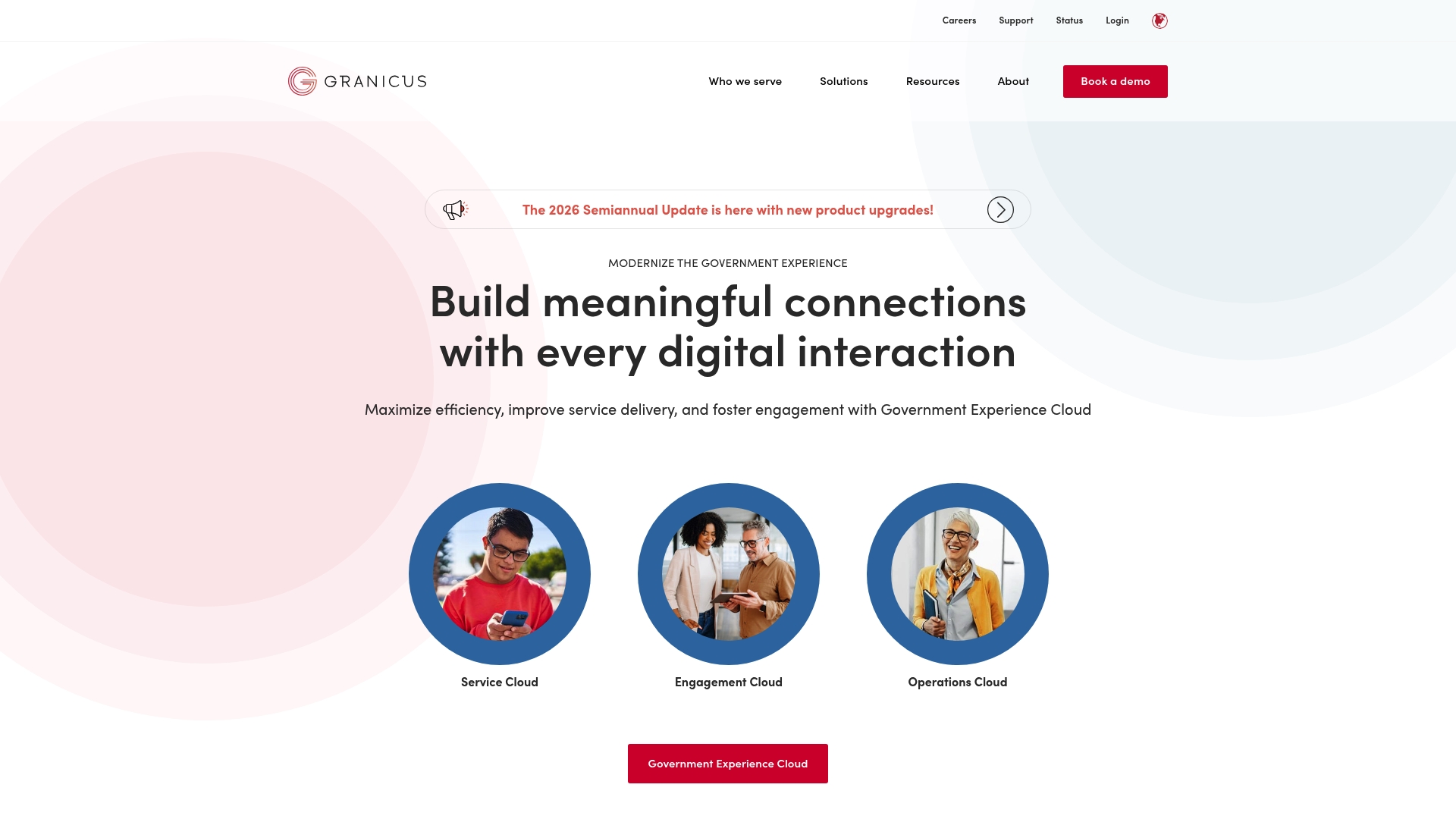
Granicus is a government technology suite focused on improving civic engagement and service delivery through cloud based products tailored for local and regional agencies. It combines citizen facing platforms with staff tools and an AI powered digital agent for self service support.
Core Features
Core features center on citizen engagement and operations with modules that cover digital experience, case management, and back office recovery.
- Government Experience Cloud for digital engagement and modernizing public websites.
- Service Cloud to manage resident requests and track satisfaction.
- Engagement Cloud for community interaction and meeting management.
- Operations Cloud to recover staff time and revenue.
- GXA an AI powered digital agent that provides 24/7 self service support.
Pros
- Comprehensive suite of government focused digital solutions provides multiple tools in one vendor relationship which simplifies procurement and integration.
- Tailored solutions for different government levels and functions allow customization for municipal, county, and state use cases.
- Strong emphasis on civic engagement helps agencies increase transparency and improve resident communication strategies.
- Global reach means experience supporting programs in multiple countries which can help larger agencies with multi jurisdiction needs.
- Integration of AI technology through GXA introduces automated citizen support that lowers routine workload for staff.
Cons
- Website content does not specify pricing details which makes budgeting and procurement planning difficult for decision makers.
- Specific customer reviews or detailed case studies are not provided in the content which limits independent validation of outcomes.
- The complexity of multiple product offerings may require substantial onboarding and change management resources from the agency.
Who It’s For
Granicus is designed for government agencies and officials pursuing digital transformation to improve engagement, transparency, and operational efficiency. IT leaders, communications directors, and service delivery teams seeking an integrated civic engagement platform will find the product directly relevant.
Unique Value Proposition
The platform bundles citizen experience tools with operational recovery and an AI powered assistant into a single vendor ecosystem. That combination lets agencies standardize digital services and measure both public engagement and internal performance from one suite.
Real World Use Case
The City of Olathe implemented the Government Experience Cloud to modernize operations, increase transparency, and support data driven decision making. That deployment illustrates how the suite can connect resident engagement with internal workflows.
Pricing
Not specified in the provided content. Agencies will need to contact Granicus for custom pricing, licensing models, and enterprise quotes during procurement discussions.
Website: https://granicus.com
Accenture
At a Glance
Accenture is a global professional services firm that combines strategy, consulting, digital engineering, and operations to help large organizations transform. Its depth across technology and industry expertise makes it a go to partner for complex, enterprise scale projects.
Core Features
Accenture offers broad capabilities including Cloud, Cybersecurity, Data and Artificial Intelligence, and Digital Engineering alongside industry specific solutions for Banking, Healthcare, Energy, Public Service, and Retail. The site also houses research and perspectives that support strategic decision making for leaders.
Pros
-
Comprehensive service coverage: Accenture provides a wide range of services that span strategy, technology, and operations which reduces the need to coordinate multiple vendors.
-
Strong research and thought leadership: The company publishes reports and perspectives that help decision makers align initiatives with current trends and evidence based guidance.
-
Global presence with local reach: Localized content and country specific sites make it easier for regional teams to access relevant services and compliance information.
-
Industry recognition: Awards and leadership mentions validate market credibility when you evaluate potential partners for major programs.
-
Career and talent depth: The careers and professional development focus indicate strong internal talent pipelines that clients can leverage on long term engagements.
Cons
-
Complex website structure: The volume of content and navigation paths can overwhelm new visitors who seek concise service descriptions and clear contact points.
-
Heavy content can slow performance: Large reports and multimedia resources create heavy content loads that may slow page load times for users on constrained networks.
-
Corporate focus may limit accessibility: Information is primarily oriented to corporate clients and professionals which can make it harder for smaller public agencies to find tailored, entry level offerings.
Who It’s For
Accenture is best for corporate decision makers, agency leaders, and industry executives who need a single partner for enterprise scale digital transformation and strategic technology programs. It fits organizations that require deep industry expertise and global delivery capability.
Unique Value Proposition
Accenture combines broad functional capabilities with industry specific solutions and extensive research to connect strategy with implementation. For agencies facing multifaceted technical and organizational change, that single vendor model simplifies governance and accountability.
Real World Use Case
A Healthcare organization partnered with Accenture to deploy AI powered health solutions and to redesign digital health records management. The engagement combined clinical transformation strategy, technology integration, and change management across hospital networks.
Pricing
Pricing is not listed on the site and is typically custom based on client scope, scale, and delivery model. Expect proposals that reflect enterprise level engagement and tailored statements of work.
Website: https://accenture.com
Microsoft
At a Glance
Microsoft offers a broad technology ecosystem that spans Microsoft 365, Azure, Windows, Surface devices, and developer tools. For government agencies seeking a single vendor for productivity, cloud, and endpoint solutions, Microsoft delivers depth and integration across those areas.
Core Features
Microsoft provides a wide range of capabilities from cloud computing with Azure to the Microsoft 365 suite for collaboration and the Windows operating system for endpoint management. The platform also includes Dynamics 365 and Power Platform for enterprise processes, developer tooling such as Visual Studio and .NET, plus education resources.
Pros
-
Extensive product ecosystem covering consumer and enterprise needs, which lets agencies consolidate vendors and simplify procurement.
-
Strong presence in both hardware and software sectors, enabling tighter integration between Surface devices and Windows management tools.
-
Innovative cloud services and AI integrations that support advanced analytics, identity management, and compliance tooling for regulated environments.
-
Global support and community networks that provide documentation, partner programs, and third party services for implementation and training.
Cons
-
Complex product selection can be overwhelming for new users and procurement teams trying to match capabilities to policy requirements.
-
Pricing can be high for premium or enterprise products, which increases budget pressure for large deployments and long term licensing.
-
Some products have steep learning curves, requiring dedicated training time for IT staff and end users before full value is realized.
Who It’s For
Microsoft fits medium to large government agencies and public institutions that need an integrated stack for productivity, cloud infrastructure, identity, and device management. It also suits agencies with in house IT teams able to manage enterprise licensing and tailor services to regulatory needs.
Unique Value Proposition
Microsoft’s unique value lies in its integrated ecosystem that connects cloud services, productivity tools, developer platforms, and managed devices. That integration reduces friction between departments and supports unified security and governance across services familiar to many public sector teams.
Real World Use Case
A government department uses Azure for cloud hosting and scalable workloads, deploys Microsoft 365 to standardize collaboration and email, and issues Surface devices to field staff. The combined approach centralizes identity and policy enforcement while reducing custom integration work.
Pricing
Pricing varies widely depending on the product or service, with options ranging from free tiers to enterprise subscriptions and licenses. Agencies should plan for subscription and support costs and evaluate long term licensing versus total cost of ownership.
Website: https://microsoft.com
IBM
At a Glance
IBM delivers enterprise grade AI, cybersecurity, and hybrid cloud solutions designed for large government agencies and complex programs. Its deep research capabilities and global delivery model make it a reliable partner when you need proven security and data governance at scale.
Core Features
IBM combines threat intelligence and cybersecurity with enterprise AI and automation to protect and accelerate mission critical workflows. The platform also offers data management and governance, hybrid cloud management, and AI model development services for large datasets and regulated environments.
Pros
- Established cybersecurity reputation: IBM’s decades of security work translate into mature threat intelligence and incident response offerings that align with government security requirements.
- Broad enterprise AI capabilities: IBM provides tools for AI model development and analytics that handle large, regulated datasets used in public sector operations.
- Global presence and expertise: IBM’s worldwide delivery network and industry experience simplify multijurisdictional projects and compliance across regions.
- High quality research and insights: IBM Research and published reports supply evidence based guidance that helps justify investment decisions to stakeholders.
- Strong industry partnerships: Collaborations with major organizations demonstrate IBM’s ability to integrate with large enterprise software and platform ecosystems.
Cons
- The complexity of IBM’s solutions often requires specialized internal skills or long term consulting engagement to fully implement and operate them.
- Pricing is typically customized and not listed openly which makes early budget planning and procurement comparisons more difficult for procurement teams.
- Large scale deployments can involve significant investment in licensing, infrastructure, and professional services which may strain limited government budgets.
Who It’s For
IBM is best for large federal, state, or municipal agencies and prime contractors that manage sensitive data and require enterprise grade security and governance. You should consider IBM when your programs need scalable AI, strong compliance, and an experienced systems integrator.
Unique Value Proposition
IBM combines enterprise grade security, research driven AI expertise, and hybrid cloud management to support mission critical operations. That combination lets you modernize infrastructure while maintaining strict controls over data and model governance.
Real World Use Case
Ferrari used IBM to reimagine its mobile app and increase user engagement while Pfizer scaled SAP workloads using IBM Power solutions to process large healthcare datasets. Those examples show IBM’s ability to support both customer experience and heavy duty data processing needs.
Pricing
Pricing is customized based on the specific solutions and services selected which requires vendor engagement to obtain formal quotes. Ask for a written estimate that separates software, cloud infrastructure, and professional services to aid procurement reviews.
Website: https://ibm.com
DataRobot
At a Glance
DataRobot is an Enterprise AI Platform that bundles AI apps, agents, and tools to build operate and govern AI at scale. It targets large organizations that need strong AI governance and observability across complex environments.
Core Features
DataRobot combines AI Apps & Agents for department specific use cases with an enterprise suite that emphasizes AI Governance and Observability. The platform supports building operating and governing AI at scale and offers open source integrations and educational resources such as a demo center and webinars.
Pros
- Comprehensive suite: The product covers model development monitoring and governance so teams can move from prototypes to production within one platform.
- Industry recognition: DataRobot has received awards and analyst attention which validates its enterprise focus and technical maturity.
- Governance and observability: The platform provides explicit tools for compliance monitoring model performance and audit trails that government agencies require.
- Flexible deployment: DataRobot supports on premises cloud and hybrid deployments to match agency security and policy constraints.
- Partner co engineering: The platform supports co engineering with partners like NVIDIA and SAP which helps integrate high performance infrastructure and enterprise systems.
Cons
- Pricing clarity absent: Pricing is not specified on the website which makes budgeting and procurement planning harder for public agencies.
- Platform complexity: The breadth of modules and features can create a steep learning curve for teams that lack AI operations experience.
- Unclear service detail: The website does not provide clear information on specific customization or implementation services which complicates project scoping.
Who It’s For
DataRobot is suited for large enterprises and government agencies that need scalable governed and secure AI solutions with industry specific applications. It fits teams that have institutional data sources and an appetite to invest in governed productionization rather than ad hoc pilots.
Unique Value Proposition
DataRobot unifies model building deployment and governance into a single platform while offering integrations with open source projects and enterprise partners. That combination reduces the number of disconnected tools agencies must manage and centralizes compliance controls and monitoring.
Real World Use Case
A global energy company used DataRobot to automate forecasting by bringing together data from Snowflake SQL and S3 which accelerated deployment and improved operational efficiency. This example highlights the platform ability to integrate diverse data stores for production analytics.
Pricing
Pricing details are not specified on the website which means you will need to request a quote or a sales conversation to obtain licensing and hosting cost estimates.
Website: https://datarobot.com
AI-Powered Solutions for Government Agencies Comparison
Explore and compare leading platforms delivering AI-driven solutions tailored for government and agency applications.
| Platform | Core Features | Pros | Pricing | Ideal For |
|---|---|---|---|---|
| AI Ritual | Consulting-first, Geo search optimization, Deployment focus | Sector-specific, ROI-focused, Local engagement | Tailored, Free strategy session | Agencies seeking outcome-oriented implementations |
| Granicus | Civic engagement suite, Workflow integration | Comprehensive tools, Transparency enhancement, AI agent for self-service support | Custom quotes | Agencies transforming digital and community interaction |
| Accenture | Enterprise consulting, Strategic and local deployment | Comprehensive coverage, Research-driven, Industry-recognized | Tailored enterprise-level proposals | Large-scale programs requiring strategic transformation |
| Microsoft | Productivity systems, Azure cloud computing, Endpoint tools | Integrated ecosystem, Familiar offerings, Advanced services | Flexible across products and tiers | Agencies consolidating cloud and collaborative solutions |
| IBM | AI and Automation for data protection and workflows | Cybersecurity expertise, Observability focus, Open-source integration | Tailored proposals | Agencies modernizing sensitive data operations |
| DataRobot | Model governance, AI for operational efficiency | Comprehensive observability, Streamlined productionization, Flexible deployment | Custom pricing | Large agencies scaling governed AI applications |
Unlock Government AI Success with Tailored Solutions
Government agencies face unique challenges when moving from pilot AI projects to impactful, measurable outcomes. You need AI strategies that align with compliance and policy, deliver faster citizen services, and demonstrate clear return on investment. This article highlights how leading AI solutions emphasize outcome-driven programs, seamless integration, and local, personalized support to cut through complexity and vendor fragmentation.
At AI Ritual, we specialize in exactly this approach by combining consultative strategy with hands-on deployments tailored for government operations. Explore our Uncategorized | Artificial Intelligence insights and attend Webinars | Artificial Intelligence to stay ahead with proven tactics for Generative Search Optimization and AI-powered citizen engagement. Don’t wait to overcome stalled AI pilots or complicated tech stacks. Visit AI Ritual today to schedule your free strategy session and start transforming government services with measurable, meaningful AI impact.
Frequently Asked Questions
What are the key AI solutions available for government agencies in 2026?
AI solutions for government agencies in 2026 include advanced Generative Search Optimization, AI Assistants for administrative automation, and tailored AI applications for specific sectors like Education and Healthcare. To explore these technologies, agencies should assess their operational needs and identify the solutions that align with their goals.
How can government agencies measure the impact of AI deployments?
Government agencies can measure the impact of AI deployments by establishing clear metrics and KPIs before implementation. Start by identifying key performance indicators related to citizen service delivery and internal efficiency to track changes over time.
What steps should agencies take to implement AI solutions effectively?
To implement AI solutions effectively, agencies should conduct a comprehensive needs assessment, followed by a pilot project to test the AI technology in a controlled environment. After gathering initial data, agencies can refine their approach and plan for full-scale deployment within 6–12 months.
How do I determine the right AI solution for my agency’s specific needs?
To determine the right AI solution, evaluate your agency’s priorities, such as improving citizen engagement or streamlining operations. List your specific requirements, and then research solutions that offer tailored features to meet those needs.
Are there any budget considerations for AI solutions in government agencies?
Yes, budget considerations are crucial when planning for AI solutions. Agencies should request tailored proposals from potential vendors to obtain clear pricing estimates that account for project scope, implementation costs, and ongoing maintenance within their budget cycles.
How can agencies ensure compliance when implementing AI technologies?
Agencies can ensure compliance by aligning their AI strategies with existing policies and regulations. Engage legal and compliance teams early in the process to identify requirements and implement monitoring systems that maintain governance throughout the deployment.
Recommended
- 7 Types of AI for Government: Boost Efficiency and Service | Artificial Intelligence
- 7 Types of AI-Powered Solutions for Local Government Success | Artificial Intelligence
- Why AI for Government Matters: Boosting Efficiency | Artificial Intelligence
- public services | Artificial Intelligence
- Role of AI in Agency Growth: Transforming Operations
Recent Comments