

Choosing the right path for digital transformation often starts with understanding how artificial intelligence can reshape business strategies. As organizations search for ways to balance efficiency with innovation, the shift toward AI consulting offers a practical framework for addressing complex challenges across diverse industries. Explore how integrating human expertise with advanced technologies empowers consultants and technology leaders to deliver dynamic solutions tailored to operational objectives.
Table of Contents
- AI Consulting Explained: Core Concepts And Definition
- Types Of AI Consulting Services For Organizations
- Key Roles And Responsibilities Of AI Consultants
- Practical Industry Use Cases And Solutions
- Risks, Challenges, And Common Pitfalls In AI Consulting
Key Takeaways
| Point | Details |
|---|---|
| AI Consulting Transforms Business | AI consulting leverages advanced technologies to enhance decision-making and optimize performance, shifting from traditional methods to data-driven approaches. |
| Diverse Service Categories | Key AI consulting services include strategic advisory, technological implementation, operational integration, and ethical compliance to meet specific organizational needs. |
| Hybrid Skill Sets Required | Effective AI consultants must combine technical expertise with business strategy and change management skills to navigate complex implementations. |
| Risks and Challenges | Organizations faced with ethical concerns, technological limitations, and resistance to change must develop comprehensive strategies to ensure responsible AI adoption. |
AI consulting explained: Core concepts and definition
AI consulting represents a transformative approach to strategic business problem-solving that leverages advanced artificial intelligence technologies to deliver actionable insights and optimize organizational performance. At its core, AI consulting involves helping businesses integrate intelligent technologies and data-driven strategies to enhance decision-making, streamline operations, and drive innovation.
The fundamental premise of AI consulting centers on transforming traditional consulting practices through strategic technological integration. Key characteristics of AI consulting include:
- Automating complex research and analytical tasks
- Enhancing data-driven decision-making processes
- Developing custom AI solutions tailored to specific business challenges
- Providing predictive insights using advanced machine learning algorithms
- Supporting organizational digital transformation strategies
AI consulting goes beyond traditional consulting by introducing a more dynamic, technology-enabled approach to solving business problems. Consultants now function as AI facilitators, bridging the gap between technological capabilities and strategic business objectives. This shift requires professionals to develop hybrid skills that combine deep technological understanding with strategic business acumen.
Here’s a summary of core differences between traditional consulting and AI-driven consulting models:
| Aspect | Traditional Consulting | AI-Driven Consulting |
|---|---|---|
| Approach | Human-led analysis | Data and technology-driven |
| Tools Used | Manual data processing | AI, machine learning algorithms |
| Speed of Insights | Slower, iterative | Accelerated, real-time |
| Type of Solutions | Standardized recommendations | Custom, adaptive AI solutions |
| Consultant Role | Subject matter expert | Hybrid tech-business facilitator |
Pro tip: Start by conducting a comprehensive AI readiness assessment to identify your organization’s specific technological needs and potential implementation challenges.
Types of AI consulting services for organizations
AI consulting services have evolved into a sophisticated ecosystem of specialized solutions designed to address complex organizational challenges across various domains. Consulting services now span strategic and operational dimensions, offering businesses targeted approaches to technological integration and digital transformation.
The primary categories of AI consulting services include:
- Strategic AI Advisory Services
- AI strategy development and roadmapping
- Technology maturity assessment
- Digital transformation planning
- Technological Implementation Services
- Custom AI solution design
- Machine learning model development
- Data infrastructure optimization
- Operational AI Integration
- Process automation consulting
- AI workflow redesign
- Performance optimization strategies
- Ethical and Compliance Consulting
- AI governance frameworks
- Regulatory compliance guidance
- Algorithmic bias detection and mitigation
Each service type addresses unique organizational needs, helping businesses navigate the complex landscape of artificial intelligence adoption. AI consultants function as critical translators, bridging technological capabilities with strategic business objectives. They provide nuanced guidance that goes beyond traditional technological implementation, focusing on holistic organizational transformation.
The most advanced AI consulting services now emphasize not just technological integration but also building comprehensive AI capabilities within organizations. This involves training internal teams, developing sustainable AI governance models, and creating adaptive strategies that can evolve with emerging technological trends.
Pro tip: Prioritize consultants who offer end-to-end services, from initial strategy development through implementation and ongoing optimization.
Key roles and responsibilities of AI consultants
AI consultants are transforming traditional consulting frameworks by developing sophisticated roles that blend technological expertise with strategic business insight. These professionals have evolved beyond traditional consulting models, becoming critical architects of organizational digital transformation.
The key roles of AI consultants include:
- AI Strategy Architects
- Develop comprehensive AI roadmaps
- Align technological capabilities with business objectives
- Assess organizational AI readiness
- Technology Integration Specialists
- Design custom AI solution frameworks
- Implement machine learning models
- Optimize data infrastructure
- Ethical AI Governance Experts
- Create AI governance frameworks
- Mitigate algorithmic bias
- Ensure regulatory compliance
- Change Management Leaders
- Train internal teams on AI technologies
- Facilitate organizational culture shifts
- Support technological adoption strategies
AI consultants serve as critical translators between complex technological capabilities and practical business applications. They possess a unique hybrid skill set that combines deep technical understanding with strategic business acumen, enabling them to design tailored AI solutions that address specific organizational challenges.

The most advanced AI consultants go beyond traditional implementation, focusing on building sustainable AI capabilities within organizations. This involves creating adaptive strategies, developing internal AI literacy, and establishing frameworks that allow businesses to continuously evolve their technological approaches.
Pro tip: Develop a multidisciplinary skill set that combines technical knowledge, business strategy, and change management expertise to become an effective AI consultant.
Practical industry use cases and solutions
AI consulting solutions are revolutionizing multiple industries by delivering targeted technological interventions that address complex organizational challenges. These practical applications demonstrate the transformative potential of artificial intelligence across diverse business environments.
Industry-specific AI consulting solutions include:
- Financial Services
- Fraud detection algorithms
- Risk management predictive models
- Automated investment portfolio optimization
- Healthcare
- Patient diagnostic support systems
- Personalized treatment recommendation engines
- Operational efficiency optimization
- Manufacturing
- Predictive equipment maintenance
- Supply chain optimization
- Quality control automation
- Retail
- Customer behavior prediction
- Personalized marketing strategies
- Inventory management optimization
AI consulting enables organizations to transform complex technological challenges into strategic advantages. By developing custom solutions that address specific industry pain points, consultants help businesses unlock unprecedented levels of operational efficiency and innovation.
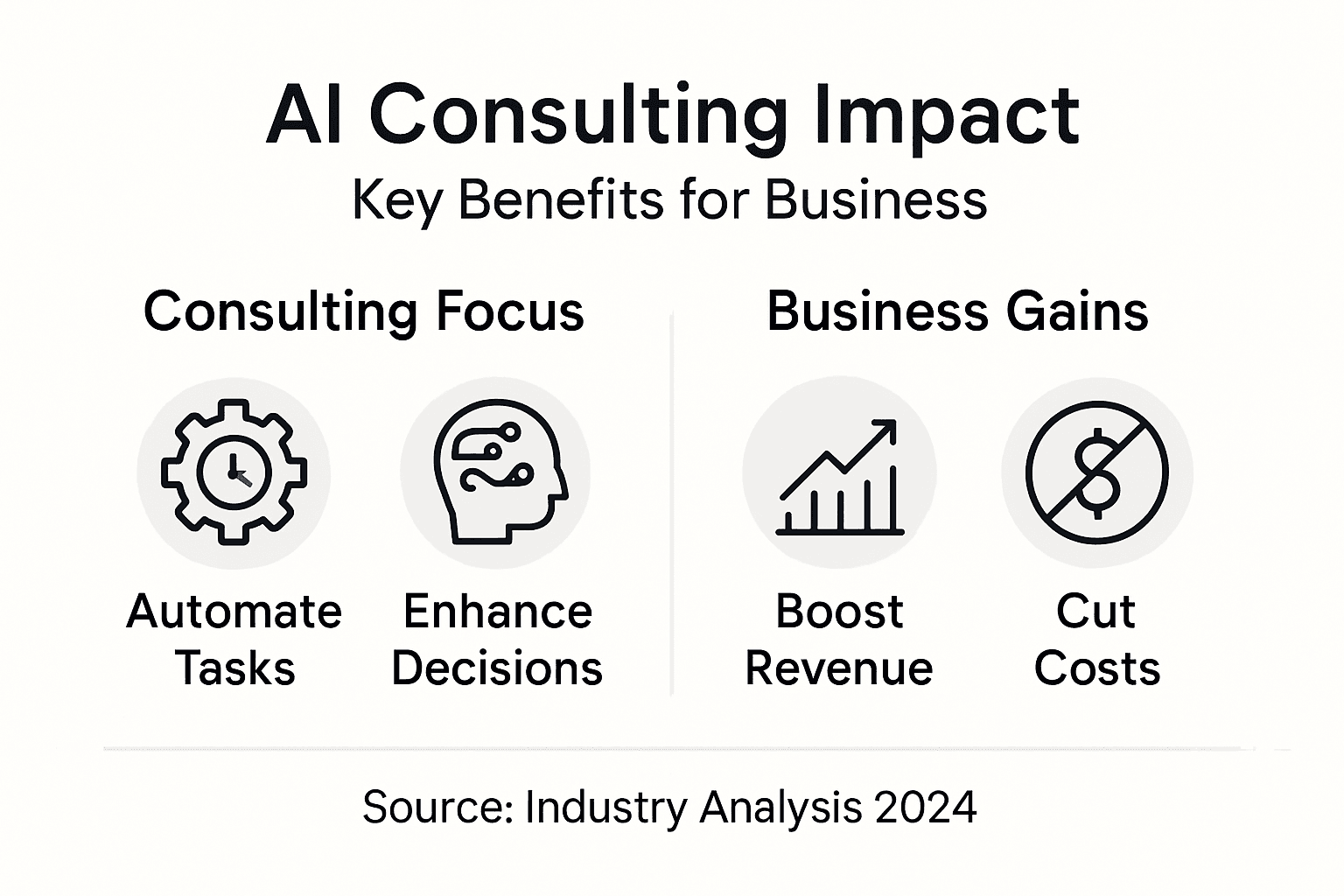
The following table compares how AI consulting impacts major industries:
| Industry | Key Benefit | Typical AI Consulting Outcome |
|---|---|---|
| Financial | Enhanced fraud detection | Automated risk analysis |
| Healthcare | Improved diagnostics | Faster patient care decisions |
| Manufacturing | Predictive maintenance | Reduced equipment downtime |
| Retail | Personalized marketing | Boosted sales through insights |
The most advanced AI consulting approaches focus on creating adaptive technological ecosystems that can evolve alongside emerging business needs. This involves developing flexible frameworks that integrate seamlessly with existing organizational infrastructure, ensuring continuous technological relevance and competitive positioning.
Pro tip: Prioritize AI solutions that offer scalable, industry-specific customization rather than generic technological implementations.
Risks, challenges, and common pitfalls in AI consulting
Ethical risks remain paramount in AI consulting frameworks that demand rigorous governance and strategic management. Understanding these challenges is crucial for organizations seeking responsible and effective artificial intelligence integration.
Key risks and challenges in AI consulting include:
- Technological Limitations
- Algorithmic bias and fairness concerns
- Unpredictable AI behavior
- Limited contextual understanding
- Organizational Challenges
- Workforce resistance to change
- Skills and talent gap
- Complex technology integration
- Ethical Considerations
- Data privacy vulnerabilities
- Transparency and explainability issues
- Potential unintended consequences
- Implementation Risks
- High initial investment costs
- Performance inconsistency
- Scalability constraints
AI consulting requires a nuanced approach that balances technological innovation with human judgment. Organizations must develop comprehensive strategies that anticipate potential risks and create robust mitigation frameworks to ensure responsible AI adoption.
The most sophisticated AI consulting practices emphasize continuous ethical monitoring and adaptive governance models. This involves developing flexible frameworks that can rapidly identify and address emerging technological and ethical challenges, ensuring that AI solutions remain aligned with organizational values and societal expectations.
Pro tip: Establish a dedicated AI ethics review board to proactively identify and mitigate potential risks before full-scale implementation.
Unlock the Full Potential of AI Consulting for Your Business
Understanding the challenges of integrating AI into your organization is the first step to achieving successful digital transformation. This article highlights common pain points such as bridging the gap between technology and business goals, overcoming organizational resistance, and navigating ethical considerations. At airitual.com, we specialize in turning these obstacles into opportunities by offering tailored AI consulting solutions that align with your unique industry needs and strategic objectives.
Explore how our expert team acts as a bridge between advanced AI technologies and practical business applications. We provide comprehensive services, from AI strategy development and custom solution design to change management and ethical governance. Ready to accelerate your AI journey with actionable insights and scalable, adaptive tools Start learning with our Webinars | Artificial Intelligence and deepen your expertise through targeted Classes | Artificial Intelligence. You can also explore broader AI solutions designed to meet diverse challenges in our Uncategorized | Artificial Intelligence section. Take the next step toward transformative AI integration with a free consult at airitual.com today.
Frequently Asked Questions
What is AI consulting?
AI consulting is a strategic approach that helps businesses integrate artificial intelligence technologies and data-driven strategies to enhance decision-making, streamline operations, and drive innovation.
How does AI consulting differ from traditional consulting?
AI consulting is data and technology-driven, automating complex research and analysis, whereas traditional consulting relies more on manual processes and human-led analysis.
What types of services do AI consultants provide?
AI consultants offer various services, including strategic AI advisory, technological implementation, operational AI integration, and ethical compliance consulting to address unique organizational challenges.
What are some common risks associated with AI consulting?
Common risks include algorithmic bias, workforce resistance to change, data privacy vulnerabilities, and scalability constraints, which organizations must proactively manage during AI adoption.
Recommended
- What Is Artificial Intelligence and Why It Matters | Artificial Intelligence
- AI Powered Customer Engagement for Retail Success | Artificial Intelligence
- Cloud-Based AI: Transforming Business Efficiency | Artificial Intelligence
- AI Strategy Guide for SMEs: Boost Efficiency Step-by-Step | Artificial Intelligence
Recent Comments