

TL;DR:
- AI tools in schools improve personalized learning and operational efficiency significantly.
- Risks include weakening critical thinking, equity issues, and teacher unpreparedness.
- Successful implementation requires clear goals, staff training, and equity-focused vendor vetting.
AI is spreading through schools faster than most administrators expected, and the numbers tell a striking story. 85% of teachers and 86% of students now use AI tools regularly, yet only 48% of teachers have received any formal training on them. That gap matters. Adoption without preparation creates real risks. This guide cuts through the noise to give you evidence-based benefits, honest risks, and actionable strategies so your school can make informed, confident decisions about AI-driven edtech solutions.
Table of Contents
- How edtech solutions personalize learning and boost results
- Operational efficiency: Beyond the classroom impact
- Risks to consider: Over-reliance, equity, and teacher readiness
- Making edtech work: Implementation strategies for schools
- A fresh perspective: Rethinking the ‘why’ behind edtech adoption
- Take your next steps with proven AI integration resources
- Frequently asked questions
Key Takeaways
| Point | Details |
|---|---|
| Personalized learning impact | AI-powered edtech platforms can boost student outcomes by up to 25% through adaptive, individualized instruction. |
| Operational efficiencies | Adopting edtech streamlines scheduling and resource allocation, reducing administrative workload and costs. |
| Implementation risks | Without proper planning, rapid adoption can exacerbate skill gaps, bias, and equity issues in schools. |
| Strategic rollout matters | Success depends on teacher training, human-centered technology design, and clear alignment with school goals. |
How edtech solutions personalize learning and boost results
With the stage set on the widespread use of AI in education, let’s explore what makes edtech fundamentally transformative for student learning outcomes.
Adaptive learning platforms are the engine behind personalized instruction. These systems use a technique called knowledge tracing, which maps what each student knows and identifies gaps in real time. Based on that map, the platform adjusts the sequence of lessons, the difficulty of questions, and the type of feedback delivered. Every student moves at their own pace, on their own path.
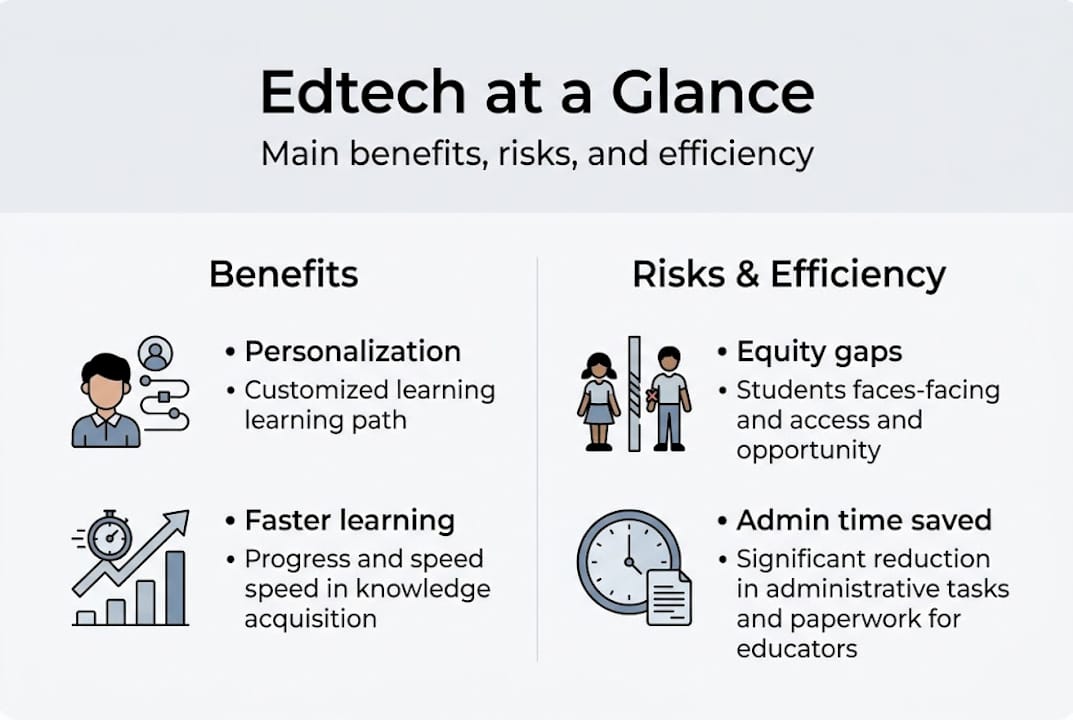
Intelligent Tutoring Systems improve learning outcomes by 12 to 25% through personalized paths, adaptive sequencing, and real-time feedback. That is not a marginal gain. For a district managing hundreds or thousands of students, a 25% improvement in achievement represents a significant shift in outcomes at scale.
Here is a clear comparison of how traditional instruction stacks up against AI-powered personalization:
| Feature | Traditional instruction | AI-powered personalization |
|---|---|---|
| Pacing | Fixed for the class | Individualized per student |
| Feedback | Delayed, often weekly | Immediate, per response |
| Content sequencing | Predetermined | Dynamically adjusted |
| At-risk identification | Teacher observation | Automated, data-driven |
| Engagement tracking | Manual | Continuous and automated |
The practical benefits extend beyond test scores. Students who receive immediate feedback are more likely to correct misconceptions before they become entrenched. Teachers gain data dashboards that surface which concepts are causing the most difficulty across the class, allowing them to focus direct instruction where it is needed most.
Key benefits of AI-powered personalized learning include:
- Reduced time-on-task for mastered concepts, freeing students to advance
- Increased student motivation through achievable challenge levels
- Stronger alignment between generative AI for curriculum design and individual learning needs
- Better data for teacher-parent communication
These gains are most visible when platforms are configured with clear pedagogical goals, not just deployed as a general tool.
Pro Tip: Before selecting an Intelligent Tutoring System, map it directly to your curriculum standards and learning objectives. Platforms aligned with your pedagogical framework consistently outperform those used as standalone supplements. Review the research on AI-powered tools’ education outcomes to identify what alignment criteria matter most.
Operational efficiency: Beyond the classroom impact
After seeing the direct academic impact, consider how these systems transform day-to-day school operations.
AI does not just help students learn faster. It also helps schools run better. Routine administrative tasks, including scheduling, resource allocation, attendance tracking, and staff communication, consume enormous amounts of staff time. AI automates many of these processes with greater accuracy and speed than manual methods allow.

Adaptive learning platforms and predictive analytics lower dropout rates by 20 to 30% and improve operational efficiency in areas like scheduling by up to 30%. That scheduling improvement alone can free dozens of administrative hours each semester.
Here is how operational performance shifts with AI integration:
| Operational area | Without AI | With AI |
|---|---|---|
| Scheduling accuracy | Manual, error-prone | Automated, optimized |
| Dropout early warning | Reactive | Proactive, predictive |
| Resource allocation | Based on estimates | Data-informed |
| Attendance tracking | Manual entry | Automated flagging |
| Staff workload | High administrative burden | Reduced, focused on students |
Predictive analytics is particularly powerful for student retention. These systems analyze attendance patterns, grade trends, and engagement signals to flag students who are drifting toward disengagement. Counselors and teachers receive alerts early enough to intervene, rather than discovering problems after a student has already withdrawn.
Operational AI benefits your team can act on now:
- Automated attendance reporting reduces manual data entry errors
- AI scheduling tools balance teacher loads and room availability simultaneously
- Predictive dashboards support AI-powered student engagement strategies at scale
- Resource planning becomes more precise, reducing waste in supply and staffing
Pro Tip: When integrating AI operational tools, connect them to your existing student information system from day one. Isolated tools create data silos. Integrated systems amplify efficiency gains across every department simultaneously.
Risks to consider: Over-reliance, equity, and teacher readiness
While benefits are clear, responsible leaders must recognize and address the risks of rapid edtech adoption.
Not every outcome of AI adoption is positive, and the risks deserve the same honest attention as the benefits. The most significant concern is metacognitive skill weakening. When students use AI tools without structured guidance, they may stop practicing the thinking skills that lead to deep learning. They get the answer, but miss the reasoning process.
“GenAI boosts institutional operations and assessment design, but requires pedagogical intent to avoid metacognitive laziness.” OECD Digital Education Outlook 2026
Equity is a second major concern. Bias in under-resourced districts leads to weaker privacy protections, less effective training, and over-reliance on unstructured AI use that can harm cognitive development. Schools with fewer resources often adopt AI tools without the infrastructure or support needed to use them well.
Teacher readiness is the third challenge. With only 48% of teachers trained on the AI tools already in their classrooms, the gap between deployment and preparation is wide. Technology without training is technology without impact.
Risks that administrators must actively manage:
- Students bypassing critical thinking by outsourcing reasoning to AI
- Algorithmic bias producing unequal outcomes across student populations
- Inadequate data privacy protections in lower-resourced settings
- Staff resistance due to insufficient onboarding and support
Here are concrete mitigation strategies you can implement:
- Require pedagogical intent documentation before any AI tool is approved for classroom use
- Conduct an equity audit of every proposed platform, focusing on performance across demographic groups
- Build a teacher training program before rollout, not after, using a structured AI implementation guide
- Set clear policies on appropriate versus inappropriate AI use for students
- Review the future of AI in schools to anticipate emerging risks before they arrive
- Use an AI for education checklist to vet vendors against your school’s specific needs and values
Making edtech work: Implementation strategies for schools
With risks in view, schools can take specific steps to ensure their edtech investments deliver lasting value.
Successful edtech implementation starts with a clear answer to one question: what specific problem are we solving? Schools that adopt AI because it is trending rarely achieve lasting results. Schools that adopt AI to address a defined gap in student outcomes or operational capacity consistently see stronger returns.
Optimists see workload relief and personalization benefits, while skeptics warn that risks outweigh benefits without human-centered design and an equity focus. Both perspectives are valid, and the best implementations account for both.
Follow these steps to align technology with your school’s goals:
- Define measurable outcomes before selecting any platform, such as a 15% improvement in reading proficiency or a 20% reduction in scheduling errors
- Involve teachers, counselors, and parents in the selection process from the beginning
- Pilot with a single grade level or department before scaling district-wide
- Build a professional development calendar that treats AI training as ongoing, not a one-time event
- Establish a feedback loop so educators can report what is and is not working in real classrooms
- Review your AI adoption guide to structure your rollout with proven frameworks
When vetting AI vendors, apply these criteria:
- Transparent data privacy policies that comply with FERPA and COPPA
- Evidence of efficacy from peer-reviewed studies or comparable school districts
- Clear onboarding and ongoing support commitments
- Customization options that align with your curriculum standards
- Demonstrated performance across diverse student populations
Pro Tip: Involve educators in vendor demos before any contract is signed. Teachers who participate in the selection process are significantly more likely to adopt and champion the tools in their classrooms. Their practical feedback also surfaces usability issues that administrators often miss from a distance.
A fresh perspective: Rethinking the ‘why’ behind edtech adoption
Conventional wisdom in education technology treats increased adoption as a sign of progress. More tools, more integration, more data. But this framing can mislead even experienced administrators.
The schools we see achieving real, sustained improvement with AI are not the ones with the most platforms. They are the ones that started with the hardest internal questions: Are our teachers supported? Are our equity gaps acknowledged? Is our community ready for this change?
Rapid scale-up without culture change is one of the most common reasons edtech investments stall. A platform can be technically excellent and still fail if teachers feel it was imposed on them or if students lack the digital literacy to use it responsibly. The uncomfortable truth is that technology adoption often reveals organizational gaps that were already there.
Lasting improvement depends on treating AI as a tool in service of a human-centered mission, not as the mission itself. If you are building your edtech strategy, start by reading through our guidance on implementing AI in education to ground your approach in that principle from the start.
Take your next steps with proven AI integration resources
If you are ready to turn insight into action, the resources below are built specifically for education leaders navigating AI adoption. Our AI integration best practices guide walks you through the frameworks that consistently produce measurable results in both learning outcomes and operational efficiency. For a structured rollout plan, the AI implementation guide provides step-by-step direction tailored to school environments. And if you want a broader view of what is possible, explore our full suite of AI for education solutions designed to meet schools where they are and scale with their goals.
Frequently asked questions
What are the main benefits of using edtech in schools?
The main benefits include personalized learning paths, stronger student engagement, and measurable outcome improvements. Intelligent Tutoring Systems consistently improve learning outcomes by 12 to 25%, alongside operational gains like smarter scheduling.
Can AI-driven edtech help reduce dropout rates?
Yes. Predictive analytics lower dropout rates by 20 to 30% by identifying at-risk students early and enabling timely, targeted intervention from counselors and teachers.
What are the risks of widespread AI adoption in education?
Key risks include weakened critical thinking skills, algorithmic bias, and insufficient teacher preparation. Only 48% of teachers have been trained on the AI tools already in use, creating a significant readiness gap.
How can schools choose the right edtech solutions?
Schools should align tool selection with specific learning or operational goals and prioritize vendor transparency on data privacy. Pedagogical intent must guide every adoption decision to avoid surface-level implementation that produces no lasting change.
Recommended
- Edtech adoption tips: 5 proven strategies for schools | Artificial Intelligence
- Why use education automation to boost efficiency | Artificial Intelligence
- Defining AI-Powered Tools: Impact on Education Outcomes | Artificial Intelligence
- Educational AI Adoption Guide for Effective Integration | Artificial Intelligence
Recent Comments