

TL;DR:
- AI adoption involves integrating data-driven tools into existing processes to automate tasks and improve insights.
- Organizations report significant efficiency gains, cost reductions, and enhanced customer engagement through AI.
- Success relies on strategic planning, phased implementation, and strong change management, not just technology investment.
Most business leaders assume AI adoption requires a massive budget, a dedicated data science team, and months of disruption. That assumption is holding organizations back. The reality is that AI has become far more accessible, modular, and results-focused than it was even three years ago. Whether you lead a regional retailer, a mid-sized manufacturer, or a public agency, the tools available today are designed to integrate with your existing workflows rather than replace them entirely. This guide covers what AI adoption actually means in practice, the measurable benefits it delivers, how it reshapes customer engagement, and the implementation strategies that minimize risk while maximizing return.
Table of Contents
- Understanding AI adoption: What it really means
- The business case: Core benefits of AI adoption
- AI’s impact on customer engagement and experience
- Overcoming challenges: Implementation strategies that work
- Why most organizations get AI adoption backwards — and what actually works
- Unlock your AI advantage with the right partner
- Frequently asked questions
Key Takeaways
| Point | Details |
|---|---|
| AI adoption demystified | Modern AI tools are accessible and valuable for businesses of all sizes. |
| Efficiency and ROI boost | AI delivers significant efficiency gains and measurable returns on investment. |
| Customer engagement upgrade | Personalized AI offerings can dramatically improve customer interactions. |
| Success requires strategy | Phased, people-centric rollouts work better than technology-first approaches. |
Understanding AI adoption: What it really means
AI adoption is not about replacing your workforce with robots or rebuilding your technology infrastructure from scratch. At its core, AI adoption means integrating intelligent, data-driven tools into your existing business processes to automate repetitive tasks, surface better insights, and improve decision-making speed. It is a strategic shift, not a one-time technology purchase.
One of the most persistent myths is that AI is only viable for large enterprises with deep pockets and specialized teams. That is simply no longer true. AI is not just for tech giants; small businesses are increasingly adopting AI tools to compete with larger players, streamline operations, and serve customers more effectively. Platforms like AI-powered scheduling tools, automated customer service systems, and predictive inventory software are now available at price points that work for businesses of all sizes.
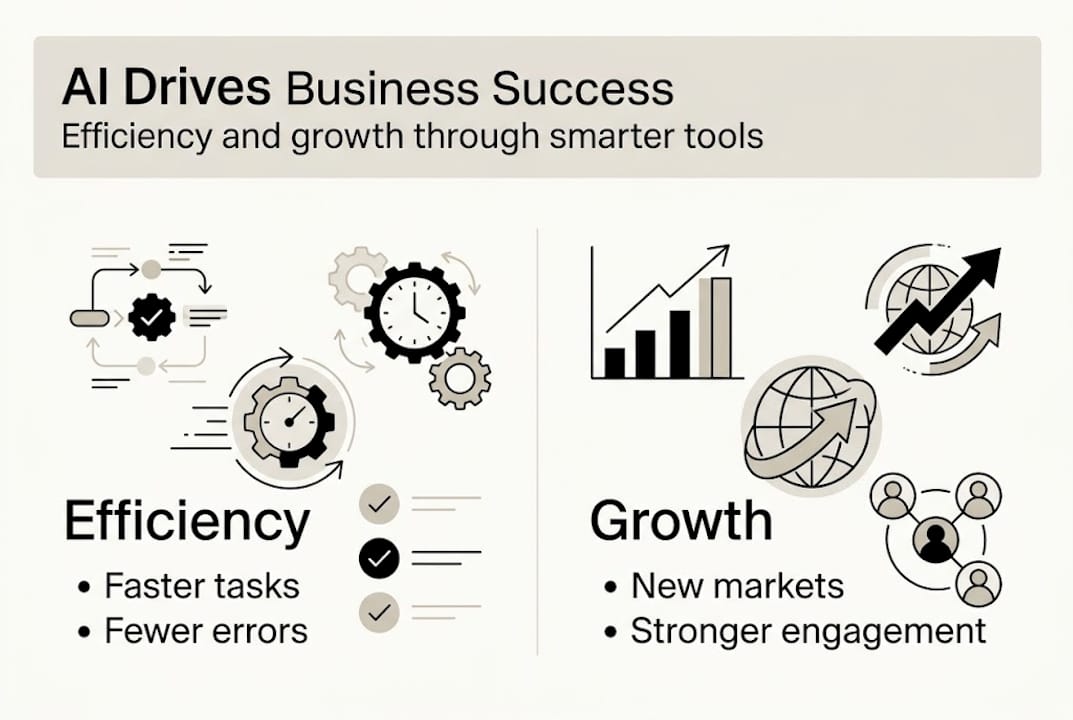
Another common misconception is that AI adoption requires perfect, clean data before you can begin. While data quality matters, most modern AI tools are designed to work with the messy, real-world data that organizations already have, improving over time as they process more inputs.
Here is a look at where businesses are applying AI right now:
- Customer service automation: Chatbots and virtual assistants handle routine inquiries 24/7, freeing staff for higher-value interactions
- Predictive analytics: AI models forecast demand, identify churn risk, and surface sales opportunities before they become obvious
- Process automation: Repetitive back-office tasks like invoice processing, scheduling, and data entry are automated with minimal setup
- Content and marketing personalization: AI tailors messaging and product recommendations to individual customer behavior
- Operational monitoring: AI flags equipment issues, supply chain disruptions, or compliance gaps in real time
“The question is no longer whether your organization should adopt AI. The question is how quickly you can do it strategically, without creating more complexity than you solve.”
For practical guidance on where to begin, exploring AI integration tips can help you identify the highest-impact entry points for your specific business context.
The business case: Core benefits of AI adoption
Understanding what AI adoption means provides context for the specific business benefits you can unlock. The numbers here are not speculative. Organizations across sectors are reporting measurable gains in efficiency, cost reduction, and revenue growth.
One of the most striking data points comes from the public sector. AI adoption can offer up to 527% ROI for public sector organizations, a figure that reflects both direct cost savings and the compounding value of faster, better-informed decisions. Private sector results are similarly compelling, with companies reporting significant reductions in manual processing time and customer service costs within the first year of deployment.
| Business area | Before AI | After AI adoption |
|---|---|---|
| Customer support response time | 6 to 24 hours | Under 2 minutes |
| Invoice processing time | 3 to 5 days | Same day |
| Lead conversion rate | Industry average | Up to 30% improvement |
| Operational error rate | Baseline | Reduced by up to 40% |
| Employee time on manual tasks | 60% of workday | Reduced to under 20% |
Beyond the table, the strategic value compounds over time. AI workflow optimization allows teams to redirect energy from repetitive tasks toward creative problem-solving, strategic planning, and customer relationship building. That shift alone changes how organizations compete.
Cost reduction is another major driver. Automated workflows reduce headcount requirements for low-skill tasks, lower error-related costs, and cut the time spent on rework. Customer satisfaction scores also tend to rise when AI reduces wait times and personalizes interactions.
Pro Tip: Focus your initial AI projects on the areas of your business with the highest volume of manual, repetitive work or the largest data sets. These areas produce the fastest, most visible wins and build internal confidence for broader rollout.
Understanding the strategic value of AI before committing to a specific platform or vendor helps you avoid the common trap of buying technology that solves the wrong problem.
AI’s impact on customer engagement and experience
If the business case for AI is clear, it is equally crucial to see how AI transforms the customer experience. Customers today expect fast, relevant, and personalized interactions. AI makes that expectation achievable at scale, even for organizations that do not have large customer experience teams.

AI tools enable personalized marketing and real-time support, allowing businesses to deliver the right message to the right customer at the right moment. That kind of precision was previously only possible for companies with massive marketing budgets. Now it is accessible through platforms that integrate directly with your CRM, email system, or e-commerce platform.
Here is how traditional and AI-driven engagement methods compare:
| Engagement factor | Traditional approach | AI-driven approach |
|---|---|---|
| Personalization | Segment-based, broad | Individual-level, real-time |
| Support availability | Business hours only | 24/7 via chatbot and automation |
| Response time | Hours to days | Seconds to minutes |
| Campaign targeting | Historical data, slow iteration | Predictive, continuously optimized |
| Customer feedback loop | Periodic surveys | Continuous, real-time analysis |
The measurable engagement gains organizations are seeing include:
- Higher customer retention rates driven by proactive, personalized outreach
- Faster issue resolution through AI-assisted support that routes and resolves common problems automatically
- Increased average order value from AI-powered product recommendations
- Improved Net Promoter Scores as response times and personalization improve
- Reduced churn through predictive models that identify at-risk customers before they leave
For organizations looking to go deeper on this topic, best AI integration practices outlines the specific frameworks that drive sustainable engagement improvements. You can also explore how boosting engagement with AI applies specifically to smaller business contexts.
Overcoming challenges: Implementation strategies that work
Once the advantages are apparent, next comes a roadmap for putting AI adoption into action. The most common reason AI projects stall is not technology failure. It is poor planning, unclear ownership, and underestimating the human side of change.
The three most frequent barriers organizations face are:
- Data quality and availability: Many organizations discover their data is fragmented, inconsistent, or incomplete when they begin an AI project
- Internal skills gaps: Teams may lack the technical knowledge to configure, manage, or interpret AI tools effectively
- Organizational resistance: Staff may fear job displacement or distrust AI-generated outputs, slowing adoption
Strategic, phased AI adoption reduces risk and maximizes results by giving teams time to learn, adjust, and build confidence at each stage.
Here is a proven implementation sequence:
- Audit your current workflows to identify the highest-friction, highest-volume processes that AI could improve
- Define clear success metrics before selecting any tool, so you can measure actual impact rather than assumed value
- Select a focused pilot project in one department or process area with a willing team and measurable outputs
- Train your team on the specific tool, its outputs, and how to interpret and act on AI-generated insights
- Measure and document results from the pilot, including time saved, errors reduced, and staff feedback
- Iterate and expand based on what worked, applying lessons learned to the next phase of rollout
Building internal buy-in is often the most underrated step. When cross-functional champions, people who understand both the business process and the AI tool, lead the pilot, adoption rates improve significantly. Their credibility with peers reduces resistance and accelerates learning.
Pro Tip: Start with a pilot project that has a clear before-and-after measurement. A visible win in 60 to 90 days builds the organizational confidence needed for larger investments.
For a structured approach tailored to smaller organizations, the SME AI strategy guide provides a practical framework that scales with your resources and goals.
Why most organizations get AI adoption backwards — and what actually works
Here is the uncomfortable truth we see repeatedly: organizations over-invest in selecting and purchasing AI tools while under-investing in the strategy and change management that determines whether those tools actually deliver value. The technology is rarely the limiting factor. The people and processes around it almost always are.
Most top-down AI rollouts fail not because the AI was wrong for the business, but because employees were not equipped, empowered, or motivated to use it effectively. Large, organization-wide deployments without phased learning cycles tend to generate confusion, workarounds, and eventual abandonment.
What consistently works is a people-first, phased approach. Identify cross-functional champions early. Give them real ownership of the pilot. Measure small wins publicly. Let success stories spread organically across teams. This approach builds the internal credibility that no vendor presentation can manufacture.
The organizations that get the most from AI are not the ones with the biggest budgets. They are the ones with the clearest strategy and the most engaged teams. Understanding the value of AI consulting before committing to a platform can make the difference between a costly experiment and a genuine competitive advantage.
Unlock your AI advantage with the right partner
Knowing what AI can do is one thing. Knowing how to implement it in a way that fits your organization’s specific workflows, culture, and goals is where most businesses need support. At AI Ritual, we work directly with business leaders to identify the right entry points, build phased implementation plans, and measure real outcomes. Whether you are just beginning to explore options or ready to scale an existing initiative, our resources are built for your context. Start with our guide to AI integration best practices or explore our AI integration tips to take the next step with confidence. Schedule a FREE Strategy Session today and see what targeted AI adoption can do for your organization.
Frequently asked questions
What are three main benefits of AI adoption for businesses?
AI adoption delivers improved operational efficiency, meaningful cost reduction, and stronger customer engagement. As AI drives efficiency and engagement, organizations gain a measurable competitive advantage across multiple business functions.
How can small businesses start adopting AI?
Small businesses should begin with a targeted pilot project in one high-friction workflow and use industry best-practice guides to avoid common mistakes. AI is accessible for all business sizes, and starting small reduces risk while building internal confidence.
What common challenges do businesses face with AI adoption?
The most frequent obstacles are poor data quality, internal skills gaps, and staff resistance to change. Addressing these early through training and phased rollout, as outlined in AI integration tips, significantly improves adoption success rates.
Is AI adoption only for large companies?
No. AI enables small business growth just as effectively as it supports enterprise operations, with many platforms specifically designed for smaller teams and tighter budgets.
Recommended
- How AI boosts efficiency and engagement in small business | Artificial Intelligence
- Essential AI integration tips to boost business success | Artificial Intelligence
- Role of AI in Operations – Transforming Efficiency for SMEs | Artificial Intelligence
- Why AI is essential for entrepreneurs in 2026 | Artificial Intelligence
- 10 Practical AI Use Cases for Small Businesses That the New Act Will Support
- Role of AI in Recruitment Agency Success | We Are Over The Moon
Recent Comments