

Disengaged customers cost businesses far more than most leaders realize. Research consistently shows that companies failing to deliver meaningful, personalized experiences lose revenue to competitors who do. The good news is that AI-driven customer engagement strategies are no longer reserved for enterprise giants with massive budgets. Whether you run a regional service business or a mid-market operation, the tools and frameworks now exist to measurably improve how customers interact with your brand, reduce service costs, and grow revenue at the same time. This guide walks you through every stage, from diagnosing the problem to scaling a strategy that delivers real results.
Table of Contents
- Understanding the challenge: Why engagement is slipping
- Essential foundations: Data, people, and culture
- Must-have tools and tactics for engagement optimization
- Step-by-step: How to implement and activate your AI engagement strategy
- Measure, refine, and scale: Sustaining high-impact engagement
- Unlock more value with expert AI engagement solutions
- Frequently asked questions
Key Takeaways
| Point | Details |
|---|---|
| Start with strong data | Unified and reliable customer data is the foundation of successful engagement optimization. |
| Leverage AI for scale | AI-powered tools enable personalized, omnichannel engagement with measurable business impact. |
| Pilot, measure, refine | Begin with pilots, link metrics to outcomes, and continuously improve using diverse feedback. |
| Balance innovation and remediation | Address customer pain points but also innovate to delight and differentiate your brand. |
Understanding the challenge: Why engagement is slipping
Customer engagement is the ongoing relationship between your business and your customers across every touchpoint, from the first ad they see to the tenth support call they make. Customer Experience, or CX, is the sum of those interactions and how customers feel about them. Both concepts sound simple, but executing them well has become genuinely difficult.
Expectations have accelerated faster than most organizations can adapt. Customers now expect instant responses, personalized recommendations, and seamless transitions between channels. When those expectations go unmet, they leave, and they tell others.
“NPS is declining in many industries, and only half of CX programs successfully link their measurements to actual business outcomes.” — Forrester
That gap between measurement and outcomes is the real problem. Many organizations track satisfaction scores without connecting them to revenue, churn, or lifetime value. The result is a lot of data and very little action.
Here is what is driving the engagement gap right now:
- Channel fragmentation: Customers move between social, email, chat, and phone, but most companies still manage these in silos.
- Generic messaging: Batch-and-blast communication no longer converts. Customers recognize and ignore it.
- Slow response cycles: Expectations for real-time interaction have risen sharply, and manual processes cannot keep pace.
- Measurement blind spots: As Forrester’s research shows, NPS alone does not tell you why customers are leaving or what would make them stay.
For practical ways to start closing this gap, the AI engagement tips resource covers foundational moves that work across industries.
Essential foundations: Data, people, and culture
Before you deploy a single AI tool, you need three things in place: clean data, aligned teams, and a culture that actually prioritizes the customer. Skip any one of these and your technology investment will underperform.
Data is the fuel. AI personalization only works when it has accurate, unified customer data to draw from. Fragmented records, duplicate profiles, and inconsistent data entry all produce poor recommendations and broken experiences. Auditing and consolidating your customer data is not glamorous work, but it is the single highest-leverage step you can take before going further.
Team alignment is the engine. Customer engagement is not a marketing problem or a support problem. It spans every department that touches the customer journey. When sales, marketing, product, and service teams operate from different playbooks, customers feel the friction. Building shared journey maps and common success metrics across teams removes that friction.
Culture determines sustainability. Customer-centric organizations that invest in deep customer knowledge and prioritize CX across their channels double their revenue growth compared to those that treat CX as a department rather than a company-wide value. That is not a marginal difference. It reflects how much leadership behavior and incentive structures shape frontline decisions every day.
Key foundations to build before scaling:
- Unified customer data platform or CRM with clean, deduplicated records
- Cross-functional journey mapping sessions that include frontline staff
- Leadership KPIs tied to customer outcomes, not just internal efficiency
- Regular feedback loops that surface customer signals to decision-makers quickly
- AI integration strategies that connect your existing systems before adding new ones
Pro Tip: Leadership buy-in accelerates everything. When executives visibly champion CX improvements and tie team incentives to customer outcomes, adoption of new tools and processes happens faster and sticks longer. Consider adding a CX metric to every department’s quarterly review.
Automating repetitive customer interactions through process automation also frees your team to focus on the high-value conversations that actually build loyalty.
Must-have tools and tactics for engagement optimization
With your foundation solid, the next step is selecting the right tools and mapping out your approach. The landscape is crowded, but the core requirements are consistent across industries.

According to Gartner’s CX research, organizations that adopt omnichannel approaches, customer journey mapping, and analytics see a 15 to 20% increase in sales conversion and a 20 to 50% decline in service costs. Those are not incremental gains. They represent a structural shift in how efficiently your business operates.
Here is a comparison of the core tools and what each one delivers:
| Tool or tactic | Primary benefit | Best for |
|---|---|---|
| Omnichannel platform | Unified customer view across channels | Mid-market and enterprise |
| AI-powered chatbot | 24/7 response, reduced support load | High-volume service teams |
| Journey mapping software | Visualize and fix friction points | All business sizes |
| Predictive analytics | Anticipate needs before customers ask | Retention-focused teams |
| Feedback collection tools | Real-time sentiment and NPS tracking | Any customer-facing team |
| Personalization engine | Tailored content and offers at scale | E-commerce and SaaS |
For a deeper look at CX tool trends, Gartner’s use-case analysis is worth reviewing before you finalize your stack.
How to deploy an AI-driven engagement tool step by step:
- Audit your current stack to identify gaps and redundancies before adding anything new.
- Define the specific outcome you want the tool to improve, whether that is first-response time, conversion rate, or churn reduction.
- Select a tool that integrates with your existing CRM and data systems without requiring a full rebuild.
- Run a controlled pilot with one customer segment or one channel before full rollout.
- Train your team on how the tool works and what it cannot do, so they can intervene when needed.
- Set baseline metrics before launch so you can measure actual impact, not just activity.
The customer engagement essentials guide and the small business engagement resource both offer practical examples of this process applied to real business contexts.
Step-by-step: How to implement and activate your AI engagement strategy
Knowing what tools to use is different from knowing how to roll them out without disrupting your operations or frustrating your customers. Sequencing matters enormously here.
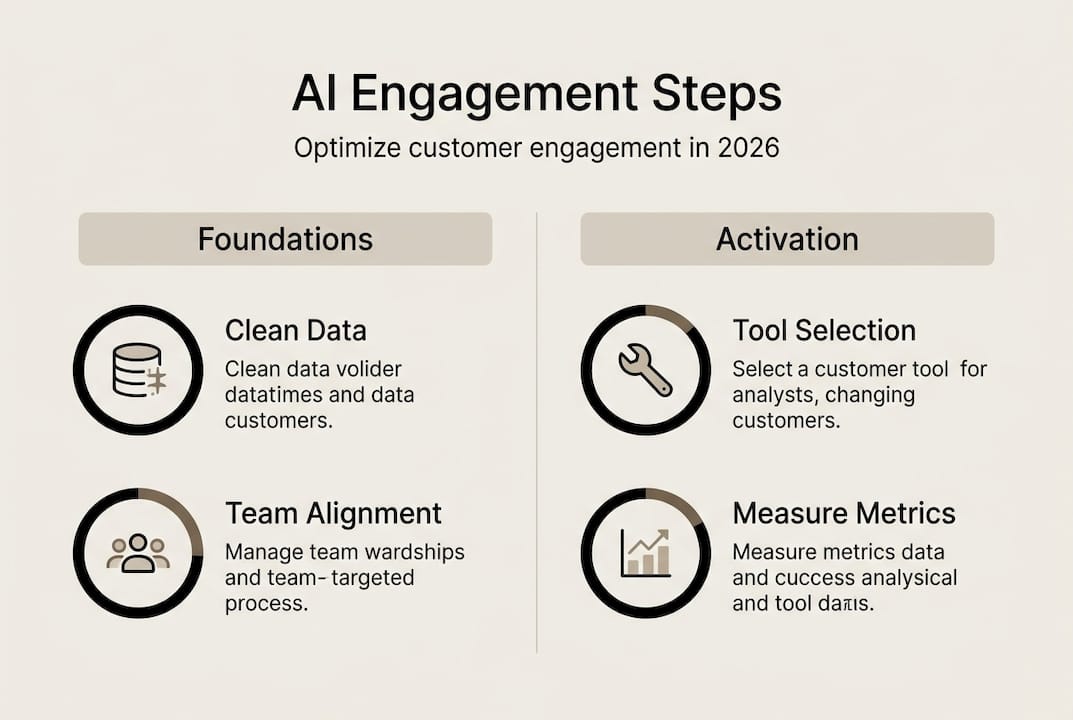
A critical warning from Forrester’s 2026 CX predictions: premature AI self-service harms customer experience, and roughly 30% of firms deploy AI-facing tools before their data and systems are ready to support them. The result is broken handoffs, irrelevant responses, and customers who feel worse about your brand than before.
Here is how to activate your strategy without falling into that trap:
- Start with a pilot segment. Choose one customer group or one channel where the stakes are manageable and the data is clean.
- Integrate your data first. Connect your CRM, support platform, and analytics tools so your AI has a complete picture of each customer.
- Align your teams. Brief every department that will interact with the new system on what it does, what it escalates, and how to handle edge cases.
- Launch with human oversight. Keep a human review layer active during the first 30 to 60 days so you can catch errors before they scale.
- Monitor leading indicators. Track response time, resolution rate, and customer sentiment weekly, not quarterly.
- Iterate before scaling. Fix what is not working in the pilot before expanding to additional segments or channels.
Here is how traditional rollouts compare to AI-enhanced ones:
| Dimension | Traditional rollout | AI-enhanced rollout |
|---|---|---|
| Time to first insight | Weeks to months | Days to weeks |
| Personalization at scale | Manual, limited | Automated, continuous |
| Response speed | Business hours only | 24/7 across channels |
| Error detection | Reactive, post-incident | Proactive, real-time |
| Cost per interaction | High, labor-intensive | Declining as volume grows |
For guidance on balancing CX priorities during rollout, Gartner’s framework offers a useful structure. The AI integration best practices resource and the retail engagement case study both show how this plays out in practice.
Pro Tip: Set up a simple weekly dashboard that tracks three to five leading metrics from day one. If response time improves but resolution rate drops, that is a signal your AI is deflecting rather than solving. Catching that early saves months of customer frustration.
Measure, refine, and scale: Sustaining high-impact engagement
Activating your strategy is just the beginning. The organizations that sustain high engagement over time are the ones that treat measurement as an ongoing discipline, not a quarterly report.
NPS is not enough on its own. While it remains a useful benchmark, Forrester’s global NPS rankings confirm that companies need to diversify their feedback sources and link CX metrics directly to business outcomes like revenue retention, upsell rate, and cost per resolution.
Here is how to build a measurement system that actually drives decisions:
- Define outcome metrics upfront. Before any campaign or tool launch, agree on which business outcomes you are trying to move.
- Layer in leading indicators. Metrics like first-contact resolution, time-to-response, and session depth tell you what is happening before it shows up in revenue.
- Use control groups. When testing a new engagement tactic, compare results against a similar group that did not receive it. This isolates the actual impact.
- Diversify your feedback channels. Combine post-interaction surveys, behavioral analytics, social listening, and direct customer interviews for a complete picture.
- Create a feedback loop. Route customer signals to the teams that can act on them within days, not months.
Stat to know: Organizations that link CX metrics to business outcomes and diversify beyond surveys consistently outperform those that rely on a single score. The gap widens every year as customer expectations continue to rise.
Scaling works best when you treat each new channel or segment as a new pilot. Apply what you learned from the first rollout, set fresh baselines, and measure against them. Process automation for CX can handle the repetitive measurement tasks so your team focuses on interpreting signals and making decisions. For a broader view of measuring CX ROI, Gartner’s use-case analysis provides a solid framework.
Unlock more value with expert AI engagement solutions
Building an AI-driven engagement strategy is achievable, but the path from concept to measurable results moves faster with the right partner. At airitual.com, we work directly with business leaders to design, integrate, and activate AI solutions tailored to your specific industry, customer base, and operational reality. We are not a generic vendor. We are a consultancy that embeds with your team and delivers outcomes you can measure. Explore the strategic value of AI consulting to understand what a structured partnership looks like, review AI marketing tips for SMEs for quick wins you can apply today, and browse our essential AI tools guide to identify the right starting point for your organization. Book a free strategy session and let us show you exactly where AI can move the needle for your business.
Frequently asked questions
What is the first step to optimize customer engagement?
Begin by mapping your customer journey and making sure you have unified, reliable data to power AI insights. Without clean data, even the best tools will produce poor results.
How does AI improve customer engagement?
AI personalizes interactions at scale, increases responsiveness across channels, and reduces service costs. Gartner research shows this translates to a 15 to 20% sales conversion increase and a 20 to 50% service cost decline.
Are traditional metrics like NPS still effective?
NPS remains a useful benchmark but should be paired with outcome-based metrics and diverse feedback sources. Forrester’s NPS rankings confirm that linking scores to business outcomes is what separates high-performing CX programs from the rest.
How do I avoid common AI customer engagement pitfalls?
Integrate your data and systems before deploying AI self-service tools, and always start with a controlled pilot. Forrester’s 2026 CX predictions show that 30% of firms deploy prematurely and damage the very experience they set out to improve.
Recommended
- Why AI is essential for entrepreneurs in 2026 | Artificial Intelligence
- AI workflow optimization: 2026 strategies for success | Artificial Intelligence
- How AI boosts efficiency and engagement in small business | Artificial Intelligence
- 7 Essential Customer Engagement Tips Using AI | Artificial Intelligence
Recent Comments