

TL;DR:
- Most districts already use AI operationally, but few have formal governance policies.
- A phased, adaptive approach with clear assessment, piloting, and ongoing evaluation is essential.
- Building educator capacity and establishing ethical guardrails are critical for responsible AI integration.
AI is reshaping K-12 education faster than most districts can keep pace with, and the pressure on educational leaders has never been greater. You are expected to modernize operations, personalize learning, and prepare students for an AI-driven workforce, all while protecting privacy, closing equity gaps, and maintaining academic integrity. The challenge is not whether to adopt AI but how to do it responsibly and effectively. This guide gives you a phased, evidence-based roadmap covering needs assessment, policy development, pilot design, educator capacity, ethical guardrails, and sustainable scaling so your district moves forward with confidence.
Table of Contents
- Assessing your AI readiness: Where K-12 stands today
- Building your phased AI transformation strategy
- Empowering educators: Building capacity and skills progression
- Guardrails, risks, and proven outcomes: Driving equity and ethics
- Monitoring results and scaling for sustainable impact
- Why responsible AI transformation trumps speed in K-12 schools
- Take your next step: Practical resources for your transformation journey
- Frequently asked questions
Key Takeaways
| Point | Details |
|---|---|
| Start with assessment | A careful audit of tools, staff, and policy is critical before any AI purchases or pilot launches. |
| Adopt phased strategies | Structured, stepwise implementation ensures safety, equity, and buy-in across your school or district. |
| Invest in people | Ongoing educator training and supporting skills progression create the foundation for lasting impact. |
| Prioritize ethics and equity | Ethical guardrails and constant monitoring prevent bias, privacy issues, and widening gaps. |
| Measure and adapt | Use real learning outcomes and equity metrics—not hype or tool numbers—to guide your next steps. |
Assessing your AI readiness: Where K-12 stands today
Understanding where your district stands before purchasing a single tool is the most important step you can take. Many leaders assume their schools are behind the curve, but the reality is more nuanced. CoSN data shows 57-85% of districts are already using AI operationally, yet very few have formal policies in place. That gap between use and governance is where the real risk lives.
Start with a structured landscape assessment. Review what current AI in education looks like across your district by auditing every tool currently in use, whether purchased officially or adopted informally by teachers. You will likely find more AI-powered platforms than your inventory reflects.
Here is a practical assessment checklist:
- Inventory tools: List every platform, app, or service with AI features across all departments
- Map staff skills: Survey educators on their comfort level and current AI use
- Review existing policies: Check acceptable use policies for AI-specific language
- Identify data flows: Understand what student data each tool collects and where it goes
- Benchmark against peers: Use national data to identify strategy gaps in districts similar to yours
| Readiness Area | Early Stage | Developing | Advanced |
|---|---|---|---|
| AI tool inventory | None documented | Partial list | Full audit complete |
| Staff AI skills | No baseline data | Informal survey done | Tiered skill map ready |
| Policy coverage | No AI mention | General tech policy | AI-specific policy |
| Data governance | Ad hoc | Partial controls | Full compliance framework |
This table gives you a quick benchmark. Most districts land in the early-to-developing range, and that is a perfectly workable starting point. The goal here is clarity, not perfection.
Pro Tip: Invite teachers to participate in the initial mapping process. Educators often use AI tools informally that never appear in official procurement records, and surfacing those tools early prevents policy blind spots.
Once you have a clear picture, you can use an effective AI integration guide to prioritize which gaps to address first and build your transformation strategy on solid ground.
Building your phased AI transformation strategy
Once your baseline is clear, it is time to map out a transformation strategy tailored for your K-12 setting. A phased approach prevents the common mistake of trying to do everything at once, which almost always leads to burnout, inconsistency, and wasted resources.
Phased implementation frameworks are widely recommended for AI adoption in K-12 settings, and for good reason. They allow your team to learn, adjust, and build confidence before committing to full-scale rollout. Here are the five core phases:
- Assessment: Audit tools, skills, and policies as outlined in the previous section
- Vision and policy: Define your district’s AI philosophy, draft usage policies, and establish a governance committee
- Pilot: Select 2-3 high-impact, low-risk use cases and run structured trials with willing educators
- Scale: Expand successful pilots with refined support structures and updated policies
- Evaluate: Monitor outcomes continuously and iterate based on data and feedback
For AI implementation steps to work in practice, each phase needs clear timelines, assigned stakeholders, and defined success metrics before you move forward.
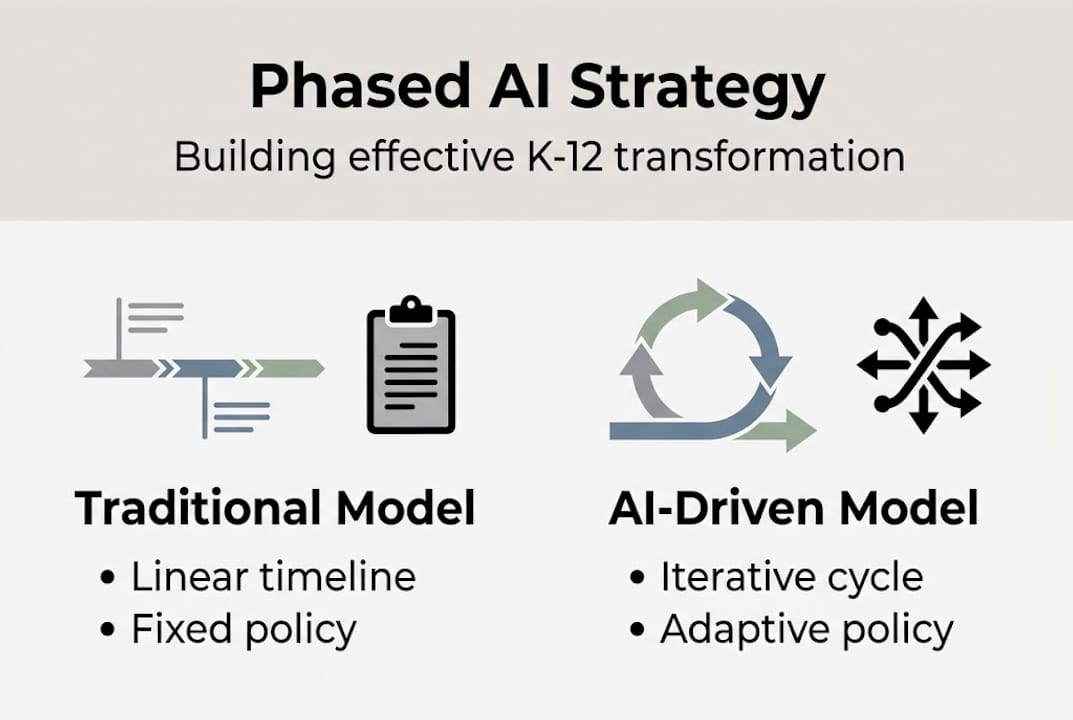
| Dimension | Traditional change model | AI-driven change model |
|---|---|---|
| Timeline | Multi-year, linear | Iterative, adaptive cycles |
| Decision driver | Administrator mandate | Data and educator feedback |
| Risk management | Reactive | Proactive, built into phases |
| Staff role | Recipients of change | Co-designers of change |
| Success measure | Adoption rate | Learning and equity outcomes |
This comparison reveals why traditional change management often fails with AI. The technology moves too fast for linear planning. An adaptive, phased model keeps your strategy responsive without losing structure.
Pro Tip: When selecting pilot use cases, prioritize areas where AI can reduce administrative burden rather than immediately targeting classroom instruction. Early wins build trust and create space for more complex classroom applications later.
For practical AI guidance on building your vision and policy layer, look to frameworks developed by districts that have already navigated this process. You do not need to start from scratch. Consult resources on creating an AI strategy that fits your community’s specific context and values.
Empowering educators: Building capacity and skills progression
Transformation depends not just on plans but on the people delivering them, especially educators. You can have the best technology and the most thorough policy, but if your teachers lack confidence and skill, adoption will stall.

Building educator capacity through structured professional development, grade-appropriate skills progressions, and ongoing coaching is the methodology most strongly associated with successful AI integration. Pedagogy must come before tools. When teachers understand why and how AI supports learning, tool selection becomes much easier.
A grade-band skills progression gives your district a shared language and clear expectations:
- K-3: Foundational digital literacy, no direct AI tool use, focus on critical thinking and questioning
- Grades 4-6: Safe exploration of AI-assisted tools with teacher guidance and structured reflection
- Grades 7-9: Prompt development, understanding AI outputs, and evaluating source reliability
- Grades 10-12: Strategic application of AI for research, productivity, and career readiness
For professional development that actually sticks, consider these approaches:
- Peer coaching cohorts where early adopters mentor hesitant colleagues
- Micro-credential pathways tied to the skills progression above
- Protected planning time for teachers to experiment without performance pressure
- Lesson study groups focused on AI-integrated instructional design
- Leadership skills for AI development for department heads and instructional coaches
“The single greatest predictor of successful AI integration is not the tool selected but the degree to which educators feel prepared, supported, and trusted to lead the change.”
This insight should shape every professional development decision you make. Invest in your people first. When educators feel ownership over the process, they become your most effective advocates. Explore AI curriculum ideas that align with your skills progression and give teachers concrete starting points for classroom integration. Resources on implementing AI for results can also support your instructional coaching team as they build their own expertise.
Guardrails, risks, and proven outcomes: Driving equity and ethics
Effective transformation also means leading with ethics and ensuring all students benefit. The evidence on AI in K-12 is encouraging but carries a critical warning: outcomes depend almost entirely on whether guardrails are in place.
Research on AI tutors and learning outcomes shows that Socratic AI tutoring with structured guardrails can boost learning by up to 127%, while unguided AI use has been associated with performance decreases of up to 17%. That is not a small difference. It is the difference between transformation and harm.
Key risks every district must address include:
- Algorithmic bias: AI tools trained on non-representative data may disadvantage students of color, English learners, or students with disabilities
- Data privacy: Student data collected by third-party AI platforms may be used in ways that violate FERPA or state privacy laws
- Cognitive dependency: Over-reliance on AI for writing or problem-solving can reduce critical thinking development
- Equity gaps: Students without home internet or devices cannot access AI-powered learning tools equally
| AI use scenario | Typical outcome |
|---|---|
| AI tutor with Socratic guardrails | Up to 127% learning improvement |
| AI writing assistant with teacher review | Moderate gains in writing quality |
| Unguided AI chatbot for homework | Up to 17% performance decrease |
| AI grading without educator oversight | Inconsistent, potentially biased results |
Must-have guardrails for K-12 AI programs:
- Written acceptable use policies with student and parent acknowledgment
- Vendor data privacy agreements reviewed by legal counsel
- Regular AI ethics in education reviews with diverse stakeholder input
- Equity audits to monitor differential outcomes by student subgroup
- Clear escalation paths when AI tools produce harmful or inaccurate outputs
Building AI career education into your guardrail framework also helps students understand AI’s role in their futures while learning to use it responsibly. Pairing guardrails with strategies for student AI engagement ensures protection does not come at the cost of meaningful learning experiences.
Monitoring results and scaling for sustainable impact
With risks managed and outcomes in focus, it is time to put the transformation cycle into action and scale for impact. Scaling without monitoring is one of the most common and costly mistakes districts make.
Continuous evaluation and monitoring are essential for sustainable AI transformation. That means setting measurable key performance indicators before you expand any pilot, not after.
Follow these steps to scale responsibly:
- Set KPIs upfront: Define what success looks like for learning outcomes, engagement, and equity before expanding
- Collect layered feedback: Gather input from students, teachers, and families at regular intervals
- Monitor equity metrics: Track outcomes by subgroup to catch emerging gaps early
- Review vendor performance: Assess whether AI tools are delivering on their promises and meeting privacy requirements
- Update policies continuously: Treat your AI policy as a living document that evolves with your experience
- Celebrate and communicate wins: Share results with your community to build trust and sustain momentum
Common pitfalls and how to address them:
- Pilot fatigue: Rotate pilot participants and provide genuine recognition to avoid burnout
- Data overload: Focus on 3-5 core metrics rather than tracking everything
- Tool sprawl: Consolidate platforms annually and retire tools that do not demonstrate impact
Pro Tip: Schedule quarterly equity checks as a standing agenda item for your AI governance committee. Gaps that go unnoticed for a semester can take years to close. Use your selecting education AI tools checklist during these reviews to reassess whether current tools still meet your standards.
For a forward-looking perspective on where this is all heading, explore resources on the future of AI in schools and how districts are positioning themselves for the next wave of innovation. Insights from rethinking AI in schools offer valuable perspective from districts that have already navigated the scaling phase.
Why responsible AI transformation trumps speed in K-12 schools
Having mapped the process, here is our perspective from years of supporting schools through both successful and failed AI transformations: the districts that move fastest rarely come out ahead.
We have seen well-funded districts rush to deploy AI tools across every grade level, only to pull back six months later because teachers felt bypassed, parents felt alarmed, and student data ended up in the hands of vendors with weak privacy practices. Speed created the illusion of progress while undermining the trust that real transformation requires.
The 2025 HPE Report is direct on this point: prioritize responsible, phased rollout with strong policies and training over rapid adoption, and balance productivity gains with genuine learning safeguards. That is not a conservative position. It is the evidence-based one.
Sustainable change in K-12 is human-centered, not tool-driven. The districts achieving the most meaningful outcomes are investing in educator confidence, community trust, and ethical governance before they invest in the next AI platform. Explore how transforming learning in 2026 looks when it is built on that foundation.
Take your next step: Practical resources for your transformation journey
Ready to lead your school or district into a successful AI-powered future? The roadmap is clear, but execution requires the right tools and support. Start with our detailed AI implementation guide to walk through each phase with structured checklists and decision frameworks. Use our AI tool checklist for schools to evaluate vendors against privacy, equity, and pedagogical standards before you commit. For strategies that connect AI directly to student outcomes, our resources on AI-powered student engagement offer proven approaches your instructional team can implement immediately. Schedule a FREE Strategy Session with our education specialists to get a personalized action plan built for your district’s specific context and goals.
Frequently asked questions
What is the first step to starting AI transformation in a K-12 school?
Begin with a landscape assessment to map existing tools, staff capacity, and policy gaps before any technology purchase. Phased frameworks consistently recommend assessment as the non-negotiable first phase.
How can schools ensure AI is used ethically and equitably?
Develop clear usage policies, provide AI literacy training, set data privacy standards, and monitor equity metrics regularly. Ethical guardrails are what separate beneficial AI programs from harmful ones.
Does AI really improve student outcomes in K-12?
Studies show AI tutors with strong guardrails can significantly improve learning, but caution is needed as unguided AI may reduce performance. Research confirms that the presence or absence of guardrails is the decisive variable.
What are common mistakes to avoid in AI adoption?
Skipping educator training, neglecting privacy, and rolling out too quickly without policies often result in poor outcomes or legal trouble. CoSN data shows that only 5% of districts have formal AI policies, making policy gaps the most widespread and avoidable mistake.
How do we measure success throughout the transformation?
Success is tracked by monitoring learning outcomes, teacher and student feedback, and narrowing equity gaps rather than just tool adoption rates. Continuous evaluation ensures your strategy stays aligned with real-world results rather than vendor promises.
Recommended
- Future of AI in Schools 2026: Transforming Learning | Artificial Intelligence
- Top AI curriculum ideas to transform student outcomes | Artificial Intelligence
- How to Create an Effective AI Integration Strategy for Schools | Artificial Intelligence
- Step-by-step guide to implementing AI-powered education | Artificial Intelligence
Recent Comments