

Educational administrators spend an average of 20 hours per week on routine administrative tasks like attendance tracking, scheduling, and grading. This staggering figure represents nearly half of a typical work week consumed by repetitive processes that could be automated. Education automation offers a transformative solution, reclaiming valuable time while simultaneously improving student engagement through data-driven insights and personalized interventions. As institutions face mounting pressure to do more with less, understanding how automation works, its tangible benefits, potential risks, and practical applications becomes essential for leaders seeking to enhance both operational excellence and educational outcomes.
Table of Contents
- Key takeaways
- How education automation boosts operational efficiency
- Enhancing student engagement through personalized interventions
- Key AI methodologies powering education automation
- Risks, challenges, and best practices for education automation
- Explore AI solutions tailored for education
- Frequently asked questions
Key Takeaways
| Point | Details |
|---|---|
| Time savings | Automation reduces routine tasks and frees administrators to focus on strategic work, with an average time savings of 5.9 hours per week. |
| Broad task coverage | Automation handles attendance, scheduling, grading, reporting, and bulk communications, delivering immediate reductions in administrative burden. |
| Personalized engagement | AI enables early identification of disengagement and real time alerts for timely interventions that support students. |
| Risks and balance | The benefits come with risks such as bias and overreliance, so leaders should balance automation with human oversight. |
How education automation boosts operational efficiency
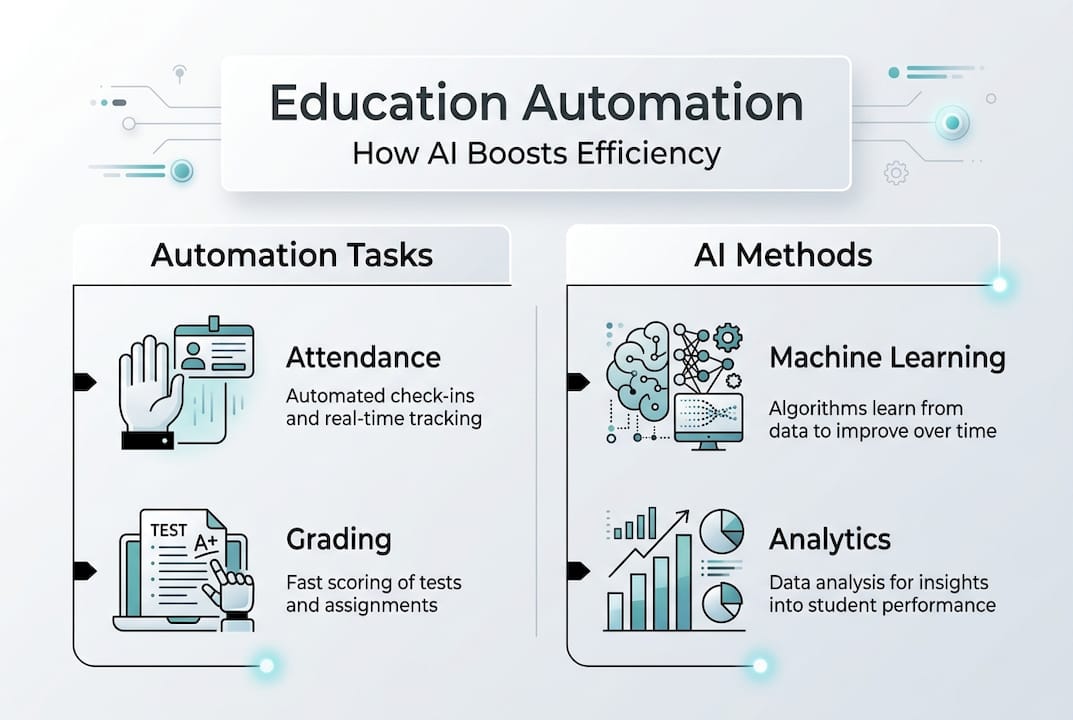
Education automation refers to the application of artificial intelligence and machine learning technologies to handle repetitive administrative tasks that traditionally consume significant staff time. This includes attendance tracking, scheduling, reporting, grading, and communication management across educational institutions. The scope extends beyond simple digitization to intelligent systems that learn patterns, make recommendations, and execute routine decisions with minimal human intervention.
Specific tasks where automation delivers immediate impact include automated attendance monitoring through integrated systems, intelligent scheduling that optimizes room assignments and resource allocation, automated grading for objective assessments, bulk communication management for parent and student notifications, and report generation that compiles data from multiple sources. These applications represent the low-hanging fruit where technology can immediately reduce administrative burden without compromising quality or requiring extensive customization.
Research demonstrates that administrators using education automation reclaim an average of 5.9 hours per week, representing a 20-40% reduction in time spent on routine tasks. This translates to roughly 300 hours annually per administrator, time that can be redirected toward strategic initiatives like curriculum development, teacher mentoring, community engagement, and long-term planning. The cumulative effect across an institution can free hundreds or thousands of hours that were previously locked in repetitive processes.
This reclaimed time allows educational leaders to focus on high-value activities that directly impact institutional effectiveness. Building meaningful relationships with teachers, students, and families becomes possible when administrators are not drowning in paperwork. Strategic planning sessions can happen more frequently. Professional development initiatives receive proper attention. The shift from reactive task management to proactive leadership represents automation’s most profound benefit.
Pro Tip: Conduct a two-week time audit of your administrative team’s activities, categorizing tasks by repetition frequency and complexity. This reveals which processes offer the highest return on automation investment and helps prioritize implementation efforts.
60% of U.S. education leaders report using AI tools daily to manage administrative functions, reflecting widespread adoption and confidence in automation technologies.
Enhancing student engagement through personalized interventions
Education automation transforms student engagement by enabling early identification of disengagement through continuous analysis of behavioral and performance data. AI systems monitor attendance patterns, assignment completion rates, assessment scores, learning management system activity, and participation metrics to detect subtle changes that signal emerging problems. Unlike periodic manual reviews, automated systems provide real-time alerts when students exhibit warning signs, allowing interventions before minor issues escalate into serious academic challenges.

Personalized interventions become scalable through automation. When AI identifies a struggling student, it can automatically trigger customized support resources, notify appropriate staff members, adjust learning paths to provide additional scaffolding, and recommend specific interventions based on similar student profiles. This personalization extends beyond remediation to include enrichment opportunities for advanced learners, ensuring all students receive appropriately challenging content.
Empirical studies document significant benefits for retention and motivation. Students receiving AI-powered personalized support show higher completion rates, improved assessment performance, increased engagement with course materials, and greater persistence through challenging content. The continuous feedback loop created by automated systems helps students understand their progress and builds self-efficacy through timely recognition of achievements and targeted support for weaknesses.
Data-driven insights guide educators in making timely, informed decisions about individual students and broader instructional strategies. Dashboards aggregate information across multiple dimensions, revealing patterns that might escape notice in manual reviews. Teachers can identify which concepts require reteaching, which students need additional support, and which instructional approaches produce the best outcomes for different learner profiles.
Steps for deploying AI-powered engagement systems
- Establish baseline metrics by collecting historical data on student performance, attendance, and engagement indicators across your institution.
- Select appropriate AI tools that integrate with existing learning management systems and student information platforms to minimize disruption.
- Train staff on interpreting AI-generated insights and translating alerts into effective interventions that match your institutional culture.
- Implement pilot programs with specific student cohorts to test effectiveness and refine approaches before full-scale deployment.
- Monitor outcomes systematically by comparing intervention groups to control groups and adjusting algorithms based on results.
- Scale successful approaches gradually while maintaining awareness training for all stakeholders about how systems work and their limitations.
Pro Tip: Always combine AI-generated insights with teacher judgment and personal knowledge of students. Technology identifies patterns, but educators understand context, relationships, and individual circumstances that algorithms cannot capture.
Key AI methodologies powering education automation
Machine learning forms the foundation of most education automation applications, employing three primary approaches. Supervised learning uses labeled historical data to train models that predict outcomes like student success probability or optimal content sequencing. Unsupervised learning identifies hidden patterns in student behavior and performance data without predetermined categories, revealing unexpected relationships. Reinforcement learning optimizes sequential decisions like adaptive content delivery by learning which actions produce the best long-term educational outcomes through trial and feedback.
Intelligent Tutoring Systems represent sophisticated applications of AI that provide personalized instruction and feedback comparable to human tutors. These systems assess student knowledge states, select appropriate learning activities, provide explanations tailored to individual needs, and adapt difficulty based on performance. Research demonstrates ITS effectiveness with effect sizes averaging 0.76 standard deviations, meaning students using these systems typically outperform control groups by substantial margins. Randomized controlled trials show gains of 0.23-0.31 standard deviations even in rigorous experimental conditions.
Generative AI enables unprecedented content personalization by creating customized learning materials, practice problems, explanations, and assessments on demand. Rather than selecting from pre-existing content libraries, generative systems produce novel materials tailored to specific student needs, learning styles, and knowledge gaps. This capability dramatically expands the range of personalization possible while reducing the burden on teachers to create multiple versions of every resource.
Multimodal analytics combine data from diverse sources including text, video, audio, and sensor inputs to create comprehensive pictures of learning processes. By analyzing facial expressions during video lessons, voice patterns in spoken responses, typing patterns during assessments, and navigation behaviors in digital environments, these systems capture nuances that single-mode analysis would miss. The integration of multiple data streams produces more accurate predictions and richer insights into student engagement and comprehension.
| AI Methodology | Key Features | Primary Benefits | Educational Impact |
|---|---|---|---|
| Machine Learning | Pattern recognition, prediction, classification | Automates routine decisions, identifies at-risk students | Enables early intervention and resource optimization |
| Intelligent Tutoring Systems | Adaptive instruction, personalized feedback, knowledge assessment | Provides scalable one-on-one support | Effect size 0.76 SD, significant learning gains |
| Generative AI | Custom content creation, dynamic problem generation | Infinite personalization without teacher effort | Addresses individual learning gaps efficiently |
| Multimodal Analytics | Integrated data from multiple sources | Comprehensive engagement insights | Captures nuanced learning behaviors |
Advantages of AI methodologies for education
- Machine learning scales pattern recognition far beyond human capacity, analyzing thousands of student interactions simultaneously to identify trends and predict outcomes that inform proactive interventions.
- Intelligent tutoring systems provide immediate, personalized feedback that accelerates learning by addressing misconceptions as they emerge rather than after summative assessments reveal gaps.
- Generative AI eliminates content scarcity as a barrier to personalization, ensuring every student receives materials perfectly matched to their current knowledge level and learning preferences.
- Multimodal analytics reveal engagement patterns invisible to traditional assessment methods, helping educators understand not just what students know but how they learn most effectively.
Risks, challenges, and best practices for education automation
Cognitive offloading occurs when users rely on automated systems to perform tasks they previously handled mentally, potentially leading to skill degradation over time. In educational contexts, administrators might lose facility with data interpretation if they simply accept AI recommendations without critical evaluation. Teachers could become less skilled at identifying struggling students if they depend entirely on automated alerts. This erosion of professional judgment represents a serious long-term risk that requires deliberate countermeasures.
Automation bias describes the tendency to favor automated suggestions even when contradictory information exists. Educational leaders might implement AI-recommended interventions without considering contextual factors the algorithm cannot assess. This blind trust in technology can lead to inappropriate decisions that harm students or waste resources. The challenge intensifies because AI systems often present recommendations with apparent confidence, masking underlying uncertainty or limitations in training data.
Cultural and contextual variability creates implementation challenges because AI systems trained on data from one population may not generalize to different student demographics, institutional types, or educational philosophies. An algorithm optimized for large urban schools might fail in rural settings. Approaches effective with traditional-age students may not work for adult learners. These context-specific limitations require careful validation before deployment and ongoing monitoring to detect performance degradation.
Privacy and ethical concerns arise from the extensive student data collection required for effective education automation. Systems that track detailed behavioral patterns, analyze communications, and make predictions about future performance raise questions about surveillance, consent, data security, and potential misuse. Institutions must balance the benefits of data-driven insights against legitimate concerns about student privacy and the potential for discriminatory outcomes if algorithms perpetuate historical biases.
Common risks during AI integration
- Algorithmic bias amplifying existing inequities when training data reflects historical discrimination or underrepresents certain student populations in ways that lead to systematically worse outcomes for marginalized groups.
- Data quality issues producing unreliable insights when source systems contain errors, inconsistencies, or gaps that algorithms cannot detect or correct automatically.
- Integration complexity creating technical barriers when AI tools fail to communicate properly with existing student information systems, learning management platforms, or assessment databases.
- Change resistance from staff who fear job displacement, distrust automated recommendations, or lack training to use new systems effectively in their daily work.
- Vendor dependence limiting institutional flexibility when proprietary systems create lock-in effects that make switching providers difficult or prevent customization to meet specific needs.
Pro Tip: Maintain ongoing teacher and administrator involvement in AI system oversight by establishing review committees that regularly audit automated recommendations, assess outcomes, and provide feedback to improve algorithms based on professional expertise and institutional knowledge.
“The greatest risk of education automation is not that technology will replace educators, but that over-reliance on automated systems will erode the critical thinking skills and professional judgment that make human educators irreplaceable. Technology should augment human capabilities, not substitute for them.”
Balancing automation benefits with these risks requires thoughtful implementation strategies. Start with low-stakes applications where errors have minimal consequences. Maintain human review of high-impact decisions like student placement or intervention escalation. Provide comprehensive training so staff understand both capabilities and limitations of AI systems. Establish clear governance policies defining appropriate uses, required oversight, and procedures for addressing concerns. Regular audits should assess whether systems produce equitable outcomes across different student populations and whether staff maintain necessary skills despite automation support.
Transparency about how AI systems work, what data they use, and how they make recommendations builds trust and enables informed oversight. Students and families deserve to understand when automated systems influence educational decisions affecting them. This transparency also helps identify edge cases where algorithms fail and require human intervention, improving system reliability over time.
Explore AI solutions tailored for education
Now that you understand how education automation enhances efficiency and engagement while managing associated risks, you can explore practical implementation pathways. Our AI solutions for education provide customized tools designed specifically for institutional needs, from automated administrative systems to student engagement platforms. We offer comprehensive training programs that prepare your team to deploy and oversee AI systems effectively while maintaining critical human oversight. Join our upcoming webinars to see live demonstrations of education automation in action and discuss how these technologies can address your specific operational challenges. Our consultative approach ensures you maximize automation benefits while preserving the educator expertise and relationship-building that remain central to educational excellence.
Frequently asked questions
What is education automation and why is it important?
Education automation applies artificial intelligence and machine learning to handle repetitive administrative tasks like attendance tracking, scheduling, grading, and communication management that traditionally consume significant staff time. It matters because administrators currently spend up to 20 hours weekly on routine processes, representing nearly half their work time that could be redirected toward strategic initiatives, relationship building, and educational leadership. By reclaiming this time while simultaneously enabling data-driven student interventions, automation addresses both operational efficiency and educational quality simultaneously. The technology represents a fundamental shift from reactive task management to proactive strategic leadership.
How does AI identify students who need help early?
AI systems continuously analyze multiple data streams including attendance patterns, assignment completion rates, assessment scores, learning management system activity, and participation metrics to detect subtle changes signaling emerging problems. When patterns indicate risk, automated alerts notify appropriate staff members before minor issues escalate into serious academic challenges. This real-time monitoring surpasses periodic manual reviews by catching problems at earlier stages when interventions prove most effective. The technology essentially provides educators with an always-on early warning system that scales across entire student populations without requiring constant manual monitoring.
What are the risks of relying too much on education automation?
Over-reliance creates several serious concerns including automation bias where users favor AI recommendations without critical evaluation, skill erosion as professionals lose facility with tasks they no longer perform regularly, privacy issues from extensive data collection, and algorithmic bias that may perpetuate historical inequities if training data reflects discriminatory patterns. The most significant risk involves losing the professional judgment and contextual understanding that make human educators irreplaceable. Technology should augment human capabilities rather than substitute for them, requiring ongoing staff involvement in oversight, regular audits of automated decisions, and maintaining human review for high-stakes determinations. Balanced implementation through thoughtful adoption strategies helps institutions capture automation benefits while preserving essential human expertise.
How long does it take to implement education automation effectively?
Effective implementation typically requires 6-12 months from initial planning through full deployment, though timelines vary based on institutional size, existing technology infrastructure, and scope of automation initiatives. The process includes establishing baseline metrics, selecting appropriate tools, training staff, piloting with specific cohorts, monitoring outcomes, and scaling successful approaches. Rushing implementation increases risk of technical problems, staff resistance, and suboptimal outcomes. Successful institutions treat automation as a gradual transformation rather than an overnight switch, allowing time for organizational learning, process refinement, and cultural adaptation. Starting with low-stakes applications builds confidence and expertise before tackling more complex use cases.
Recent Comments