

Generative search optimization promises transformative results, yet many projects stumble before delivering value. Lack of clear prerequisites, misaligned goals, and missing feedback loops cause 45% of initiatives to fail. This guide walks you through proven preparation, execution, troubleshooting, and measurement steps to implement generative search optimization successfully in your organization.
Table of Contents
- Prerequisites And Infrastructure Setup
- Stepwise Optimization Process
- Common Failures And Troubleshooting
- Cost, Timeline, And Resource Considerations
- Safety, Ethics, And Governance
- Alternative Approaches And Tradeoffs
- Expected Outcomes And Metrics For Success
- Enhance Your Business With Expert Generative Search Optimization
- Frequently Asked Questions
Key takeaways
| Point | Details |
|---|---|
| Foundation matters | AI readiness, skilled teams, quality data, and goal alignment are critical before starting. |
| Iterative process | Phased tuning, user training, and continuous feedback loops drive sustained improvements. |
| Common pitfalls | Misaligned goals and insufficient user training cause most project failures. |
| Realistic planning | Budget $150K–$350K and expect 6–9 months to measurable results. |
| Ongoing governance | Bias monitoring and ethical frameworks maintain trust and compliance long-term. |
Prerequisites and infrastructure setup
Before launching generative search optimization, you need solid groundwork. AI-ready infrastructure and strategy forms the foundation for successful deployment. Without modern data pipelines, cloud compute, and integration capabilities, your optimization efforts will struggle.
Team composition is equally vital. You need dedicated AI specialists who understand model tuning, prompt engineering, and retrieval optimization. 70% of successful deployments involved dedicated AI teams and modernized data platforms, proving that skilled personnel directly impact project outcomes. Generic IT staff without AI expertise cannot deliver the nuanced optimization required.
Data quality determines optimization ceiling. High-quality labeled datasets for training, representative query samples, and clean metadata enable your models to learn effectively. Poor data input guarantees poor search output, regardless of model sophistication.
Business alignment prevents wasted effort. Define specific objectives like reducing support query time or improving product discovery before beginning technical work. Vague goals like “make search better” lead to misaligned optimization and difficulty measuring success.
Key prerequisites checklist:
- Cloud infrastructure with scalable compute and storage
- Dedicated AI/ML team with tuning expertise
- Quality labeled training data and query logs
- Clear business objectives mapped to search metrics
- Executive sponsorship and budget commitment
- Data governance and privacy framework
Pro Tip: Conduct an infrastructure readiness audit three months before project kickoff to identify and resolve gaps early.
Stepwise optimization process
Successful generative search optimization follows a structured sequence. Rushing steps or skipping phases creates technical debt and poor user experiences. The stepwise optimization roadmap provides detailed frameworks for each phase.
Start with infrastructure setup. Establish data pipelines feeding your search system, implement monitoring dashboards, and configure baseline models. This phase typically takes 6–8 weeks and sets technical foundations.
Next, align business goals with optimization targets. Translate objectives like “improve customer satisfaction” into measurable search metrics such as click-through rate, result relevance scores, and query resolution time. This alignment ensures optimization efforts drive business value.
Begin iterative tuning cycles. Test prompt variations, adjust retrieval parameters, and refine ranking algorithms in controlled experiments. Each cycle should last 2–3 weeks with clear success criteria. Run A/B tests comparing optimized versions against baselines to validate improvements.

User training is critical yet often neglected. User training on interpreting generative search results increases effectiveness and reduces dissatisfaction rates by 18%. Teach users how to formulate effective queries, interpret AI-generated summaries, and provide feedback on result quality.
Implement continuous feedback loops. Capture user interactions, query reformulations, and explicit ratings to inform ongoing optimization. Automated feedback integration prevents accuracy drift over time.
Deploy in phases, starting with limited user groups before full rollout. Monitor performance closely during initial deployment, ready to roll back if issues emerge. Gradual expansion reduces risk while building confidence.
Sequential implementation steps:
- Complete infrastructure setup and baseline model deployment
- Define and validate business-aligned success metrics
- Execute 4–6 iterative tuning cycles with A/B testing
- Conduct comprehensive user training programs
- Launch phased deployment starting with pilot groups
- Establish automated monitoring and feedback collection
- Schedule regular optimization reviews and tuning adjustments
Pro Tip: Balance deployment speed with optimization depth by running parallel tuning experiments during phased rollout rather than sequentially.
Common failures and troubleshooting
Understanding failure modes helps you avoid costly mistakes. 45% of generative search projects fail due to misalignment between optimization goals and business objectives. When technical teams optimize for metrics that do not drive business value, projects deliver impressive benchmarks but disappointing outcomes.
Lack of feedback loops causes gradual performance degradation. User behavior evolves, content changes, and query patterns shift over time. Without continuous feedback integration, your search system becomes less relevant even if initial optimization was strong.
Ignoring bias detection creates trust and compliance risks. Generative models can amplify existing biases in training data, producing skewed results that alienate users or violate regulations. Regular bias audits identify problems before they damage your reputation.
Insufficient user training leads to underutilization. Users accustomed to traditional keyword search may struggle with generative interfaces without guidance. Poor adoption rates mean your optimization investment delivers minimal impact regardless of technical quality.
Practical troubleshooting techniques:
- Conduct quarterly alignment reviews ensuring optimization targets match current business priorities
- Implement automated feedback pipelines capturing user interactions and satisfaction signals
- Schedule monthly bias audits examining result distribution across user demographics and query types
- Provide recurring training sessions as user base expands and features evolve
- Monitor query failure rates and manually review problematic searches for pattern identification
- Establish escalation protocols when performance drops below acceptable thresholds
Pro Tip: Create a cross-functional review board including business stakeholders, technical teams, and user representatives to catch misalignment early.
To avoid common pitfalls in AI search, establish governance frameworks from project start rather than retrofitting them later.
Cost, timeline, and resource considerations
Realistic budgeting prevents underfunded projects that compromise quality. Typical project costs ranged from $150,000 to $350,000 with a median time to measurable results around 7 months. Costs vary based on data volume, infrastructure needs, and optimization complexity.
Timelines depend on organizational readiness and resource availability. Organizations with existing AI infrastructure and skilled teams move faster than those building capabilities from scratch. Expecting results in 3 months sets unrealistic expectations, while 12-month timelines may lose executive support.
Team composition directly impacts success probability. Beyond AI specialists, you need data engineers, user experience designers, and business analysts. Understaffing creates bottlenecks that delay deployment and reduce optimization quality.
| Cost Component | Range | Timeline | Team Requirements |
|---|---|---|---|
| Infrastructure setup | $40K–$80K | 6–8 weeks | Cloud architects, data engineers |
| Model tuning and optimization | $60K–$150K | 12–20 weeks | AI/ML specialists, prompt engineers |
| User training and change management | $20K–$50K | 8–12 weeks | Training specialists, UX designers |
| Monitoring and governance | $30K–$70K | Ongoing | Data analysts, compliance officers |
Balancing speed with thoroughness requires strategic tradeoffs. Rushing deployment with minimal optimization delivers faster time to market but lower initial performance. Extensive pre-launch tuning delays user access while maximizing quality. Most organizations benefit from phased approaches launching basic functionality quickly then iterating based on real usage.
For effective resource planning for AI projects, allocate 15–20% of project budget for unexpected challenges and scope adjustments.
Safety, ethics, and governance
Ethical considerations determine long-term viability. Unchecked bias in search results erodes user trust and exposes your organization to regulatory penalties. Users who receive consistently poor results for certain query types will abandon your system regardless of technical sophistication.
Governance frameworks reduce compliance incidents and reputational risks. Establish clear policies for acceptable search behavior, result transparency, and bias mitigation before deployment. Retrofitting governance after problems emerge proves more costly and damaging.
Ongoing monitoring prevents drift in ethical standards. Models that perform fairly at launch can develop biases as usage patterns evolve and training data accumulates. Monthly audits examining result quality across demographic segments catch problems early.
Transparency builds user confidence. When users understand how your system generates results and can provide feedback, they trust recommendations more readily. Opaque systems that provide no explanation for search behavior create skepticism.
Ethical AI governance is not a constraint on performance but a foundation for sustainable success. Organizations that embed ethics from project start avoid costly remediation and maintain user trust that drives long-term adoption.
Ethical best practices:
- Conduct bias impact assessments before deployment and quarterly thereafter
- Implement explainability features showing users why specific results appear
- Establish clear escalation paths for users reporting problematic results
- Document decision-making processes for model training and tuning choices
- Create diverse review teams evaluating results across user segments
- Build transparency into result generation explaining confidence levels
For comprehensive guidance, explore ethical AI and governance frameworks that provide actionable implementation steps.
Alternative approaches and tradeoffs
Not every organization needs full generative AI optimization immediately. Hybrid generative-keyword search models combine traditional exact-match capabilities with AI-generated contextual understanding. These approaches offer faster deployment and lower costs while sacrificing some contextual sophistication.
Full generative optimization provides superior contextual relevance and natural language understanding. Users can ask complex questions and receive synthesized answers rather than document lists. This approach demands more infrastructure, data quality, and tuning effort.
Hybrid models balance speed and capability. They use keyword matching for high-confidence exact queries while applying generative AI for ambiguous or complex searches. This reduces computational costs and allows faster deployment with existing infrastructure.
| Approach | Contextual Relevance | Deployment Speed | Cost Range | Accuracy Ceiling |
|---|---|---|---|---|
| Full generative | Excellent | 6–9 months | $150K–$350K | 85–95% |
| Hybrid generative-keyword | Good | 3–5 months | $80K–$180K | 75–85% |
| Traditional keyword | Limited | 1–2 months | $30K–$80K | 60–75% |
Your choice depends on organizational readiness and business urgency. Organizations with mature AI capabilities and patient stakeholders benefit from full generative optimization. Those needing faster results or operating with limited budgets should consider hybrid approaches initially, then migrate to full generative systems as capabilities mature.
Explore alternative generative search approaches to understand implementation options for different organizational contexts.
Expected outcomes and metrics for success
Clear metrics separate successful projects from disappointing ones. Without defined success criteria, you cannot determine whether optimization efforts justify investment or identify areas needing improvement.
Well-optimized generative search delivers measurable engagement increases. Organizations typically see 25–50% improvements in user engagement metrics like session duration and pages per visit. Users who find relevant information quickly explore more content rather than abandoning searches.
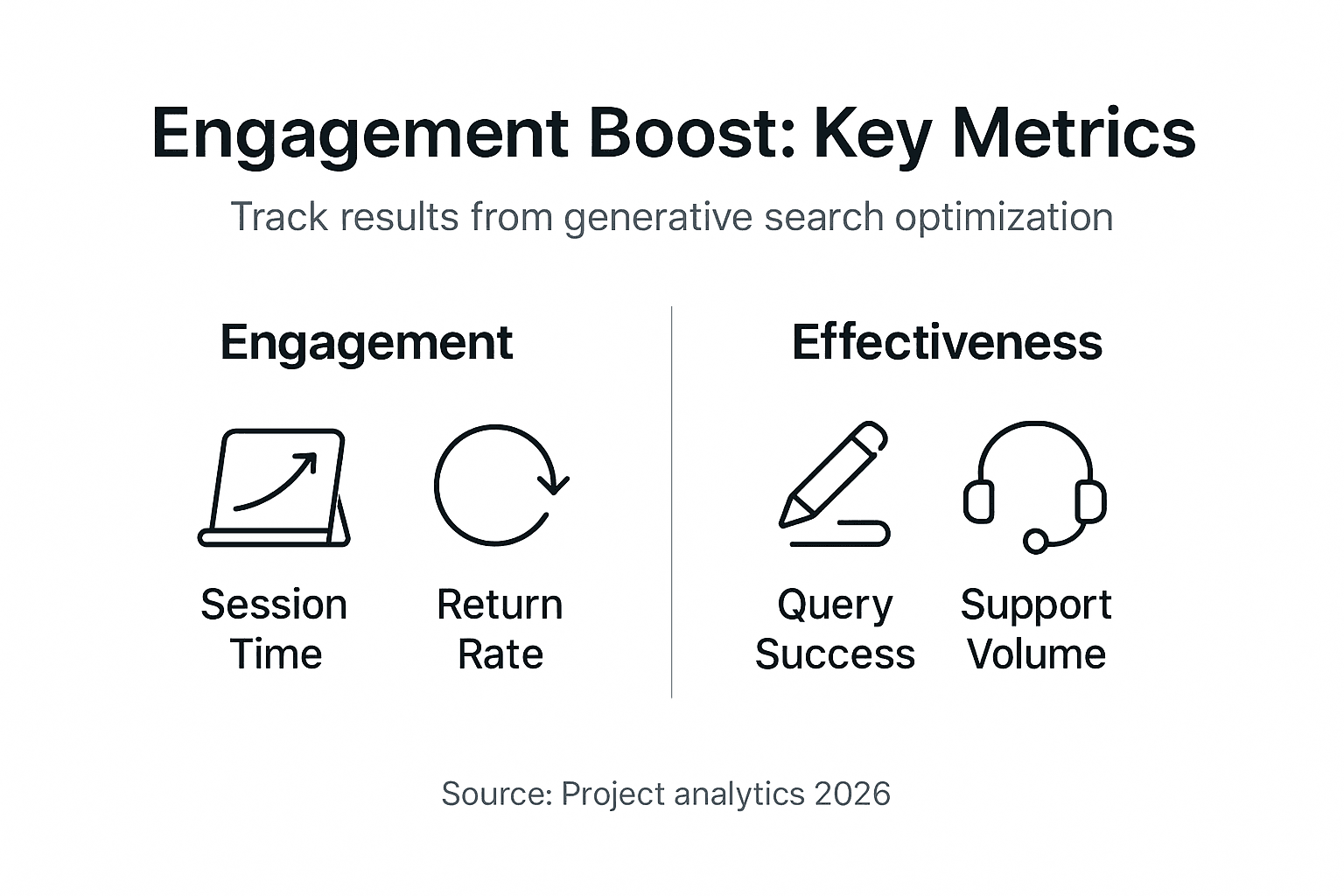
Customer support efficiency improves substantially. Effective self-service search reduces support query volume by enabling users to find answers independently. Organizations report 15–30% reductions in support query time as users resolve issues through optimized search rather than contacting support teams.
Relevance improvements reduce user frustration. Dropping irrelevant results by 25% means users spend less time sorting through unhelpful information and more time engaging with valuable content. This efficiency gain translates to higher satisfaction and retention.
Continuous improvement sustains long-term value. Initial optimization delivers significant gains, but ongoing feedback integration and tuning maintain performance as user needs evolve. Organizations that treat optimization as ongoing practice rather than one-time projects achieve superior sustained results.
Key performance metrics:
- User engagement increase of 25–50% within 6 months
- Support query time reduction of 15–30% within 9 months
- Irrelevant result rate decrease of 20–25% within 4 months
- Query success rate improvement to 80–90% within 8 months
- User satisfaction scores rising 15–20 points within 7 months
To measure success of generative search effectively, establish baseline metrics before optimization begins and track consistently throughout implementation.
For broader context on tracking AI initiative performance, review performance metrics for generative search across different deployment scenarios.
Enhance your business with expert generative search optimization
Implementing generative search optimization successfully requires specialized expertise and proven processes. Airitual offers comprehensive guidance through each phase, from infrastructure readiness to ongoing optimization tuning.
Our generative search optimization process guide ensures your implementation aligns with business objectives while meeting technical requirements. We help you avoid common pitfalls that derail projects and waste resources.
User adoption determines optimization ROI. Our AI user training and awareness programs maximize user effectiveness, reducing dissatisfaction while accelerating value realization from your search investment.
Partner with Airitual to accelerate your AI search implementation and achieve measurable results faster while avoiding costly mistakes.
Frequently asked questions
What are the key prerequisites for generative search optimization?
AI-ready infrastructure with modern data pipelines, skilled tuning personnel, quality labeled training data, and clear business goal alignment form essential prerequisites. Organizations lacking these foundations should address gaps before beginning optimization to avoid project failure and wasted investment.
How long does it usually take to see measurable improvements with generative search optimization?
Most projects require 6–9 months for measurable performance improvements, depending on organizational readiness and resource availability. Early phases focus on infrastructure setup and initial tuning cycles, with visible results emerging around month 4–5 as optimizations accumulate.
What are common mistakes that can cause generative search projects to fail?
Misaligned business and optimization goals, lack of continuous feedback loops, ignoring bias mitigation, and insufficient user training cause 45% of project failures. Organizations that proactively address these areas through governance frameworks and cross-functional collaboration achieve significantly higher success rates.
How much should we budget for a generative search optimization project?
Typical projects cost $150,000–$350,000 depending on data volume, infrastructure requirements, and optimization complexity. Allocate additional budget for ongoing monitoring, governance, and iterative improvements to sustain performance beyond initial deployment.
What metrics indicate successful generative search optimization?
User engagement increases of 25–50%, support query time reductions of 15–30%, and irrelevant result decreases of 20–25% indicate successful optimization. Track these metrics against pre-optimization baselines to validate ROI and identify areas needing further tuning.
Recommended
- Master the Generative Search Optimization Process for Results | Artificial Intelligence
- Generative Search: AI-Powered Student Engagement | Artificial Intelligence
- Top 6 Best Generative Search Tools in 2026 for Enhanced Business Efficiency | Artificial Intelligence
- 6 Key Advantages of Generative Search for Business Efficiency | Artificial Intelligence
- SEO Trends in 2025: How They Shape Small Business Growth – Go Online Now
- Verbeter je leadgeneratie met een data-driven outreach strategie
Recent Comments