

Most american schools still rely on static online resources, yet studies reveal that personalized learning can increase student engagement by over 60 percent. As artificial intelligence tools rapidly reshape education worldwide, understanding generative search becomes crucial for every mid-level manager aiming to keep students motivated and curious. This overview offers practical insights into how generative search transforms traditional classrooms by delivering dynamic, adaptive content tailored to student needs.
Table of Contents
Key Takeaways
| Point | Details |
| Generative Search Enhances Learning | It dynamically creates personalized educational resources tailored to individual student needs and learning styles. |
| Transformative Technologies | Various generative search technologies enable rich content creation across text, audio, and visuals, enhancing interaction and engagement. |
| Implementation Proceeds with Caution | Institutions should pilot these technologies gradually, monitoring outcomes to ensure integration aligns with pedagogical goals. |
| Ethical Considerations are Crucial | Careful evaluation of AI outputs and robust governance are necessary to mitigate risks related to data privacy and content accuracy. |
Generative Search Defined for Education
Generative search represents a groundbreaking technological approach where artificial intelligence dynamically creates and customizes search results specifically for educational contexts. Unlike traditional search methods that merely retrieve existing information, generative search actively generates contextually relevant, personalized learning resources that adapt to individual student needs and learning styles.
At its core, Generative Artificial Intelligence (GenAI) in education involves AI systems capable of producing innovative datasets including text, images, audio, video, and interactive learning materials. These intelligent systems analyze vast educational databases to construct targeted, responsive content that goes beyond simple information retrieval. By understanding nuanced learning patterns, generative search can create:- Customized study guides- Adaptive practice questions- Personalized learning pathways- Real-time explanatory content- Interactive educational simulationsThe transformative potential of generative search lies in its ability to transcend traditional one-size-fits-all educational resources. Educational institutions can leverage these AI-driven tools to provide students with dynamically generated content that responds to individual comprehension levels, learning preferences, and academic objectives. This approach represents a significant shift from static information delivery toward intelligent, responsive educational experiences that can adjust in real-time.
Pro Tip – Strategic AI Integration: Start by piloting generative search technologies in specific departments or subject areas, carefully monitoring student engagement and learning outcomes to build institutional confidence and expertise in AI-enhanced educational tools.
How Generative Search Models Work
Generative search models represent complex technological ecosystems where advanced artificial intelligence processes transform educational information retrieval. These sophisticated systems leverage large language models to comprehend, analyze, and dynamically generate contextually precise learning resources that adapt to unique student requirements and learning contexts.
Large language models in educational contexts function by processing sophisticated algorithms that understand intricate user queries and generate coherent, contextually relevant responses. The underlying architecture involves multiple critical components: natural language processing, semantic understanding, contextual analysis, and intelligent response generation. These models break down complex queries into granular components, enabling them to:
-
Interpret nuanced student questions
-
Extract relevant contextual information
-
Generate precise, tailored educational content
-
Adapt responses based on learning style
-
Provide personalized explanatory frameworks
Moreover, advanced generative agent frameworks like AgentSME demonstrate how artificial intelligence can simulate diverse communication modes, enhancing interactive learning experiences. These systems go beyond traditional information retrieval by creating dynamic, responsive educational interactions that feel personalized and intuitive. The AI continuously learns from each interaction, refining its understanding of student needs and improving response accuracy over time.
Pro Tip – Model Optimization: Regularly validate and fine-tune generative search models using diverse student interaction data to ensure consistently high-quality, contextually relevant educational responses.
Types of Generative Search Technologies
Generative search technologies represent a diverse ecosystem of artificial intelligence tools designed to revolutionize educational content creation and information retrieval. These sophisticated technologies span multiple modalities, each offering unique capabilities for transforming how students and educators interact with digital learning resources.
Generative AI technologies in educational contexts encompass several critical modality types that enable dynamic content generation:
-
Text-to-Text Models: Create written educational content like summaries, explanations, and study guides
-
Text-to-Speech Models: Transform written materials into audio learning resources
-
Text-to-Image Models: Generate visual learning aids, diagrams, and illustrative graphics
-
Interactive Prompt Models: Enable customized content generation based on specific educational inputs
Advanced interactive mega-prompt technologies represent another breakthrough, allowing educators to input detailed classroom specifications and generate highly customized lesson plans. These intelligent systems analyze complex contextual inputs, understanding nuanced educational requirements and producing tailored content that adapts to specific learning environments. The technological sophistication enables unprecedented personalization, moving beyond generic educational resources toward truly adaptive learning experiences.
Here is a summary of key generative search technology types and their unique benefits in education:
| Technology Type | Content Modality | Unique Benefit |
| Text-to-Text | Written summaries | Enables rapid guide and note creation |
| Text-to-Speech | Audio | Enhances accessibility for all learners |
| Text-to-Image | Visuals and graphics | Supports visual and spatial learning |
| Interactive Prompt | Custom modules | Facilitates real-time classroom adaptability |
Pro Tip – Technology Selection: Evaluate generative search technologies based on specific institutional needs, prioritizing platforms that offer multiple content generation modalities and demonstrate robust integration capabilities.
Real-World Applications in Schools
Generative search technologies are transforming educational landscapes by providing innovative solutions that address traditional learning challenges. These AI-driven tools are creating unprecedented opportunities for personalized, adaptive, and interactive learning experiences across multiple academic domains.
AI-powered learning platforms like QANDA demonstrate remarkable practical applications in educational settings. For instance, optical character recognition technologies enable students to receive immediate, step-by-step problem-solving guidance, particularly in complex subjects like mathematics. These platforms offer several key benefits:
Compare generative search benefits for students and educators:
| Stakeholder | Main Advantage | Example Use Case |
| Student | Personalized resources | Instantly tailored math explanations |
| Educator | Adaptive lesson creation | On-demand lesson plan generation |
-
Instant academic feedback
-
Personalized learning pathways
-
Comprehensive problem-solving strategies
-
Adaptive difficulty levels
-
Real-time error correction
Mobile inquiry-based learning environments represent another groundbreaking approach to integrating generative search technologies. By empowering students to create, share, and evaluate their own questions, these systems promote critical thinking and higher-order cognitive skills. The technology transforms traditional passive learning models into dynamic, student-driven educational experiences that encourage intellectual curiosity and independent knowledge construction.
Pro Tip – Gradual Integration: Implement generative search technologies incrementally, starting with pilot programs in select classrooms to build institutional confidence and understand specific implementation challenges.
Risks, Privacy, and Implementation Challenges
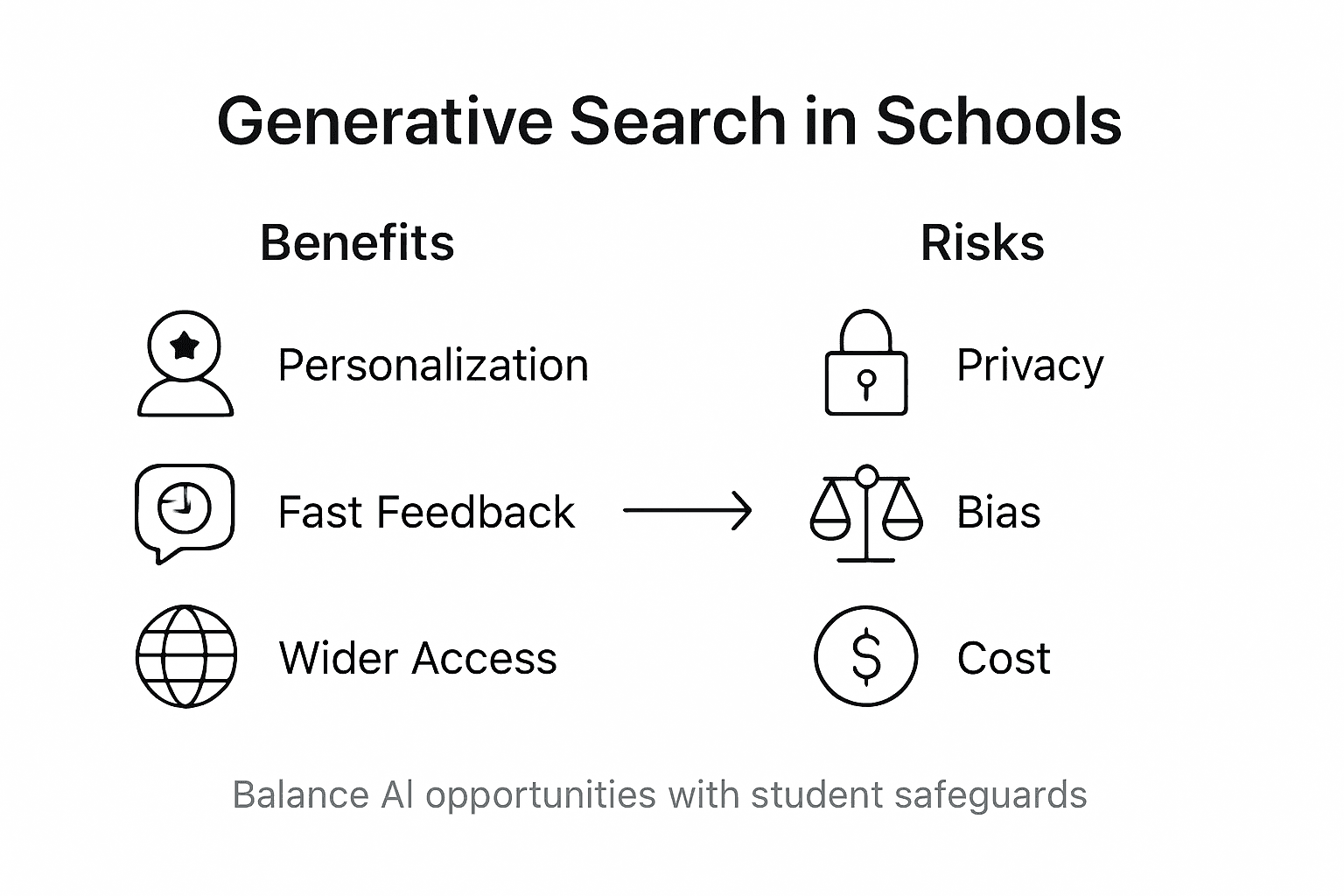
Generative search technologies in educational settings introduce complex ethical and operational challenges that demand strategic, proactive management. Educational institutions must navigate a nuanced landscape of technological potential and potential vulnerabilities, ensuring responsible AI implementation that protects student interests and maintains academic integrity.
Generative AI systems require critical evaluation of their outputs, as these technologies fundamentally lack genuine conceptual understanding. The potential risks include:
-
Generating factually inaccurate content
-
Producing biased or inappropriate educational materials
-
Compromising student data privacy
-
Creating potential intellectual property conflicts
-
Introducing unintended algorithmic biases
AI risk management frameworks provide essential guidelines for mitigating these challenges. Successful implementation requires comprehensive strategies that balance technological innovation with robust ethical safeguards. Educational leaders must develop multifaceted approaches that include continuous monitoring, transparent AI usage policies, and adaptive risk assessment protocols.
Pro Tip – Risk Mitigation: Establish a dedicated AI governance committee that includes technological experts, educators, ethicists, and student representatives to develop comprehensive AI implementation strategies.
Unlock the Power of Generative Search to Transform Student Engagement
Generative search is reshaping education by offering personalized, AI-driven learning experiences that dynamically adapt to each student’s unique needs. If you are facing challenges like delivering tailored content, managing real-time adaptive lessons, or ensuring meaningful student interaction, generative search technologies can provide strategic solutions. By embracing terms like “large language models” and “interactive prompt models,” educators and administrators can overcome barriers to engagement while improving learning outcomes.
At AirItual, we specialize in deploying AI-powered educational tools that take generative search beyond theory into practical, measurable results. Our customized AI integrations help institutions create personalized study guides, adaptive problem-solving support, and interactive content that evolves with student progress. Make your classrooms more responsive and your lessons more effective with technology designed to empower both teachers and learners.
Explore how our AI solutions drive educational innovation and start your journey toward smarter learning today.
Ready to elevate student engagement through generative search? Connect with us now at AirItual to schedule a free strategy session and transform how your institution leverages AI for education.
Frequently Asked Questions
What is generative search in education?
Generative search in education refers to an AI-driven approach that actively creates and customizes search results, providing personalized learning resources tailored to individual student needs and learning styles.
How do generative search models work?
Generative search models leverage large language models to analyze user queries and generate contextually precise educational content. They break down complex questions, enabling the creation of tailored responses that adapt to a student’s unique learning context.
What are some types of generative search technologies?
Generative search technologies include text-to-text models for written content, text-to-speech models for audio resources, text-to-image models for visuals, and interactive prompt models that facilitate customized content generation based on specific educational inputs.
What are the risks associated with using generative search technologies in education?
Risks include the potential for generating factually inaccurate or biased content, compromising student data privacy, and creating intellectual property conflicts. It’s crucial for institutions to develop robust strategies to mitigate these challenges.