

Finding new ways to improve everyday business operations remains a constant challenge for many North American enterprise leaders. With digital demands rising and customer expectations changing, exploring artificial intelligence offers a pathway to both greater efficiency and deeper engagement. This practical guide highlights how a systematic approach to identifying AI opportunities within your organization can deliver meaningful results without unnecessary complexity.
Table of Contents
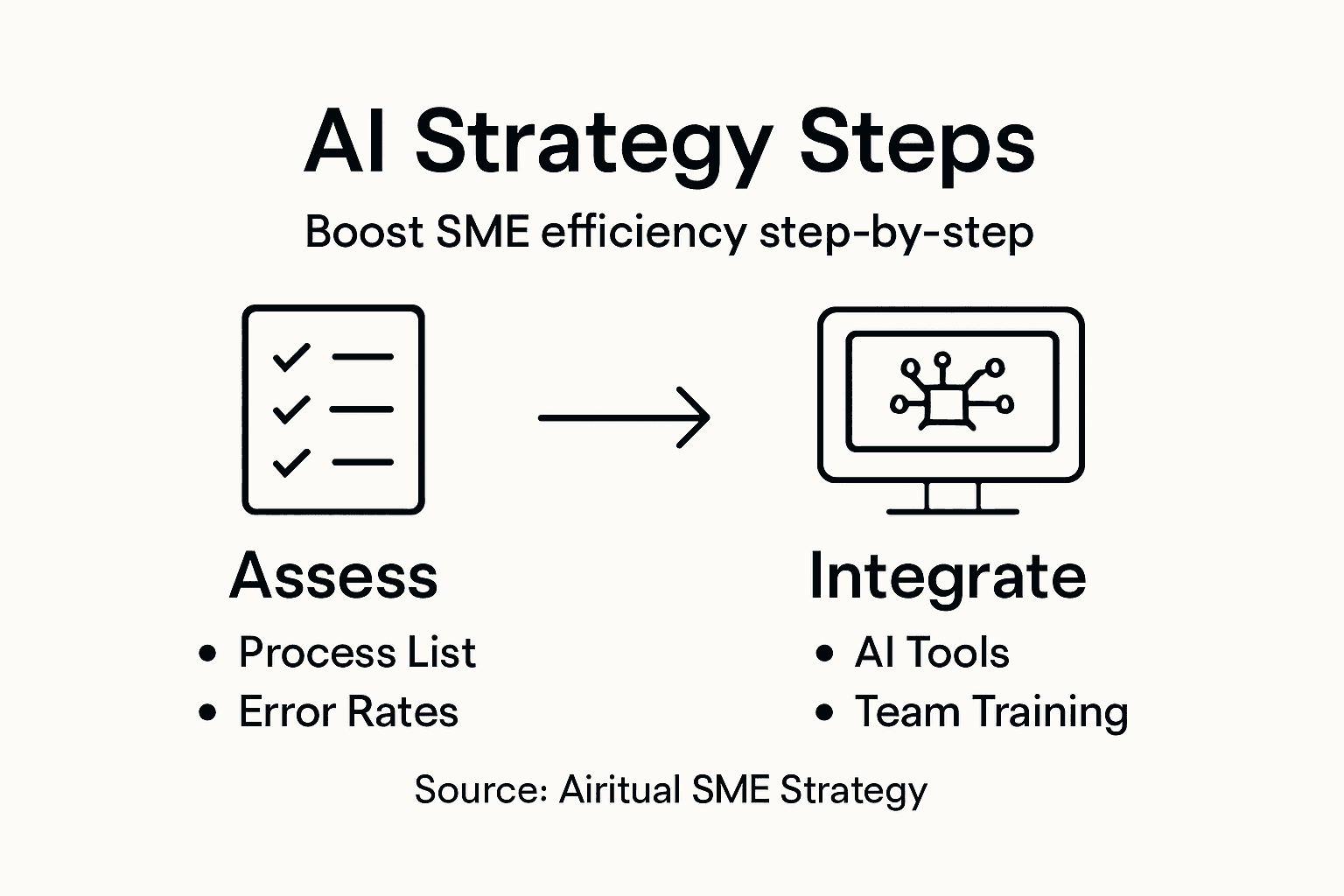
- Step 1: Assess Current Operations For AI Opportunities
- Step 2: Define Measurable AI Goals And Key Outcomes
- Step 3: Select And Customize The Right AI Solutions
- Step 4: Integrate AI Tools Into Daily Workflows
- Step 5: Monitor Results And Refine Your AI Approach
Quick Summary
| Key Insight | Explanation |
|---|---|
| 1. Assess Current Operations | Map out business processes to identify areas where AI can improve efficiency and effectiveness. |
| 2. Set SMART AI Goals | Define specific, measurable, achievable, relevant, and time-bound objectives to guide AI initiatives. |
| 3. Select Suitable AI Solutions | Evaluate AI technologies for scalability, compatibility, and customization to meet business needs. |
| 4. Integrate AI Gradually | Roll out AI tools incrementally and provide thorough employee training for smooth adaptation. |
| 5. Monitor and Refine Approaches | Continuously track performance and gather feedback to improve AI integration and effectiveness. |
Step 1: Assess current operations for AI opportunities
Identifying potential AI opportunities within your small to medium enterprise requires a systematic and strategic approach. The goal is to pinpoint operational areas where artificial intelligence can deliver meaningful efficiency gains and competitive advantages.
To conduct a comprehensive assessment, start by mapping your current business processes and workflow challenges. Analyzing digital transformation barriers reveals critical insights into where AI can bridge performance gaps. Focus on these key evaluation areas:
- Repetitive tasks that consume significant employee time
- Data-intensive processes requiring manual analysis
- Customer interaction channels with potential automation
- Decision-making workflows dependent on complex information synthesis
During your assessment, prioritize processes with the following characteristics:
- High transaction volumes
- Standardized steps
- Predictable decision patterns
- Measurable performance metrics
Successful SMEs recognize that AI implementation isn’t about wholesale technological replacement, but strategic augmentation of existing capabilities. Identifying meaningful impact areas requires understanding both technological potential and organizational readiness.

Here’s a comparison of common AI opportunity types and their potential business impact:
| AI Opportunity Type | Example Scenario | Expected Business Impact |
|---|---|---|
| Repetitive Task | Invoice data entry | Reduced manual errors and labor costs |
| Data-Intensive Process | Sales forecast reporting | Faster, more accurate decisions |
| Customer Interaction | Automated chatbot for support | 24/7 service, improved satisfaction |
| Decision Workflows | AI-powered risk assessments | Faster responses, objective evaluations |
Strategic AI adoption starts with honest operational assessment, not technological hype.
Pro tip: Create a detailed process inventory documenting time spent, error rates, and potential automation opportunities before investing in any AI solution.
Step 2: Define measurable AI goals and key outcomes
Successful AI implementation for small and medium enterprises demands strategic goal setting that transforms technological potential into tangible business improvements. By establishing clear measurement frameworks, you can ensure your AI initiatives deliver meaningful and verifiable results.
When defining your AI goals, focus on creating objectives that are specific, measurable, achievable, relevant, and time-bound (SMART). Consider the following key areas for goal development:
- Operational efficiency metrics
- Cost reduction targets
- Customer experience improvement indicators
- Process automation performance benchmarks
To create robust AI outcomes, break down your objectives into quantifiable elements:
- Identify current baseline performance
- Set specific percentage improvements
- Define precise time frames for achievement
- Establish clear success criteria
Responsible AI implementation requires more than just technological deployment – it demands a comprehensive approach that aligns technological capabilities with strategic organizational needs.
Effective AI goals transform technological potential into measurable business value.
Pro tip: Develop a dashboard that tracks your AI initiative’s performance against predefined metrics, ensuring continuous visibility and accountability.
Step 3: Select and customize the right AI solutions
Navigating the complex landscape of AI technologies requires a strategic approach tailored specifically to your small or medium enterprise’s unique operational needs. Analyzing AI solution compatibility involves understanding how different technologies can address your specific business challenges and integrate seamlessly with existing workflows.
When selecting AI solutions, consider these critical evaluation criteria:
- Scalability of the AI platform
- Compatibility with existing technology infrastructure
- Customization potential for your specific use cases
- Cost-effectiveness and potential return on investment
- Ease of implementation and learning curve
To effectively choose and customize your AI solution, follow these systematic steps:
- Conduct a comprehensive technology audit
- Map AI capabilities to specific business requirements
- Request detailed demonstrations and proof-of-concept trials
- Evaluate vendor support and training resources
- Plan for gradual, phased implementation
Tailoring AI technologies is not about finding a universal solution, but creating a bespoke approach that aligns with your organization’s strategic objectives and operational realities.
The right AI solution transforms technological potential into strategic advantage.
Pro tip: Prioritize AI solutions that offer flexible integration and robust customization options, ensuring the technology can evolve alongside your business needs.
Step 4: Integrate AI tools into daily workflows
Successfully embedding AI technologies into your organization requires a thoughtful and strategic approach that transforms technological potential into practical operational improvements. Embedding AI into organizational processes demands careful redesign of existing workflows and a commitment to maintaining human oversight and strategic direction.
To effectively integrate AI tools into daily operations, consider these critical implementation strategies:
- Gradual rollout of AI capabilities
- Employee training and change management
- Clear performance metrics for AI tools
- Regular feedback loops and continuous improvement
- Flexible adaptation of workflow processes
Implement AI integration through these systematic steps:
- Identify repetitive or time-consuming tasks suitable for automation
- Develop comprehensive training programs for team members
- Establish clear protocols for AI tool usage
- Create monitoring mechanisms to track AI performance
- Build flexibility into workflow design
Transforming workplace productivity requires more than technological implementation – it demands a holistic approach that empowers employees and aligns AI capabilities with strategic organizational objectives.
Successful AI integration is about augmenting human capabilities, not replacing them.
Pro tip: Implement AI tools incrementally and maintain open communication channels to help team members understand and embrace technological changes.
Step 5: Monitor results and refine your AI approach
Continuous evaluation is the cornerstone of successful AI implementation, transforming initial deployments into strategic, adaptive technological solutions. Systematic performance tracking enables small and medium enterprises to understand AI’s real-world impact and make data-driven refinements that maximize operational efficiency.
Establish a comprehensive monitoring framework by focusing on these critical assessment dimensions:
- Quantitative performance metrics
- Qualitative employee feedback
- Operational efficiency improvements
- Cost savings and ROI indicators
- Alignment with strategic objectives
Implement a robust monitoring approach through these strategic steps:
- Define clear, measurable key performance indicators
- Create regular reporting and review cycles
- Collect multidimensional performance data
- Analyze results against initial expectations
- Develop iterative improvement strategies
Continuous AI system refinement requires a dynamic, flexible approach that balances technological potential with organizational learning and adaptation.
Effective AI monitoring transforms technology from a static tool to an evolving strategic asset.
Pro tip: Implement a quarterly AI performance review that includes both quantitative metrics and qualitative insights from team members who interact with the technology.
This summary table shows how each step in the AI journey contributes to SME success:
| Implementation Step | Core Focus | Key Contribution to SME Strategic Goals |
|---|---|---|
| Assess Operations | Identify high-impact opportunities | Targeted efficiency improvements |
| Define Measurable Goals | Set SMART objectives | Trackable progress and ROI |
| Select & Customize Solutions | Evaluate and adapt AI platforms | Solutions aligned with real business needs |
| Integrate into Workflows | Embed tools and manage change | Smooth adoption and staff empowerment |
| Monitor & Refine | Ongoing performance improvement | Sustainable results and competitive agility |
Unlock Your SME’s Full Potential with Tailored AI Solutions
Struggling to identify the right AI opportunities or set clear, measurable goals for your small or medium enterprise? You are not alone. Many businesses face challenges like finding scalable AI platforms and seamlessly integrating technology into daily workflows while ensuring employee buy-in. This article lays out the critical steps for AI adoption, focusing on leveraging data-driven insights to boost efficiency and sustain competitive advantage.
At Airitual, we specialize in partnering with organizations like yours to navigate these exact challenges. Our customized AI services range from strategic consulting to implementation support designed for real-world SME environments. Explore our expert offerings in Classes | Artificial Intelligence to empower your team with hands-on knowledge. For location-based or industry-specific AI integration, visit our GEO | Artificial Intelligence section. Take the first step toward measurable AI success now by contacting us through our main site for a free strategy session and turn your AI ambitions into actionable business transformation.
Frequently Asked Questions
How can I assess my current operations for AI opportunities?
Start by mapping your existing business processes and identifying workflow challenges. Focus on areas with repetitive tasks, data-intensive processes, customer interactions, and decision-making workflows to find where AI can improve efficiency within the next few weeks.
What specific goals should I set for AI implementation in my SME?
Set SMART (Specific, Measurable, Achievable, Relevant, Time-bound) goals that focus on operational efficiency, cost reduction, and customer experience improvements. For example, aim to reduce operational costs by 15% within six months through targeted automation initiatives.
How do I choose the right AI solution for my business needs?
Evaluate AI solutions based on scalability, compatibility, customization potential, cost-effectiveness, and ease of implementation. Conduct a technology audit and request demonstrations to ensure the chosen AI solution meets your specific operational requirements.
What steps should I take to integrate AI tools into my daily workflows?
Implement AI tools through a gradual rollout, ensuring employees receive proper training and support. Start with specific tasks suitable for automation, and establish clear usage protocols, aiming to increase productivity and reduce task completion time by up to 30% within a few months.
How can I monitor and refine my AI initiatives effectively?
Establish a comprehensive monitoring framework using quantitative performance metrics and qualitative employee feedback. Set up regular reporting cycles to assess performance against defined indicators and plan for iterative improvements every quarter.
Recommended
- 7 Essential Steps for an Effective AI Automation Checklist | Artificial Intelligence
- 7 Essential AI Strategy List Tips for IT Managers | Artificial Intelligence
- Lead Generation with Artificial Intelligence for Higher ROI | Artificial Intelligence
- What Is Artificial Intelligence and Why It Matters | Artificial Intelligence
- Cómo crear estrategia de IA para negocios paso a paso – Bit2Brain
Recent Comments