

AI adoption in U.S. small businesses increases operational efficiency by automating repetitive tasks, reducing manual workload by up to 40%. This transformation extends beyond simple task automation to reshape how small enterprises interact with customers, manage resources, and drive growth. For small business leaders navigating competitive markets in 2026, understanding AI’s practical applications unlocks measurable advantages in both operations and customer relationships without requiring deep technical expertise.
Table of Contents
- Introduction To AI In Small Business
- Core AI Applications For Operational Efficiency
- Enhancing Customer Engagement Through AI
- Common Misconceptions About AI In Small Business
- Cost, ROI, And Strategic Decision-Making For AI
- Framework And Best Practices For AI Integration
- Maximizing AI Value: Beyond Automation
- Conclusion And Next Steps
- Explore AI Solutions Tailored For Your Small Business
Key takeaways
| Point | Details |
|---|---|
| Workload reduction | AI automates up to 40% of repetitive manual tasks, freeing time for strategic work |
| Customer engagement lift | AI-driven personalization increases customer retention rates by 20% or more |
| Phased adoption success | Businesses using staged AI implementation see 30% higher success rates |
| Fast payback period | 65% of small businesses achieve cost-effective AI solutions within the first year |
| Low technical barriers | 70% successfully implement AI using turnkey solutions or consultants |
Introduction to AI in small business
Artificial intelligence for small businesses means practical tools that learn from data to automate decisions, predict outcomes, and personalize customer interactions. These technologies have matured significantly, moving from experimental novelties to reliable solutions that small enterprises can adopt without hiring data scientists or building custom infrastructure.
The accessibility revolution stems from turnkey platforms designed specifically for resource-conscious businesses. 70% of small businesses successfully implement AI using turnkey solutions or external consultants, eliminating the need for in-house technical teams. This democratization means even single-location retailers or service providers can leverage sophisticated AI capabilities that were once exclusive to large corporations.
Small businesses gain multiple AI benefits from adoption:
- Operational efficiency through intelligent task automation and resource optimization
- Cost savings by reducing manual labor hours and minimizing waste
- Enhanced customer experiences via personalized interactions and faster response times
- Data-driven insights that inform better strategic decisions
The combination of accessible technology, proven ROI, and competitive pressure makes 2026 the pivotal year for small business AI adoption. Those who integrate AI thoughtfully position themselves to outperform competitors still relying solely on manual processes.
Core AI applications for operational efficiency
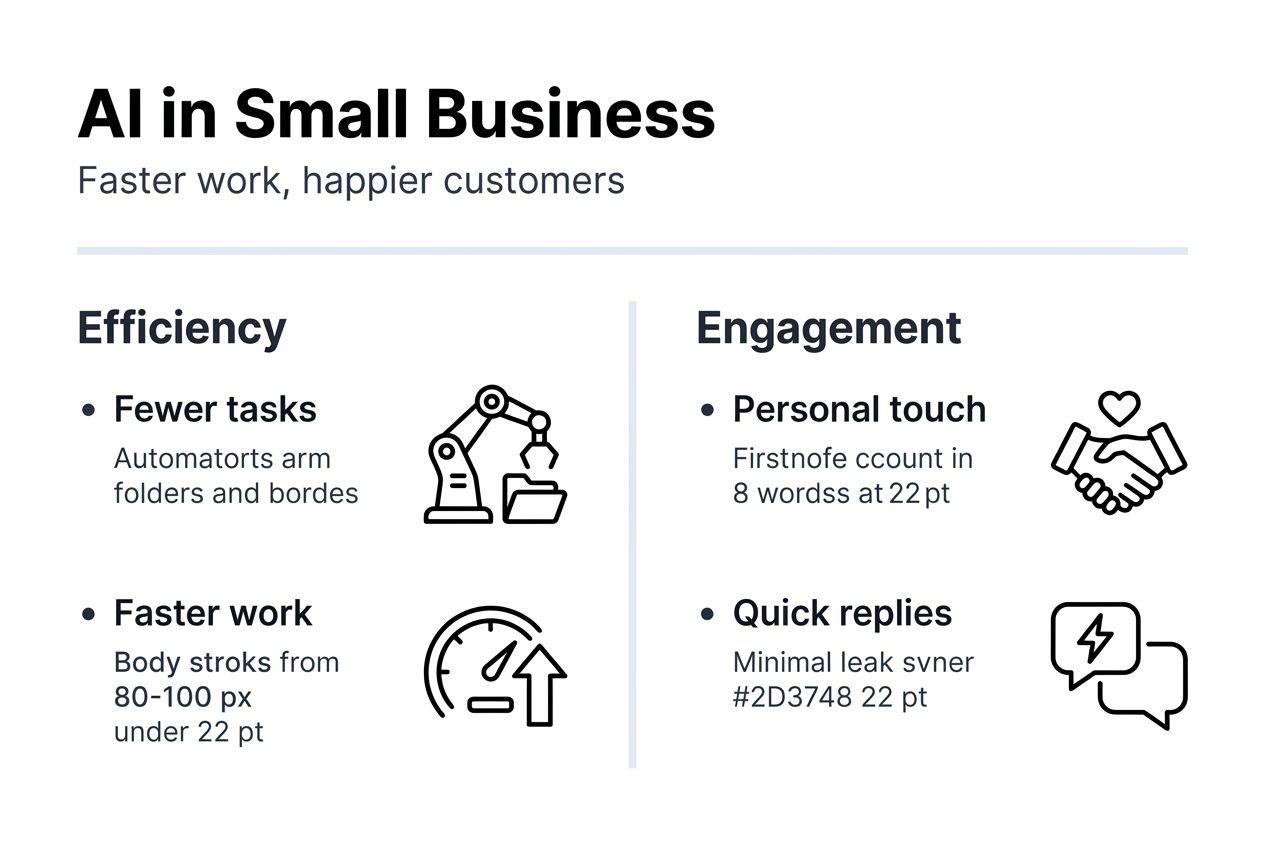
AI adoption automates repetitive tasks reducing manual workload by up to 40%, delivering immediate operational relief. This transformation touches nearly every business function, from scheduling to financial management.
Small businesses leverage AI operational applications across key areas:
- Scheduling automation that optimizes appointments, staff shifts, and resource allocation without manual coordination
- Invoice processing and expense categorization that eliminates data entry and accelerates financial closes
- Inventory management systems that predict demand patterns, preventing both stockouts and overstock situations
- Document processing that extracts relevant information from receipts, contracts, and forms instantly
Predictive analytics represent a powerful efficiency multiplier. AI systems analyze historical patterns to forecast customer demand, seasonal trends, and resource needs. A small retailer might use AI to predict which products will sell during specific weeks, adjusting inventory orders accordingly and reducing storage costs.
Employee adaptation timelines vary, but most staff members gain proficiency with new AI tools within two to four weeks of hands-on use. Automating workflows typically starts with identifying the most time-consuming repetitive tasks, then selecting appropriate tools that integrate with existing systems.
Pro Tip: Start your AI journey by automating one high-frequency, low-complexity task like appointment reminders or receipt categorization. Early wins build team confidence and demonstrate value before tackling complex processes.
The operational efficiency gains compound over time. As AI systems learn from more data, their accuracy improves, and businesses discover additional automation opportunities they initially overlooked.

Enhancing customer engagement through AI
AI-driven personalized marketing can increase customer retention rates by 20% or more, transforming how small businesses maintain relationships and drive repeat business. This engagement enhancement goes beyond basic email campaigns to create genuinely personalized experiences.
AI-powered chatbots provide 24/7 customer support without requiring night shift staff. These systems handle common questions, process simple transactions, and escalate complex issues to human team members during business hours. Customers appreciate instant responses, while businesses reduce support costs and capture inquiries that would otherwise go unanswered outside regular hours.
Personalized marketing reaches new sophistication levels through AI analysis of customer behavior, purchase history, and engagement patterns. Small businesses can now deliver:
- Product recommendations tailored to individual customer preferences and browsing history
- Timing optimization that sends promotional messages when customers are most likely to engage
- Dynamic content that adjusts email layouts and offers based on recipient characteristics
- Sentiment analysis that identifies at-risk customers before they churn
Response time improvements directly impact customer satisfaction scores. AI systems can acknowledge inquiries instantly, categorize requests by urgency, and route them to the most qualified team member. This customer engagement optimization reduces the frustration of waiting for basic information.
The loyalty impact extends beyond immediate transactions. When customers feel understood through personalized interactions and receive timely, relevant communication, they develop stronger emotional connections to brands. Small businesses gain competitive advantages against larger retailers by using AI to deliver the attentive, personalized service that customers associate with local businesses, but at scale.
Effective business communication through AI-enhanced channels strengthens relationships systematically rather than relying on sporadic manual outreach.
Common misconceptions about AI in small business
Many small business owners hesitate to explore AI based on outdated assumptions about technical requirements, costs, and workforce impacts. Understanding reality helps overcome these barriers.
Myth number one claims AI demands deep technical expertise or in-house data scientists. 70% of small businesses use turnkey solutions or consultants, completely bypassing the need for technical staff. Modern AI platforms feature intuitive interfaces designed for business users, not programmers. Implementation often resembles adopting any new software tool rather than a technology project.
The cost barrier myth suggests AI requires massive upfront investments with uncertain returns. Reality shows 65% of small businesses find AI cost-effective within first year, with many solutions available through affordable monthly subscriptions. Starting costs for basic AI tools often match or undercut traditional software licenses.
Perhaps the most damaging misconception involves job displacement. AI primarily augments human capabilities rather than replacing workers:
- Routine tasks get automated, freeing employees for relationship building and strategic thinking
- Staff members gain tools that enhance their effectiveness and job satisfaction
- Businesses typically redeploy saved time toward growth activities rather than workforce reductions
- Human judgment remains essential for complex decisions, creative problem solving, and empathetic customer interactions
Small businesses using AI adoption strategies report that employees appreciate relief from tedious tasks and the opportunity to focus on more meaningful work. The augmentation model strengthens teams rather than diminishing them.
Pro Tip: When evaluating AI solutions, prioritize fit with your specific workflows over feature lists or price alone. The best tool solves your actual problems elegantly rather than offering the most capabilities you’ll never use.
Dispelling these myths opens pathways for small businesses to explore AI opportunities with realistic expectations and appropriate caution.
Cost, ROI, and strategic decision-making for AI
65% of small businesses report AI solutions are cost-effective within the first year, establishing AI as a viable investment rather than a speculative gamble. Understanding the economics helps leaders make informed decisions.
Typical ROI timelines span 6 to 18 months depending on implementation scope and business model. Service businesses often see faster returns through customer engagement improvements, while inventory-heavy retailers benefit more gradually as AI optimizes stock levels over multiple seasons.
Common failure points include selecting tools misaligned with actual needs, inadequate employee training, and unrealistic expectations about immediate transformation. Successful implementations share characteristics: clear goals, phased deployment, strong change management, and commitment to iterative improvement.
Decision criteria for evaluating AI investments:
- Goal alignment: Does the solution address your most pressing operational pain points or growth opportunities?
- Integration ease: Can the tool connect with your existing systems without extensive customization?
- Scalability: Will the solution grow with your business or require replacement as you expand?
- Support quality: Does the vendor provide training, troubleshooting, and ongoing optimization guidance?
- Total cost of ownership: Beyond subscription fees, what implementation, training, and maintenance costs should you budget?
| Approach | Best For | Typical Cost | Implementation Time | Customization Level |
|---|---|---|---|---|
| Turnkey SaaS | Standard processes | $50-500/month | 1-4 weeks | Low |
| Consulting-led | Unique workflows | $5,000-50,000 | 2-6 months | High |
| Hybrid model | Mixed needs | $200-2,000/month + setup | 1-3 months | Medium |
The evaluation process should progress systematically. Start by documenting current workflows and identifying specific inefficiencies or opportunities. Research solutions designed for businesses of similar size and industry. Request demonstrations focused on your use cases rather than generic feature tours. Calculate potential time savings and revenue impacts to establish ROI projections.
AI ROI data consistently shows that businesses with clear success metrics and phased implementation plans achieve better outcomes than those pursuing broad, undefined AI transformation. AI strategy guides help structure this decision-making process.
Framework and best practices for AI integration
Successful AI integration follows a structured approach rather than sporadic tool adoption. This three-stage framework helps small businesses maximize value while minimizing disruption.
Stage 1: Assessment involves documenting current processes, identifying automation opportunities, and establishing success metrics. Businesses should prioritize high-frequency tasks with clear completion criteria over complex, judgment-heavy processes. This stage typically requires 2 to 4 weeks of internal analysis.
Stage 2: Integration encompasses tool selection, technical setup, and initial deployment. Best practices include:
- Start with a single department or process rather than organization-wide rollout
- Ensure technical compatibility with existing systems before purchase
- Establish feedback channels so users can report issues and suggest improvements
- Set realistic timelines that account for learning curves and adjustment periods
- Document new workflows and create reference materials for consistent adoption
Stage 3: Optimization focuses on continuous improvement as teams gain experience and identify additional opportunities. Regular review cycles every 4 to 6 weeks help identify what’s working, what needs adjustment, and where to expand AI usage next.
Employee buy-in determines success or failure more than technical factors. Change management strategies include involving staff in tool selection, emphasizing how AI makes their jobs easier rather than threatening job security, providing adequate training time, and celebrating early wins publicly.
Measurable success metrics should align with business goals: percentage reduction in time spent on specific tasks, customer retention rate improvements, error rate decreases in data processing, or response time reductions for customer inquiries.
Pro Tip: Invest heavily in training during the first month of any new AI tool deployment. Well-trained employees adopt tools enthusiastically, while under-trained staff resist change and revert to old methods.
AI integration frameworks provide detailed roadmaps, while AI adoption best practices address common implementation challenges specific to educational and service contexts.
Maximizing AI value: beyond automation
While efficiency gains justify initial AI investments, the technology’s greatest value often emerges in revenue growth and strategic innovation. Forward-thinking small businesses leverage AI to identify new opportunities rather than simply reducing costs.
AI-enhanced customer insights reveal patterns invisible to manual analysis. Purchase behavior analysis might uncover that customers who buy product A within 30 days of product B have 3x higher lifetime value, informing both marketing strategy and inventory planning. Sentiment analysis of customer feedback identifies emerging preferences before they become obvious trends.
Revenue growth potential reaches 15 to 20% for businesses that apply AI-driven engagement strategies systematically. This growth stems from multiple sources:
- Improved conversion rates through better-timed, more relevant marketing
- Increased average order values via intelligent product recommendations
- Enhanced customer lifetime value through proactive retention efforts
- New revenue streams identified through data analysis of customer needs
Some small businesses expand their AI use to innovate core offerings. A local service provider might develop an AI-powered customer portal that becomes a competitive differentiator. A retailer could use AI to offer virtual styling services that larger competitors don’t provide.
Balancing efficiency and innovation requires intentional strategy. Businesses should allocate roughly 70% of AI efforts toward proven efficiency gains while reserving 30% for experimental applications that might unlock new value. This balance maintains immediate ROI while exploring longer-term opportunities.
The competitive advantage compounds over time. As AI systems accumulate more business-specific data, they become increasingly valuable and difficult for competitors to replicate. A business with three years of AI-analyzed customer data possesses insights no new market entrant can match immediately.
Conclusion and next steps
AI integration offers U.S. small businesses concrete paths to enhanced efficiency and deeper customer engagement. The evidence demonstrates that concerns about technical barriers, prohibitive costs, and workforce displacement are largely unfounded for businesses that approach AI strategically.
Successful adoption requires acknowledging both opportunities and challenges. Clear goal-setting, phased implementation, adequate training, and commitment to continuous improvement separate successful AI users from disappointed experimenters. The 40% workload reduction and 20% retention improvements documented across thousands of implementations represent achievable outcomes, not exceptional cases.
Starting your AI journey involves:
- Conducting an honest assessment of your highest-impact automation opportunities
- Researching solutions proven effective for businesses similar to yours
- Beginning with limited scope to build experience and confidence
- Seeking strategic partnerships with consultants who understand small business realities
The small businesses thriving in 2026 treat AI as an ongoing capability to develop rather than a one-time project to complete. Resources for deeper learning include industry-specific case studies, implementation frameworks, and consultation with experienced AI integration specialists who can translate general capabilities into solutions for your specific context.
Explore AI solutions tailored for your small business
Airitual specializes in helping small businesses navigate AI adoption with practical, results-focused solutions. Our AI training programs build internal capabilities so your team can leverage AI tools confidently and independently. We offer consulting services that assess your unique operational challenges and design phased implementation roadmaps aligned with your budget and goals. Join our educational webinars to learn from real-world case studies and ask questions about your specific situation. Whether you’re exploring initial AI opportunities or optimizing existing implementations, Airitual provides the expertise and partnership approach that helps small businesses realize measurable AI benefits without unnecessary complexity or risk.
FAQ
What are the first steps for a small business to adopt AI?
Begin by conducting an internal assessment identifying your most time-consuming repetitive tasks and customer engagement pain points. Select one or two AI tools aligned with these specific needs rather than attempting broad transformation. Implement in phases, starting with a pilot in one department, and invest in thorough training so your team adopts the tools confidently.
How long does it typically take to see ROI from AI investments?
Most small businesses achieve measurable returns within 6 to 12 months of implementation. 65% report cost-effective AI solutions within the first year, though timelines vary based on solution complexity and how well defined your success metrics are. Phased implementations with clear goals typically deliver faster, more predictable returns than broad, unfocused AI adoption.
Can AI replace employees in a small business?
AI primarily augments human capabilities rather than replacing workers. The technology automates routine, repetitive tasks, freeing employees to focus on relationship building, creative problem solving, and strategic work that requires human judgment. Most small businesses redeploy time saved through automation toward growth activities rather than workforce reductions, and employees typically appreciate relief from tedious tasks.
What types of AI tools are best for service-based small businesses?
Service businesses benefit most from AI chatbots that provide 24/7 customer support and answer common questions instantly. Personalized marketing platforms that analyze customer behavior and optimize communication timing drive retention improvements. Turnkey solutions designed specifically for service industries integrate quickly and require minimal technical expertise, making them ideal starting points for businesses without dedicated IT resources.
Recent Comments