

Entrepreneurs today face a paradox: AI tools promise transformative growth, yet most business leaders remain uncertain about where to start or which solutions deliver real value. The confusion is understandable given the rapid evolution of artificial intelligence technologies and the overwhelming number of platforms competing for attention. However, AI has moved beyond experimental status to become a fundamental driver of competitive advantage, operational efficiency, and customer engagement. This article cuts through the noise to explain why AI matters specifically to entrepreneurs in 2026, how it transforms core business functions, and what actionable steps you can take to harness its power effectively.
Table of Contents
- Understanding AI’s Role In Transforming Entrepreneurial Operations
- How AI Enhances Customer Engagement And Marketing Effectiveness
- Choosing The Right AI Tools And Aligning AI Strategy With Business Goals
- Measuring AI Impact And Scaling Successful Initiatives
- Explore AI Solutions Tailored For Entrepreneurs
Key takeaways
| Point | Details |
|---|---|
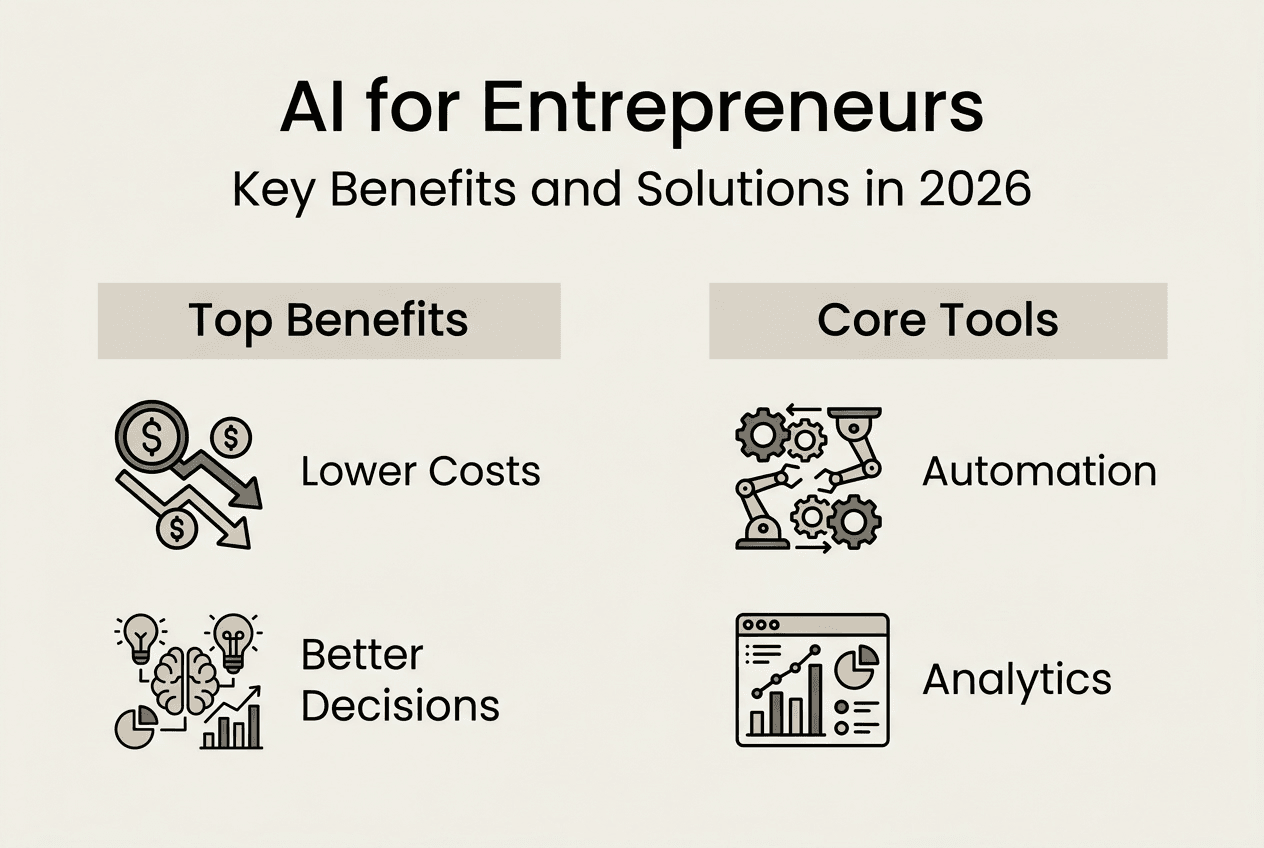
| Operational efficiency | AI automates repetitive tasks, reducing costs and freeing time for strategic work. |
| Customer engagement | Personalized AI marketing increases conversion rates and builds stronger customer relationships. |
| Strategic alignment | Successful AI adoption requires matching tools to specific business goals rather than chasing trends. |
| Measurable impact | Tracking KPIs ensures AI investments deliver sustained ROI and guide scaling decisions. |
Understanding AI’s role in transforming entrepreneurial operations
Artificial intelligence encompasses several technologies that enable machines to perform tasks typically requiring human intelligence. For entrepreneurs, the most relevant subsets include automation (executing routine processes without human intervention), machine learning (systems that improve through experience), and natural language processing (understanding and generating human language). These capabilities translate into practical business applications that streamline operations and increase efficiency across multiple functions.
AI impacts three critical operational areas for growing businesses. Workflow automation handles repetitive administrative tasks like data entry, invoice processing, and appointment scheduling. Inventory management systems use predictive analytics to optimize stock levels, reducing waste while preventing shortages. Customer service chatbots provide 24/7 support, answering common questions and escalating complex issues to human agents only when necessary.

The measurable benefits are substantial. Businesses implementing AI automation report cost reductions of 20 to 40 percent in affected processes, with time savings allowing teams to focus on revenue generating activities. Error rates drop significantly when machines handle data intensive tasks, improving accuracy in financial records, order fulfillment, and compliance documentation. These improvements compound over time as systems learn from patterns and refine their performance.
Pro Tip: Prioritize AI tools that integrate seamlessly with your existing software ecosystem. The best automation solution is worthless if it creates data silos or requires manual workarounds to connect with your CRM, accounting platform, or communication tools.
Identifying automation opportunities in your business requires systematic evaluation:
- Map all recurring tasks that consume more than two hours weekly
- Analyze which processes follow consistent rules or patterns
- Calculate the current labor cost and error rate for each candidate task
- Research AI solutions designed specifically for your industry and business size
- Start with one high impact, low complexity process to build confidence and demonstrate value
Understanding the role of AI in operations helps you move from theoretical knowledge to practical implementation. The key is recognizing that AI serves as a force multiplier for your team rather than a replacement for human judgment and creativity.
How AI enhances customer engagement and marketing effectiveness
Personalization has evolved from a nice marketing feature to a customer expectation. AI powered personalization engines analyze browsing behavior, purchase history, and demographic data to tailor product recommendations, email content, and website experiences for each visitor. This targeted approach dramatically outperforms generic mass marketing, with personalized campaigns generating conversion rates up to six times higher than one size fits all messaging.
Several AI marketing tools have become essential for entrepreneurs competing in crowded markets. Chatbots engage website visitors in real time, qualifying leads and scheduling consultations without human intervention. Predictive analytics identify which prospects are most likely to convert, allowing sales teams to prioritize outreach effectively. Content generators assist with drafting blog posts, social media updates, and ad copy, accelerating production while maintaining brand voice consistency.
Businesses using AI powered marketing strategies report average engagement increases of 35 percent and customer acquisition cost reductions of 25 percent within the first year of implementation.
The impact becomes clear when comparing performance metrics. Companies that adopted AI marketing tools in 2025 saw email open rates climb from 18 percent to 27 percent, click through rates double from 2.3 percent to 4.6 percent, and customer lifetime value increase by an average of $340 per client. These improvements stem from AI’s ability to deliver the right message to the right person at the optimal moment.
Implementing AI marketing strategies effectively requires thoughtful planning:
- Start by consolidating customer data from all touchpoints into a unified platform
- Define clear segments based on behavior patterns rather than just demographics
- Test AI recommendations on a small audience before full deployment
- Monitor performance metrics weekly and adjust targeting parameters based on results
- Maintain human oversight to ensure AI generated content aligns with brand values
Small businesses particularly benefit from AI’s democratizing effect on sophisticated marketing capabilities. Tools that once required enterprise budgets and dedicated data science teams are now accessible through affordable SaaS platforms. Entrepreneurs can compete with larger competitors by leveraging AI to boost efficiency and engagement without proportional increases in headcount or marketing spend.
Choosing the right AI tools and aligning AI strategy with business goals
The AI marketplace offers thousands of solutions, making tool selection overwhelming for time constrained entrepreneurs. A structured comparison helps narrow options based on your specific needs and constraints.
| Tool Category | Best For | Typical Cost | Integration Complexity |
|---|---|---|---|
| Chatbot Platforms | Customer service, lead qualification | $50 to $300 monthly | Low to medium |
| Marketing Automation | Email campaigns, social scheduling | $100 to $500 monthly | Medium |
| Predictive Analytics | Sales forecasting, inventory optimization | $200 to $1000 monthly | Medium to high |
| Content Generators | Blog posts, ad copy, social media | $20 to $100 monthly | Low |
| Process Automation | Data entry, invoice processing | $300 to $1500 monthly | High |
Developing an effective AI strategy requires more than selecting tools. Follow these steps to ensure alignment with your business objectives:
- Identify your top three business challenges that technology could address
- Research which AI capabilities directly solve those specific problems
- Calculate the potential ROI by estimating time savings and revenue impact
- Evaluate vendor options based on integration requirements and support quality
- Implement a pilot program with clear success metrics and a 90 day evaluation period
- Gather feedback from team members who interact with the AI system daily
- Scale successful pilots while discontinuing tools that fail to deliver measurable value
Common adoption barriers include limited technical expertise, concerns about data security, and resistance from team members worried about job displacement. Mitigate these challenges by starting with user friendly platforms that require minimal coding knowledge. Choose vendors with strong security certifications and transparent data handling policies. Communicate clearly with your team that AI augments their capabilities rather than replacing them, freeing them from tedious tasks to focus on work requiring human creativity and judgment.
Pro Tip: Launch pilot projects targeting specific pain points rather than attempting comprehensive AI transformation. A successful chatbot handling 70 percent of common customer questions builds organizational confidence and provides concrete data to justify expanding AI initiatives across other functions.
Entrepreneurs who align AI adoption with business goals achieve significantly better outcomes than those chasing technology trends without strategic focus. The advantages of AI for SMEs become tangible only when implementation serves clearly defined objectives tied to revenue growth, cost reduction, or customer satisfaction improvement.
Measuring AI impact and scaling successful initiatives
Implementing AI without tracking performance is like driving with your eyes closed. Establish key performance indicators before deployment to measure actual impact against expected outcomes. Critical KPIs vary by application but typically include cost per transaction, time to completion, error rates, customer satisfaction scores, and revenue attribution.
Effective measurement requires robust data collection and analysis capabilities:
- Deploy analytics platforms that capture before and after metrics for AI affected processes
- Set up automated dashboards that update daily with relevant performance indicators
- Conduct monthly reviews comparing actual results to initial projections
- Survey employees and customers to gather qualitative feedback on AI system performance
- Document unexpected benefits or challenges that emerge during real world usage
Feedback loops ensure continuous improvement rather than set it and forget it implementations. AI systems improve through exposure to more data and refinement based on observed outcomes. Schedule quarterly reviews to analyze patterns, identify optimization opportunities, and update training data to reflect evolving business conditions.
Scaling successful AI initiatives requires strategic planning. Start by documenting what worked in your pilot program and why. Identify other departments or processes with similar characteristics where the same approach could deliver comparable benefits. Develop a phased rollout plan that spreads implementation costs over time while building internal expertise gradually.
Cross departmental AI adoption amplifies benefits through network effects. When marketing automation integrates with sales CRM data and customer service chatbot interactions, each system becomes more intelligent and effective. This interconnected approach requires executive commitment to breaking down organizational silos and establishing shared data standards.
Measuring AI impact provides the evidence needed to secure additional investment and expand successful programs. Entrepreneurs who demonstrate 30 percent cost savings or 40 percent productivity gains in initial AI projects find it much easier to obtain budget approval for subsequent initiatives. The key is maintaining rigorous tracking from day one and communicating results clearly to stakeholders.
Sustained business impact requires viewing AI as an ongoing capability rather than a one time project. Technology evolves rapidly, with new models and features emerging constantly. Allocate time quarterly to evaluate whether newer solutions might deliver better results than your current tools. Stay connected with industry peers to learn from their experiences and avoid repeating common mistakes.
Explore AI solutions tailored for entrepreneurs
Navigating AI adoption successfully requires both knowledge and practical support. Airitual specializes in helping entrepreneurs make informed decisions about AI implementation through expert training programs, comprehensive strategy guides, and interactive learning experiences. Our training programs equip business leaders with the frameworks needed to evaluate AI opportunities and manage implementations effectively. For those seeking immediate insights, our webinars cover current AI trends and provide actionable tactics you can apply immediately. These resources are designed specifically for business leaders in 2026 who recognize AI’s potential but need guidance translating that potential into measurable results. Whether you’re exploring your first AI project or looking to scale existing initiatives, our consultative approach ensures you invest in solutions that align with your unique business goals and deliver sustained competitive advantage.
FAQ
What is AI and why is it important for entrepreneurs?
Artificial intelligence refers to computer systems that can perform tasks requiring human like intelligence, including learning from experience, recognizing patterns, and making decisions. For entrepreneurs, AI matters because it automates time consuming processes, personalizes customer interactions at scale, and provides data driven insights that improve strategic decision making. In 2026’s competitive landscape, businesses leveraging AI operate more efficiently and respond to market changes faster than competitors relying solely on manual processes. The technology has matured beyond experimental status to become a practical tool accessible to businesses of all sizes.
How can AI improve customer engagement for small businesses?
AI enables small businesses to deliver personalized experiences previously available only to enterprises with large marketing teams. Chatbots provide instant responses to customer inquiries 24/7, while predictive analytics identify which products or services each customer is most likely to purchase. Email marketing platforms use AI to optimize send times and customize content based on individual behavior patterns. These technologies allow small businesses to compete effectively by targeting and serving customers with the precision and responsiveness that builds loyalty and drives repeat purchases.
What challenges do entrepreneurs face when adopting AI, and how can they overcome them?
Common adoption barriers include limited technical expertise, concerns about implementation costs, and uncertainty about which solutions deliver real value versus hype. Many entrepreneurs also worry about data security and employee resistance to new technologies. Overcome these challenges by starting with pilot programs that target specific pain points and require minimal upfront investment. Partner with consultants who specialize in small business AI implementation to avoid costly mistakes. Focus on user friendly platforms with strong vendor support, and communicate clearly with your team about how AI augments rather than replaces their work. Beginning small and scaling based on demonstrated results builds confidence and organizational buy in.
What are the first steps entrepreneurs should take to explore AI applications?
Begin by identifying your most time consuming repetitive tasks and biggest customer service pain points. Research AI tools designed specifically for your industry and business size, focusing on solutions that integrate with your existing software. Calculate potential ROI by estimating time savings and efficiency gains for each candidate application. Start with one high impact, low complexity project to build experience and demonstrate value before expanding to more sophisticated implementations. Consider attending workshops or webinars to build foundational AI knowledge and connect with other entrepreneurs who have successfully implemented similar solutions.
How much should small businesses budget for AI implementation in 2026?
AI investment varies widely based on complexity and scope, but many effective solutions are now available at accessible price points. Basic chatbot platforms and content generation tools start around $20 to $100 monthly, while more sophisticated marketing automation and predictive analytics typically range from $200 to $1000 monthly. Implementation costs including setup, integration, and training often equal two to four months of subscription fees. Start with lower cost tools to gain experience and demonstrate value before committing to enterprise level solutions. Many businesses find that AI pays for itself within six months through time savings and efficiency gains, making it a worthwhile investment even for bootstrapped startups.
Recommended
- Why ethical AI matters: benefits for business in 2026 | Artificial Intelligence
- Why prioritize cybersecurity in AI for business 2026 | Artificial Intelligence
- 6 Key Advantages of AI for SMEs and How to Use Them | Artificial Intelligence
- How AI boosts efficiency and engagement in small business | Artificial Intelligence
Recent Comments