

Companies automating business processes see up to 30% increase in operational efficiency, yet many small and medium enterprises hesitate, fearing complexity and cost. The reality is far different. Automation has become accessible, affordable, and essential for competitive advantage in 2026. This guide cuts through misconceptions to reveal genuine benefits, practical implementation strategies, and measurement approaches that transform operational performance. You’ll discover how strategic automation reallocates human talent to high-value work, reduces errors dramatically, and creates data-driven decision-making capabilities that drive sustainable growth.
Table of Contents
- Understanding The Benefits Of Automating Business Processes
- Common Misconceptions And Challenges In Automation Adoption
- Choosing The Right Automation Strategy And Tools For Your Business
- Measuring Success And Scaling Automation Across Your Business
- Explore AI And Automation Solutions Tailored For Your Business
- Frequently Asked Questions About Automating Business Processes
Key takeaways
| Point | Details |
|---|---|
| Efficiency gains | Automation delivers measurable productivity improvements while reducing operational costs by up to 20%. |
| Strategic implementation | Success requires careful workflow assessment, phased rollout, and continuous optimization aligned with business goals. |
| Measurement matters | Tracking key performance indicators rigorously increases automation ROI and enables effective scaling. |
| Overcoming barriers | Common misconceptions about cost and complexity prevent adoption, but systematic approaches minimize risk. |
Understanding the benefits of automating business processes
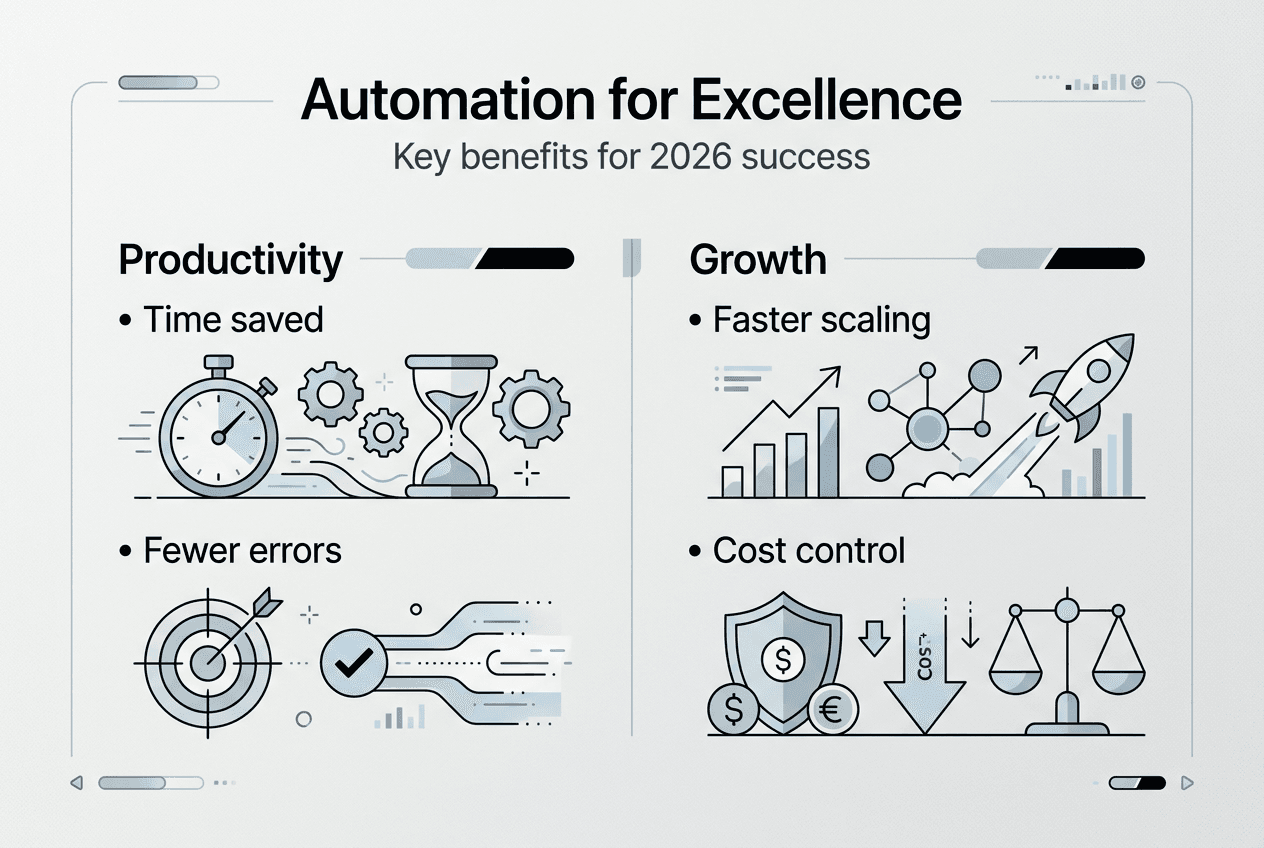
Automation fundamentally reshapes how businesses operate by eliminating repetitive manual tasks that consume valuable time and resources. When you automate invoice processing, data entry, customer communications, or inventory management, your team gains hours each week to focus on strategic initiatives that actually grow your business. The financial impact is substantial. Automation reduces manual errors by up to 40% and cuts operational costs by 20%, creating immediate bottom-line improvements.

Accuracy improvements represent another critical advantage. Human error in data entry, calculations, or process execution creates costly mistakes that ripple through operations. Automated systems execute tasks consistently, following programmed rules without fatigue or distraction. A single pricing error in a manual quote can cost thousands. Automated pricing tools eliminate this risk entirely.
Productivity gains extend beyond simple time savings. When repetitive work shifts to automated systems, employees redirect energy toward creative problem solving, customer relationship building, and innovation. This reallocation of human capital creates competitive advantages that manual processes cannot match. Your marketing team stops copying data between systems and starts analyzing customer behavior patterns. Your finance team moves from transaction processing to strategic financial planning.
Real-time data access transforms decision making. Automated systems capture, process, and present information instantly, enabling you to respond to market changes, customer needs, or operational issues without delay. AI boosts efficiency in small business operations by providing insights that would take days or weeks to compile manually.
Consider these specific automation benefits:
- Reduced processing time for routine transactions by 60% to 80%
- Improved customer response times through automated communication workflows
- Enhanced compliance through consistent application of business rules and regulations
- Better resource allocation based on accurate, current operational data
Automation is not about replacing people. It’s about amplifying human capabilities by removing obstacles to productivity and enabling focus on work that requires judgment, creativity, and relationship skills.
The McKinsey automation insights research demonstrates that organizations implementing intelligent automation see improvements across multiple dimensions simultaneously. Customer satisfaction increases as response times decrease. Employee engagement rises when tedious tasks disappear. Profit margins expand as operational efficiency improves.
Common misconceptions and challenges in automation adoption
The belief that automation requires massive capital investment stops many SMEs before they start. Many SMEs overestimate the cost and underestimate the ROI of automation technologies, creating a perception gap that delays beneficial changes. Cloud-based automation tools now operate on subscription models with minimal upfront costs. You can automate specific workflows for hundreds rather than thousands of dollars monthly.
Complexity concerns also create unnecessary barriers. Modern automation platforms feature intuitive interfaces designed for business users, not programmers. You don’t need a technical degree to build automated workflows in tools like Zapier, Make, or Microsoft Power Automate. Drag-and-drop functionality and pre-built templates enable rapid implementation without coding knowledge.
Job displacement fears generate internal resistance that undermines automation initiatives. Employees worry that automated systems will eliminate their roles. The reality is more nuanced. Automation changes job responsibilities rather than eliminating positions entirely. Your accounts payable clerk becomes a financial analyst. Your customer service representative shifts to complex problem resolution and relationship management. Communicating this evolution clearly reduces resistance and builds support.
Lack of strategic clarity represents a genuine challenge. Automating inefficient processes simply creates faster inefficiency. You must analyze and optimize workflows before automation. Many businesses rush to implement tools without understanding which processes deliver maximum ROI when automated. This scattered approach wastes resources and creates disappointing results.
Key challenges to address:
- Identifying automation candidates with highest impact and feasibility
- Securing stakeholder buy-in across departments and organizational levels
- Managing change effectively to minimize disruption during implementation
- Maintaining security and data privacy in automated systems
- Integrating new automation tools with existing software infrastructure
Pro Tip: Start with one high-volume, low-complexity process to build confidence and demonstrate value before tackling more complex automation projects. Quick wins create momentum and organizational support for broader initiatives.
The HBR automation misconceptions article highlights how executive misunderstanding of automation capabilities creates strategic blind spots. Leaders often underestimate implementation speed and overestimate technical requirements. This knowledge gap delays decisions and creates competitive disadvantages.
Understanding advantages of AI for SMEs helps contextualize automation within broader digital transformation efforts. Automation represents one component of intelligent business operations, working alongside AI-powered analytics, customer engagement tools, and decision support systems.
Choosing the right automation strategy and tools for your business
Effective automation begins with comprehensive workflow assessment. Map current processes end to end, identifying bottlenecks, redundancies, and manual touchpoints. Document how information flows between systems and people. This visibility reveals automation opportunities you might otherwise miss. Focus on high-volume, rule-based processes with clear inputs and outputs. Invoice processing, lead routing, report generation, and data synchronization represent ideal starting points.
Selecting automation tools aligned with business workflows increases implementation success by 50%, making tool evaluation critical. Compare platforms based on integration capabilities, ease of use, scalability, and total cost of ownership. The table below highlights key considerations:
| Evaluation Criteria | Why It Matters | Questions to Ask |
|---|---|---|
| Integration capabilities | Connects with existing software ecosystem | Does it integrate with our CRM, ERP, and communication tools? |
| User interface | Determines adoption speed and training requirements | Can non-technical staff build and modify workflows independently? |
| Scalability | Supports growth without platform changes | Will it handle 10x current transaction volume? |
| Support and documentation | Affects implementation success and ongoing optimization | What training resources and technical support are included? |
Implementation should follow a phased approach that minimizes risk and maximizes learning:
- Pilot with a single, well-defined process that delivers measurable value
- Measure results rigorously against baseline performance metrics
- Refine the automated workflow based on user feedback and performance data
- Expand to additional processes using lessons learned from the pilot
- Integrate automated workflows into standard operating procedures
- Train staff on both using and optimizing automated systems
Stakeholder engagement determines implementation success as much as technical execution. Involve process owners early in planning. Their domain expertise identifies edge cases and exceptions that automated workflows must handle. Their buy-in creates champions who drive adoption across teams.
Explore top automation software 2026 options to understand current platform capabilities and pricing models. Different tools excel in different scenarios. Zapier offers broad integration coverage. Microsoft Power Automate provides deep integration with Microsoft 365. UiPath delivers sophisticated robotic process automation for complex workflows.
Pro Tip: Build automation workflows with monitoring and exception handling from the start. Automated processes should alert you when unexpected conditions occur rather than failing silently or producing incorrect results.
The guide on how to automate workflows efficiently provides detailed implementation frameworks and best practices. Following proven methodologies reduces trial and error while accelerating time to value.
Consider the Gartner automation tools guide for independent platform assessments and market trend analysis. Understanding vendor positioning and technology roadmaps informs long-term tool selection decisions.
Measuring success and scaling automation across your business
Defining key performance indicators before implementation creates objective success criteria. Align metrics with strategic business goals rather than focusing solely on efficiency measures. Track time savings, error reduction, cost per transaction, customer satisfaction scores, and employee productivity. Baseline measurements establish the starting point for comparison.
Companies that measure KPIs rigorously see 3x higher automation ROI and scalability because data drives continuous optimization. Monitor automated workflows weekly during initial deployment, then monthly once stable. Look for performance degradation, exception rates, and user satisfaction trends.
The following metrics provide comprehensive automation performance visibility:
| Metric Category | Specific Measures | Target Improvement |
|---|---|---|
| Efficiency | Processing time, throughput volume, resource utilization | 40% to 60% reduction in processing time |
| Quality | Error rates, rework frequency, compliance violations | 70% to 90% reduction in errors |
| Financial | Cost per transaction, labor cost savings, ROI | 20% to 35% cost reduction |
| Experience | Customer satisfaction, employee engagement, response times | 25% to 40% satisfaction improvement |
Scaling automation requires strategic prioritization based on impact and feasibility. After proving value with initial implementations, expand to processes with similar characteristics. Build a pipeline of automation candidates ranked by expected ROI, implementation complexity, and strategic importance. This systematic approach prevents scattered efforts that dilute resources.
Continuous optimization separates high-performing automation programs from stagnant implementations. Business conditions change. Automated workflows must evolve accordingly. Schedule quarterly reviews of all automated processes. Analyze performance data, gather user feedback, and identify enhancement opportunities. Small refinements compound into significant performance improvements over time.
Key scaling strategies:
- Develop internal automation expertise through training and certification programs
- Create a center of excellence that shares best practices across departments
- Establish governance frameworks that balance innovation with risk management
- Build reusable workflow components that accelerate new automation development
- Monitor emerging automation technologies for competitive advantage opportunities
Improving business automation workflow efficiency requires ongoing attention to process design, tool capabilities, and organizational change management. Automation is not a one-time project but an operational capability that matures over time.
The Forbes automation KPIs analysis emphasizes leading indicators that predict long-term automation success. Monitor adoption rates, user satisfaction, and process coverage alongside traditional efficiency metrics. These forward-looking measures reveal whether your automation program builds sustainable competitive advantages.
Explore AI and automation solutions tailored for your business
Navigating automation opportunities requires strategic guidance tailored to your specific industry, operational challenges, and growth objectives. Airitual specializes in helping SMEs design and implement automation strategies that deliver measurable results without unnecessary complexity. Discover how AI consulting strategic value accelerates your automation journey by connecting technology capabilities with business outcomes.
Explore vetted top automation software 2026 platforms matched to common SME use cases, with implementation guidance that reduces trial and error. Learn practical techniques to automate workflows guide across departments, creating integrated operations that scale with your business growth.
Frequently asked questions about automating business processes
What types of business processes can be automated most effectively?
Rule-based, high-volume processes with clear inputs and outputs deliver the strongest automation ROI. Invoice processing, data entry, customer onboarding, report generation, and inventory management represent ideal candidates. Processes requiring human judgment, creativity, or complex relationship management remain better suited for human execution with automation support.
How long does it typically take to see ROI from automation?
Most SMEs see positive ROI within three to six months for straightforward process automation. Time savings and error reduction create immediate value, while strategic benefits like improved decision-making and customer experience compound over time. Cloud-based tools with subscription pricing accelerate ROI by eliminating large upfront investments.
What are the common risks and how can they be minimized?
Key risks include poor process design, inadequate testing, weak security controls, and insufficient change management. Minimize these by thoroughly documenting and optimizing processes before automation, conducting comprehensive testing with real data, implementing robust access controls and audit trails, and investing in user training and communication. Start small to limit exposure while building expertise.
Can automation enhance employee satisfaction rather than replace jobs?
Absolutely. Automation eliminates tedious, repetitive tasks that drain energy and create frustration. Employees freed from manual data entry or transaction processing can focus on creative problem-solving, customer relationships, and skill development. Organizations that communicate automation benefits clearly and involve employees in implementation see higher satisfaction scores and reduced turnover.
Recommended
- How to Automate Workflows for Efficient Business Operations | Artificial Intelligence
- Master Business Automation Workflow for Higher Efficiency | Artificial Intelligence
- Implement Process Automation Workflow for Seamless Efficiency | Artificial Intelligence
- Top 7 Automation Software 2026 | Artificial Intelligence
Recent Comments