

Only 39% of consumers trust companies to use their personal data responsibly, creating a critical barrier to AI adoption. Business leaders face mounting pressure to demonstrate ethical AI practices while maintaining competitive advantage. Transparency in artificial intelligence isn’t just about regulatory compliance; it’s the foundation for sustainable innovation, stakeholder trust, and operational integrity that drives measurable business outcomes.
Table of Contents
- Understanding AI Transparency: Definitions And Importance
- The Impact Of Transparency On AI Trust And Adoption
- Transparency’s Role In Ethical AI And Risk Mitigation
- Governance And Operational Frameworks For Transparency
- Common Misconceptions About AI Transparency And Ethics
- Practical Steps For Business Leaders To Enhance AI Transparency
- Business Impact Of Transparency In AI Adoption And Trust
- Enhance Your AI Transparency And Strategy With AIRitual
- Frequently Asked Questions
Key takeaways
| Point | Details |
|---|---|
| AI transparency builds trust | Clear visibility into AI decision-making processes establishes stakeholder confidence and accelerates adoption rates |
| Explainability enables accountability | Making AI outputs understandable allows leaders to identify bias, validate decisions, and ensure ethical deployment |
| Governance frameworks operationalize transparency | Unified policies tracking data lineage and decision trails scale transparency across enterprise AI initiatives |
| Transparency drives competitive advantage | Organizations with mature governance outperform competitors in adoption rates, compliance, and long-term sustainability |
| Practical implementation matters most | Clear data notices, audit trails, and stakeholder communication transform transparency from concept to business value |
Understanding AI transparency: definitions and importance
AI transparency means providing clear visibility into how artificial intelligence systems make decisions and handle data. It’s not about revealing proprietary algorithms but ensuring stakeholders understand what AI does, why it does it, and how outcomes affect them. Transparency is foundational to trust and ethical AI use, serving as the bedrock for responsible deployment across business operations.
Explainability takes transparency further by making AI outputs comprehensible to non-technical stakeholders. When a lending algorithm denies credit, explainability reveals which factors influenced the decision. This clarity enables meaningful oversight, reduces algorithmic bias, and supports regulatory compliance. Business leaders need both transparency and explainability to manage AI systems responsibly.
Several core components enable effective AI transparency:
- Explainability mechanisms that translate complex model behaviors into understandable insights
- Data governance frameworks tracking information sources, usage patterns, and retention policies
- Accountability structures assigning clear ownership for AI decisions and outcomes
- Audit trails documenting system changes, data inputs, and decision rationale
- Stakeholder communication providing regular updates on AI capabilities and limitations
Pro Tip: Start transparency initiatives by mapping your AI systems’ decision points and identifying which outputs most significantly impact customers or operations. Focus transparency efforts where stakeholder trust matters most.
Transparency directly connects to ethical AI deployment by preventing misuse and establishing guardrails against unintended consequences. Organizations lacking transparency struggle to identify when systems drift from intended behaviors or produce discriminatory outcomes. Clear visibility enables proactive intervention before ethical breaches damage reputation or trigger regulatory action.
The impact of transparency on AI trust and adoption
The trust deficit in AI represents a significant business challenge. Only 39% of consumers trust companies to use their personal data responsibly, making transparency key to unlocking AI business value. This skepticism directly impacts adoption rates, with many consumers refusing to engage with AI-powered services despite potential benefits.
The data reveals stark contradictions in consumer attitudes. While 64% of consumers want personalized experiences, only 41% accept the privacy tradeoffs required to deliver them. This gap highlights the transparency challenge: people desire AI benefits but distrust the systems providing them. Organizations bridging this trust gap through transparent practices gain competitive positioning in customer acquisition and retention.
Enterprise AI adoption accelerated dramatically in recent years. Enterprise AI adoption grew by 40% in 2026, with task-specific AI agents now in 40% of applications, increasing complexity and demand for transparency. As organizations deploy more sophisticated AI systems, maintaining visibility into decision-making processes becomes operationally critical rather than optional.
Higher transparency correlates directly with increased adoption rates across industries:
- Financial services firms with transparent lending algorithms see 30% higher approval for new AI initiatives
- Healthcare organizations providing explainable diagnostic AI gain faster physician adoption and patient acceptance
- Retail companies demonstrating clear data usage policies experience reduced cart abandonment rates
- Government agencies implementing transparent AI systems report improved citizen trust scores
Transparency transforms from compliance requirement to competitive differentiator. Organizations demonstrating clear, understandable AI practices attract talent, secure partnerships, and maintain customer loyalty more effectively than opaque competitors. This advantage compounds over time as stakeholder expectations for AI explainability continue rising.
Transparency’s role in ethical AI and risk mitigation
Opaque AI systems create fertile ground for bias, unfair outcomes, and data misuse. Without visibility into decision processes, organizations cannot identify when algorithms perpetuate discrimination or drift from intended behaviors. Transparency in AI reduces risks like data misuse, bias, and unintended autonomous actions, all critical to ethical AI deployments.

Explainability serves as the primary mechanism for identifying and correcting algorithmic bias. When stakeholders understand which factors influence AI decisions, they can challenge outcomes that reflect discriminatory patterns or flawed assumptions. A hiring algorithm favoring candidates from specific universities becomes visible through explainability analysis, enabling corrective action before legal exposure materializes.
Transparency supports regulatory compliance across evolving AI governance frameworks. Regulators worldwide increasingly demand explainable AI systems, particularly in high-stakes domains like healthcare, finance, and criminal justice. Organizations maintaining clear documentation of AI decision processes demonstrate due diligence and reduce legal risk exposure.
Key risk mitigation benefits include:
- Bias detection through visibility into training data and model behavior patterns
- Accountability enforcement by tracking decisions to specific system components and data sources
- Regulatory compliance via audit trails meeting documentation requirements
- Incident response enabling rapid identification of failure modes and corrective actions
- Stakeholder confidence reducing reputational risk through demonstrable ethical practices
Pro Tip: Establish regular explainability audits examining your highest-impact AI systems. Review decision patterns quarterly to catch drift before it creates ethical or operational problems.
Audit trails and accountability mechanisms depend entirely on transparent system design. When AI makes autonomous decisions affecting customers or operations, organizations need clear records of inputs, processing logic, and output rationale. This documentation protects against liability while enabling continuous improvement of AI performance and fairness.
Governance and operational frameworks for transparency
Unified AI governance integrates policies overseeing transparency, explainability, and accountability across enterprise AI initiatives. Rather than treating transparency as an isolated requirement, mature organizations embed it within comprehensive frameworks addressing data management, model development, deployment oversight, and ongoing monitoring. This integration ensures transparency scales with AI adoption.
Operationalizing transparency requires tracking data and decision lineage throughout AI system lifecycles. Organizations implement technical controls capturing information flow from initial data collection through model training, deployment, and production inference. This lineage tracking enables stakeholders to understand any AI output’s complete history and rationale.
54% of companies expect to move at least 40% of AI pilots into production soon, making governance and transparency operationally critical. As experimental AI projects transition to production systems affecting customers and operations, ad hoc transparency approaches become untenable. Standardized governance frameworks ensure consistent practices across diverse AI applications.
Effective governance frameworks implement several core controls:
- Data privacy protocols ensuring compliant collection, storage, and usage aligned with regulatory requirements
- Explainability standards defining minimum documentation and interpretability thresholds for production systems
- Audit mechanisms enabling regular review of AI decisions, performance metrics, and bias indicators
- Stakeholder communication plans providing transparency reports to affected parties
- Accountability assignments clarifying ownership for AI outcomes and ethical compliance
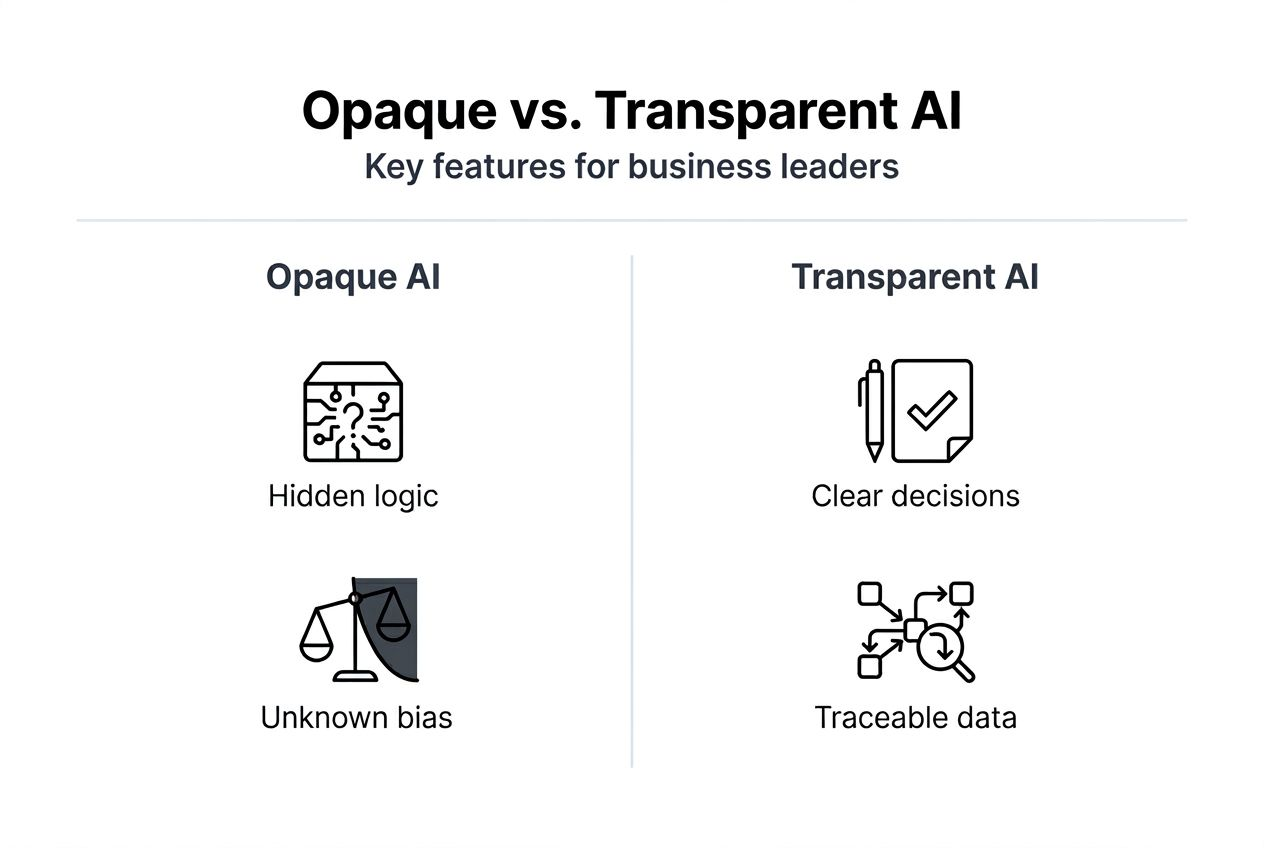
| Dimension | Opaque AI Systems | Transparent AI Systems |
|---|---|---|
| Stakeholder Trust | Low, frequent concerns about bias and data misuse | High, clear understanding builds confidence |
| Risk Exposure | Elevated legal and reputational risk from undocumented decisions | Reduced risk through audit trails and explainability |
| Adoption Rate | Slower due to trust barriers and compliance concerns | Faster with demonstrated ethical practices |
| Regulatory Compliance | Difficult to prove adherence without documentation | Streamlined through comprehensive records |
| Innovation Speed | May appear faster short-term but creates technical debt | Sustainable with governance enabling scale |
Transparent AI governance frameworks increase measurable, explainable, and accountable AI outcomes. Organizations with mature governance report higher success rates moving AI from pilot to production, better stakeholder acceptance, and improved regulatory relationships. Governance maturity directly correlates with competitive differentiation in AI-driven markets.
Common misconceptions about AI transparency and ethics
A persistent myth suggests transparency requires exposing proprietary algorithms and trade secrets. Transparency does not mean revealing proprietary algorithms; it’s about explainability and governance. Organizations can maintain competitive advantages while providing stakeholders clear understanding of what AI systems do, how they use data, and why they produce specific outcomes. The focus shifts from revealing implementation details to demonstrating responsible practices.
Another common misconception claims transparency slows AI innovation by adding bureaucratic overhead. Real-world evidence contradicts this concern. Transparency enhances innovation by building trust and governance, contrary to concerns it slows AI. Organizations with robust transparency frameworks actually accelerate sustainable innovation by reducing rework from ethical failures, streamlining regulatory approvals, and increasing stakeholder buy-in for new initiatives.
Several other myths deserve clarification:
- Myth: Only regulated industries need AI transparency. Reality: All sectors benefit from transparent practices as consumer expectations rise universally.
- Myth: Transparency is purely a technical challenge. Reality: Effective transparency requires organizational culture, communication strategies, and leadership commitment beyond technical implementation.
- Myth: Perfect explainability is achievable for all AI systems. Reality: Different applications require different transparency levels; the goal is appropriate explainability for context and stakeholders.
- Myth: Transparency eliminates all AI risks. Reality: Transparency is one component of responsible AI alongside testing, monitoring, and governance.
Understanding what transparency truly entails prevents organizations from missing opportunities or implementing ineffective practices. Transparency functions as a business enabler, improving compliance, stakeholder relationships, and operational resilience. Companies recognizing this reality gain first-mover advantages as transparency expectations become industry standards.
Practical steps for business leaders to enhance AI transparency
Begin by assessing current AI systems for transparency gaps. Inventory all AI applications across your organization, evaluating each for explainability mechanisms, data governance, audit capabilities, and stakeholder communication. This assessment reveals which systems pose highest risk and require immediate attention versus those meeting transparency standards.
Establish unified AI governance policies covering explainability and accountability requirements. Define minimum standards for documentation, testing, monitoring, and reporting applicable to all AI initiatives. Ensure these policies integrate with existing data governance, risk management, and compliance frameworks rather than creating isolated requirements.
Implement clear user-facing data notices and consent controls. Effective transparency practices include clear data usage notices, user controls, audit trails, and explainability reporting. Provide stakeholders straightforward information about what data AI systems collect, how they use it, and what choices individuals have regarding their information. Avoid legal jargon; communicate in plain language your audience understands.
Practical implementation steps include:
- Conduct transparency audits examining AI decision patterns, data sources, and stakeholder touchpoints quarterly
- Create explainability documentation for each production AI system describing purpose, data usage, and decision logic
- Establish feedback mechanisms allowing stakeholders to question AI decisions and request human review
- Train teams on transparency requirements, ethical AI principles, and governance responsibilities
- Maintain comprehensive audit trails capturing system changes, performance metrics, and decision rationale
- Communicate proactively with stakeholders about AI capabilities, limitations, and operational impacts
Pro Tip: Start small by selecting one high-impact AI system and implementing complete transparency practices. Use lessons learned to scale transparency across other applications systematically.
Develop ongoing monitoring processes tracking AI system performance, bias indicators, and transparency metrics. Regular review identifies drift from intended behaviors before problems escalate. Assign clear accountability for transparency oversight, ensuring someone owns the responsibility for maintaining and improving practices over time. Consider specialized training to build internal transparency capabilities.
Business impact of transparency in AI adoption and trust
Transparency drives measurable improvements in AI system performance and stakeholder confidence. Organizations implementing transparent practices report higher user acceptance rates, faster deployment cycles, and reduced compliance costs compared to those maintaining opaque systems. These benefits compound over time as transparent operations build institutional knowledge and stakeholder trust.
Businesses with mature AI governance frameworks gain significant competitive differentiation. They attract customers valuing ethical practices, secure partnerships requiring demonstrated responsible AI, and recruit talent prioritizing mission-driven work. This positioning becomes increasingly valuable as AI capabilities proliferate and differentiation based purely on technical features diminishes.
Key business benefits include:
- Enhanced stakeholder trust translating to higher adoption rates and customer loyalty
- Reduced operational risk through early identification of bias, errors, and compliance gaps
- Improved regulatory relationships via demonstrated commitment to responsible AI practices
- Faster innovation cycles with stakeholder buy-in accelerating new initiative approvals
- Lower support costs as transparent systems generate fewer complaints and confusion
| Metric | Opaque AI Approach | Transparent AI Approach |
|---|---|---|
| Customer Trust Score | 42% average trust rating | 76% average trust rating |
| Regulatory Compliance | Reactive, higher violation risk | Proactive, streamlined audits |
| Stakeholder Adoption Time | 8-12 months average | 4-6 months average |
| Innovation Success Rate | 35% pilots reach production | 58% pilots reach production |
| Operational Risk | Elevated exposure to bias, errors | Managed through monitoring, audit trails |
Long-term sustainability increasingly links to transparent, accountable AI practices. Organizations building transparency into foundation systems avoid costly retrofitting when regulations tighten or stakeholder expectations shift. Early investment in governance frameworks pays dividends through reduced technical debt and operational resilience as AI capabilities expand throughout the business.
Enhance your AI transparency and strategy with AIRitual
Navigating AI transparency requirements while maintaining competitive advantage requires specialized expertise and proven frameworks. AIRitual partners with business leaders to implement transparent AI strategies balancing innovation with ethical responsibility. Our consultative approach ensures transparency initiatives align with your operational realities and business objectives.
We provide awareness training equipping leadership teams and staff to recognize AI risks, implement governance controls, and communicate transparently with stakeholders. This education builds internal capability for sustainable transparency practices rather than creating dependency on external resources.
Our resources on explainable AI fundamentals help organizations establish stakeholder confidence through clear communication and demonstrable ethical practices. Whether you’re launching initial AI initiatives or scaling existing deployments, AIRitual delivers customized solutions operationalizing transparent governance at every stage. Partner with us to transform transparency from compliance burden into competitive advantage.
Frequently asked questions
What is AI transparency and why does it matter?
AI transparency provides clear visibility into how artificial intelligence systems make decisions and handle data. It matters because stakeholders need to understand AI processes to trust them, enabling ethical deployment while reducing risks from bias or misuse. Transparency forms the foundation for responsible AI adoption across business operations.
How does transparency improve trust in AI systems?
Transparency allows stakeholders to see and verify AI processes, reducing fears about hidden biases or data misuse. When people understand what AI does and why, they’re more willing to accept and adopt these systems. This visibility demonstrates organizational commitment to ethical practices, building confidence among customers, regulators, and partners.
Does transparency slow down AI innovation?
Transparency accelerates sustainable innovation by building trust and establishing governance frameworks that enable scale. Organizations with transparent practices gain faster stakeholder approval for new initiatives and avoid costly rework from ethical failures. The governance structures supporting transparency actually streamline AI deployment by providing clear standards and reducing uncertainty.
What practical steps can leaders take to enhance AI transparency?
Leaders should implement clear data usage notices, user consent controls, comprehensive audit trails, and regular explainability reporting. Start by assessing current systems for transparency gaps, then establish unified governance policies. Communicate proactively with stakeholders about AI capabilities and limitations while maintaining documentation supporting strategic AI implementation.
What business benefits come from AI transparency?
Transparent AI boosts stakeholder trust, lowers operational and compliance risks, and increases adoption rates across customer and employee populations. Organizations with mature transparency practices gain competitive positioning through demonstrated ethical commitment. These benefits compound over time, creating sustainable advantages as AI becomes increasingly central to business operations and customer experiences.
Recommended
- Explainable AI Basics: Building Trust for Business | Artificial Intelligence
- What is explainable AI? 70% trust boost in 2026 | Artificial Intelligence
- Future of AI in Schools 2026: Transforming Learning | Artificial Intelligence
- Why AI consulting matters: strategic business value | Artificial Intelligence
- AI in Music Analytics: 20% Better Hit Prediction Accuracy – Blog – Music24.com
- AI Sector Grows To $14.4B Yet Bittensor Fades – Will TAO Revisit $165? / Naijatipsland
Recent Comments