

Business leaders often face the challenge of managing growing data while searching for smarter, faster ways to connect with customers. As operational demands increase, understanding cloud-based AI becomes crucial for staying competitive. By embracing cloud-based artificial intelligence, organizations in the technology and education sectors gain powerful tools for automating processes, enhancing service, and scaling solutions without heavy hardware investments. This overview reveals how the right cloud AI fundamentals can help enterprises maximize productivity and foster meaningful engagement.
Table of Contents
- Cloud-Based AI Fundamentals Explained
- Types of Cloud-Based AI Solutions
- How Cloud-Based AI Works in Practice
- Real-World Uses Across Industries
- Security Risks and Compliance Essentials
- Cost, Scalability, and Common Pitfalls
Key Takeaways
| Point | Details |
|---|---|
| Cloud-Based AI Advantages | Provides scalability and flexibility for businesses to deploy advanced AI solutions without significant upfront investments. |
| Deployment Models Overview | Organizations can choose from IaaS, PaaS, or SaaS depending on their specific AI needs and operational contexts. |
| Industry Applications | Cloud-based AI transforms sectors like Healthcare and Finance by enabling data-driven decision-making and operational efficiencies. |
| Security and Compliance | Developing robust security protocols and compliance frameworks is essential to mitigate risks associated with cloud-based AI systems. |
Cloud-Based AI Fundamentals Explained
Cloud-based AI represents a revolutionary approach to artificial intelligence that transforms how businesses leverage computational power and advanced algorithms. By moving AI infrastructure to cloud environments, organizations gain unprecedented flexibility and scalability in deploying intelligent systems. Understanding core AI technologies enables companies to strategically integrate these powerful solutions.
The fundamental architecture of cloud-based AI involves several critical components:
- Distributed Computing: Enabling massive parallel processing across multiple servers
- Elastic Resources: Dynamically scaling computational power based on demand
- Machine Learning Models: Advanced algorithms trained on extensive datasets
- Data Storage: Secure, scalable cloud infrastructure supporting complex AI operations
Cloud platforms provide unique advantages for AI implementation. Unlike traditional on-premise systems, cloud environments allow businesses to access cutting-edge machine learning capabilities without substantial upfront infrastructure investments. Organizations can experiment, prototype, and deploy AI solutions rapidly, reducing time-to-market and technological barriers.
Cloud-based AI democratizes advanced technological capabilities, making sophisticated machine learning accessible to businesses of all sizes.
Pro tip: Start with a pilot project to understand your specific cloud AI requirements before full-scale implementation.
Types of Cloud-Based AI Solutions
Cloud-based AI solutions have emerged as powerful tools that enable businesses to leverage advanced technologies without substantial infrastructure investments. AI cloud services provide diverse platforms designed to meet specific organizational needs across multiple industries and operational contexts.
The primary categories of cloud-based AI solutions include:
- Predictive Analytics Platforms: Utilizing machine learning to forecast trends and outcomes
- Natural Language Processing Services: Enabling advanced text and speech understanding
- Computer Vision Solutions: Providing image and video analysis capabilities
- Generative AI Tools: Creating original content, designs, and computational outputs
- Intelligent Chatbot Systems: Automating customer interaction and support processes
Enterprise organizations typically choose between three primary deployment models for cloud AI solutions. Infrastructure-as-a-Service (IaaS) provides raw computational resources, Platform-as-a-Service (PaaS) offers development environments, and Software-as-a-Service (SaaS) delivers fully configured AI applications ready for immediate use.

Here’s a comparison of cloud AI deployment models and their typical use cases:
| Deployment Model | Key Benefits | Common Use Cases |
|---|---|---|
| Infrastructure as a Service (IaaS) | Maximum control, flexible scaling | Research, custom algorithm development |
| Platform as a Service (PaaS) | Simplifies development, built-in tools | Rapid prototyping, app integration |
| Software as a Service (SaaS) | Fast implementation, minimal setup | Customer service, business analytics |
Cloud AI solutions transform technological accessibility, allowing even small businesses to leverage sophisticated machine learning capabilities.
Pro tip: Conduct a comprehensive assessment of your specific organizational requirements before selecting a cloud AI solution to ensure optimal alignment with your strategic objectives.
How Cloud-Based AI Works in Practice
Cloud-based AI transforms organizational capabilities by enabling intelligent data processing and decision-making across complex technological ecosystems. Real-world AI implementation strategies demonstrate how businesses integrate advanced machine learning technologies into their existing infrastructure.
The practical implementation of cloud-based AI involves several critical operational stages:
- Data Collection: Aggregating relevant organizational information from multiple sources
- Machine Learning Training: Developing algorithmic models using collected datasets
- Inference and Prediction: Generating actionable insights from trained models
- Continuous Learning: Iteratively improving AI performance through ongoing feedback
- Integration with Existing Systems: Seamlessly connecting AI capabilities with current technological environments
Enterprise AI deployments typically follow a structured approach that prioritizes scalability, security, and strategic alignment. Computational resources are dynamically allocated, machine learning models are continuously refined, and predictive analytics generate real-time insights that drive strategic decision-making across departments.
Cloud-based AI enables organizations to transform raw data into strategic intelligence, creating unprecedented operational agility.
Pro tip: Start with pilot projects targeting specific, measurable organizational challenges to demonstrate tangible AI value before executing broader implementation strategies.
Real-World Uses Across Industries
Cloud-based AI has revolutionized operational strategies across diverse sectors, creating unprecedented opportunities for innovation and efficiency. Artificial intelligence applications demonstrate remarkable potential for transforming traditional business processes through intelligent automation and data-driven decision-making.
Key industry applications of cloud-based AI include:
- Healthcare: Enhancing medical imaging diagnostics and patient treatment planning
- Finance: Detecting fraudulent transactions and predicting market trends
- Manufacturing: Optimizing supply chain management and predictive equipment maintenance
- Retail: Personalizing customer experiences and managing inventory forecasting
- Agriculture: Monitoring crop health and optimizing agricultural resource allocation
- Transportation: Improving route efficiency and autonomous vehicle technologies
Each industry leverages specialized AI models designed to address unique operational challenges. In healthcare, machine learning algorithms analyze complex medical images with precision, while financial institutions use advanced predictive models to assess investment risks and detect anomalous transactions. Manufacturing sectors implement intelligent monitoring systems that can predict equipment failures before they occur, dramatically reducing downtime and maintenance costs.
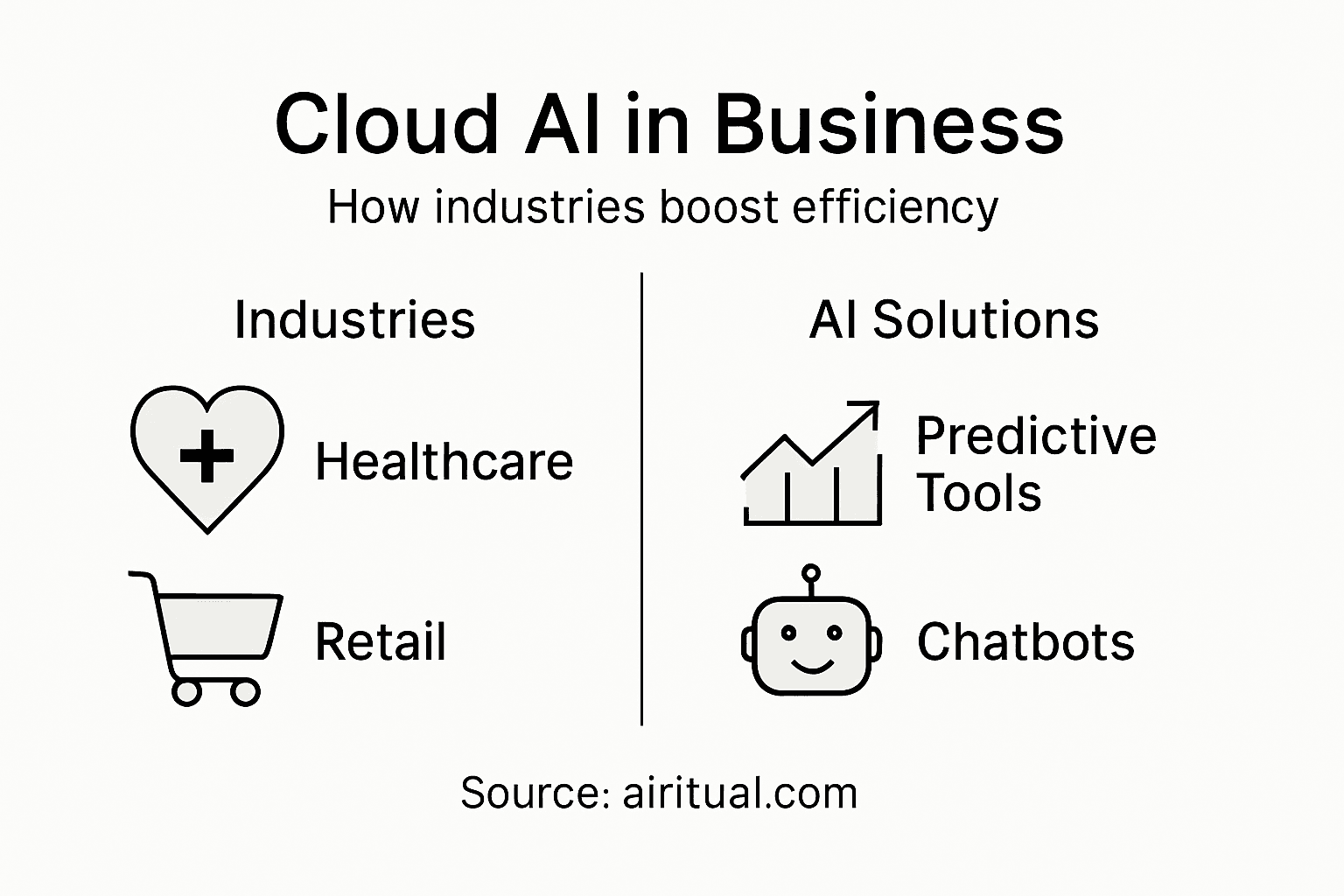
Below is a summary highlighting how cloud-based AI impacts selected industries:
| Industry | Key AI Advantage | Operational Impact |
|---|---|---|
| Healthcare | Precise diagnostics | Improved patient outcomes |
| Finance | Automated anomaly detection | Enhanced fraud prevention |
| Manufacturing | Predictive maintenance | Reduced downtime |
| Retail | Personalized shopping | Higher customer loyalty |
| Agriculture | Crop health monitoring | Better resource planning |
Cloud-based AI empowers organizations to transform data into strategic insights, creating competitive advantages across multiple sectors.
Pro tip: Conduct a comprehensive technology audit to identify specific areas where AI can provide measurable operational improvements within your organization.
Security Risks and Compliance Essentials
Cloud-based AI introduces complex cybersecurity challenges that require sophisticated risk management strategies. Cybersecurity risks specific to AI systems demand comprehensive understanding and proactive mitigation approaches across organizational technology infrastructures.
Key security risks in cloud-based AI environments include:
- Data Breach Vulnerabilities: Potential unauthorized access to sensitive information
- Algorithmic Manipulation: Risks of adversarial attacks disrupting AI model performance
- Privacy Compliance Issues: Challenges maintaining regulatory data protection standards
- Model Poisoning Threats: Potential interference with training data integrity
- Unintended AI Behavior: Risks of unexpected system responses
Compliance frameworks require organizations to implement robust security protocols that protect AI systems throughout their lifecycle. This involves continuous monitoring, encryption of sensitive data, regular security audits, and developing comprehensive incident response strategies. Financial, healthcare, and government sectors face particularly stringent regulatory requirements that demand meticulous AI security management.
Effective AI security is not about eliminating all risks, but creating adaptive, resilient systems that can detect and respond to potential threats.
Pro tip: Develop a comprehensive AI risk management framework that includes regular vulnerability assessments and employee cybersecurity training.
Cost, Scalability, and Common Pitfalls
Cloud-based AI presents complex financial and operational challenges that organizations must carefully navigate. Cloud AI integration challenges reveal significant considerations for businesses seeking to leverage advanced technological capabilities without incurring excessive expenses.
Key cost and scalability considerations include:
- Initial Infrastructure Investment: High upfront technology implementation costs
- Computational Resource Expenses: Increasing costs as AI model complexity grows
- Talent Acquisition: Expenses related to hiring specialized AI professionals
- Ongoing Maintenance: Continuous system updates and optimization requirements
- Scalability Limitations: Potential performance bottlenecks during rapid expansion
Operational efficiency demands strategic planning to manage cloud AI expenses effectively. Organizations must balance technological capabilities with budgetary constraints, carefully evaluating return on investment and implementing incremental adoption strategies. Smaller enterprises can mitigate risks by starting with targeted, low-complexity AI implementations and progressively expanding their technological capabilities.
Successful cloud AI adoption requires a balanced approach that prioritizes strategic value over pure technological enthusiasm.
Pro tip: Conduct detailed cost-benefit analysis and start with pilot projects to validate AI investment potential before full-scale implementation.
Unlock the Full Potential of Cloud-Based AI for Your Business
Many organizations face challenges in implementing scalable, secure, and cost-effective cloud-based AI solutions that truly transform business efficiency. The article highlights key pain points such as managing computational resources, ensuring compliance, and selecting the right AI deployment model to meet specific operational needs. If you are aiming to reduce technological barriers and achieve measurable operational improvements, strategic partnerships focused on customization and ongoing support are essential.
At airitual.com, we specialize in guiding businesses, government agencies, and educational institutions through the complex landscape of cloud AI. Our tailored AI-powered tools and consultative approach address your unique challenges while prioritizing security and scalability. Explore our Webinars | Artificial Intelligence and Classes | Artificial Intelligence for deeper insights into integrating cutting-edge AI technologies effectively.
Ready to transform your operational efficiency with cloud-based AI solutions designed just for you Act now and schedule a free strategy session at airitual.com to start your AI-powered journey with expert support tailored to your goals.
Frequently Asked Questions
What is cloud-based AI?
Cloud-based AI refers to artificial intelligence solutions that leverage cloud computing infrastructure to process data and run algorithms, providing businesses with scalable and flexible access to advanced AI technologies.
How does cloud-based AI improve business efficiency?
Cloud-based AI streamlines operations by enabling organizations to deploy intelligent systems quickly, access powerful computing resources without large capital investments, and automate processes, which leads to faster decision-making and improved productivity.
What are the main types of cloud-based AI solutions?
The primary types include predictive analytics platforms, natural language processing services, computer vision solutions, generative AI tools, and intelligent chatbot systems, each designed to address different organizational needs.
What are the potential security risks associated with cloud-based AI?
Key security risks include data breach vulnerabilities, algorithmic manipulation, privacy compliance issues, model poisoning threats, and unintended AI behavior. Organizations must implement robust security protocols to mitigate these risks.
Recommended
- AI Strategy Guide for SMEs: Boost Efficiency Step-by-Step | Artificial Intelligence
- What Is Artificial Intelligence and Why It Matters | Artificial Intelligence
- Top 4 AI Automation Platforms 2026 for Businesses Seeking Innovation | Artificial Intelligence
- 7 Essential Customer Engagement Tips Using AI | Artificial Intelligence
- 7 Key Advantages of AI in Sales for B2B Success
Recent Comments