

Imagine customers expecting personalized service with every interaction and retail managers striving to deliver without missing a beat. With growing competition across the U.S., building meaningful connections is no longer optional but crucial for sustainable sales. AI powered customer engagement now gives managers access to predictive analytics, virtual assistants, and real-time insights that reshape customer experiences. This article reveals how American retail businesses can harness intelligent tools to drive loyalty and transform every customer touchpoint.
Table of Contents
- Defining AI Powered Customer Engagement
- Types Of AI Solutions For Retail Businesses
- How AI Enhances Customer Interactions
- Real-World Applications In U.S. Retail
- Risks And Challenges Of AI Adoption
- Maximizing ROI With Strategic Implementation
Key Takeaways
| Point | Details |
|---|---|
| AI Enhances Customer Engagement | AI technologies enable businesses to create personalized interactions, anticipating customer needs through predictive analytics and machine learning. |
| Diverse Solutions for Retail | AI solutions like demand forecasting and dynamic pricing can revolutionize retail operations and improve customer experiences. |
| Implementation Challenges | Organizations face risks related to data privacy, algorithmic bias, and technical complexity, necessitating careful planning and governance. |
| Maximizing ROI | Strategic, incremental implementation of AI with clear performance metrics ensures sustainable returns on investment. |
Defining AI powered customer engagement
AI powered customer engagement represents a transformative approach where artificial intelligence technologies enable businesses to create personalized, intelligent interactions with customers across multiple touchpoints. By leveraging advanced algorithms and data analysis, companies can now understand and predict customer behaviors with unprecedented precision.
At its core, AI powered customer engagement integrates multiple intelligent technologies to enhance customer experiences. Key components include:
- Predictive Analytics: Anticipating customer needs before they arise
- Machine Learning Algorithms: Continuously improving interaction quality
- Natural Language Processing: Understanding customer communication nuances
- Real-time Response Mechanisms: Providing instant, contextual support
Research demonstrates that AI-driven customer engagement strategies enable businesses to streamline processes and gain deeper insights into customer behavior. These technologies transform traditional customer interactions by offering personalized experiences that adapt in real-time.
Customer engagement through AI isn’t just about technological implementation – it’s about creating meaningful, intelligent connections that make customers feel genuinely understood. By analyzing vast amounts of data, AI systems can detect subtle patterns and preferences that human agents might miss.
Here’s a summary of key AI technologies and their business impact in customer engagement:
| AI Technology | Main Function | Business Impact |
|---|---|---|
| Predictive Analytics | Anticipates customer needs | Improves retention and loyalty |
| Machine Learning | Enhances interaction quality over time | Raises customer satisfaction |
| Natural Language Processing | Interprets human language | Increases efficiency in support |
| Real-time Response Mechanisms | Delivers instant, contextual responses | Boosts responsiveness and trust |
Pro tip: Start small by implementing one AI-powered customer engagement tool and measure its impact before scaling across your entire customer interaction ecosystem.
Types of AI solutions for retail businesses
The retail landscape is experiencing a revolutionary transformation through diverse AI solutions that address critical business challenges. Comprehensive AI technology roadmaps reveal multiple categories of intelligent technologies designed to enhance operational efficiency and customer experiences across retail environments.
Retail businesses can leverage AI solutions across several strategic domains:
- Demand Forecasting: Machine learning algorithms predicting inventory needs
- Customer Service: Natural language processing chatbots and virtual assistants
- Pricing Optimization: Dynamic pricing models using predictive analytics
- Visual Analytics: Computer vision for inventory tracking and store monitoring
- Personalization: Recommendation engines tailoring individual customer experiences
These AI technologies can be categorized into three primary implementation approaches. End-to-end platforms offer comprehensive solutions, while point solutions target specific operational challenges. Cloud building blocks provide flexible infrastructure for custom AI integrations, allowing businesses to select modular components matching their unique requirements.
Advanced AI solutions transform traditional retail operations by converting raw data into actionable insights. By analyzing customer behaviors, predicting market trends, and automating complex decision-making processes, these intelligent systems enable retailers to create more responsive, efficient, and customer-centric business models.
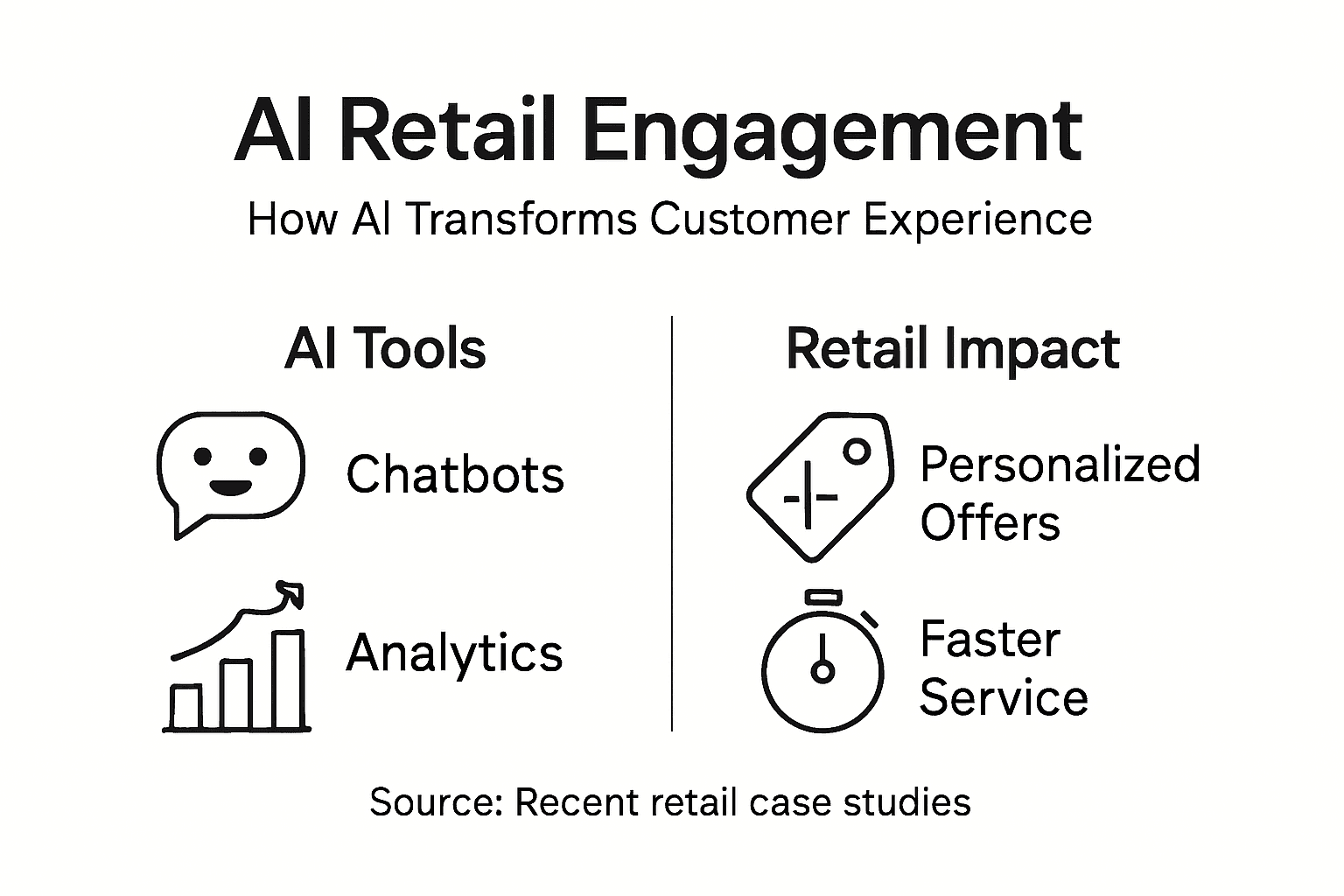
Compare the three main AI solution types for retailers:
| Solution Type | Scope | Customization Level |
|---|---|---|
| End-to-End Platforms | Manages full workflows | Low to moderate |
| Point Solutions | Solves specific problems | High for single tasks |
| Cloud Building Blocks | Modular, scalable tools | Very high; fully custom |
Pro tip: Conduct a thorough assessment of your current technological infrastructure before implementing AI solutions to ensure seamless integration and maximum return on investment.
How AI enhances customer interactions
AI-powered customer interactions represent a quantum leap in how businesses engage with their customers, transforming traditional communication channels into intelligent, responsive experiences. Personalized customer engagement strategies now leverage advanced technologies to create more meaningful, adaptive interactions that anticipate and address individual customer needs.
The key mechanisms through which AI enhances customer interactions include:
- Predictive Personalization: Anticipating customer preferences before they articulate them
- Real-time Adaptive Responses: Instant, context-aware communication
- Sentiment Analysis: Understanding emotional nuances in customer interactions
- Multichannel Integration: Seamless communication across different platforms
- Intelligent Recommendation Systems: Tailoring suggestions based on individual behavior patterns
AI technologies go beyond simple automation by creating deeply intelligent interaction frameworks. Virtual agents and chatbots now employ sophisticated natural language processing that allows them to understand context, detect emotional undertones, and provide human-like responses that feel genuinely personalized and empathetic.

These intelligent systems continuously learn and improve, analyzing vast amounts of interaction data to refine their understanding of customer needs. By breaking down communication barriers and providing instantaneous, relevant support, AI transforms customer interactions from transactional exchanges to meaningful, personalized experiences that build long-term loyalty and trust.
Pro tip: Implement AI-driven customer interaction tools incrementally, starting with specific touchpoints and carefully measuring their impact on customer satisfaction and engagement metrics.
Real-world applications in U.S. retail
AI technologies are rapidly transforming the U.S. retail landscape, offering innovative solutions that address critical business challenges. Practical AI retail applications demonstrate how intelligent systems are revolutionizing operational strategies and customer experiences across multiple retail sectors.
Key real-world AI applications in U.S. retail include:
- Inventory Management: Predictive algorithms preventing stockouts
- Dynamic Pricing: Real-time price adjustments based on market conditions
- Personalized Recommendations: Tailored product suggestions for individual customers
- Supply Chain Optimization: Intelligent logistics and demand forecasting
- Customer Service Automation: AI-powered chatbots and virtual assistants
Retail giants are implementing AI solutions to gain competitive advantages. For instance, major department stores now use computer vision technologies to track in-store customer movements, analyze shopping patterns, and optimize store layouts. Smaller boutique retailers leverage machine learning algorithms to create hyper-personalized marketing campaigns that target specific customer segments with unprecedented precision.
These intelligent systems provide more than just operational efficiency. They create immersive, responsive shopping experiences that adapt in real-time to customer preferences, transforming traditional retail interactions into dynamic, data-driven engagements that increase customer satisfaction and loyalty.
Pro tip: Start with pilot AI implementations in one specific retail domain, carefully measure performance metrics, and gradually expand based on measurable outcomes.
Risks and challenges of AI adoption
AI adoption in retail presents a complex landscape of potential risks and strategic challenges that demand careful navigation. Organizational readiness and implementation challenges represent critical factors that can significantly impact the successful integration of artificial intelligence technologies.
Key risks and challenges in AI implementation include:
- Data Privacy Concerns: Protecting customer information and maintaining regulatory compliance
- Algorithmic Bias: Ensuring fair and unbiased decision-making processes
- Technical Complexity: Managing sophisticated AI integration across existing systems
- High Implementation Costs: Balancing investment against potential returns
- Skill Gap: Developing internal talent capable of managing AI technologies
- Ethical Considerations: Addressing potential societal and operational implications
Retail organizations must carefully assess their technological infrastructure and organizational culture before widespread AI adoption. The most significant challenges often emerge from misalignment between technological capabilities and existing operational frameworks. Successful implementation requires a holistic approach that combines technical expertise, strategic planning, and a deep understanding of potential ethical implications.
Moreover, businesses must develop robust governance frameworks that address the nuanced challenges of AI integration. This involves creating transparent processes, establishing clear ethical guidelines, and maintaining ongoing monitoring mechanisms to mitigate potential risks and optimize AI performance.
Pro tip: Conduct a comprehensive AI readiness assessment that evaluates your organization’s technological infrastructure, data quality, and change management capabilities before initiating any AI implementation strategy.
Maximizing ROI with strategic implementation
Strategic AI implementation requires a sophisticated approach that balances technological investment with measurable business outcomes. AI strategy guide for businesses offers crucial insights into developing a comprehensive roadmap for maximizing return on investment in artificial intelligence technologies.
Key strategies for maximizing AI-driven ROI include:
- Incremental Deployment: Phased implementation to minimize risk
- Clear Performance Metrics: Establishing quantifiable success indicators
- Continuous Learning: Regular assessment and optimization of AI systems
- Cross-Functional Alignment: Ensuring technology integration across departments
- Talent Development: Investing in skills necessary for AI management
Successful ROI optimization demands a holistic perspective that goes beyond simple technology acquisition. Retail businesses must view AI not as a standalone solution, but as an integrated strategy that transforms operational capabilities, enhances customer experiences, and drives sustainable competitive advantages.
Financial returns from AI investments are most effectively realized through strategic, patient implementation. This means carefully selecting use cases with clear value propositions, maintaining flexibility in technological approaches, and creating a culture of continuous innovation and data-driven decision-making.
Pro tip: Develop a comprehensive AI implementation strategy that includes pilot programs, robust performance tracking, and iterative improvement mechanisms to ensure sustained return on investment.
Unlock Retail Success with AI Powered Customer Engagement
Struggling to transform everyday customer interactions into intelligent, personalized experiences The article highlights key challenges such as predictive personalization, real-time adaptive responses, and maintaining customer trust in a fast-evolving retail environment These are common barriers that many retailers face when trying to implement AI solutions effectively
At Airitual, we specialize in bridging this gap by offering customized AI strategies designed to elevate customer engagement and drive measurable results Our expertise spans predictive analytics, natural language processing, and real-time response mechanisms that help businesses anticipate customer needs and optimize satisfaction Our GEO | Artificial Intelligence category dives deeper into localized AI applications perfect for retailers looking to connect on a community level
Are you ready to revolutionize how your retail business connects with customers Take advantage of our tailored solutions and free strategy sessions to start your AI journey today Visit Airitual and explore insights from our Webinars | Artificial Intelligence to gain practical knowledge and accelerate your retail success
Frequently Asked Questions
What is AI powered customer engagement?
AI powered customer engagement refers to using artificial intelligence technologies to create personalized and intelligent interactions with customers across various touchpoints, enhancing the overall customer experience.
How does predictive analytics improve customer engagement?
Predictive analytics anticipates customer needs by analyzing historical data, enabling businesses to address customer preferences proactively, which can lead to increased retention and loyalty.
What are the main types of AI solutions available for retail businesses?
Retail businesses can utilize various AI solutions, including demand forecasting, customer service chatbots, pricing optimization, visual analytics for inventory management, and personalization through recommendation engines.
What are the risks associated with adopting AI in retail?
Risks of AI adoption in retail include data privacy concerns, algorithmic bias, high implementation costs, technical complexity, skill gaps in the workforce, and ethical considerations regarding decision-making processes.
Recommended
- 7 Essential Customer Engagement Tips Using AI | Artificial Intelligence
- Lead Generation with Artificial Intelligence for Higher ROI | Artificial Intelligence
- What Is Artificial Intelligence and Why It Matters | Artificial Intelligence
- AI Strategy Guide for SMEs: Boost Efficiency Step-by-Step | Artificial Intelligence
- Digital Transformation Trends in Retail | singleclic
Recent Comments