

Public agencies are no longer limited by traditional approaches when it comes to engaging citizens or running daily operations. Facing mounting demands for transparency and efficiency, local government leaders and educational administrators are searching for next-level solutions. Adopting AI in digital services offers a way to transform decision-making and enhance public trust, while addressing unique governmental challenges through ethical and innovative strategies.
Table of Contents
- Defining AI in Digital Services Today
- Types of AI Used in Local Government
- Key Applications in Education and Community Engagement
- Strategies for Implementing Responsible AI Solutions
- Risks, Challenges, and Mitigation for Public Agencies
Key Takeaways
| Point | Details |
|---|---|
| AI Enhances Government Efficiency | AI technologies are transforming public service delivery by automating workflows and improving citizen engagement. |
| Ethical AI Governance Is Crucial | Local governments must prioritize ethical frameworks to ensure transparency and protect citizens’ rights when implementing AI. |
| Diverse AI Applications in Services | Various AI types, such as Machine Learning and Natural Language Processing, are effectively addressing unique governmental challenges. |
| Proactive Risk Management Needed | Agencies should implement comprehensive risk mitigation strategies to address data privacy, algorithmic bias, and job displacement concerns. |
Defining AI in Digital Services Today
Artificial Intelligence (AI) in digital services represents a transformative technological paradigm that enables local governments to reimagine operational efficiency and public engagement. Cutting-edge AI developments are rapidly reshaping how public sector organizations deliver services, process information, and interact with constituents.
At its core, AI in digital services encompasses sophisticated computational systems capable of performing tasks that traditionally require human intelligence. These systems leverage advanced algorithms, machine learning models, and data processing capabilities to:
- Automate complex administrative workflows
- Analyze large datasets for strategic decision-making
- Enhance predictive capabilities in public service planning
- Improve citizen interaction through intelligent communication platforms
- Optimize resource allocation across government departments
The technological landscape of AI for local government is particularly nuanced. Unlike corporate environments, government digital services must balance innovation with stringent requirements for transparency, accountability, and equitable access. This means AI implementations must be carefully designed to support ethical computational practices that protect citizen rights and maintain public trust.
Machine learning algorithms and neural network technologies now enable local government digital services to process information with unprecedented speed and accuracy. From intelligent document processing to automated customer support systems, AI is transforming traditional bureaucratic structures into more responsive, data-driven organizations.
AI in digital services is not just about technological replacement, but about augmenting human capabilities to serve communities more effectively.
Pro tip: Governments should establish clear AI governance frameworks that prioritize algorithmic transparency and continuous ethical evaluation before implementing new digital services.
Types of AI Used in Local Government
Local governments are increasingly leveraging diverse AI technologies for operational enhancement, implementing sophisticated computational approaches that transform traditional public service delivery. These AI systems represent a complex ecosystem of intelligent technologies designed to address unique governmental challenges and improve citizen experiences.
The primary types of AI utilized in local government settings include:
- Machine Learning: Algorithms that learn from data patterns to predict outcomes and optimize decision-making
- Natural Language Processing (NLP): Systems that understand, interpret, and generate human language
- Computer Vision: Technologies that analyze and interpret visual information from images and video streams
- Predictive Analytics: Advanced modeling techniques that forecast trends and potential scenarios
- Robotic Process Automation: Tools that automate repetitive administrative tasks
Each AI type serves distinct functions within governmental ecosystems. Machine learning algorithms, for instance, can analyze historical service request data to predict future infrastructure maintenance needs, while natural language processing enables intelligent chatbots that provide 24/7 citizen support and streamline communication channels.
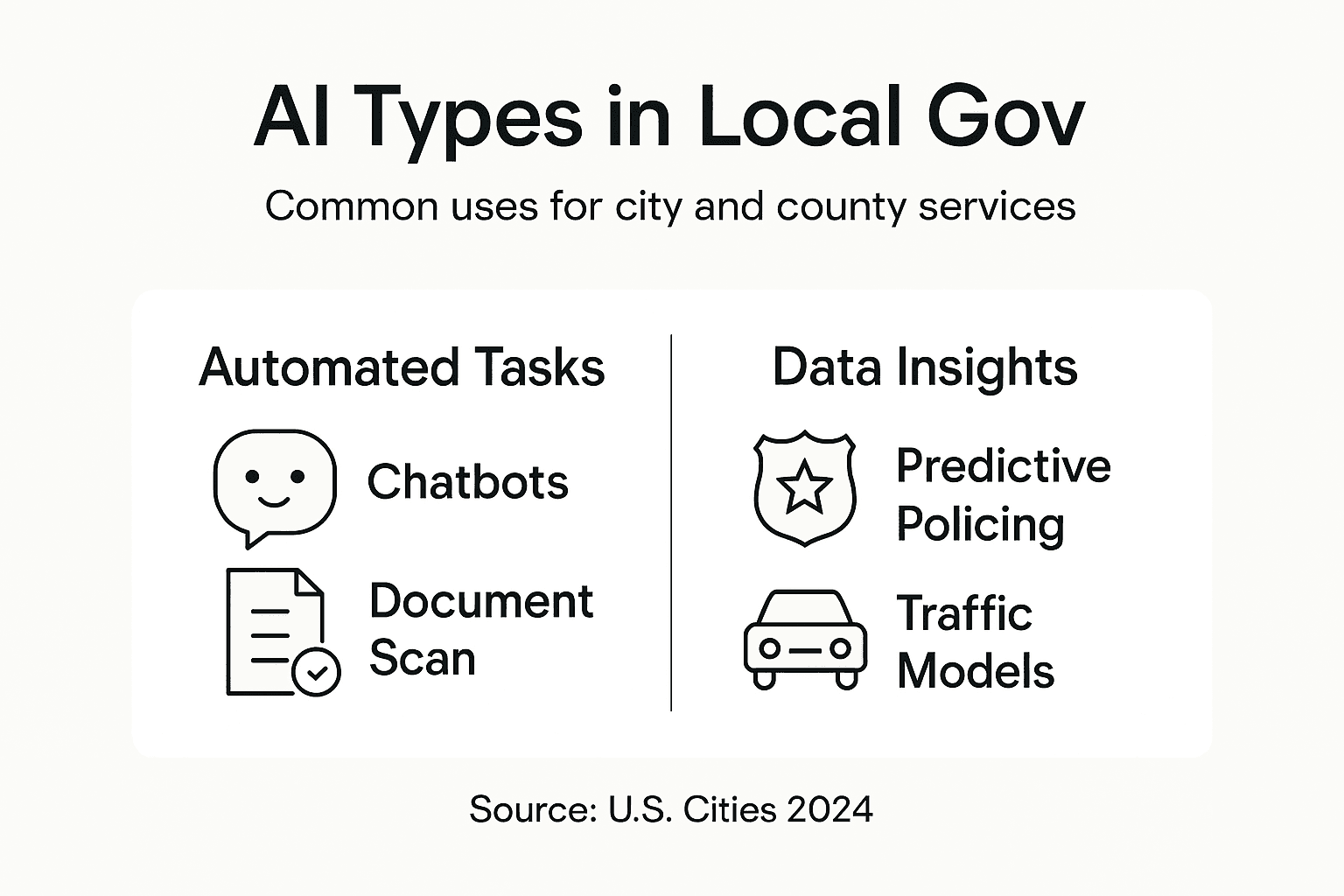
Here is a summary of key AI technologies and their strategic value for local government digital services:
| AI Technology | Primary Use | Strategic Value |
|---|---|---|
| Machine Learning | Pattern recognition and predictions | Optimizes resource allocation |
| Natural Language Processing | Human language understanding | Streamlines citizen interactions |
| Computer Vision | Image and video analysis | Enhances surveillance and safety |
| Predictive Analytics | Forecasting trends | Informs long-term planning |
| Robotic Process Automation | Automating repetitive tasks | Reduces administrative workload |
Moreover, local government AI implementations must navigate complex ethical landscapes. Unlike corporate sectors, public institutions must prioritize transparency, accountability, and equitable service delivery. This means AI technologies must be carefully designed with robust governance frameworks that prevent algorithmic bias and protect citizens’ privacy rights.
AI technologies in local government are not just technological tools, but strategic assets that can fundamentally reshape public service delivery.
Pro tip: Develop comprehensive AI governance protocols that include regular algorithmic audits and transparent performance metrics to ensure responsible technological implementation.
Key Applications in Education and Community Engagement
Local governments are increasingly adopting sophisticated AI technologies to transform educational experiences, creating more personalized, accessible, and responsive learning environments. These digital innovations are reshaping how communities interact with educational institutions and public services.
Key AI applications in education and community engagement include:
- Personalized Learning Platforms: Adaptive systems that customize educational content based on individual student performance
- Intelligent Tutoring Systems: AI-powered tools that provide real-time academic support and feedback
- Community Engagement Chatbots: Automated communication channels for citizen inquiries and service requests
- Predictive Student Success Models: Analytics that identify at-risk students and recommend targeted interventions
- Digital Resource Accessibility Tools: AI systems that enhance educational content for diverse learning needs
These technologies go beyond traditional educational approaches by enabling data-driven decision-making and creating more inclusive learning environments. For instance, machine learning algorithms can analyze student performance data to identify learning gaps, while natural language processing tools can provide multilingual support for diverse student populations.
Moreover, AI-driven community engagement platforms are revolutionizing how local governments interact with citizens. These intelligent systems can process complex citizen requests, route inquiries to appropriate departments, and provide personalized information in real-time, significantly improving public service accessibility and responsiveness.
AI in education is not about replacing human educators, but about empowering them with intelligent tools to enhance learning experiences.
Pro tip: Develop a comprehensive AI integration strategy that prioritizes ethical considerations, data privacy, and continuous professional development for educators implementing these technologies.
Strategies for Implementing Responsible AI Solutions
Local governments are increasingly focused on developing comprehensive AI governance frameworks that balance technological innovation with ethical considerations and public accountability. These strategies are critical for ensuring AI technologies serve community interests while mitigating potential risks and unintended consequences.
Key strategies for implementing responsible AI solutions include:
- Ethical Framework Development: Establishing clear guidelines that prioritize fairness, transparency, and human rights
- Continuous Risk Assessment: Regular audits of AI systems to identify and address potential biases
- Stakeholder Engagement: Creating inclusive processes that involve community members in AI decision-making
- Robust Data Governance: Implementing strict protocols for data privacy and protection
- Algorithmic Transparency: Developing mechanisms to explain AI decision-making processes
Responsible AI implementation requires a multifaceted approach that goes beyond technological capabilities. Local governments must create comprehensive oversight mechanisms that ensure AI technologies align with public values and legal requirements. This involves developing detailed documentation, creating independent review boards, and establishing clear accountability protocols.
Moreover, successful AI adoption demands significant investment in workforce training and cultural transformation. Local government leaders must cultivate a nuanced understanding of AI technologies, addressing both their potential benefits and inherent ethical challenges. This includes developing staff capabilities to critically evaluate AI systems, understand their limitations, and make informed decisions about their deployment.
Responsible AI is not about limiting innovation, but about directing technological progress toward meaningful and ethical public service.
Pro tip: Create a cross-functional AI governance team that includes technical experts, ethicists, legal professionals, and community representatives to ensure comprehensive oversight and balanced decision-making.
Risks, Challenges, and Mitigation for Public Agencies
Public agencies face significant challenges when implementing AI technologies, with critical risks emerging across multiple operational domains. These potential pitfalls range from technical vulnerabilities to profound ethical and societal implications that demand comprehensive strategic approaches.
Key risks and challenges for public agencies include:
- Data Privacy Vulnerabilities: Potential breaches of sensitive citizen information
- Algorithmic Bias: Unintended discrimination in automated decision-making processes
- Technological Reliability: Inconsistent performance and potential system failures
- Workforce Displacement: Potential job disruptions from AI automation
- Ethical Governance: Maintaining transparency and accountability in AI systems
Technological complexity introduces multifaceted challenges that extend beyond simple technical implementations. Public agencies must develop sophisticated risk mitigation strategies that address both immediate operational concerns and long-term societal impacts. This requires creating adaptive frameworks that can evolve alongside rapidly changing AI technologies.

Moreover, successful risk management demands a holistic approach integrating technical expertise, legal compliance, and ethical considerations. Local government leaders must invest in continuous staff training, develop robust oversight mechanisms, and create flexible policies that can adapt to emerging AI capabilities while protecting citizen rights and maintaining public trust.
The following table compares major risks in public sector AI with common mitigation strategies:
| Risk Area | Example Scenario | Mitigation Strategy |
|---|---|---|
| Data Privacy | Sensitive data exposure | Strong encryption and access controls |
| Algorithmic Bias | Unfair service allocation | Regular algorithm audits |
| System Reliability | Service disruptions | Redundant infrastructure |
| Workforce Disruption | Job displacement | Employee reskilling programs |
Effective AI risk management is not about preventing technological innovation, but about guiding it responsibly toward meaningful public service outcomes.
Pro tip: Establish a dynamic AI risk assessment protocol that includes regular independent audits, stakeholder feedback mechanisms, and clear accountability pathways.
Unlock the Full Potential of AI for Your Local Government Services
The article highlights critical challenges faced by U.S. local governments such as maintaining transparency, ensuring ethical AI use, and improving citizen engagement through advanced digital services. If you are striving to automate complex workflows, optimize resource allocation, or implement AI responsibly while protecting privacy and equity, these are pressing concerns that require expert guidance. Concepts like machine learning, natural language processing, and predictive analytics are essential tools but need tailored and ethical application to truly transform public service.
At Airitual, we specialize in delivering customized AI solutions designed to meet these exact challenges. Whether you want to empower your teams with AI-powered education platforms or implement intelligent automation that enhances community engagement, our consultative approach offers measurable results rooted in trust and transparency. Explore our Classes | Artificial Intelligence and Webinars | Artificial Intelligence to build your knowledge and get inspired on how AI can serve your community better. Do not wait for AI risks to become roadblocks. Visit our website today and schedule a free strategy session to start transforming your local government digital services with responsible AI solutions.
Frequently Asked Questions
What are the primary benefits of AI in local government digital services?
AI enhances operational efficiency, improves citizen engagement, automates administrative tasks, and allows for data-driven decision-making in public service delivery.
How does AI help in community engagement for local governments?
AI technologies, such as chatbots and predictive analytics, enable local governments to streamline communication with citizens, providing personalized responses and anticipating community needs.
What types of AI technologies are commonly used in local government?
Local governments typically utilize machine learning, natural language processing, computer vision, predictive analytics, and robotic process automation to enhance service delivery and operational workflows.
What are the potential risks of implementing AI in public agencies?
Risks include data privacy vulnerabilities, algorithmic bias, technological reliability issues, workforce displacement, and challenges in maintaining ethical governance and accountability.
Recommended
- 7 Types of AI-Powered Solutions for Local Government Success | Artificial Intelligence
- 7 Practical Examples of AI Use Cases for Local Governments | Artificial Intelligence
- Why Use AI for Public Services: Enhanced Efficiency | Artificial Intelligence
- 7 Types of AI for Government: Boost Efficiency and Service | Artificial Intelligence
Recent Comments