

TL;DR:
- AI tutoring systems can outperform human tutors in providing personalized, scalable support for students.
- Studies show AI feedback significantly improves student performance, engagement, and reduces achievement gaps.
- Successful adoption requires addressing privacy, teacher training, cultural integration, and responsible implementation practices.
Human tutors have long been considered the gold standard for personalized learning. That assumption is now being challenged by data. Intelligent tutoring systems can outperform human tutors in novel problem solving, and adoption across districts is accelerating at a pace few anticipated. For educational administrators and organizational decision-makers, this shift presents both a strategic opportunity and a set of real implementation questions. This article walks you through how AI-driven personalized feedback works, what the evidence says about its impact, and how to adopt it responsibly and at scale.
Table of Contents
- The evolution of personalized feedback: From human to AI
- Core features of AI-driven personalized feedback
- Proven benefits: AI feedback’s impact on learning and engagement
- Challenges, risks, and best practices for AI-powered feedback
- A caution and opportunity: What most AI feedback adopters miss
- Take AI-powered feedback further: Next steps for your organization
- Frequently asked questions
Key Takeaways
| Point | Details |
|---|---|
| AI surpasses human feedback | Evidence shows AI-powered feedback systems can boost novel problem solving and performance more than human tutors. |
| Proven results in equity and engagement | Studies demonstrate bigger performance gains, major equity gap reductions, and increased class attendance with AI feedback. |
| Mind the risks | Programs must address privacy, teacher readiness, and student overreliance for effective implementation. |
| Hybrid and training needed | Blending AI with teacher guidance and investing in training delivers the most sustainable results. |
The evolution of personalized feedback: From human to AI
For decades, personalized feedback depended entirely on the availability of skilled teachers and tutors. A student struggling with algebra at 9 p.m. had no one to turn to. A classroom of 30 students meant each learner received, at best, a few minutes of individualized attention per week. That scarcity was not a failure of effort. It was a structural limitation.
AI has changed the structural equation. Systems like Khanmigo use Socratic questioning, meaning they guide students toward answers rather than simply providing them. They combine large language models with specialized educational tools to adapt in real time to each learner’s responses. The impact of AI-powered tools in education is no longer theoretical. It is measurable, replicable, and scaling fast.
Consider what happened with Khanmigo’s approach over a single year: users grew more than tenfold. That growth reflects genuine demand from districts recognizing that AI can do what no hiring budget ever could: provide every student with on-demand, adaptive, personalized support.
Here is what makes this shift significant for administrators:
- Scalability: AI systems serve thousands of students simultaneously without degrading feedback quality.
- Cost efficiency: Once deployed, AI reduces the per-student cost of personalized support dramatically.
- Consistency: Every student receives the same quality of engagement, regardless of time of day or class size.
- Data continuity: AI tracks learning progress across sessions, building a detailed picture of each student’s mastery over time.
The old model required you to choose between breadth and depth. AI removes that tradeoff. Having highlighted the significant improvements AI brings, next we break down the core features that make AI feedback effective.
Core features of AI-driven personalized feedback
Not all AI feedback systems are built the same. The most effective ones share a specific set of capabilities that distinguish them from basic automated grading tools.
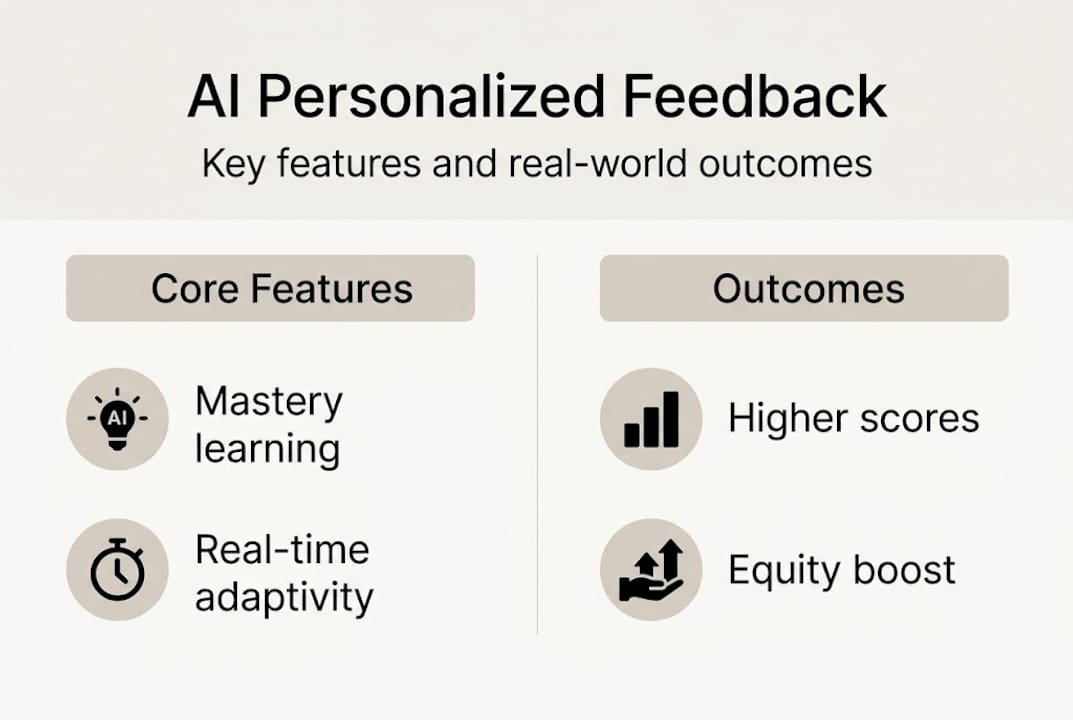
According to recent performance studies, the systems that produce the strongest outcomes combine mastery learning, real-time adaptivity, hint safeguards, and domain-specific tools. Each of these components plays a distinct role.
Mastery learning means the system does not move a student forward until they demonstrate genuine understanding. This prevents the common problem of students advancing with gaps that compound over time.
Real-time adaptivity means the system adjusts difficulty, tone, and question type based on how the student is responding right now, not based on last week’s test score.
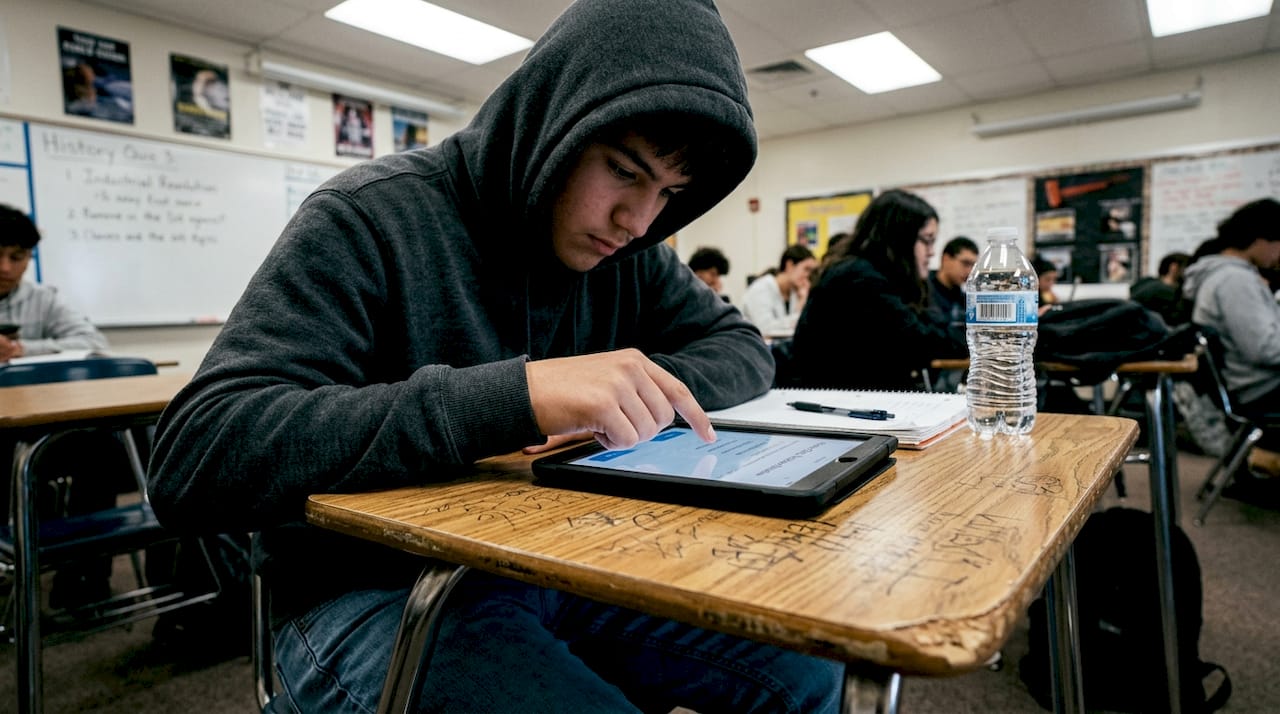
Hint safeguards are a critical design feature. Without them, students can game the system by requesting hints until the answer is revealed. Well-designed systems prevent this by limiting hint pathways and redirecting students toward reasoning.
Domain-specific tools mean the feedback is calibrated for the subject. A writing feedback tool behaves differently from a math reasoning tool, and that specificity matters for quality.
Here is a direct comparison of how human and AI feedback differ in practice:
| Feature | Human feedback | AI feedback |
|---|---|---|
| Response time | Hours to days | Immediate |
| Consistency | Varies by teacher | Uniform |
| Availability | Limited hours | 24/7 |
| Personalization depth | High but slow | High and instant |
| Scalability | Low | Very high |
| Revision tracking | Manual | Automated |
When choosing top AI feedback tools, look beyond surface features. Evaluate whether the system supports revision behavior, meaning it encourages students to revisit and improve their work rather than just accepting the first answer.
Pro Tip: Before piloting any AI feedback system, map it against your learning objectives. A system strong in math reasoning may not support writing development equally well. Match the tool to the domain.
With a solid grasp of the main features, let’s examine the measurable impacts these systems have on learning.
Proven benefits: AI feedback’s impact on learning and engagement
The evidence is no longer preliminary. Controlled studies are producing consistent findings across student populations and subject areas.
A quasi-experimental study found that AI-driven feedback systems produced +12.63 percentage points in performance, a 56.5% reduction in equity gaps between high and low performers, and attendance improvements of up to 30 percentage points in some cohorts. These are not marginal gains. They represent a meaningful shift in what is achievable at scale.
Here is a summary of the key findings:
| Outcome | Measured impact |
|---|---|
| Academic performance | +12.63 percentage points |
| Equity gap reduction | 56.5% decrease |
| Attendance improvement | Up to 30 percentage points |
| Student engagement | Significant increase |
The students who benefit most are often those who traditional systems underserve: learners with negative academic histories, those from under-resourced schools, and students who disengage when they feel behind. AI feedback removes the social risk of asking for help. A student who would never raise their hand in class will ask an AI system the same question five times until they understand it.
For a broader view of how these systems drive engagement, explore AI engagement strategies that pair feedback tools with broader instructional design.
The latest LLM feedback research also points to an important nuance: short-term performance gains are easier to measure than long-term retention. Administrators should build assessment frameworks that track both.
Here is a numbered breakdown of which student groups see the strongest results:
- Students with prior low performance who receive consistent AI feedback show the largest absolute gains.
- Learners in under-resourced districts benefit from AI’s ability to equalize access to quality feedback.
- Students who struggle with self-advocacy improve when AI removes the social barrier to asking for help.
- High performers benefit from AI’s ability to provide challenge-level content without waiting for teacher intervention.
While the benefits are tangible, it is crucial to understand the challenges and how to address them.
Challenges, risks, and best practices for AI-powered feedback
Adopting AI feedback systems is not without friction. Administrators who go in without a clear implementation strategy often encounter predictable obstacles.
Key challenges include data privacy and ethics, teacher readiness, student overreliance on AI-generated answers, and low uptake of revision behaviors. Each of these deserves a deliberate response.
Data privacy is non-negotiable. Any system collecting student interaction data must comply with FERPA and your district’s specific privacy policies. Vet vendors carefully and require transparent data handling agreements before deployment.
Teacher readiness is often underestimated. Teachers who feel bypassed by AI tools disengage from the process. The most successful implementations treat teachers as co-designers, not bystanders. For practical guidance, review AI-powered teaching tips that help instructors integrate AI into their existing workflows.
Overreliance is a real risk. When students learn that AI will always provide a path to the answer, some stop engaging their own reasoning. Systems with strong hint safeguards help, but so does classroom culture. Teachers need to frame AI as a thinking partner, not an answer machine.
Here is a practical list of best practices for responsible scaling:
- Establish clear learning objectives before selecting any AI tool.
- Pilot with a single grade level or subject before district-wide rollout.
- Collect both quantitative and qualitative data from students and teachers during the pilot.
- Review Khanmigo equity insights to understand how access disparities affect outcomes.
- Build professional learning time into the implementation timeline.
- Set explicit policies on how AI feedback integrates with grading and assessment.
For a structured approach to rollout, the implementing AI in education guide provides a step-by-step framework that reduces common deployment risks.
Pro Tip: Hybrid teacher-AI models consistently outperform AI-only deployments. Design your implementation so teachers receive AI-generated insights about student progress and use them to inform their direct instruction.
By addressing these risks, educational leaders can unlock the full value of AI feedback. For a fresh perspective, consider this:
A caution and opportunity: What most AI feedback adopters miss
Most organizations focus on the technology selection and miss the harder work entirely. Picking the right AI feedback system is maybe 20% of the challenge. The other 80% is culture, training, and integration design.
We see this consistently: districts deploy capable AI tools, skip meaningful teacher onboarding, and then wonder why adoption stalls. The evidence is clear that teacher training, robust outcome metrics, and hybrid instructional models are what separate successful implementations from expensive experiments.
There is also a cognitive risk that rarely gets discussed. When students receive instant AI feedback repeatedly, some reduce the depth of their own processing. They optimize for getting feedback rather than for thinking. This is not the AI’s fault. It is a design and integration problem that instructors need to actively counteract.
The organizations that get this right treat AI feedback as an infrastructure investment, not a product purchase. They build toward personalizing learning with AI in ways that are transparent, measurable, and continuously improved. Hybrid models with clear teacher roles and visible outcome metrics are not just best practice. They are the only path to sustainable, equitable impact.
Take AI-powered feedback further: Next steps for your organization
If the evidence in this article has shifted how you think about personalized feedback, the next step is moving from insight to action. AI-powered feedback is within reach for districts and organizations of every size, and the implementation path is clearer than most leaders expect.
Explore the full range of AI solutions for education available through Airitual, including tools designed specifically for student engagement and learning outcomes. Use the integration best practices resource to build a deployment plan that accounts for equity, privacy, and teacher readiness. When you are ready to move forward, the AI implementation guide gives you a structured, step-by-step framework. Schedule a free strategy session with Airitual to align your goals with the right tools and approach.
Frequently asked questions
How does AI personalize feedback better than traditional methods?
AI delivers instant, adaptive responses tailored to each learner’s current performance level, outperforming generic manual feedback in both speed and relevance. Unlike human feedback, AI tracks mastery across sessions and adjusts the learning path in real time.
What evidence supports the effectiveness of AI-powered feedback?
Controlled studies show AI-driven feedback produces +12.63 percentage points in performance, a 56.5% reduction in equity gaps, and up to 30 percentage points in attendance improvement across student cohorts.
What are the main challenges when adopting AI for personalized feedback?
The primary obstacles are data privacy and ethics, teacher readiness, student overreliance on AI-generated answers, and ensuring equitable access across all student populations.
How can administrators ensure responsible use of AI feedback systems?
Adopt hybrid teaching models that keep instructors central to the learning process, invest in structured staff training, and implement robust privacy safeguards to protect student data and maximize long-term outcomes.
Recommended
- AI for student engagement: proven strategies for better learning | Artificial Intelligence
- How to Personalize Learning With AI for Student Success | Artificial Intelligence
- 10 AI-powered teaching tips that boost results in 2026 | Artificial Intelligence
- AI Training | Artificial Intelligence
- Personalización del aprendizaje con IA: ventajas y aplicaciones – Rescrito
Recent Comments