

Local governments across North America are facing increasing pressure to make decisions quickly and confidently in a complex environment. The shift toward AI-driven policy making is more than a technological trend—it reflects an urgent need for transparency, efficiency, and responsiveness that traditional frameworks struggle to deliver. This article breaks down how Artificial Intelligence empowers policy makers through smarter problem diagnosis, evidence-based recommendations, and real-time impact projections, supporting communities with precision and adaptability.
Table of Contents
- Defining AI in Policy Making Today
- AI Models and Applications in Governance
- Key Processes and Implementation Strategies
- Legal, Ethical, and Regulatory Frameworks
- Risks, Challenges, and Best Practices
Key Takeaways
| Point | Details |
|---|---|
| AI Enhances Policy Making | AI tools are transforming governance by facilitating data-driven decision-making and improving transparency and efficiency. |
| Augmentation of Human Judgment | AI is intended to assist rather than replace human decision-making, helping policymakers navigate complex issues. |
| Importance of Ethical Frameworks | Comprehensive legal and ethical guidelines are crucial for responsible AI adoption in governance. |
| Proactive Risk Management | Local governments should implement strategies to identify and mitigate risks associated with AI technologies, ensuring accountability and transparency. |
Defining AI in Policy Making Today
Artificial Intelligence (AI) has rapidly transformed from a theoretical concept to a practical tool reshaping how local governments approach policy development and implementation. Policy making through AI algorithms represents a significant shift in governance strategies, moving beyond traditional decision-making frameworks.
At its core, AI in policy making involves sophisticated algorithms and machine learning techniques designed to analyze complex data, predict potential outcomes, and support more informed governmental decisions. The contemporary understanding of AI in this context encompasses three critical dimensions:
- Problem Diagnosis: Using data analytics to identify systemic challenges
- Solution Design: Generating evidence-based policy recommendations
- Outcome Projection: Simulating potential policy impacts before implementation
Governments worldwide are increasingly recognizing AI’s potential to enhance transparency, efficiency, and responsiveness. By leveraging advanced computational techniques, policymakers can process vast amounts of information, recognize intricate patterns, and develop more nuanced, data-driven strategies that address community needs with unprecedented precision.
The evolution of AI in policy making is not about replacing human judgment but augmenting it. Intelligent systems provide decision-makers with comprehensive insights, helping them navigate increasingly complex social and economic landscapes. These technologies enable more proactive, adaptive governance models that can quickly respond to emerging challenges.
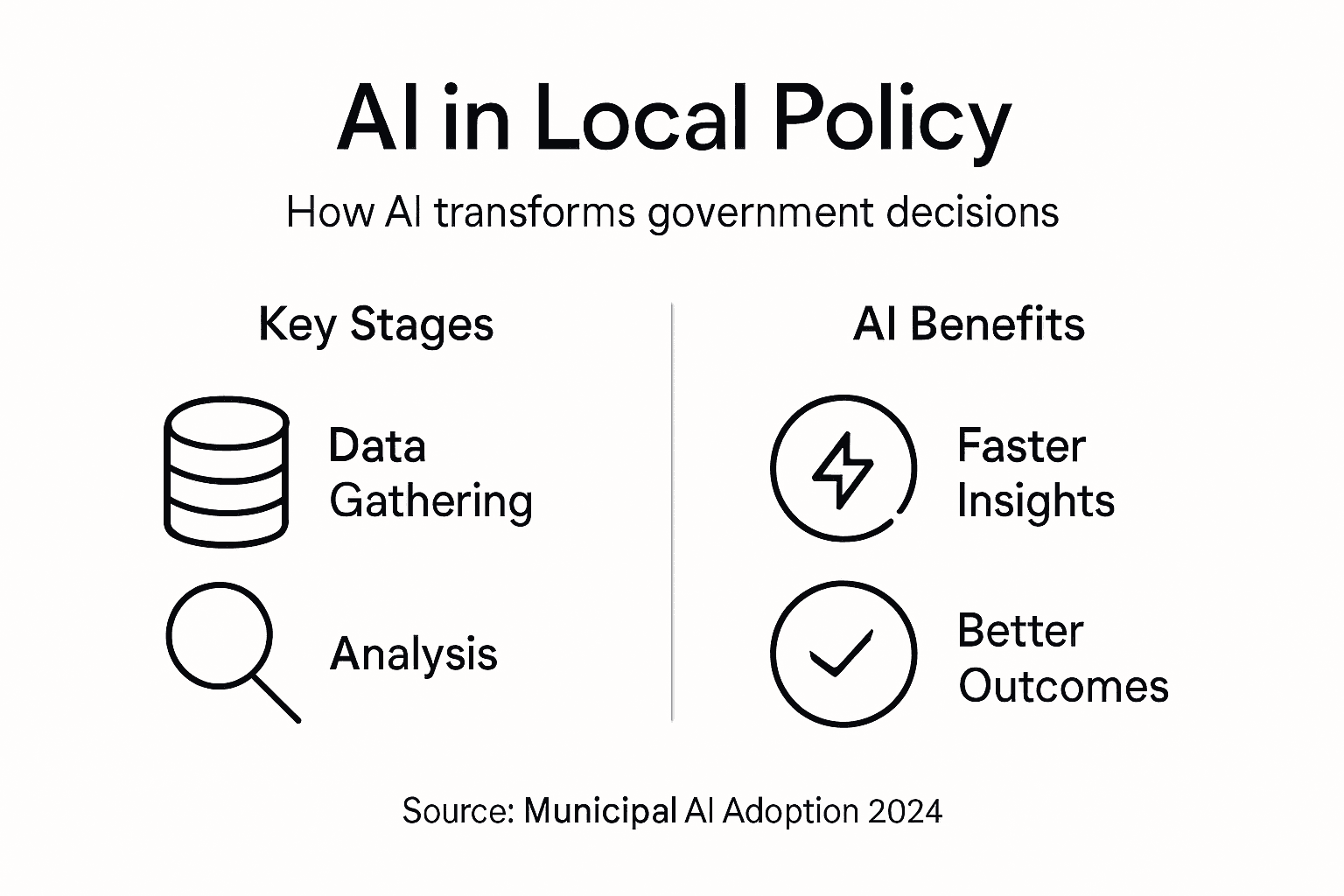
Here’s a summary of how AI transforms key stages of policy making:
| Stage | Traditional Approach | AI-Driven Approach |
|---|---|---|
| Problem Identification | Manual reviews, expert intuition | Automated data analytics |
| Policy Design | Limited scenario modeling | Predictive simulations, ML models |
| Impact Evaluation | Pilot programs, lagging feedback | Real-time outcome projections |
Pro tip: Start by identifying specific, measurable policy areas where AI can provide immediate, tangible improvements in your local government’s decision-making processes.
AI Models and Applications in Governance
AI models are revolutionizing governance by providing sophisticated tools for complex decision-making processes. Advanced predictive policy modeling enables governments to analyze massive datasets and generate more precise, data-driven strategies that address intricate societal challenges.
The landscape of AI applications in governance spans multiple critical domains:
- Predictive Analytics: Forecasting social trends and potential policy outcomes
- Risk Assessment: Identifying potential systemic challenges before they escalate
- Resource Allocation: Optimizing governmental budget and service distribution
- Performance Monitoring: Tracking policy effectiveness in real-time
- Citizen Engagement: Creating more responsive and interactive government platforms
Local governments are increasingly adopting machine learning algorithms that can process complex information faster and more accurately than traditional methods. These intelligent systems help policymakers move from reactive to proactive governance models, enabling them to anticipate community needs and design more targeted interventions.

The most sophisticated AI models integrate multiple data sources, combining historical records, real-time information, and predictive algorithms to generate comprehensive insights. By synthesizing diverse datasets, these technologies provide nuanced perspectives that human analysts might overlook, ultimately supporting more informed and equitable policy decisions.
Consider how different AI applications benefit local governments:
| AI Application | Primary Benefit | Example Use Case |
|---|---|---|
| Predictive Analytics | Anticipates social changes | Forecasting service demand |
| Resource Allocation | Improves budget efficiency | Optimizing emergency response |
| Citizen Engagement | Enhances public participation | Automated feedback systems |
Pro tip: Begin implementing AI governance models by conducting a comprehensive audit of your existing data infrastructure and identifying specific areas where predictive analytics can deliver immediate operational improvements.
Key Processes and Implementation Strategies
Successful AI integration in local governance requires a structured and strategic approach. Comprehensive AI policy implementation demands meticulous planning, stakeholder engagement, and a commitment to ethical and transparent technological adoption.
The key processes for effective AI implementation in governance include:
- Stakeholder Mapping: Identifying and engaging all relevant governmental and community participants
- Data Infrastructure Assessment: Evaluating existing data collection and management systems
- Ethical Framework Development: Creating clear guidelines for AI use and decision-making
- Continuous Learning Programs: Training personnel in AI technologies and applications
- Iterative Model Development: Implementing adaptive AI systems with regular performance reviews
Local governments must adopt a phased approach to AI integration, beginning with pilot programs that demonstrate clear value and minimize potential risks. Strategic implementation involves carefully selecting use cases where AI can deliver immediate, measurable improvements in service delivery, resource allocation, or decision-making processes.
The most successful AI governance strategies prioritize transparency, accountability, and ongoing evaluation. This means developing robust mechanisms for monitoring AI performance, ensuring algorithmic fairness, and maintaining human oversight in critical decision-making processes. By creating flexible frameworks that can adapt to technological advancements and emerging ethical considerations, governments can harness the transformative potential of AI while mitigating potential risks.
Pro tip: Create a cross-functional AI implementation team that includes technology experts, policy makers, and community representatives to ensure comprehensive and balanced AI adoption strategies.
Legal, Ethical, and Regulatory Frameworks
AI governance requires comprehensive legal frameworks that balance technological innovation with robust ethical considerations. Emerging AI regulatory approaches emphasize creating adaptive systems that protect public interests while fostering technological advancement.
Key ethical and legal dimensions of AI governance include:
- Algorithmic Transparency: Ensuring AI decision-making processes are comprehensible and explainable
- Bias Mitigation: Developing mechanisms to identify and eliminate discriminatory computational patterns
- Privacy Protection: Establishing stringent data collection and usage guidelines
- Accountability Mechanisms: Creating clear lines of responsibility for AI-driven decisions
- Consent and User Rights: Defining frameworks for individual data control and algorithmic interaction
Local governments must develop nuanced regulatory strategies that recognize the complexity of AI technologies. This involves creating flexible legal frameworks that can rapidly adapt to technological changes while maintaining consistent ethical standards. Effective regulation requires a collaborative approach that brings together technology experts, legal professionals, ethicists, and community representatives.
The most progressive regulatory models adopt a risk-based approach, categorizing AI applications based on their potential social impact and implementing proportional oversight. By establishing clear guidelines that prioritize human rights, fairness, and transparency, governments can create an environment that encourages responsible AI innovation while protecting citizens’ fundamental interests.
Pro tip: Develop a dynamic AI ethics committee with diverse representation to continuously review and update regulatory frameworks as technological capabilities evolve.
Risks, Challenges, and Best Practices
Artificial Intelligence integration in local governance presents a complex landscape of potential risks and transformative opportunities. Systematic AI risk assessment reveals critical challenges that demand proactive and strategic management to ensure responsible technological implementation.
Key risks and challenges in AI governance include:
- Algorithmic Bias: Unintended discriminatory patterns in decision-making systems
- Data Privacy Vulnerabilities: Potential breaches of sensitive citizen information
- Transparency Limitations: Difficulty in explaining complex AI-driven decisions
- Technological Dependency: Over-reliance on automated systems
- Workforce Displacement: Potential job market disruptions
Successful AI implementation requires a comprehensive risk management strategy that goes beyond technical considerations. Local governments must develop robust frameworks that balance technological innovation with ethical considerations, ensuring that AI systems remain accountable, transparent, and aligned with community values.
The most effective approaches to mitigating AI risks involve continuous monitoring, adaptive governance, and inclusive stakeholder engagement. This means creating mechanisms for ongoing evaluation, establishing clear ethical guidelines, and maintaining human oversight in critical decision-making processes. By adopting a proactive and nuanced approach, governments can harness AI’s potential while protecting citizens’ fundamental rights and interests.
Pro tip: Implement a multi-disciplinary AI governance committee that includes technology experts, ethicists, legal professionals, and community representatives to provide comprehensive oversight and guidance.
Unlock the Power of AI for Smarter Local Governance
The article highlights critical challenges local governments face today such as complex decision making, data privacy, algorithmic bias, and the urgent need for transparent, ethical AI integration. If you are seeking to transform these pain points into opportunities for more effective policy making through predictive analytics, resource optimization, and citizen engagement, then strategic AI adoption is your key. Leveraging concepts like outcome projection and adaptive governance models, your community can benefit from data-driven insights that enhance transparency and operational efficiency.
At airitual.com, we specialize in delivering tailored AI solutions designed specifically for local governments. Our consultative approach bridges ethical frameworks with cutting-edge technology to help you build trust and improve policy impact. Explore our Webinars | Artificial Intelligence to stay informed on best practices, join interactive Classes | Artificial Intelligence for hands-on learning, and tap into customized strategies that align with your governance goals. Do not wait to future-proof your policymaking. Take the next step toward smarter, more responsible AI integration today with a free consultation at airitual.com.
Frequently Asked Questions
What are the main dimensions of AI in policy making?
AI in policy making encompasses three critical dimensions: problem diagnosis, solution design, and outcome projection. These dimensions involve using data analytics to identify challenges, generating evidence-based policy recommendations, and simulating potential impacts before implementation.
How can AI improve decision-making in local governance?
AI can enhance decision-making in local governance by processing vast amounts of information, recognizing patterns, and generating insights that support data-driven strategies. This allows governments to design targeted interventions and respond proactively to community needs.
What are some examples of AI applications in governance?
Examples of AI applications in governance include predictive analytics for forecasting social trends, risk assessment to identify challenges, resource allocation optimization, performance monitoring of policies, and citizen engagement through interactive platforms.
What are the key challenges in implementing AI in local governance?
Key challenges include algorithmic bias, data privacy vulnerabilities, transparency limitations, technological dependency, and potential workforce displacement. Addressing these challenges requires robust risk management and ethical frameworks that prioritize accountability and community values.
Recommended
- Role of AI in Digital Services: Impact for U.S. Local Government | Artificial Intelligence
- 7 Practical Examples of AI Use Cases for Local Governments | Artificial Intelligence
- 7 Types of AI-Powered Solutions for Local Government Success | Artificial Intelligence
- 7 Types of AI for Government: Boost Efficiency and Service | Artificial Intelligence
Recent Comments