

Protecting citizen data has become a central challenge for IT leaders as artificial intelligence gains ground in local public services. Balancing innovation with data privacy is now more than just a technical hurdle—it is a question of public trust and regulatory responsibility. With emerging laws like the EU AI Act and increasing demands for ethical oversight, this article explores practical steps for building AI systems that respect privacy, meet compliance benchmarks, and uphold the rights of every resident.
Table of Contents
- Defining Data Privacy In AI Systems
- Variations Of AI And Privacy Challenges
- Legal Regulations For Local Governments
- Risks, Liabilities, And Mitigation Strategies
- Roles And Responsibilities Of Agencies
- Best Practices For Ensuring Compliance
Key Takeaways
| Point | Details |
|---|---|
| Data privacy is essential in AI systems | Organizations must protect personal information while promoting responsible AI development through comprehensive governance strategies. |
| Unique privacy challenges exist for different AI types | Generative AI and other variations pose distinct risks, necessitating specialized mitigation strategies for effective privacy protection. |
| Collaboration is crucial among agencies | Local governments need coordinated efforts among regulatory, legal, and ethical bodies to ensure comprehensive AI governance. |
| Proactive compliance measures are necessary | Implementing privacy by design and continuous monitoring are vital for maintaining regulatory alignment and protecting individual rights in AI systems. |
Defining Data Privacy in AI Systems
Data privacy in AI systems represents a critical intersection between technological innovation and individual rights. At its core, data privacy means protecting personal information from unauthorized access, misuse, or unintended exposure while enabling responsible artificial intelligence development. Privacy principles in AI governance demand comprehensive strategies that balance technological potential with fundamental human rights.
The landscape of AI data privacy involves several key considerations:
- Protecting individual identities and personal information
- Ensuring transparent data collection practices
- Implementing robust consent mechanisms
- Maintaining data minimization principles
- Establishing clear boundaries for data usage
Government agencies and organizations must recognize that data privacy is not merely a technical challenge but a complex ethical framework. Regulatory compliance becomes essential, with frameworks like GDPR and emerging AI regulations providing structured guidelines for responsible data management.
Privacy professionals play a crucial role in developing AI governance structures, conducting thorough risk assessments and ensuring ethical data utilization. Their expertise helps organizations navigate complex regulatory environments while maintaining technological innovation and individual rights.
Pro tip: Develop a comprehensive data privacy assessment checklist that includes consent verification, data minimization protocols, and periodic privacy impact reviews.
Variations of AI and Privacy Challenges
Generative AI has introduced unprecedented complexity in data privacy landscapes, presenting unique challenges that transcend traditional technological boundaries. Diverse governance approaches reveal the intricate nature of managing privacy risks across different AI system categories and jurisdictions.
The primary variations of AI and their associated privacy challenges include:
- Generative AI: Risks of unintended personal data generation and potential misuse
- Predictive AI: Potential for algorithmic bias and unauthorized profiling
- Conversational AI: Challenges with conversational data storage and consent
- Autonomous Systems AI: Privacy concerns related to continuous data collection
- Machine Learning Models: Risks of data leakage and model reconstruction attacks
Each AI variation demands specialized privacy protection strategies. Generative AI, for instance, raises unique concerns about data reproduction, consent, and potential unauthorized information generation. The technology’s ability to synthesize and generate content introduces complex ethical and legal challenges that traditional privacy frameworks struggle to address.
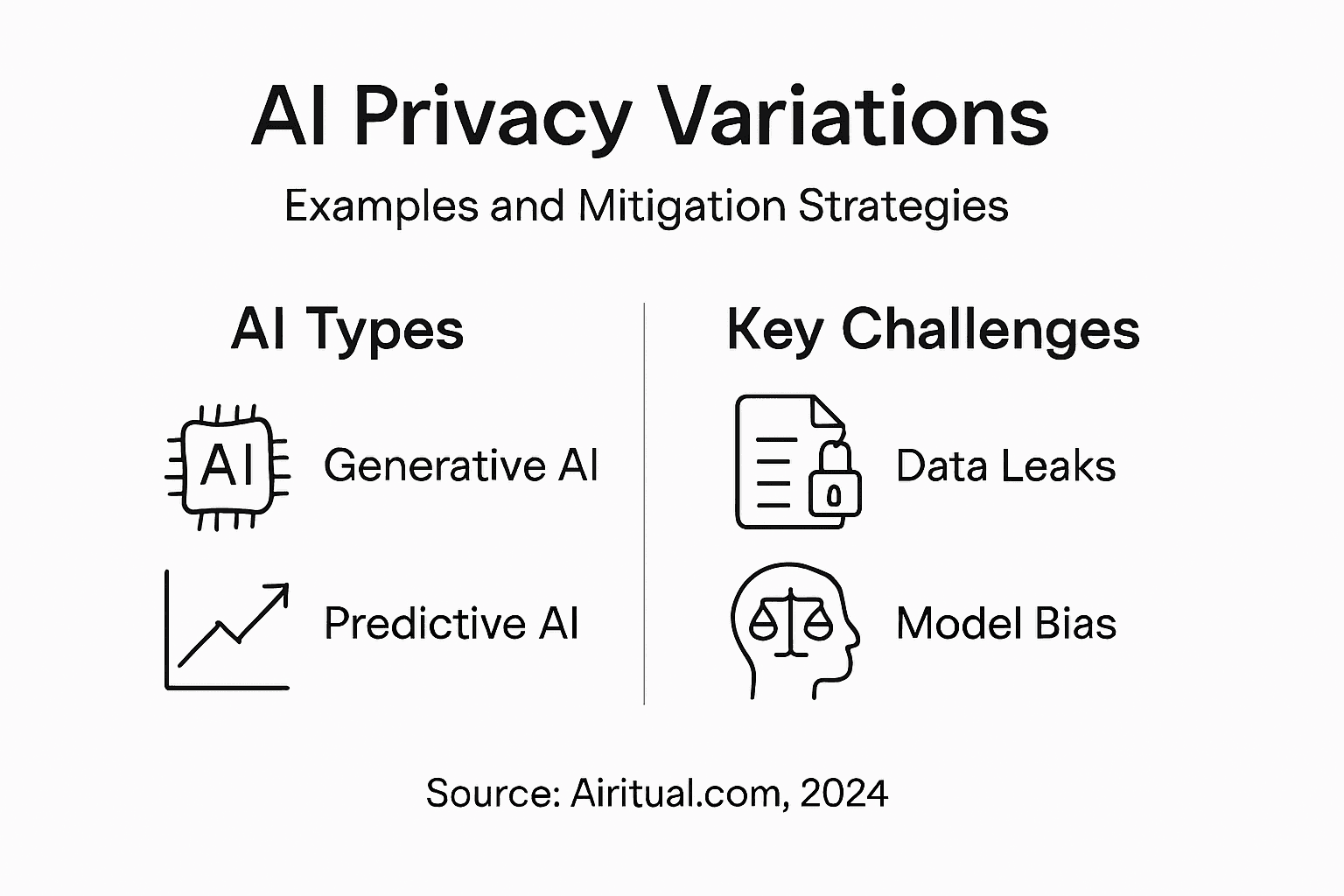
Here’s a comparison of common AI variations and their distinct privacy concerns:
| AI Type | Unique Privacy Challenge | Key Mitigation Strategy |
|---|---|---|
| Generative AI | Unintended personal data synthesis | Enhanced content screening tools |
| Predictive AI | Unauthorized profiling risks | Bias audits on data models |
| Conversational AI | Loss of sensitive conversational data | Secure data storage and user consent |
| Autonomous Systems | Continuous real-world data capture | Real-time monitoring and minimization |
| Machine Learning | Data leakage through model outputs | Output sanitization and privacy review |
Multisectoral governance approaches are essential in addressing these nuanced privacy challenges. Organizations must develop adaptive frameworks that can quickly respond to emerging technological capabilities while maintaining robust privacy protections. Continuous assessment, transparent practices, and proactive risk management become critical in navigating the evolving AI privacy landscape.
Pro tip: Implement a dynamic AI privacy assessment framework that includes periodic reviews of data handling practices, consent mechanisms, and potential unintended data generation risks.
Legal Regulations for Local Governments
Local governments are rapidly developing comprehensive legal frameworks to address the complex challenges posed by artificial intelligence technologies. Generative AI use policies have become critical in establishing clear guidelines for responsible AI deployment across public services.
Key legal regulatory components for local government AI governance include:
- Transparency Requirements: Mandatory disclosure of AI system usage
- Privacy Protection: Stringent data handling and protection protocols
- Ethical Use Guidelines: Frameworks preventing discriminatory AI applications
- Accountability Mechanisms: Clear responsibility and oversight structures
- Consent Management: Explicit user permission protocols for data usage
The regulatory landscape demands a multifaceted approach to AI governance. Local governments must develop adaptive policies that balance technological innovation with robust citizen protection. These regulations typically address critical areas such as algorithmic bias prevention, data security, and maintaining individual privacy rights.
Implementing comprehensive AI regulations requires collaboration between legal experts, technology professionals, and policy makers. Organizations need flexible frameworks that can quickly respond to emerging technological capabilities while maintaining strict adherence to ethical standards and legal requirements.
Pro tip: Develop a cross-departmental AI governance committee that includes legal, technology, and ethics experts to create comprehensive and adaptable AI use policies.
Risks, Liabilities, and Mitigation Strategies
Artificial intelligence introduces complex risk landscapes that demand comprehensive strategic approaches from local government agencies. Systematic AI risk assessment becomes crucial in navigating potential operational, ethical, and governance challenges inherent in AI implementation.
Primary risk categories for AI systems include:
- Operational Risks: System failures, performance inconsistencies
- Ethical Risks: Algorithmic bias, discriminatory decision-making
- Security Risks: Data breaches, unauthorized system access
- Compliance Risks: Regulatory violations, legal accountability
- Reputational Risks: Loss of public trust, negative perception
Effective risk mitigation requires a multilayered approach that integrates technical safeguards, robust governance frameworks, and continuous monitoring mechanisms. Local governments must develop adaptive strategies that can quickly identify and neutralize potential vulnerabilities while maintaining the transformative potential of AI technologies.

Implementing comprehensive risk management involves creating cross-functional teams with expertise in technology, legal compliance, ethics, and data security. These teams should develop scenario-based risk assessment protocols, conduct regular audits, and establish clear accountability structures that ensure responsible AI deployment and maintain public confidence.
This summary outlines risk categories and recommended mitigation in AI governance:
| Risk Category | Example Threat | Mitigation Approach |
|---|---|---|
| Operational | System downtime | Redundant backups and failover systems |
| Ethical | Discriminatory decisions | Fairness testing protocols |
| Security | Data breach incidents | Encryption and access controls |
| Compliance | Regulation violations | Automated compliance checks |
| Reputational | Public mistrust | Transparent communication strategies |
Pro tip: Develop a dynamic risk assessment matrix that includes periodic reviews, scenario simulations, and adaptive mitigation protocols for AI systems.
Roles and Responsibilities of Agencies
Local government agencies play a critical role in managing and governing artificial intelligence technologies to protect public interests. Coordinated agency roles are essential for creating comprehensive AI governance frameworks that ensure transparency, accountability, and ethical implementation.
Key agency responsibilities in AI governance include:
- Regulatory Agencies: Developing comprehensive AI policy frameworks
- Data Protection Authorities: Enforcing privacy and data protection standards
- Technology Oversight Bodies: Monitoring AI system performance and risks
- Legal Compliance Departments: Ensuring adherence to emerging AI regulations
- Ethics Review Committees: Evaluating algorithmic fairness and potential biases
Effective AI governance requires seamless collaboration and clear delineation of responsibilities across different agency functions. Each agency must contribute specialized expertise while maintaining a unified approach to managing AI technologies, balancing innovation with rigorous public protection mechanisms.
Implementing robust agency coordination involves establishing formal communication channels, developing shared assessment protocols, and creating integrated oversight mechanisms. Cross-agency teams must develop adaptive strategies that can respond quickly to technological changes while maintaining consistent regulatory standards and protecting citizen rights.
Pro tip: Create a centralized AI governance task force with representatives from multiple agencies to streamline communication and develop holistic AI management strategies.
Best Practices for Ensuring Compliance
Ensuring compliance in AI systems requires a comprehensive and proactive approach that integrates privacy protection throughout technological development. Privacy safeguards in AI design must be strategically embedded to maintain regulatory alignment and protect individual rights.
Critical compliance best practices include:
- Privacy by Design: Integrating privacy protections from initial development stages
- Regular Impact Assessments: Conducting ongoing privacy and risk evaluations
- Transparent Documentation: Maintaining clear records of data handling processes
- Consent Management: Implementing robust user consent mechanisms
- Continuous Monitoring: Establishing real-time compliance tracking systems
Successful compliance strategies demand a holistic approach that goes beyond mere regulatory checkbox exercises. Organizations must cultivate a culture of proactive privacy protection, where data governance is viewed as a fundamental organizational responsibility rather than an administrative burden.
Implementing these practices requires cross-functional collaboration, involving legal experts, technology professionals, and data protection specialists. Teams must develop adaptive frameworks capable of responding quickly to evolving regulatory landscapes while maintaining the highest standards of ethical data management and individual privacy protection.
Pro tip: Create a comprehensive AI compliance playbook that includes step-by-step guidelines, accountability matrices, and periodic review protocols for maintaining regulatory alignment.
Strengthen Data Privacy in AI to Preserve Public Trust
Data privacy challenges in AI systems demand more than just technical fixes. You are facing the critical need to protect personal information through transparent data use, consent management, and ethical AI governance. Establishing clear privacy protocols helps prevent unauthorized data exposure and builds the public trust essential for your AI initiatives. Key concepts like consent verification, privacy by design, and continuous risk assessment are vital tools for navigating this complex landscape.
At Airitual.com, we specialize in helping government agencies and organizations integrate AI with robust privacy safeguards. Explore our GEO | Artificial Intelligence solutions that focus on tailored AI implementations ensuring compliance with regulations while maximizing operational benefits. Join our expert-led Webinars | Artificial Intelligence to stay ahead on data privacy best practices and risk mitigation strategies.
Protect your community and modernize your AI approach with trusted guidance. Connect with us now at airitual.com for a personalized AI privacy strategy that safeguards citizen data and upholds public trust.
Frequently Asked Questions
What is data privacy in AI systems?
Data privacy in AI systems refers to protecting personal information from unauthorized access and ensuring ethical handling of data while enabling responsible AI development.
What challenges does generative AI pose for data privacy?
Generative AI presents unique challenges such as the risk of unintended personal data generation and the potential for misuse of synthesized content, which complicate traditional privacy frameworks.
How can organizations maintain compliance with AI privacy regulations?
Organizations can maintain compliance by embedding privacy protections from the development stage, conducting regular impact assessments, and establishing transparent documentation and consent management processes.
What roles do local government agencies play in AI data governance?
Local government agencies are responsible for developing AI policy frameworks, enforcing privacy standards, monitoring AI performance and risks, and evaluating algorithmic fairness to ensure ethical implementation of AI technologies.
Recommended
- Explainable AI in Government: Boosting Trust and Accountability | Artificial Intelligence
- Why Use AI for Public Services: Enhanced Efficiency | Artificial Intelligence
- Explainable AI Basics: Building Trust for Business | Artificial Intelligence
- AI Awareness Training for employees | Artificial Intelligence
Recent Comments