

Every education leader faces tough choices as Artificial Intelligence makes its way into classrooms across North America. The real challenge is that many still believe AI literacy is just about learning code—missing the bigger picture. AI literacy means understanding, critiquing, and applying AI ethically and effectively, giving you the tools to guide your district’s decisions, protect equity, and boost engagement. This clear breakdown reveals common misconceptions and lays out what truly sets effective programs apart.
Table of Contents
- AI Literacy Defined And Common Misconceptions
- Key Components Of AI Literacy Programs
- Real-World Impact On Teaching And Learning
- Risks Of Ignoring AI Literacy Initiatives
- Best Practices For Effective Implementation
Key Takeaways
| Point | Details |
|---|---|
| AI Literacy Definition | AI literacy encompasses the understanding, critique, and ethical application of AI technology, extending beyond mere technical skills. |
| Importance for Leadership | Education leaders require AI literacy first, as they must make informed decisions regarding AI implementation before teachers attain technical proficiency. |
| Misconceptions Addressed | AI literacy is essential for all staff, not just tech-savvy individuals, and is an ongoing learning process rather than a one-time event. |
| Equity Considerations | Understanding AI’s societal impacts enables leaders to prevent equity issues and effectively design inclusive learning environments. |
AI Literacy Defined and Common Misconceptions
AI literacy is not what most education leaders think it is. Many administrators equate it exclusively with coding skills or technical programming expertise. This misconception limits how you view AI’s role in your schools and what you can realistically implement across your district.
Here’s the actual definition: AI literacy comprises the competencies to understand, critique, and apply AI technology ethically and effectively. It reaches far beyond technical skills into how AI affects society, how to use it responsibly, and how to make informed decisions about its adoption. Think of it as fluency—not the ability to build AI systems, but the ability to work alongside them intelligently.
What Sets AI Literacy Apart from AI Competency
These terms get confused constantly. Understanding how AI works and its societal impacts represents literacy—the foundational knowledge. Competency, by contrast, refers to practical skill using existing AI tools. You need both, but they’re distinct.
Education leaders specifically need literacy first. Why? Because you’re making decisions about implementing AI in classrooms before any teacher becomes technically proficient. You must understand the implications.
The OECD framework breaks down AI literacy across four critical domains:
To clarify the difference between AI literacy and AI competency, here’s a concise comparison:
| Aspect | AI Literacy | AI Competency |
|---|---|---|
| Focus | Understanding, critique, ethical use | Practical tool usage, application |
| Required for | Decision-makers, leaders, all staff | Teachers, curriculum designers |
| Depth of technical knowledge | Basic concepts, societal impact | Tool features, workflow integration |
| Timing in AI adoption | Early in the process | After foundational knowledge is built |
- Engaging with AI—recognizing where AI exists in your school operations
- Creating with AI—using AI to design lessons, assessments, or administrative solutions
- Managing AI—overseeing responsible implementation and handling problems
- Designing AI—understanding what questions to ask when evaluating AI tools
Five Critical Misconceptions Holding You Back
You’ve likely encountered these myths. They’re worth addressing directly.
Misconception 1: Only tech-savvy people need AI literacy. False. Every administrator, teacher, and board member benefits from understanding AI’s capabilities and limitations. This knowledge directly impacts hiring decisions, budget allocation, and policy.
Misconception 2: AI literacy equals computer science training. Your staff doesn’t need to learn Python or algorithm design. They need to understand what AI can and cannot do, recognize bias in AI systems, and evaluate tools critically.
Misconception 3: AI literacy is a one-time professional development session. It’s not. The ethical dimensions and broad applicability of AI literacy mean this is ongoing learning. AI tools, policies, and best practices evolve constantly.
Misconception 4: Implementing AI means replacing teachers. AI literacy helps you understand that AI augments instruction—it handles grading, tracks student progress, personalizes practice—freeing teachers for meaningful student interaction.
Misconception 5: You need a technology background to start. The best foundation is curiosity and willingness to ask tough questions about how AI affects your school community.
Why This Matters Right Now
Schools across North America are already deploying AI tools in classrooms. Teachers use ChatGPT for lesson planning. Administrators rely on predictive analytics for student retention. The question isn’t whether AI is coming to your district—it’s whether your leadership understands it well enough to guide implementation responsibly.
AI literacy gives you the confidence to evaluate tools, set ethical boundaries, and make decisions that align with your school’s values—not just follow vendor promises.
Pro tip: Start by having one conversation this month with your IT director or a trusted technology coordinator about where AI currently exists in your systems. You’ll likely be surprised—and this baseline awareness launches genuine literacy.
Key Components of AI Literacy Programs
Effective AI literacy programs don’t follow a one-size-fits-all template. Your school district’s program must address specific gaps in understanding while building confidence across your leadership team and teaching staff.
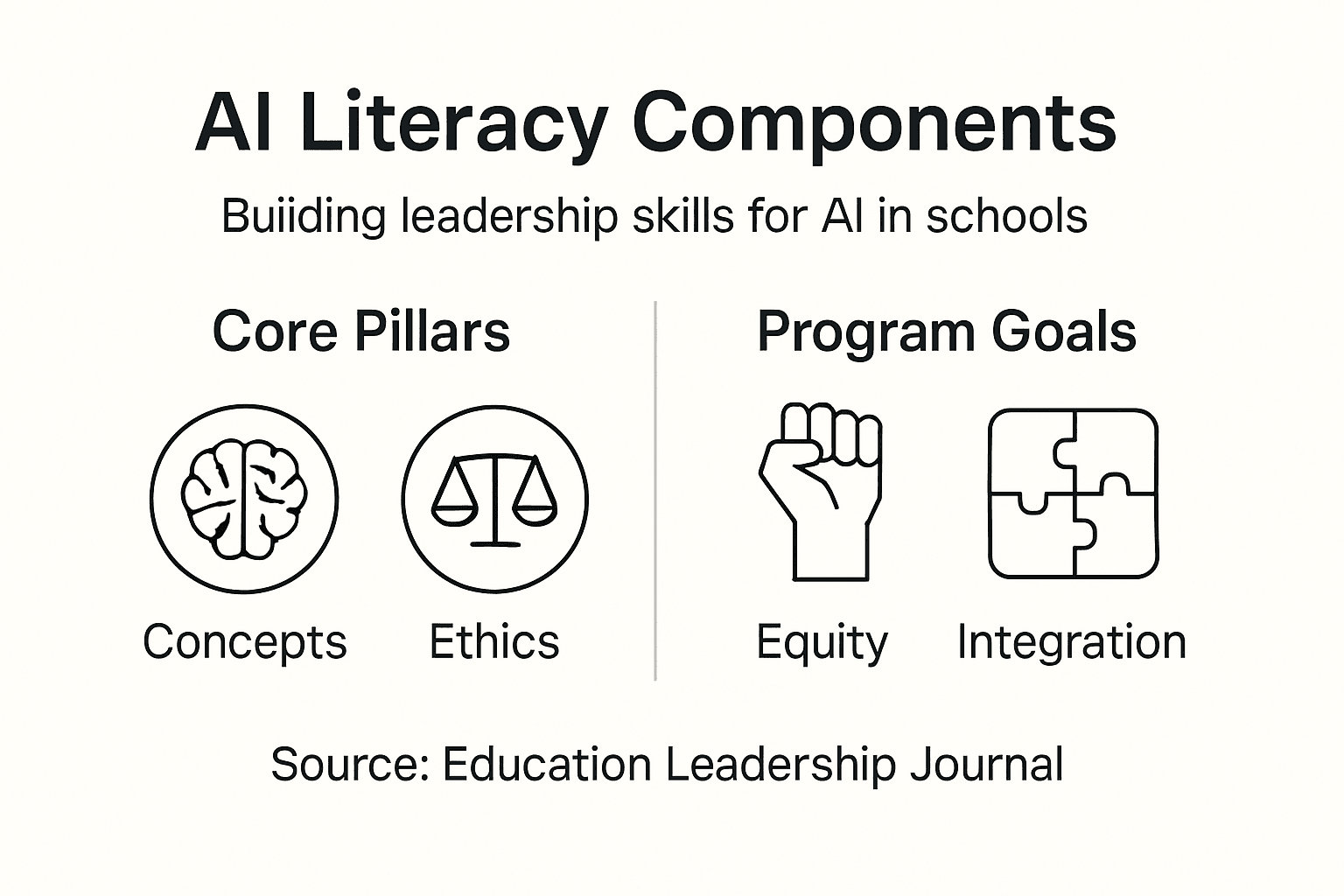
The foundation starts with foundational AI concepts. Your educators need to understand how AI systems actually work—not the mathematics, but the logic. What is machine learning? How do training datasets shape outputs? Why might an AI system produce biased results? These questions matter because they inform decisions you make about tool selection and implementation.
The Five Core Pillars
Strong AI literacy programs rest on five interconnected components:
- Technical understanding—grasping how AI works without needing to build it yourself
- Ethical awareness—recognizing bias, privacy concerns, and responsible use principles
- Critical thinking—evaluating AI claims and understanding limitations
- Practical application—using AI tools effectively in your specific context
- Continuous learning—staying current as AI capabilities and policies evolve
Your program should weave these together, not treat them as separate modules.
Ethical and Societal Dimensions Matter Most
Here’s what separates mediocre programs from transformative ones: understanding how AI impacts society and education sits at the core, not as an afterthought. This means exploring how AI perpetuates bias in student assessment tools, how data privacy protections vary, and how algorithmic decisions affect student opportunity.
Education leaders especially need this component. You’re responsible for ensuring AI implementation doesn’t widen equity gaps or compromise student privacy. Without societal awareness, you might adopt tools that sound innovative but create unfair outcomes.

Practical Integration Across Your District
Theory without application leaves your staff confused. Effective programs include guided strategies for adopting AI in educational contexts through real classroom scenarios and administrative tasks.
Think about where AI actually appears in your schools:
- Grading platforms that use AI to detect patterns in student work
- Learning management systems with AI-powered recommendations
- Administrative tools predicting student dropout risk
- Lesson planning resources powered by generative AI
Your program should help educators recognize these tools, understand what they do, and evaluate whether they align with your district’s values.
Building a Sustainable Learning Structure
One-off workshops don’t create lasting literacy. Your program needs ongoing professional development built into your calendar. Quarterly learning sessions beat annual trainings. Monthly resource updates beat silence between sessions.
Create pathways for different skill levels. New administrators need different support than experienced tech leaders. Teachers implementing AI tools need different training than board members making policy decisions.
Sustainable AI literacy programs treat learning as continuous, integrated into regular professional development cycles rather than isolated special events.
Pro tip: Start your program by surveying staff about which AI tools they already use or have questions about. This gives you immediate, relevant content for your first learning session and demonstrates you’re addressing actual needs, not abstract concepts.
Real-World Impact on Teaching and Learning
AI literacy isn’t an abstract skill—it directly transforms what happens inside your classrooms. When education leaders understand AI, they make smarter decisions about implementation that actually improve student outcomes instead of creating busywork with shiny new tools.
Consider what happens when teachers gain AI literacy. They stop viewing AI as a replacement for instruction and start seeing it as a thinking partner. Educators who understand AI can design thoughtfully integrated learning experiences that personalize instruction while maintaining human connection and critical engagement.
Where You’ll See Real Changes
Three concrete shifts emerge when education leaders invest in AI literacy:
- Teacher confidence grows—educators feel empowered to evaluate tools rather than passively accept vendor claims
- Student engagement increases—personalized practice powered by AI means less busywork, more meaningful learning
- Equity improves—leaders spot biased tools before implementation and design inclusive systems
These aren’t theoretical benefits. Schools across North America report measurable shifts within months of implementing strong AI literacy programs.
Educator Agency and Responsible Adoption
Here’s the honest truth: without AI literacy, your teachers become passive consumers of technology. With it, they become decision-makers. AI literacy empowers educators to adopt AI responsibly while improving their own digital competencies.
When teachers understand AI capabilities and limitations, they ask harder questions: Does this tool actually improve learning or just reduce my grading time? Will it create equity problems for students with disabilities? Does the data collection align with our privacy commitments?
These questions lead to better implementation decisions.
Student Learning Outcomes Improve
Your students benefit directly. AI-enabled personalized learning means differentiation that actually scales. One student gets extra practice on fractions while another explores advanced applications—the system adjusts without manual teacher intervention for each student.
More importantly, students develop critical thinking about AI itself. They learn to evaluate outputs, spot bias, and understand when to trust algorithms and when to question them. That’s a life skill for 2026 and beyond.
Addressing Equity Head-On
AI literacy helps you spot and prevent equity problems before they harm students. Biased assessment tools. Predictive algorithms that unfairly flag certain student groups. Privacy violations that disproportionately affect low-income families.
When your leadership team understands these risks, you design safeguards into your adoption strategy from day one.
AI-literate leaders create inclusive learning environments where technology enhances opportunity rather than narrowing it—the difference between transformation and harm.
Pro tip: After your first AI literacy session, ask one teacher to pilot an AI tool and share findings with staff. Real examples from your own classrooms beat any outside case study for building buy-in and demonstrating measurable classroom impact.
Risks of Ignoring AI Literacy Initiatives
Skipping AI literacy isn’t a conservative choice—it’s a risk. Schools that delay building AI competency among leaders and teachers don’t stay cautious; they fall behind and expose themselves to real harm.
Without AI literacy, your district becomes vulnerable to predictable mistakes. Teachers adopt tools without understanding how they work. Administrators make purchasing decisions based on vendor marketing instead of educational fit. Students encounter biased algorithms without anyone noticing the problem.
The Equity Crisis You’re Not Seeing
Ignore AI literacy and you almost guarantee equity problems. Neglecting AI literacy initiatives increases risks of ethical violations and diminished capacity to address AI’s societal implications. This isn’t abstract harm—it directly affects your students.
Consider predictive algorithms that flag students as dropout risks. Without literacy, you won’t notice the system disproportionately flags low-income students and students of color. That biased prediction becomes a self-fulfilling prophecy, narrowing opportunities for the students who need support most.
Three Concrete Risks Your District Faces
Without AI literacy in your leadership, expect these problems:
- Tool misuse—deploying AI systems that don’t fit your actual needs, wasting budget and creating frustration
- Privacy violations—collecting student data without understanding regulations or student rights
- Misinformation spread—leaders and teachers can’t distinguish between AI capabilities and marketing hype
Each carries financial, legal, and reputational consequences.
Here’s an overview of common risks when AI literacy is absent versus benefits when it is present:
| Impact Area | Without AI Literacy | With AI Literacy |
|---|---|---|
| Equity | Bias goes unnoticed, unfair outcomes | Proactive bias detection and prevention |
| Decision-making | Reliance on marketing, poor fit | Informed choices, critical evaluation |
| Student Privacy | Data misuse, compliance issues | Strong safeguards, ethical practices |
| Teacher Confidence | Passive technology use | Empowered, responsible implementation |
The Competency Gap Grows Wider
Educators without AI literacy become passive consumers of technology. They can’t evaluate whether a tool actually improves learning. They can’t troubleshoot when something goes wrong. They can’t advocate for their students’ needs in conversations with vendors.
Widening educational inequities and diminished educator preparedness occur when AI literacy remains absent. Your experienced teachers feel less competent. Your newer teachers never develop critical thinking about technology. The entire staff falls behind.
Dependency Without Understanding
Maybe the most dangerous risk: your school becomes dependent on AI tools while remaining ignorant about how they work. You’re using algorithms to make decisions that affect student futures without anyone really understanding the implications.
This creates liability. If an AI system makes a harmful decision, can your district explain why you chose it? Can you defend how it works? Without literacy, you’re defenseless.
Schools ignoring AI literacy initiatives don’t stay ahead of technology—they become passengers in their own technology decisions, vulnerable to mistakes that harm students and expose the district legally.
Pro tip: Before adopting any AI tool, require your implementation team to complete a one-page risk assessment: What could go wrong? Who might be harmed? How will we monitor for bias? This forces critical thinking and surfaces problems before deployment.
Best Practices for Effective Implementation
Successful AI literacy programs don’t happen by accident. They require deliberate planning, sustained leadership commitment, and strategies that account for your specific school context. Here’s what actually works.
Start with leadership buy-in. Without principals, superintendents, and board members genuinely committed to AI literacy, your initiative becomes another compliance checkbox. Leaders must model learning—attend sessions, ask questions, admit uncertainty. This signals that AI literacy matters.
Build Your Implementation Strategy
Effective AI literacy programs use ongoing professional development, interdisciplinary collaboration, and culturally responsive approaches. Don’t launch everything at once. Instead, scaffold learning progressively across your district.
Phase your rollout like this:
- Phase 1 (Months 1-3)—Train your leadership team and early adopter teachers
- Phase 2 (Months 4-6)—Expand to department leads and subject specialists
- Phase 3 (Months 7-12)—Reach all educators with role-specific content
- Phase 4 (Ongoing)—Maintain momentum with quarterly learning and community of practice meetings
This prevents overwhelm and builds confidence gradually.
Provide Just-In-Time Support
Theory-first training doesn’t stick. Your educators need support exactly when they’re using AI tools. Best practices integrate AI literacy progressively with educator support through timely training and communities of practice.
Pair your quarterly sessions with monthly drop-in office hours. Create Slack channels where teachers ask questions about specific tools. Share one quick tip each Friday. Connect teachers with peers who’ve successfully integrated AI.
Center Real-World Applications
Don’t teach abstract AI concepts. Show how AI appears in your actual classrooms and offices. A grading tool that flags unusual answer patterns. An assessment system that personalizes question difficulty. An attendance app that predicts absences.
When educators see AI solving real problems they recognize, they understand why literacy matters.
Foster Equity and Inclusion Explicitly
Address equity head-on. Create space for teachers to discuss bias concerns. Evaluate tools together for potential harms. Ask hard questions: Who benefits from this tool? Who might be harmed? How do we protect students with disabilities?
This builds critical thinking and prevents harmful implementation.
Effective AI literacy implementation treats learning as continuous, role-specific, and grounded in educators’ actual classroom needs—not a generic training requirement.
Pro tip: After your first two months, survey staff anonymously: “What AI question keeps you awake at night?” Use these genuine concerns to shape your next quarter’s sessions instead of following a preset curriculum.
Unlock the Full Potential of AI Literacy in Your Education Leadership
The challenges highlighted in the article around AI literacy for education leaders are clear. Decision-makers face the urgent need to understand AI’s ethical impact, evaluate tools critically, and build sustainable learning programs. Without this foundation, schools risk widening equity gaps and making costly technology mistakes that affect students and staff alike. Your goal is to empower leadership and teachers with practical AI knowledge that bridges ethical awareness and real-world application.
At Airitual, we specialize in tailored AI solutions and educational programs designed to address these exact pain points. Whether your district needs focused Classes | Artificial Intelligence that build foundational knowledge or ongoing learning through expert-led Webinars | Artificial Intelligence, we provide strategic support to accelerate AI literacy and responsible adoption. Don’t wait for risks to materialize. Start transforming your leadership team’s approach to AI with a trusted local partner committed to measurable results.
Explore our comprehensive offerings today and schedule your free strategy session to begin shaping an ethical, effective AI future in your schools. Visit Airitual now to take the critical first step.
Frequently Asked Questions
What is AI literacy and why is it important for education leaders?
AI literacy encompasses the skills necessary to understand, critique, and ethically apply AI technology. It’s crucial for education leaders because it informs decision-making regarding the implementation of AI tools in schools, ensuring that these technologies are used responsibly and effectively.
How does AI literacy differ from AI competency in an educational context?
AI literacy focuses on understanding and evaluating AI’s societal impacts and ethical use, while AI competency involves the practical use of AI tools. Leaders need to prioritize literacy to make informed decisions before teachers achieve technical proficiency with AI technologies.
What are the risks of ignoring AI literacy initiatives in education?
Ignoring AI literacy can lead to tool misuse, privacy violations, and equity problems. It creates a dependency on AI without a proper understanding of its implications, potentially harming students and compromising educational equity.
How can education leaders effectively implement AI literacy programs?
Effective implementation involves phased training for leadership and staff, just-in-time support, real-world applications of AI tools, and a continuous feedback loop with educators to address real needs and concerns regarding AI usage.
Recommended
- How to Personalize Learning With AI for Student Success | Artificial Intelligence
- How to Implement AI in Education for Enhanced Results | Artificial Intelligence
- Future of AI in Schools 2026: Transforming Learning | Artificial Intelligence
- 7 Essential AI Strategy List Tips for IT Managers | Artificial Intelligence
Recent Comments