

Every local government leader faces the pressure to deliver more with fewer resources. As communities across the United States and Canada grow, expectations for faster, smarter public services keep rising. Defining AI’s role in local government matters now because these technologies automate routine work, uncover trends in data, and help municipal teams solve problems that previously drained both time and budgets. Discover how clear strategy and practical guidelines can turn artificial intelligence from an abstract buzzword into a practical force for your municipality.
Table of Contents
- Defining AI’s Role in Local Government
- What AI Means for Your Municipality
- Why Local Governments Need to Define AI Strategy
- The Real Impact: Efficiency, Not Replacement
- Common Applications and Innovations Today
- Immediate Impact: Where AI Works Today
- Chatbots and Citizen Engagement
- Emerging Applications Gaining Traction
- Cybersecurity and Data Protection
- Why Innovation Happens in Pockets
- Legal, Compliance, and Ethical Frameworks
- Building Governance Around AI Use
- The Bias Problem
- Transparency and Public Trust
- Compliance With State and Federal Law
- Ethical Frameworks for Decision-Making
- Getting Started With Governance
- Risks, Limitations, and Mitigation Strategies
- The Risk Landscape
- When AI Reaches Its Limits
- Data Quality and Training Issues
- Mitigation Strategies
- Building Public Confidence
- Managing Vendor Risk
- Implementation Best Practices for Local Agencies
- Start With Clear Goals and Governance
- Build Staff Readiness First
- Develop Policies for Risk Management
- Implementation Phases
- Engage the Public Early
- Select and Validate Vendors Carefully
- Monitor and Adjust Continuously
Key Takeaways
| Point | Details |
|---|---|
| Understanding AI’s Role | Local governments should define AI’s role to align technology with municipal priorities and improve service delivery. |
| Strategic Implementation | AI should be implemented to solve specific, repeatable problems for enhanced operational efficiency. |
| Governance and Ethics | Establish robust governance frameworks to ensure transparency, accountability, and bias mitigation in AI use. |
| Continuous Monitoring | Regular audits and public engagement are crucial for assessing AI performance and maintaining public trust. |
Defining AI’s Role in Local Government
Artificial intelligence is reshaping how local governments serve their communities. Rather than a single technology, AI is a collection of tools that automate decision-making, analyze patterns in data, and help officials respond faster to citizen needs.
For local government leaders, understanding AI starts with recognizing what it actually does. AI systems process information, identify trends, and recommend actions without explicit programming for every scenario. This capability addresses a fundamental challenge facing municipalities: serving more residents with tighter budgets.
What AI Means for Your Municipality
Think of AI as a force multiplier for your workforce. Mayors and city officials globally report varying levels of interest in adopting AI solutions to improve public service delivery. The technology excels at tasks that are repetitive, data-heavy, or time-consuming.
Common applications in North American municipalities include:
- Permit processing: Automating document review and approval workflows
- Citizen service requests: Routing complaints and service calls to the right department
- Budget forecasting: Analyzing spending patterns to predict future costs
- Code enforcement: Identifying properties that need inspection based on complaint history
- Water management: Detecting leaks before they waste thousands of gallons
AI works best when solving specific, repeatable problems that affect operational efficiency or citizen satisfaction. Start there.
Why Local Governments Need to Define AI Strategy
Without a clear definition of AI’s role, municipalities risk scattered implementation. One department adopts a chatbot while another invests in predictive analytics, and nobody connects the results. Strategic planning and ethical considerations must be tailored to municipal contexts to ensure coherent adoption.
Defining AI’s role means answering questions like:
- What problems are costing us the most time or money?
- Which processes involve handling large amounts of data?
- Where do citizens experience the longest wait times?
- What decisions do staff make using manual review of files?
- Which services require 24/7 availability?
These questions connect AI adoption directly to your municipal priorities rather than chasing technology for its own sake.
The Real Impact: Efficiency, Not Replacement
Local officials often worry AI will eliminate jobs. That’s backward. AI removes drudgery. An inspector can spend 2 hours daily reviewing violation photos to prioritize inspection routes, or an AI system can flag high-risk properties in minutes. The inspector then conducts the actual inspection, applies judgment, and helps the property owner understand violations.

The honest truth: AI transforms how work gets done, not whether people do it. Your team works smarter, not smaller.
Here’s a summary of how AI transforms key municipal functions and their business impact:
| Municipal Function | AI Transformation | Tangible Impact |
|---|---|---|
| Permit Processing | Automated document workflow | Faster approvals, reduced errors |
| Citizen Services | Smart request routing | Shorter wait times, higher satisfaction |
| Budget Management | Predictive analytics | More accurate forecasting |
| Public Safety | Crime pattern detection | Targeted patrols, improved safety |
| Water Management | Leak detection | Less water loss, cost savings |
Pro tip: Start by mapping one workflow that frustrates both staff and citizens, measure the current time investment, then pilot an AI solution against that specific problem. Results speak louder than proposals.
Common Applications and Innovations Today
Local governments across North America are already deploying AI in ways that directly impact daily operations and citizen experience. These aren’t futuristic experiments—they’re active solutions solving real problems right now.
Immediate Impact: Where AI Works Today
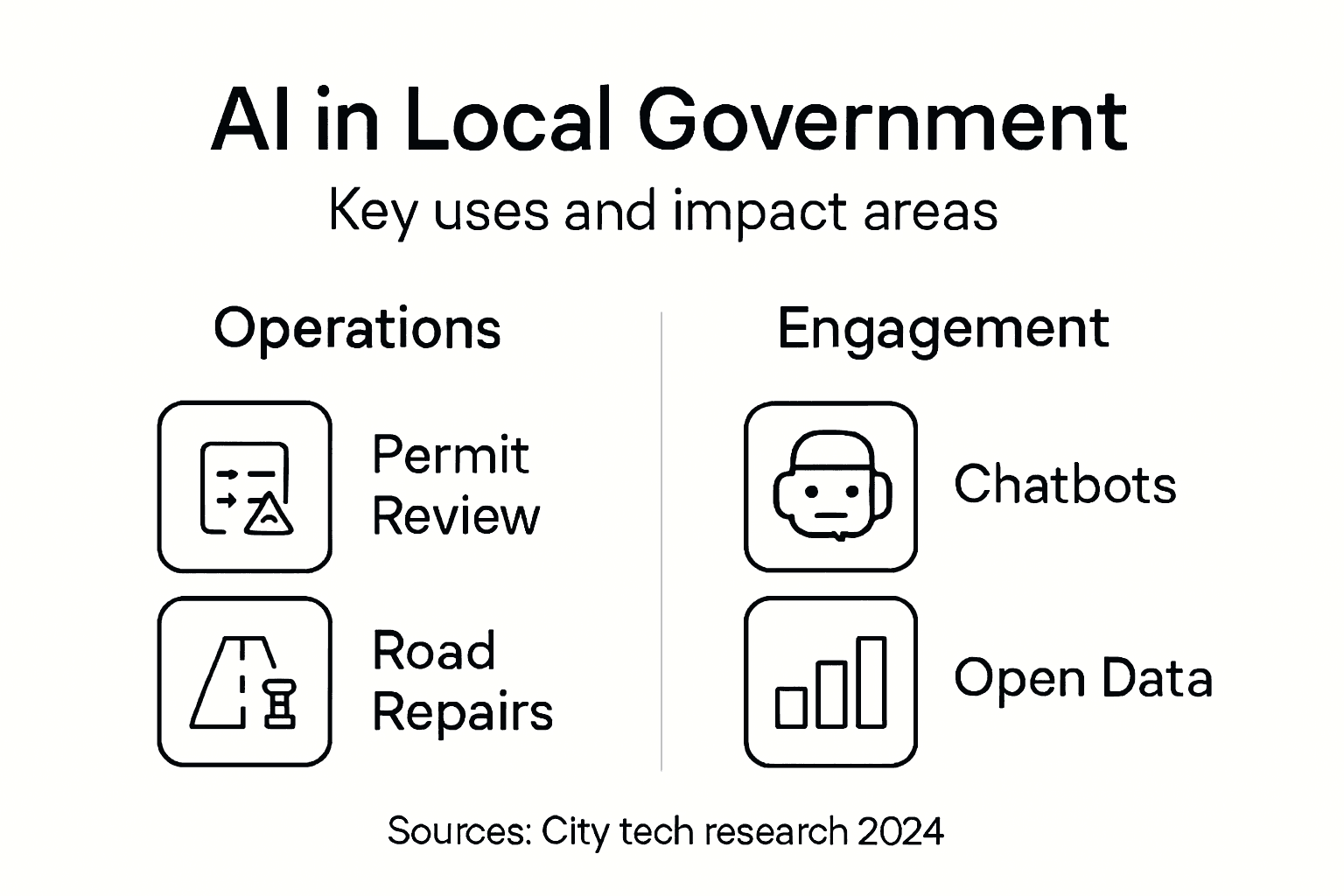
Generative AI is transforming administrative tasks and public benefits approvals across municipalities. Staff are using AI to draft responses to citizen inquiries, summarize complaint patterns, and process routine paperwork that once consumed hours.
Current applications delivering measurable results include:
- Permit and license processing: Automating initial document review and flagging incomplete applications
- Emergency dispatch optimization: Routing calls based on incident type and available resources
- Utility billing and collections: Identifying payment patterns and predicting delinquent accounts
- Public safety analytics: Analyzing crime data to identify patrol priorities
- Building inspection scheduling: Using historical violation data to target inspections
The most successful AI implementations solve one specific problem exceptionally well before expanding to additional applications.
Chatbots and Citizen Engagement
Citizens expect 24/7 answers. Chatbots handle routine questions about hours, permits, payment options, and service locations without requiring staff intervention. When questions exceed the chatbot’s scope, the system routes citizens to the appropriate department with full context.
This reduces phone volume by 20-40% in most implementations, freeing staff for complex cases that require human judgment.
Emerging Applications Gaining Traction
Cities worldwide are experimenting with AI across diverse services. Healthcare departments use AI to predict patient no-shows and optimize clinic scheduling. Transportation departments analyze traffic patterns to improve signal timing. Water utilities detect infrastructure problems before pipes burst.
These innovations share a common thread: they use historical data to predict outcomes and guide better decisions.
Cybersecurity and Data Protection
AI monitors network traffic in real time, identifying suspicious activity that human analysts would miss. It learns what “normal” looks like for your systems and alerts security teams to anomalies instantly.
This continuous monitoring is critical as cyberattacks targeting municipal databases increase in frequency and sophistication.
Why Innovation Happens in Pockets
Different departments have different needs. Public works priorities differ from planning departments. Successful municipalities let departments experiment with AI solutions tailored to their challenges, then share results across the organization.
The goal isn’t uniformity—it’s solving real problems faster.
Pro tip: Identify one department achieving results with an AI solution, document the workflow and outcomes, then use that case study to accelerate adoption elsewhere in your municipality.
Legal, Compliance, and Ethical Frameworks
AI deployment in local government isn’t just a technical decision—it’s a legal and ethical one. Municipalities face growing scrutiny over how algorithms make decisions affecting citizens. Getting the framework right protects your community and builds public trust.
Building Governance Around AI Use
Most municipalities lack formal AI governance structures. That creates risk. Municipalities should establish clear policies addressing transparency, fairness, accountability, and protection of individual rights in all AI implementations.
Your governance framework should answer these questions:
- Who approves new AI deployments?
- How do we monitor AI systems for bias or errors?
- What happens when an AI decision affects a citizen negatively?
- How do we ensure transparency about when AI is being used?
- Who owns accountability if something goes wrong?
Governance isn’t bureaucracy—it’s the structure that lets you scale AI safely.
The Bias Problem
AI learns from historical data. If your hiring patterns favored certain demographics, the AI learns that bias and amplifies it. If your code enforcement data shows unequal enforcement by neighborhood, predictive algorithms perpetuate that inequality.
Testing for bias requires deliberate effort. You must examine training data, validate results against protected classes, and audit decisions regularly.
Transparency and Public Trust
Citizens deserve to know when an algorithm influences decisions about them. If an AI system denies a permit application, flags a property for inspection, or routes emergency services differently, residents should understand why.
Transparency doesn’t mean releasing proprietary code. It means explaining the logic: “This property was flagged for inspection because historical data shows similar properties in this zip code have higher violation rates.”
Compliance With State and Federal Law
Fair Housing Act, Americans with Disabilities Act, and emerging AI-specific regulations all constrain how you can deploy AI. Some states require bias audits before deployment. Others mandate disclosures when algorithms make consequential decisions.
Research applicable regulations before implementation. Consulting with your municipal attorney prevents costly compliance failures.
Ethical Frameworks for Decision-Making
Global ethical frameworks guide governments in ensuring AI adoption aligns with human rights, fairness, and accountability. These frameworks prioritize:
- Human oversight: Humans make final decisions on consequential matters
- Explainability: Citizens and staff understand how AI reaches conclusions
- Fairness: Outcomes don’t discriminate against protected groups
- Accountability: Someone owns the results, good or bad
- Privacy: Citizen data is protected and used only as authorized
Getting Started With Governance
Don’t wait for perfect policies. Start with a small pilot project, document decision-making, measure results against equity standards, and refine your approach. Build governance as you learn.
This iterative approach lets you establish safeguards without parallyzing innovation.
Pro tip: Before deploying any AI system, run a bias audit by checking whether outcomes differ significantly across demographic groups or neighborhoods. If disparities exist, investigate and adjust before going live.
Risks, Limitations, and Mitigation Strategies
AI isn’t a silver bullet. Every implementation carries real risks—from biased outcomes to data breaches to citizen backlash. Understanding these risks upfront lets you design safeguards that protect your municipality.
The Risk Landscape
Insufficient governance creates potential negative impacts on human rights, data privacy, and social equity when AI is deployed without adequate oversight. This isn’t theoretical. Real municipalities have faced lawsuits after deploying algorithms that discriminated against specific neighborhoods or demographics.
Major risk categories include:
- Algorithmic bias: AI perpetuates patterns in historical data, potentially discriminating against protected groups
- Data privacy breaches: Citizen information used to train models can be exposed or misused
- System failures: Bugs or edge cases cause incorrect decisions affecting service delivery
- Loss of public trust: Communities reject AI systems they don’t understand or that harm them
- Over-reliance: Staff defer to AI recommendations without critical thinking
The goal isn’t eliminating risk—it’s managing it consciously so benefits outweigh harms.
When AI Reaches Its Limits
AI works well on repetitive, data-heavy tasks. It struggles with novel situations, context-dependent decisions, and cases requiring empathy or nuance. Deploying AI to make final decisions on housing assistance, child welfare investigations, or permit denials crosses ethical lines most municipalities shouldn’t cross.
Use AI to recommend and assist. Keep humans making final calls on consequential matters.
Data Quality and Training Issues
Your AI is only as good as its training data. If historical data reflects discriminatory practices, biased enforcement, or incomplete information, the AI learns those flaws and amplifies them at scale.
Before deployment, audit your data for completeness, accuracy, and fairness. Remove biased patterns that don’t reflect current policies or values.
Compare different types of AI risks and how municipalities can address them:
| Risk Category | Example Scenario | Recommended Mitigation |
|---|---|---|
| Algorithmic Bias | Unequal permit approvals | Regular audits, data review |
| Data Privacy | Unauthorized data use | Access controls, encryption |
| System Failure | Incorrect citizen notifications | Human oversight, rollback plans |
| Loss of Trust | Citizens reject AI decisions | Clear communication, feedback loops |
Mitigation Strategies
Reduce risk through deliberate design choices:
- Start small: Pilot programs on low-stakes decisions before scaling
- Audit regularly: Test for bias and errors every 3-6 months
- Keep humans involved: Use AI for recommendations, not autonomous decisions
- Document everything: Record why decisions were made for transparency
- Monitor outcomes: Track whether results differ by demographics or location
- Train staff: Ensure teams understand system limitations and bias risks
Building Public Confidence
Citizens fear what they don’t understand. Publish plain-language explanations of which AI systems you’re using and why. Invite community feedback on fairness concerns. Show how you’re auditing for bias.
Transparency transforms AI from a black box into a tool the community understands and trusts.
Managing Vendor Risk
Many municipalities license AI from vendors rather than building in-house. Ensure contracts require vendors to audit for bias, disclose model limitations, and provide explanations when decisions affect citizens.
Never deploy a vendor solution without understanding how it works and validating its fairness on your own data.
Pro tip: Before going live with any AI system, conduct a pilot on 5-10% of cases, compare AI recommendations against human decisions from the past year, and measure whether outcomes differ by demographic group—if disparities appear, investigate root causes before expanding.
Implementation Best Practices for Local Agencies
Successful AI adoption requires more than buying software. It demands structured planning, staff preparation, governance frameworks, and ongoing evaluation. Agencies that follow proven practices avoid costly mistakes and achieve faster results.
Start With Clear Goals and Governance
Establishing an AI task force with interdisciplinary representation helps develop comprehensive governance frameworks emphasizing ethical use, transparency, and human oversight. Your task force should include IT staff, department heads, legal counsel, and community representatives.
Define your goals before selecting technology. Ask: What problem are we solving? How will we measure success? Who owns the decision if something goes wrong?
Governance structures aren’t restrictions—they’re the foundation that lets teams move faster with confidence.
Build Staff Readiness First
Technology fails when people aren’t ready. Workforce preparation through training programs ensures staff understand AI capabilities, limitations, and ethical implications. Staff need to know:
- How the AI system works
- When to trust its recommendations and when to question them
- What to do when outputs seem wrong
- How to explain AI decisions to citizens
Invest in training before deployment, not after.
Develop Policies for Risk Management
Write policies addressing bias testing, data quality standards, audit schedules, and escalation procedures. Document what happens when an AI system makes an error, identifies bias, or produces unexpected results.
Policies create consistency. They prevent one department from deploying AI recklessly while another plays it safe.
Implementation Phases
Roll out AI deliberately across phases:
- Discovery phase: Map current workflows and identify where AI adds value
- Pilot phase: Test on a small subset of cases with close monitoring
- Validation phase: Audit for bias, compare AI recommendations against historical decisions
- Scaling phase: Expand to full operations with ongoing monitoring
- Optimization phase: Refine based on real-world performance data
Engage the Public Early
Communities support AI they understand. Publish clear explanations of which systems you’re deploying and why. Share results transparently. Invite feedback on fairness and accuracy concerns.
Public engagement builds trust and catches problems before they escalate into scandals.
Select and Validate Vendors Carefully
If licensing AI from vendors, require them to provide documentation on how models were trained, what data they use, and how they audit for bias. Test vendor solutions on your own data before committing.
Never accept a vendor’s claim that their system is “fair.” Validate it yourself.
Monitor and Adjust Continuously
Best practices include establishing ongoing risk assessment and public engagement strategies. Set a schedule to audit AI systems every 3-6 months. Track whether outcomes differ by demographics or location. Measure whether AI recommendations improved decision quality or just shifted work around.
Be willing to shut down systems that aren’t delivering value or that cause harm.
Pro tip: Create a simple scorecard tracking AI system performance monthly: accuracy rates, bias audit results, staff feedback, and citizen complaints. Share results transparently with leadership and community so everyone sees whether the system is actually helping.
Unlock the Power of AI in Your Local Government Today
Local governments face rising demands to improve efficiency, transparency, and citizen engagement while managing tight budgets and complex ethical challenges. This article highlights critical pain points like streamlining permit processing, ensuring fairness through bias audits, and building governance frameworks that protect public trust. If you recognize the struggle to integrate AI meaningfully across departments or the need to pilot AI with measurable impact, you are not alone.
At Airitual, we specialize in delivering AI solutions tailored specifically for municipalities seeking to transform services without risking compliance or public confidence. Our strategic approach emphasizes ethical adoption, staff readiness, and continuous risk management so your team can unlock AI’s full potential responsibly. Explore insights from our Uncategorized | Artificial Intelligence content to deepen your understanding of AI’s role in public service, or join our Webinars | Artificial Intelligence for live guidance on overcoming implementation hurdles.
Ready to redefine how your government meets community needs? Connect with us now for a no-obligation strategy session at Airitual and start piloting AI solutions that deliver real, transparent, and trusted outcomes. Don’t wait to lead your municipality into the future of smart, equitable service delivery.
Frequently Asked Questions
What are some common applications of AI in local government?
AI is used in various applications within local government, including permit processing, citizen service requests, budget forecasting, code enforcement, and water management. These applications help automate repetitive tasks, enhance service delivery, and improve operational efficiency.
How can local governments define an AI strategy effectively?
Local governments can define an AI strategy by identifying specific problems that cost time or money, understanding which processes involve large data sets, and recognizing where citizens experience delays. By connecting AI adoption to municipal priorities, they can ensure the technology meets community needs.
What are the risks associated with deploying AI in local government?
Risks of deploying AI include algorithmic bias, data privacy breaches, system failures, loss of public trust, and over-reliance on AI recommendations. Understanding these risks helps municipalities design effective safeguards and make informed decisions about AI use.
How can local agencies ensure ethical use of AI?
Local agencies should establish governance frameworks addressing transparency, fairness, accountability, and individual rights. Regular auditing for bias, ensuring human oversight in decision-making, and implementing clear policies for risk management are essential steps to ensure ethical AI use.
Recommended
- Role of AI in Digital Services: Impact for U.S. Local Government | Artificial Intelligence
- 7 Types of AI-Powered Solutions for Local Government Success | Artificial Intelligence
- Role of AI in Policy Making: Transforming Local Governance | Artificial Intelligence
- Why AI for Government Matters: Boosting Efficiency | Artificial Intelligence
Recent Comments