
Student engagement is evolving quickly as artificial intelligence moves from theory to reality in classrooms worldwide. Educational technology directors face the challenge of translating complex AI innovations into everyday learning that supports every student’s growth. By focusing on personalized support, adaptive curriculum design, and ethical safeguards, leaders can harness AI’s potential to create dynamic learning experiences, empower teachers, and set a strong foundation for measurable outcomes by 2026.
Table of Contents
- Defining AI’s Role in Education by 2026
- Major AI Technologies Impacting Classrooms
- Personalized Learning and Student Engagement
- Data Privacy and Ethical Safeguards
- Training Faculty and Managing Change
Key Takeaways
| Point | Details |
|---|---|
| AI Transformation in Education | By 2026, AI will create personalized learning environments, enhancing educator capabilities and student engagement. |
| Ethical AI Implementation | Schools must establish robust data privacy and ethical guidelines to ensure responsible AI usage and address potential biases. |
| Comprehensive Faculty Training | Investing in faculty AI literacy programs will empower educators to effectively integrate technology into their teaching practices. |
| Interdisciplinary Collaboration | Formation of committees with diverse stakeholders is essential to oversee AI implementation and address ethical concerns. |
Defining AI’s Role in Education by 2026
By 2026, artificial intelligence will fundamentally reshape educational experiences, transforming traditional learning models into dynamic, personalized environments. The integration of AI is not about replacing teachers, but empowering them with sophisticated tools to enhance student engagement and learning outcomes. Advanced personalized learning pathways will become standard, allowing educators to customize instruction based on individual student needs and learning styles.
The artificial intelligence landscape in education centers on three critical dimensions: personalized learning support, administrative efficiency, and adaptive curriculum design. AI systems will act as intelligent tutors, providing real-time feedback and generating customized learning materials that adapt to each student’s comprehension level and learning pace. Generative AI technologies will enable more nuanced, context-aware educational experiences that go beyond traditional one-size-fits-all instructional models.
Critical implementation requires strategic planning. Educational institutions must develop robust frameworks that balance technological innovation with pedagogical principles. This means establishing clear guidelines for AI usage, ensuring data privacy, and maintaining human oversight. AI should augment teacher capabilities, not substitute human connection. Key focus areas include developing ethical AI guidelines, training educators in AI integration, and creating transparent assessment mechanisms that validate AI-enhanced learning outcomes.
Pro tip: Start developing your district’s AI education strategy now by assembling a cross-functional team of educators, technologists, and curriculum specialists to create comprehensive implementation guidelines.
Major AI Technologies Impacting Classrooms
By 2026, artificial intelligence will revolutionize classroom technologies through sophisticated, adaptive systems designed to enhance learning experiences. Intelligent tutoring systems represent a groundbreaking approach to personalized education, enabling real-time student support and customized instructional strategies that adapt dynamically to individual learning patterns and comprehension levels.
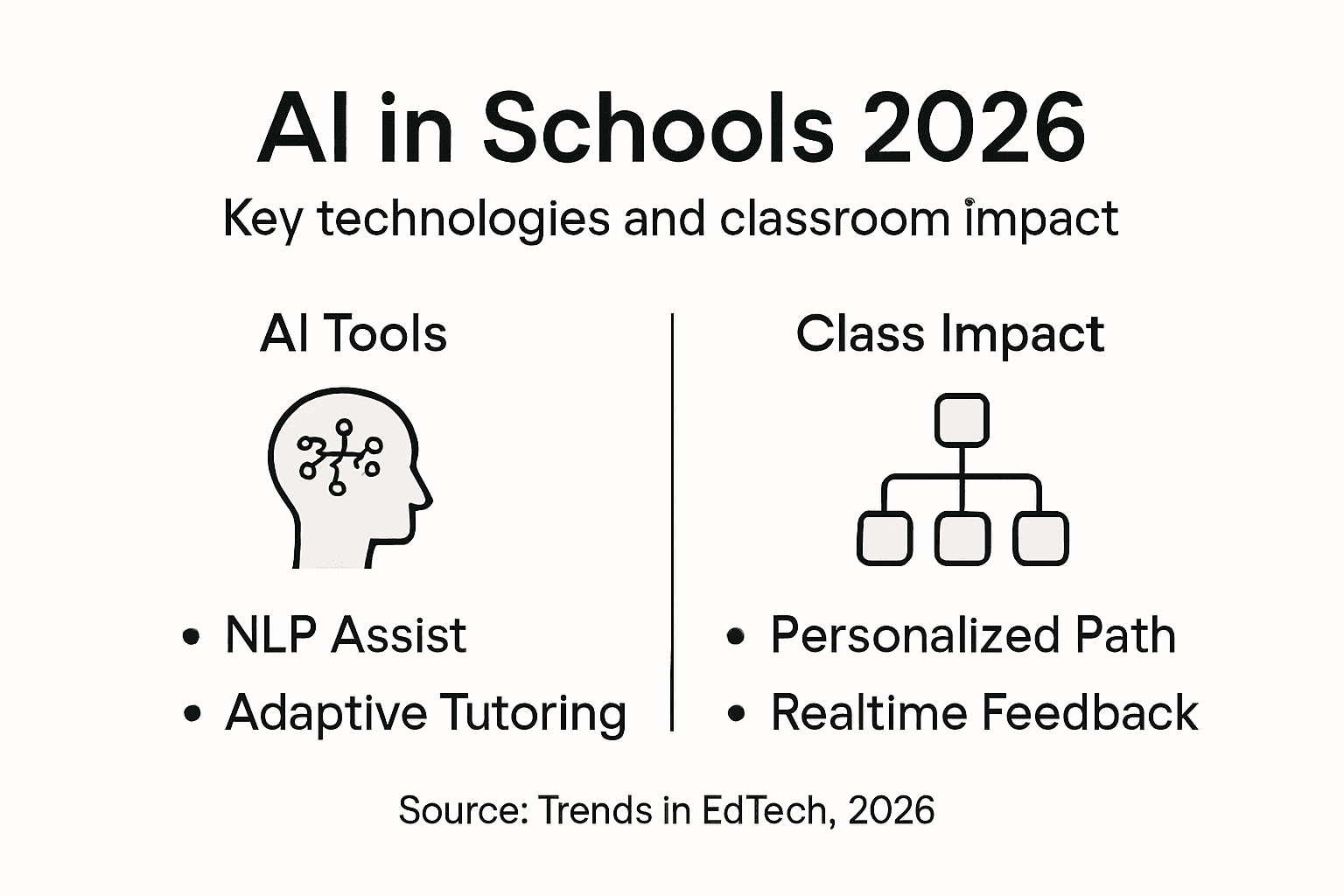
The landscape of classroom AI technologies encompasses several transformative tools. First, natural language processing enables advanced language learning and communication skills assessment. Second, automated assessment platforms provide immediate, objective feedback across multiple subject domains. Third, generative AI tools can create personalized learning materials, worksheets, and adaptive curriculum content that respond to student performance metrics and learning preferences. These technologies work synergistically to create more responsive, engaging educational environments that support both student learning and teacher effectiveness.
Implementation of these AI technologies requires careful strategic planning. Educational institutions must develop comprehensive frameworks that balance technological innovation with pedagogical principles. Automated assessment tools must be integrated with robust ethical guidelines, ensuring data privacy, maintaining human oversight, and preventing over-reliance on technological solutions. The goal is to augment human teaching capabilities, not replace the critical emotional and interactive components of education.
Pro tip: Develop a pilot program in your school district that gradually introduces AI technologies, allowing educators to provide continuous feedback and refine implementation strategies.
Here’s a comparison of key AI technologies and their classroom impact as we approach 2026:
| Technology Type | Main Function | Classroom Impact |
|---|---|---|
| Intelligent Tutoring Systems | Provide instant student feedback | Improve learning personalization |
| Natural Language Processing | Assess communication and language skills | Support language mastery |
| Automated Assessment Tools | Deliver immediate skill evaluation | Save teachers time, boost accuracy |
| Generative AI Content | Create adaptive curriculum materials | Customize instruction for engagement |
Personalized Learning and Student Engagement
Artificial intelligence is poised to revolutionize student engagement by creating dynamic, adaptive learning experiences that respond to individual student needs and learning styles. Personalized learning pathways represent a transformative approach that goes beyond traditional one-size-fits-all educational models, enabling students to learn at their own pace and according to their unique cognitive strengths.

The personalization of learning encompasses multiple sophisticated strategies. AI technologies can analyze individual student performance data, identifying knowledge gaps, learning preferences, and optimal instructional approaches. These systems create customized content sequences, adjust difficulty levels in real-time, and provide targeted interventions that support students with diverse learning backgrounds. For students with disabilities, multilingual learners, and those requiring additional academic support, AI-driven adaptive technologies offer unprecedented opportunities for inclusive, responsive education.
Successful implementation of personalized learning technologies requires a holistic approach that balances technological innovation with human-centered pedagogical principles. Educational institutions must develop comprehensive frameworks that ensure ethical use of student data, maintain student privacy, and preserve the critical emotional connections between educators and learners. The goal is not to replace human teachers, but to provide them with powerful tools that enhance their ability to understand and support each student’s unique learning journey.
Pro tip: Create student feedback mechanisms that allow learners to provide input on their AI-assisted learning experiences, ensuring continuous improvement and maintaining human agency in educational technology.
Data Privacy and Ethical Safeguards
As artificial intelligence becomes increasingly integrated into educational environments, robust data privacy and ethical safeguards have become paramount. Ethical AI deployment requires comprehensive strategies that protect student information, prevent algorithmic bias, and maintain transparency throughout technological implementation.
The ethical framework for AI in education centers on several critical principles. First, schools must develop rigorous data protection protocols that clearly define what student information can be collected, how it will be used, and who has access to it. This includes implementing advanced encryption technologies, establishing strict access controls, and creating transparent consent mechanisms that empower students and parents to understand and control their personal data. UNESCO’s policy recommendations emphasize the importance of developing comprehensive guidelines that address potential risks of data misuse and discrimination.
Successful ethical AI implementation requires a multidisciplinary approach involving educators, technologists, ethicists, and legal experts. Educational institutions must continuously audit AI systems for potential biases, ensuring that algorithmic decision-making does not perpetuate existing social inequities. This means developing sophisticated assessment tools that can identify and mitigate algorithmic discrimination, creating diverse development teams, and maintaining ongoing transparency about how AI systems make educational recommendations.
Pro tip: Establish a dedicated AI ethics committee in your school district that includes student, parent, and community representation to provide ongoing oversight and guidance on technological implementations.
This summary highlights best practices for ethical and effective AI implementation in schools:
| Focus Area | Key Practice | Stakeholder Involvement |
|---|---|---|
| Data Privacy | Use advanced encryption | IT staff, administrators |
| Preventing Bias | Audit algorithms regularly | Educators, external experts |
| Transparency | Communicate AI decisions clearly | Teachers, parents, students |
| Ongoing Oversight | Form ethics committees | Community, school leadership |
Training Faculty and Managing Change
Successful AI integration in education demands a comprehensive approach to faculty training and organizational transformation. Faculty AI literacy programs represent a critical strategy for empowering educators to effectively leverage technological innovations while maintaining pedagogical integrity.
The change management process requires a multifaceted approach addressing technological, psychological, and professional development dimensions. Educational institutions must design robust training frameworks that go beyond basic technical skills, focusing on helping educators understand AI’s pedagogical potential, ethical considerations, and practical classroom applications. Professional development strategies should include hands-on workshops, collaborative learning communities, and ongoing support networks that help teachers navigate technological transitions confidently and creatively.
Implementing successful faculty training requires creating an institutional culture that values continuous learning and technological adaptation. This involves developing flexible professional development models, establishing mentorship programs pairing technology-savvy educators with those needing additional support, and creating opportunities for educators to experiment with AI tools in low-stakes environments. The goal is to transform potential technological resistance into curiosity and innovative thinking about educational technology’s transformative potential.
Pro tip: Create a peer-learning network within your district where early AI adopters can share practical experiences and support colleagues through technology transition.
Empower Your School’s AI Transformation Today
The challenge of integrating artificial intelligence in education by 2026 is clear. Schools need to adopt personalized learning pathways, safeguard data privacy, and train faculty effectively while maintaining ethical standards and human connection. Many educators face uncertainty in managing these complex tasks alongside their daily responsibilities. This article highlights the critical need for strategic planning and adaptive AI tools that enhance learning without replacing the teacher.
At Airitual, we understand these pain points and offer tailored AI-powered solutions specifically designed for education. Our expertise helps schools implement intelligent tutoring systems, secure data management, and faculty training programs that match the goals outlined for AI-enhanced classrooms. Partner with us to create ethical AI frameworks and adaptive curricula that truly engage students and support educators.
Don’t wait to meet the future of AI in schools. Explore how our AI-powered tools for education can drive meaningful change in your classrooms. Take the first step toward measurable improvement in student engagement and administrative efficiency by scheduling a free strategy session with our experts today at Airitual’s website.
Frequently Asked Questions
What role will AI play in education by 2026?
AI will transform educational experiences by creating personalized learning environments, empowering teachers with advanced tools and enhancing student engagement and learning outcomes.
How will AI support personalized learning in classrooms?
AI will analyze individual student performance data to customize learning pathways, adjusting difficulty levels in real-time and providing tailored interventions suited to students’ unique needs and preferences.
What ethical considerations must schools take into account when implementing AI?
Schools need to ensure data privacy, prevent algorithmic bias, and maintain transparency in AI deployment. Establishing rigorous data protection protocols and ethical guidelines is essential.
How can teachers be trained to effectively use AI technology in their classrooms?
Teachers can be empowered through comprehensive AI literacy programs that include hands-on workshops, collaboration with peers, and ongoing support networks to navigate technological transitions and leverage AI’s potential.
Recent Comments