

Finding the right AI-powered tools can feel like a turning point for your institution. The difference between traditional educational software and intelligent systems lies in their ability to understand each learner’s strengths and needs, creating truly personal experiences. With options such as intelligent tutoring systems and adaptive learning platforms, mid-sized institutions can boost teaching capacity and deliver relevant content to every student. Learn how scalable personalization and real-time feedback open doors to more effective teaching and deeper student engagement.
Table of Contents
- Core Definition of AI-Powered Tools
- Key Types and Educational Applications
- How AI-Powered Tools Enhance Learning
- Practical Benefits for Teachers and Students
- Compliance, Privacy, and Ethical Risks
Key Takeaways
| Point | Details |
|---|---|
| AI tools redefine education | They serve as intelligent systems that adapt to student needs, providing personalized instruction and immediate feedback. |
| Scalable personalization is key | Unlike traditional software, AI tools adjust learning experiences based on individual student interactions, enhancing engagement and outcomes. |
| Efficient use of faculty time | By automating grading and content customization, AI allows educators to focus more on mentoring and complex problem-solving tasks. |
| Be mindful of ethical concerns | Institutions must address data privacy, algorithmic bias, and the need for transparency when implementing AI tools in education. |
Core Definition of AI-Powered Tools
AI-powered tools in education represent a fundamental shift in how institutions support teaching and learning. These tools are software systems designed to perceive educational environments, understand student needs, and execute targeted interventions to improve outcomes. Unlike traditional educational software that simply delivers content, AI-powered educational tools function as intelligent agents that make real-time decisions, adapt their responses based on student performance, and provide immediate feedback within personalized learning contexts. For your institution, this distinction matters because it means you’re not just implementing another platform—you’re integrating systems capable of understanding and responding to the individual cognitive, behavioral, and affective needs of each learner.
The scope of these tools extends across multiple educational dimensions. They encompass intelligent tutoring systems that provide one-on-one personalized instruction, adaptive learning platforms that adjust difficulty and content based on student progress, and collaborative agents powered by large language models that enable context-aware dialogue and real-time support. A mid-sized institution might deploy an AI tutor for remedial mathematics that tracks which concepts a student struggles with, identifies knowledge gaps the student hasn’t yet noticed, and then restructures explanations using metaphors and examples aligned with that specific learner’s background. Another institution might use generative AI for curriculum design, automating the creation of differentiated assignments that match diverse learning levels without overwhelming your faculty with manual customization work.
What distinguishes AI-powered educational tools from conventional solutions is their capacity for scalable personalization. Traditional software delivers the same experience to all users; AI systems continuously learn from interactions and modify their approach. This human-AI collaboration model—where machines handle pattern recognition, content adaptation, and initial feedback while educators focus on relationships, complex problem-solving, and motivation—creates opportunities to extend educational quality beyond what your current staffing allows. The technology doesn’t replace your instructors; it extends their reach and allows them to spend less time on repetitive tasks and more time on mentoring relationships that drive meaningful learning outcomes.
Pro tip: When evaluating AI tools for your institution, prioritize solutions that provide transparency into how the system makes decisions and adapts content—this transparency helps your faculty build trust with the technology and understand how it complements their pedagogical expertise.
Key Types and Educational Applications
AI-powered educational tools come in several distinct varieties, each serving specific pedagogical functions within your institution. Intelligent tutoring systems provide one-on-one instruction that adapts in real time to student performance, offering immediate corrective feedback and alternative explanations when students struggle with concepts. Assessment and evaluation tools analyze student work, identify learning gaps, and track progress across competency areas without requiring manual grading for every assignment. Curriculum design aids help your faculty generate differentiated lesson plans, create varied difficulty levels for the same content, and develop project-based learning sequences that align with learning objectives. Personalization engines sit at the core of modern platforms, using student interaction data to recommend content, adjust pacing, and create customized learning pathways that match individual readiness levels and learning preferences.
These systems operate across multiple educational contexts and serve diverse learning needs. In K-12 environments, intelligent tutoring systems and personalization engines help struggling readers catch up while preventing advanced learners from becoming bored. Higher education institutions deploy assessment tools that grade written assignments, provide feedback on arguments, and identify conceptual misconceptions in problem solving. Game-based learning applications powered by AI create engaging practice environments where students receive adaptive difficulty adjustments—the system gets harder when they succeed and provides scaffolding when they struggle. Human-computer collaborative tools enable students to work alongside AI agents on complex projects, with the AI handling research synthesis and the student managing critical thinking, ethical reasoning, and creative problem formulation. Personalized learning approaches address the reality that your institution likely serves students with vastly different backgrounds, learning speeds, and content preferences.
The pedagogical roles these tools fulfill extend beyond simple content delivery. They function as instructional partners that augment teacher expertise by handling routine tasks, freeing educators to focus on relationship building and complex problem solving. They serve evaluative functions, providing detailed analytics about learning patterns, skill gaps, and long-term retention trends that would be impossible to gather manually. They support pedagogical decision making by recommending instructional strategies based on aggregate student performance data and research-validated practices. Your faculty member teaching organic chemistry can receive data-driven suggestions about which concepts need reteaching, which students need one-on-one attention, and which explanations work best for different learner types. This transforms teaching from reactive problem solving to proactive, informed instruction.
Pro tip: Start by identifying one high-impact course where manual grading or content customization consumes significant faculty time, then pilot an appropriate AI tool there—measurable time savings in year one build faculty confidence for broader adoption.
Here’s a summary of key AI-powered educational tools and their primary educational impacts:
| Tool Type | Main Function | Impact on Learning |
|---|---|---|
| Intelligent Tutoring | Personalized instruction | Improved learning outcomes |
| Assessment/Evaluation | Automated grading and analytics | Immediate feedback |
| Curriculum Design Aids | Differentiated lesson creation | Efficient content customization |
| Personalization Engines | Adaptive content recommendation | Student engagement and pacing |
| Collaborative Agents | Human-AI partnered projects | Enhanced critical thinking |
How AI-Powered Tools Enhance Learning
AI-powered tools transform learning by creating environments where every student receives instruction tailored to their specific needs, pace, and learning style. Traditional classrooms operate under a one-size-fits-all model where instructors deliver the same lesson to thirty diverse learners and hope it resonates with most of them. AI systems eliminate this constraint by continuously analyzing how each student responds to content, then adjusting difficulty, pacing, and explanatory approaches in real time. A student struggling with fractions receives simpler visual representations and extra practice, while an advanced student moves forward to applications. This simultaneous support for heterogeneous learner populations means struggling students no longer fall further behind while waiting for reteaching, and advanced learners no longer experience boredom from unnecessary review.
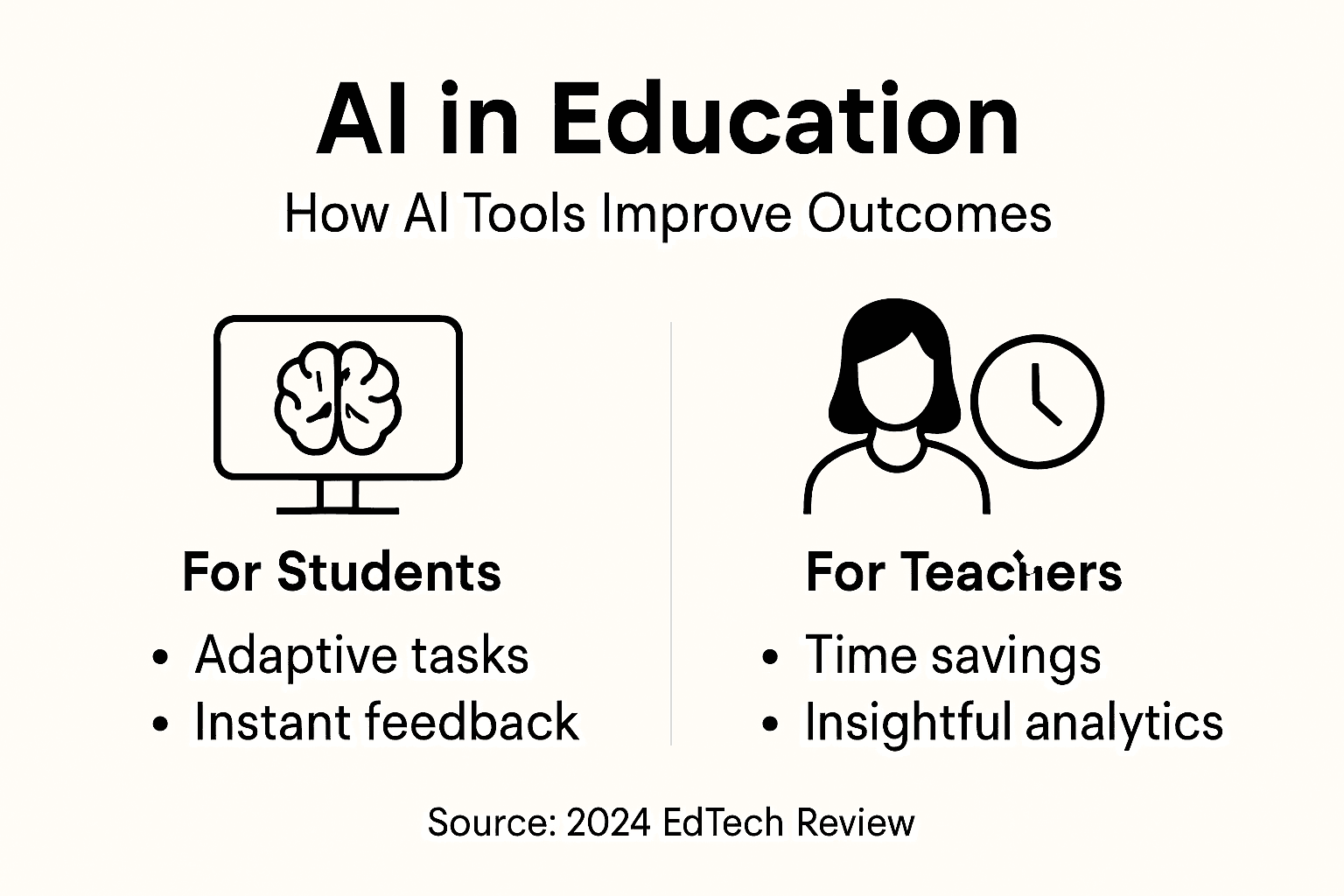
The engagement factor cannot be overstated. Personalized learning environments powered by AI directly address student motivation by giving learners control over their learning path and pace. When students see content adapted to their interests and readiness level, they experience autonomy rather than passive content consumption. Immediate, specific feedback from AI systems builds intrinsic motivation because students understand exactly what they got right, what they missed, and why it matters. A mathematics student who submits work receives not just a score but detailed feedback explaining conceptual errors and suggesting concrete next steps. This contrasts sharply with traditional grading where feedback arrives days later, leaving students uncertain about their misconceptions. AI-powered systems also foster critical thinking skills by presenting problems that adapt to student responses, ensuring learners face appropriate cognitive challenge without overwhelming frustration.
Beyond individual learning experiences, these tools streamline the operational side of education that currently consumes enormous faculty time. Automated grading, content recommendation, and progress tracking free your instructors from administrative tasks so they can focus on mentoring, classroom discussion facilitation, and complex problem solving that machines cannot handle. GPT-based systems and similar technologies deliver tailored content while reducing the manual labor required for differentiation. Your chemistry instructor no longer spends three hours each week grading stoichiometry problems when an AI system can evaluate work and provide immediate feedback. That time redirects toward one-on-one conversations with struggling students, curriculum refinement, and professional growth. The result is not a replacement of teaching but a transformation where AI handles scalable, repetitive elements while humans focus on irreplaceable relational and creative dimensions of education.
Pro tip: When implementing AI tools, set a baseline measurement of faculty time spent on grading and content customization in your first year, then track time savings—demonstrating quantified efficiency gains accelerates adoption and helps justify expansion to other departments.
Practical Benefits for Teachers and Students
For teachers, AI-powered tools translate into concrete time savings and instructional capacity they never had before. Automated grading systems eliminate hours spent marking assignments, allowing instructors to redirect that energy toward analyzing student work patterns and providing meaningful one-on-one feedback. A high school English teacher no longer spends Monday evening grading fifty essays; instead, an AI system provides initial assessment and feedback while the instructor focuses on complex writing issues that require human judgment. Intelligent lesson planning assistants help your faculty design differentiated instruction by generating multiple versions of the same lesson at varying difficulty levels, creating practice problems, and suggesting instructional strategies aligned with learning objectives. Progress tracking becomes automated and granular—rather than relying on quarterly test scores, teachers receive real-time dashboards showing exactly which concepts individual students have mastered and which require reteaching. This data-driven visibility transforms classroom decision making from guesswork to informed instruction.

The student experience improves measurably across multiple dimensions. Tailored feedback and adaptive learning challenges create engagement levels impossible to achieve in traditional settings where students work through identical assignments. A struggling algebra student receives scaffolded problems with hints and alternative explanations, building confidence through appropriate challenge. Meanwhile, an advanced student encounters enrichment problems that extend thinking without requiring teacher customization. Resource recommendations powered by AI surface learning materials aligned with individual learning preferences and readiness levels, making self-directed study more effective. Students no longer feel stuck with a single textbook explanation; they access multiple modalities—video, interactive simulations, worked examples, text-based tutorials—all filtered for their current level. This accessibility proves especially valuable for English language learners, students with learning differences, and those returning to education after extended breaks.
Perhaps the most underappreciated benefit is how AI-powered tools support diverse learner populations simultaneously. Your institution likely serves students with vastly different prior knowledge, learning speeds, language backgrounds, and economic circumstances. Traditional instruction cannot differentiate at scale without overwhelming faculty. AI systems enable each student to progress at their own pace while receiving appropriate support and challenge. A first-generation college student receives more detailed scaffolding; an advanced student moves faster through foundational content. Both experience success rather than frustration or boredom. This inclusive capacity means fewer students slip through the cracks, and advanced learners remain engaged rather than disengaged from standardized pacing.
Pro tip: Start by collecting baseline data on teacher satisfaction with current grading time and student feedback turnaround before implementing AI tools, then measure improvements after six months—teachers respond powerfully to quantified evidence that AI genuinely reduces their workload rather than creating new management demands.
Compliance, Privacy, and Ethical Risks
Implementing AI-powered tools in your institution introduces legitimate concerns that demand deliberate attention before, during, and after deployment. The most immediate concern centers on data privacy and security. These systems require student information to function—academic performance, learning patterns, demographic data, engagement metrics—which creates a privacy surface that traditional educational software never exposed. When an AI tutoring system learns that a particular student struggles with algebra, that insight lives in a database. If that system processes student data across your institution, you accumulate detailed learning profiles that could be breached, misused, or sold to third parties. Educational records fall under regulations like FERPA in the United States, which specify how institutions can collect, store, and share student information. Before adopting any AI tool, your legal and compliance teams need to audit the vendor’s data handling practices, encryption standards, and data retention policies. Ask explicitly: Where is student data stored? Who has access? How long is it retained? What happens to it if you discontinue the service?
Algorithmic bias presents a subtler but equally serious risk. AI systems trained on biased data can perpetuate or amplify discrimination in ways that directly harm student outcomes. If an AI tutoring system was trained primarily on data from affluent school districts, it may not recognize learning patterns common in under-resourced communities, leading to inappropriate content recommendations or pacing adjustments for those students. An assessment AI trained on historical grading patterns might internalize the biases embedded in those patterns, systematically underestimating certain student populations. The challenge is that bias often operates invisibly—your faculty see the system recommending differentiated instruction without understanding the problematic patterns driving those recommendations. Institutional responsibility requires that you understand how your chosen AI systems were developed, what datasets trained them, and whether independent audits have tested for bias across demographic groups.
Transparency and cognitive autonomy demand equal attention. Ethical implementation requires inclusive regulatory frameworks and robust transparency about how AI makes decisions that affect students. Students have a right to understand why an AI system recommended they retake a concept or placed them in a particular learning pathway. When AI operates as a black box, students lose autonomy over their learning decisions. They cannot contest recommendations or understand the reasoning behind placements. Additionally, over-reliance on AI feedback can undermine intrinsic motivation if students come to trust algorithm recommendations more than their own judgment or their instructor’s guidance. Your institution should establish clear policies: Which AI-driven decisions do students and parents have a right to understand? How can they request human review of algorithmic recommendations? What safeguards prevent over-dependence on automation?
The table below outlines major risks of AI adoption and essential mitigation actions for institutions:
| Risk Area | Why It Matters | Suggested Mitigation |
|---|---|---|
| Data Privacy | Protects sensitive student records | Vendor audits, data encryption |
| Algorithmic Bias | Prevents unfair outcomes | Diverse training data, regular reviews |
| Transparency | Builds user trust and autonomy | Clear AI decision explanations |
| Overdependence | Maintains critical human oversight | Human review of key decisions |
Pro tip: Before signing any vendor agreement, require the AI provider to complete a data protection impact assessment and submit it to your legal team—this single document clarifies privacy practices, identifies risk points, and often reveals vendor practices that violate your institutional policies.
Unlock the Full Potential of AI-Powered Educational Tools Today
Many educational institutions face the challenge of providing truly personalized learning experiences while managing limited faculty time and resources. This article highlights key pain points such as the need for scalable personalization, immediate adaptive feedback, and efficient curriculum design that supports diverse learners without overwhelming instructors. Terms like “intelligent tutoring systems,” “assessment and evaluation tools,” and “personalization engines” reveal the evolving landscape where AI acts as a strategic partner in education. With growing concerns around data privacy and algorithmic bias, successful integration demands transparency and thoughtful partnership.
At Airitual, we specialize in helping educational organizations navigate these challenges through tailored AI solutions designed to improve learning outcomes and operational efficiency. Explore our insights and solutions in the GEO | Artificial Intelligence category to see how strategic AI integration can maximize impact while maintaining ethical standards. Ready to empower your institution with intelligent AI tools that transform teaching and learning? Visit our main site now and join upcoming sessions featured in our Webinars | Artificial Intelligence series to begin your journey toward measurable educational transformation.
Frequently Asked Questions
What are AI-powered tools in education?
AI-powered tools in education are software systems designed to support teaching and learning by perceiving educational environments, understanding student needs, and executing targeted interventions for improved outcomes. They adapt in real time based on student performance and provide personalized feedback.
How do AI-powered educational tools enhance personalized learning?
AI-powered tools enhance personalized learning by continuously analyzing student interactions, adjusting content difficulty and pacing based on individual performance, and providing tailored feedback. This creates a more engaging and effective learning environment compared to traditional one-size-fits-all methods.
What types of AI-powered tools are commonly used in education?
Common types of AI-powered tools in education include intelligent tutoring systems, assessment and evaluation tools, curriculum design aids, personalization engines, and collaborative agents. Each serves specific functions to improve educational outcomes and support diverse learner needs.
What are the potential risks associated with implementing AI tools in education?
Potential risks include data privacy concerns, algorithmic bias, and a lack of transparency regarding how decisions are made by AI systems. Institutions should conduct thorough vendor audits, ensure diverse training data, and maintain clear policies to mitigate these risks.
Recommended
- How to Personalize Learning With AI for Student Success | Artificial Intelligence
- How to Implement AI in Education for Enhanced Results | Artificial Intelligence
- How to Use Generative AI for Curriculum Success | Artificial Intelligence
- Future of AI in Schools 2026: Transforming Learning | Artificial Intelligence
- ai-powered job interview tools – ParakeetAI
Recent Comments