

TL;DR:
- Most organizations struggle to turn data into consistently strong decisions due to culture and strategy issues.
- Effective data-driven decision-making involves clear objectives, validated data, analytical rigor, and contextual judgment.
- Building organizational discipline, leadership sponsorship, and governance are key to successful implementation.
Despite access to more data than any previous generation of leaders, only 20% of organizations excel at translating that data into consistently strong decisions. That gap is not a technology problem. It is a strategy and culture problem. Data-driven decision-making (DDDM) offers a disciplined path forward, replacing guesswork with evidence and opinion with structured analysis. In this article, we walk through what DDDM actually means, why it matters so urgently for modern organizations, and the practical steps your team can take to make it a repeatable, measurable capability.
Table of Contents
- Defining data-driven decision-making: What it really means
- Why data-driven decision-making matters for modern organizations
- Core elements of successful data-driven decision-making
- Challenges, pitfalls, and how to make DDDM actually work
- Practical steps to implement data-driven decision-making in your organization
- Our perspective: Why excellence in data-driven decisions is rare but achievable
- Empower your team with next-level data-driven strategies
- Frequently asked questions
Key Takeaways
| Point | Details |
|---|---|
| DDDM defined | Data-driven decision-making combines data analysis with human expertise to guide choices at every level. |
| Business impact | Organizations excel when they use data to boost efficiency, engage stakeholders, and track progress. |
| Framework essentials | Clear goals, reliable data, and disciplined evaluation form the backbone of DDDM. |
| Avoiding pitfalls | Recognizing biases and weak experiments helps leaders make smarter, more consistent decisions. |
| Roadmap to success | Implementing DDDM is achievable through practical steps and fostering a data-driven culture. |
Defining data-driven decision-making: What it really means
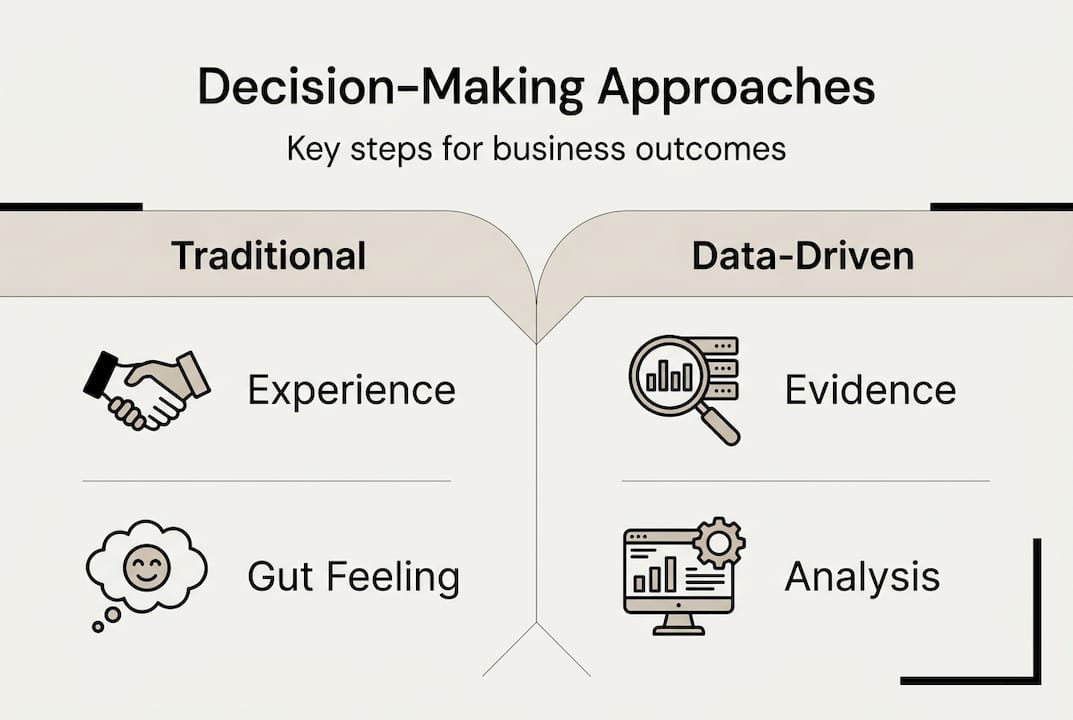
Data-driven decision-making is the practice of grounding organizational choices in verified evidence, structured analysis, and measurable outcomes rather than gut instinct or seniority-based opinion. It does not mean eliminating human judgment. It means making that judgment more reliable by testing it against real-world data.
A common misconception is that more data automatically leads to better decisions. It does not. Leaders who accumulate data without a clear framework for evaluating it often end up more confused, not less. The volume of information is not the advantage. The quality of interpretation is.
Here is a quick contrast between DDDM and traditional decision-making:
| Factor | Traditional decision-making | Data-driven decision-making |
|---|---|---|
| Primary input | Intuition, experience | Verified data, analytics |
| Speed | Often faster short-term | Structured, deliberate |
| Consistency | Variable | Repeatable with governance |
| Accountability | Personality-driven | Process-driven |
| Error correction | Reactive | Proactive through monitoring |
The table above makes one thing clear: DDDM is not about replacing leaders with algorithms. It is about creating a consistent, auditable process that reduces costly errors and builds organizational trust.
Key principles that define genuine DDDM include:
- Clear decision objectives defined before any data is collected
- Validated data sources with known provenance and reliability
- Analytical rigor that separates correlation from causation
- Contextual judgment applied after the evidence is reviewed
- Action orientation that converts insight into measurable steps
As research from Harvard Business Review highlights, DDDM requires balancing data with human judgment, and leaders must rigorously evaluate evidence validity. That balance is what separates organizations that use data well from those that simply collect it. Exploring AI tools for decision makers can help your team close that gap faster.
Why data-driven decision-making matters for modern organizations
The stakes are high. Research confirms that only 20% of organizations excel at decision-making, which means the vast majority of businesses are leaving performance on the table every single day. That is not a minor inefficiency. Over time, it compounds into lost revenue, slower growth, and declining stakeholder trust.
Organizations that practice DDDM consistently report measurable gains across several dimensions:
| Benefit area | Impact observed |
|---|---|
| Operational efficiency | Faster cycle times, reduced waste |
| Stakeholder engagement | Higher transparency, improved trust |
| Strategic agility | Faster adaptation to market shifts |
| Cross-department alignment | Shared language, fewer silos |
Consider a mid-sized healthcare network that shifted from physician-led anecdotal reporting to structured outcome data. Within 18 months, readmission rates dropped by 14% simply because teams could see patterns they had previously missed. The data did not make the decisions. The clinicians did. But the data made those decisions far more accurate.

DDDM also bridges the gap between departments that traditionally operate in silos. When finance, operations, and marketing all work from a shared data layer, conversations shift from opinion battles to evidence-based alignment. That shift alone can accelerate execution dramatically.
Pro Tip: Avoid paralysis by analysis by setting a decision threshold before you start. Define upfront what data quality and confidence level is “good enough” to act. Waiting for perfect data is a decision in itself, and usually a costly one.
The organizational benefits extend beyond efficiency. When leaders demonstrate that decisions are grounded in evidence, it builds credibility with boards, investors, and employees alike. Linking AI integration for business success to your DDDM framework accelerates these gains, particularly in organizations where data analytics in governance is becoming a compliance and accountability expectation.
Core elements of successful data-driven decision-making
Knowing that DDDM matters is not enough. You need a repeatable structure. The following sequence gives your team a reliable foundation:
- Define clear objectives. Every data initiative should start with a specific question. “How can we reduce customer churn by 10% in Q3?” is a decision objective. “Let’s look at our data” is not.
- Audit and source quality data. Identify what data you have, where it comes from, and how reliable it is. Poor data quality is the single most common cause of failed DDDM programs.
- Apply valid analytical methods. Match your analysis technique to your question. Descriptive analytics answers “what happened.” Predictive analytics answers “what might happen next.”
- Apply contextual judgment. Data rarely tells the full story. Leaders must layer in domain expertise, ethical considerations, and organizational context before acting.
- Execute and monitor. Convert insight into action with clear ownership, timelines, and success metrics. Then measure results and feed them back into the next cycle.
This sequence mirrors established workflow models like the PDCA cycle (Plan, Do, Check, Act) and the OODA loop (Observe, Orient, Decide, Act), both of which are widely used in manufacturing, military strategy, and increasingly in enterprise management.
Data governance is not optional in this process. Ethics, compliance, and data privacy must be embedded from the start, not added as an afterthought. Leaders who ignore governance expose their organizations to regulatory risk and eroded stakeholder trust.
Pro Tip: Always assess data provenance before acting. Know where your data came from, when it was collected, and what biases might be embedded in it. A confident analysis built on flawed inputs is more dangerous than admitting uncertainty.
As HBR research reinforces, leaders must rigorously evaluate evidence validity to avoid both over-reliance and dismissal of data. Supporting this with tools like AI-powered optimization and cloud-based AI benefits can significantly reduce the manual burden of data validation.
Challenges, pitfalls, and how to make DDDM actually work
Even well-resourced organizations stumble with DDDM. Knowing the common failure points is the fastest way to avoid them.
Common DDDM pitfalls:
- Data overload: Too many dashboards, too little clarity. Teams lose focus when every metric is treated as equally important.
- Confirmation bias: Leaders unconsciously seek data that validates existing beliefs and dismiss contradictory evidence.
- Lack of action: Insight without execution is just expensive reporting. Many organizations analyze well but act slowly.
- Poor experimentation design: Running tests without proper controls or sample sizes leads to misleading conclusions.
- Siloed data: When departments guard their data, the organization loses the cross-functional view needed for sound decisions.
One particularly dangerous trap is the “winner’s curse” in weak experiments. Research on edge case evaluation shows that weak experiments need careful decision rules to avoid falsely declaring a winner based on noise rather than signal. This is especially relevant in A/B testing and pilot programs where sample sizes are small or conditions are not well controlled.
Do’s and don’ts for DDDM success:
- Do foster data literacy at every level of the organization, not just among analysts
- Do build bias checks into your review process before finalizing decisions
- Do create robust experimentation frameworks with pre-registered hypotheses
- Don’t treat every data point as equally credible
- Don’t skip the “so what” step after analysis
- Don’t let perfect be the enemy of good when time-sensitive decisions are required
Addressing these pitfalls requires a commitment to ethical AI for business practices and AI transparency in business, particularly as automated systems play a larger role in surfacing insights.
Practical steps to implement data-driven decision-making in your organization
Ready to move from concept to execution? Here is a structured roadmap your leadership team can begin using immediately.
- Define your decision priorities. Identify the top three to five decisions your organization makes repeatedly that would benefit most from better data. Start there, not everywhere.
- Audit your current data landscape. Map what data you collect, where it lives, who owns it, and how accessible it is. Gaps and redundancies will become immediately visible.
- Prioritize quick wins. Find one decision where better data is already available and apply a structured analysis process. Early wins build momentum and demonstrate value to skeptics.
- Train your teams. Data literacy is not just for analysts. Managers and executives need enough fluency to ask the right questions and interpret results critically. Invest in targeted training, not generic workshops.
- Build governance structures. Establish clear policies for data access, quality standards, and decision documentation. Governance creates the accountability layer that sustains DDDM over time.
- Measure and refine. Track whether your data-driven decisions are producing better outcomes than previous approaches. Feed those results back into your process and adjust accordingly.
Leadership sponsorship is non-negotiable. When senior leaders visibly use data in their own decision-making, it signals to the entire organization that this is a real cultural shift, not a temporary initiative. Without that sponsorship, even the best frameworks stall.
Automation and AI can significantly accelerate this journey. Implementing AI workflow optimization reduces the manual effort required for data preparation and reporting, freeing your team to focus on interpretation and action. Similarly, choosing to automate business processes creates consistent data trails that make ongoing DDDM far more reliable.
Our perspective: Why excellence in data-driven decisions is rare but achievable
We work with organizations across sectors, and the pattern is consistent: most leaders understand the value of data-driven decision-making intellectually but struggle to operationalize it. The barrier is rarely technology. It is almost always culture and discipline.
Here is our honest take. Organizations that invest heavily in dashboards and analytics platforms without first building a culture of testing, learning, and honest course correction are wasting most of that investment. The tool is not the transformation.
What actually moves the needle is a leadership team that treats wrong decisions as learning opportunities rather than failures to hide. That psychological safety, combined with repeatable standards for how decisions get made and reviewed, is what separates the top 20% from everyone else.
Even imperfect data, handled with rigor and humility, can drive dramatic improvement. We have seen organizations with modest data infrastructure outperform competitors with enterprise-grade systems simply because their teams asked better questions and followed through on what the evidence showed. Investing in essential AI tools matters, but only after the culture is ready to use them well.
Empower your team with next-level data-driven strategies
If this article has sparked ideas about where your organization can improve, Airitual is ready to help you turn that clarity into action. We specialize in building tailored AI and data strategy solutions that fit your specific sector, goals, and team capabilities. From implementing AI integration best practices to deploying generative search optimization that keeps your organization visible and competitive, our consultants work alongside your leadership team every step of the way. Schedule a FREE Strategy Session today and discover exactly where data-driven decision-making can deliver the fastest, most measurable results for your organization.
Frequently asked questions
How is data-driven decision-making different from traditional decision-making?
Data-driven decision-making relies on empirical evidence and structured analytics, while traditional methods typically depend on intuition or experience. As HBR research confirms, effective DDDM still requires human judgment, but that judgment is tested and refined against real evidence.
What is the biggest challenge in DDDM for organizations?
The biggest challenge is consistently converting data into quality decisions that drive results. Only 20% of organizations achieve this level of decision excellence, which means most teams are still bridging the gap between data access and disciplined action.
What types of data are most useful for DDDM?
High-quality, relevant data that directly connects to your decision objectives is most valuable. Leaders should rigorously evaluate evidence validity to avoid acting on data that is outdated, biased, or misaligned with the actual question being asked.
How can I start incorporating data-driven decision-making in my business?
Begin by defining clear goals, auditing your existing data sources, and training your team to interpret and act on analytics with confidence. Starting small with one high-impact decision area builds the skills and credibility needed to scale DDDM across the organization.
Recommended
- AI workflow optimization: 2026 strategies for success | Artificial Intelligence
- AI-Powered Optimization: Transforming Operations Worldwide | Artificial Intelligence
- Why automate business processes for excellence in 2026 | Artificial Intelligence
- Blog | Artificial Intelligence
- Role of Data Analytics – Driving Smarter Ad Campaigns
- Top AI tools for business managers in trades 2026
Recent Comments