

Automation isn’t about robots stealing jobs. It’s about creating smarter operations where technology and people work together to achieve what neither could alone. Fully autonomous systems still need human oversight due to judgment and exception handling. You’ll discover how automation and humans collaborate for better outcomes, explore proven methodologies, tackle real-world challenges, and gain practical implementation strategies that drive measurable results.
Table of Contents
- What does automation mean in modern industry?
- Key automation methodologies: From RPA to hyper-automation
- Benefits of automation: Efficiency, reliability, and engagement
- Automation challenges: Edge cases, integration, and the human factor
- The future workforce: Human-AI collaboration and new skillsets
- How to implement automation: Practical steps for business leaders
- Connect automation to your business goals
- Frequently asked questions
Key Takeaways
| Point | Details |
|---|---|
| Hybrid automation is essential | Combining AI with human oversight yields the best operational results and resilience. |
| Skills are shifting, not vanishing | Most industrial jobs evolve with automation—success depends on adaptability and digital fluency. |
| Start with strategic pilots | Launching high-ROI projects like predictive maintenance builds momentum for broader automation. |
| Integration and security matter | Careful planning and risk management are critical when connecting automation systems. |
| ROI is about more than cost | Automation increases productivity and engagement, ultimately supporting sustainable business growth. |
What does automation mean in modern industry?
Automation refers to technology-driven processes that reduce human intervention across operations. It spans simple scripts to advanced AI-powered agents that adapt and learn. Many leaders assume automation replaces all human workers, but reality tells a different story. Human oversight and collaboration become essential as complexity rises.
Key methodologies include RPA, AI agents, digital twins, and predictive maintenance that transform how industries operate. These tools handle repetitive tasks while freeing your team to focus on strategic decisions, creative problem-solving, and managing exceptions that machines can’t anticipate.
The spectrum of automation includes:
- Basic automation: Scheduled tasks and simple workflows
- Process automation: Multi-step operations with decision logic
- Intelligent automation: AI-driven systems that learn and adapt
- Hyper-automation: Integrated platforms combining robotics, AI, and analytics
Exploring automation software options helps you identify which level matches your operational needs and readiness.
Modern automation isn’t about removing humans from the equation. It’s about positioning them where they add the most value while machines handle predictable, high-volume work.
Key automation methodologies: From RPA to hyper-automation
Understanding the leading methodologies helps you choose the right approach for your operations. Each serves different needs and complexity levels.
| Methodology | Best For | Key Benefit | Implementation Complexity |
|---|---|---|---|
| RPA | Repetitive data tasks | Quick wins, low cost | Low |
| AI Agents | Customer service, analysis | Adaptive responses | Medium |
| Predictive Maintenance | Equipment monitoring | Reduced downtime | Medium |
| Digital Twins | Process simulation | Risk-free testing | High |
| Hyper-automation | End-to-end operations | Maximum efficiency | High |
Robotic Process Automation (RPA) handles rule-based tasks like data entry, invoice processing, and report generation. It’s your entry point for automation, delivering fast ROI with minimal disruption.
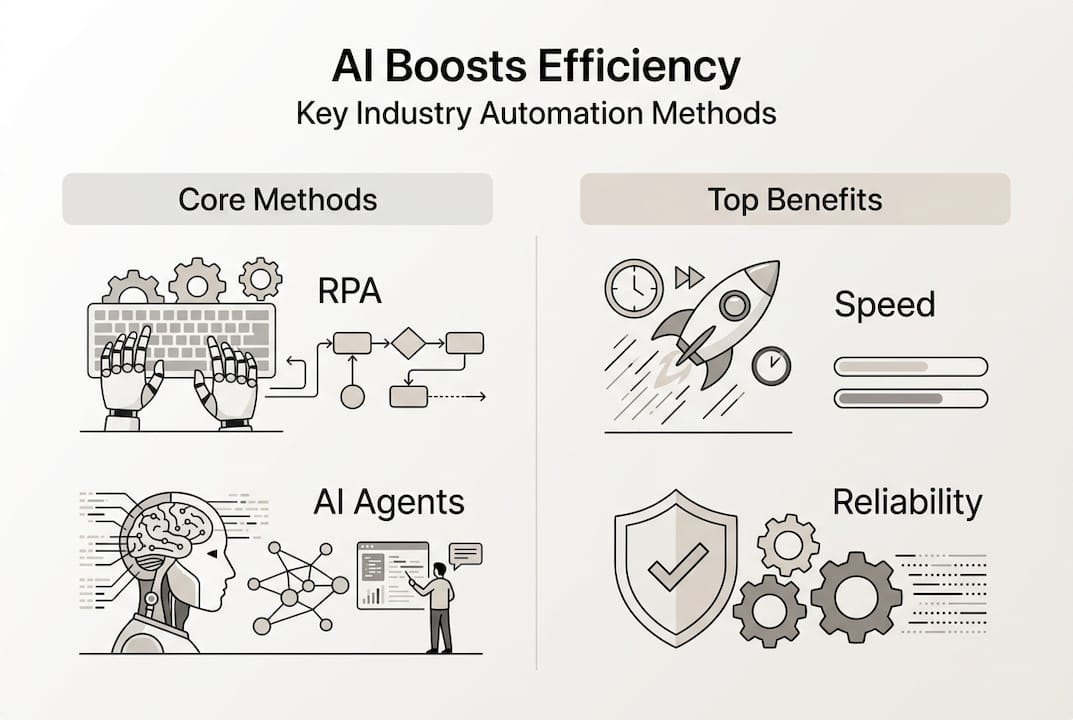
AI agents go further by understanding context, learning from interactions, and making informed decisions. They power chatbots, analyze customer sentiment, and route complex inquiries to the right specialists.
Predictive maintenance uses sensors and machine learning to forecast equipment failures before they happen. This approach cuts unplanned downtime by identifying patterns humans might miss.
Digital twins create virtual replicas of physical systems, letting you test changes, optimize workflows, and predict outcomes without risking actual operations. Digital twin approaches enable manufacturers to simulate production scenarios and refine processes before implementation.
Digital twins and hyper-automation integrate robotics, AI, and data, leading to 51% automated warehouses that adapt to demand fluctuations in real time.
Pro Tip: Start with modular pilots like AI-driven maintenance on critical assets. This approach proves value quickly while building organizational confidence in automation.
Exploring AI automation platforms and workflow automation strategies provides frameworks for selecting and implementing these methodologies. Understanding process automation workflows helps you map current operations to future automated states.
Benefits of automation: Efficiency, reliability, and engagement
Automation delivers measurable improvements across operations, customer experience, and bottom-line results. The evidence supports significant gains when implemented strategically.

Automation can boost productivity by $2.9 trillion by 2030 and shifts skill requirements across industries. This productivity surge comes from machines handling high-volume tasks with consistency while humans tackle complex judgment calls.
Operational benefits include:
- Increased output: Systems run 24/7 without fatigue or breaks
- Lower error rates: Automated processes eliminate human mistakes in repetitive tasks
- Faster cycle times: Workflows complete in minutes instead of hours or days
- Better resource allocation: Teams focus on high-value activities requiring creativity and judgment
- Enhanced compliance: Automated logging and reporting ensure regulatory adherence
Customer engagement improvements:
- Personalized interactions based on behavior and preferences
- Instant responses through AI-powered support channels
- Proactive service through predictive analytics
- Consistent experience across all touchpoints
- Reduced wait times and faster resolution
Hybrid automation, where humans and machines collaborate, improves reliability over fully autonomous systems. Machines handle predictable scenarios with speed and accuracy. Humans step in for exceptions, novel situations, and decisions requiring empathy or ethical judgment.
This partnership creates resilience. When automation encounters an edge case, human expertise prevents failures and captures learning that improves future performance.
Reviewing the automation excellence guide shows how leading organizations structure these hybrid models for sustained competitive advantage.
Automation challenges: Edge cases, integration, and the human factor
No digital solution is perfect. To ensure sustainable gains, business leaders must prepare for these automation roadblocks.
Edge cases and novel failures still limit fully autonomous systems, requiring human experts to maintain operational continuity.
Primary challenges include:
- Novel failures: Situations the system hasn’t encountered before
- Exception handling: Scenarios outside programmed rules requiring judgment
- Data silos: Disconnected systems preventing seamless automation
- Integration complexity: Legacy systems resisting modern automation tools
- Security vulnerabilities: Prompt injection attacks on AI agents, unauthorized access risks
- Change resistance: Teams uncomfortable with new workflows and responsibilities
Human expertise remains irreplaceable for overseeing complex automated systems. Operators monitor performance, identify anomalies, and intervene when automation reaches its limits. This oversight prevents small issues from cascading into major failures.
Security risks deserve special attention. AI agents can be manipulated through carefully crafted inputs that bypass safety controls. Automated systems may execute unintended actions if not properly secured. Regular audits, access controls, and human verification of critical decisions mitigate these risks.
Successful automation requires continuous upskilling and collaboration frameworks that position humans as strategic supervisors rather than displaced workers.
Transition strategies should include:
- Training programs focused on system oversight and exception management
- Clear escalation paths when automation encounters limits
- Regular reviews of automated processes to identify improvement opportunities
- Cross-functional teams combining technical and domain expertise
Implementing workflow optimization strategies and business automation workflows helps you anticipate and address these challenges before they impact operations.
The future workforce: Human-AI collaboration and new skillsets
Automation shifts skill demands rather than eliminating jobs entirely. Understanding these changes helps you prepare your organization for the evolving industrial landscape.
Hybrid human-AI partnerships are essential, with wage and skill effects depending on task type. While 70% of skills endure, they’re applied differently in collaborative environments.
| Role Type | Skills Retained | New Skills Required | Wage Impact |
|---|---|---|---|
| Machine Operators | Equipment knowledge, safety protocols | System monitoring, data interpretation | Stable to positive |
| Quality Control | Defect recognition, standards | AI tool operation, pattern analysis | Positive |
| Maintenance Technicians | Mechanical skills, troubleshooting | Predictive analytics, sensor management | Positive |
| Production Managers | Process optimization, team leadership | Change management, AI strategy | Positive |
| Data Entry Clerks | Accuracy, attention to detail | Exception handling, system oversight | Neutral to negative |
Adaptability, digital fluency, and oversight capabilities rise in importance. Workers who can interpret AI outputs, make judgment calls on exceptions, and continuously learn new tools will thrive.
The pathway forward involves hybridized teams where humans and AI complement each other’s strengths. Machines excel at speed, consistency, and processing vast data sets. Humans bring creativity, ethical reasoning, and the ability to navigate ambiguous situations.
Pro Tip: Leaders should invest early in change management and reskilling programs. Organizations that support workforce transitions see faster adoption, lower resistance, and better outcomes from automation investments.
New training focuses on:
- Understanding AI capabilities and limitations
- Interpreting automated system outputs
- Managing exceptions and edge cases
- Collaborating with AI tools rather than competing against them
- Continuous learning as automation evolves
Exploring automation leadership insights provides frameworks for building these future-ready teams.
How to implement automation: Practical steps for business leaders
Let’s make it practical. Follow these steps to move from concept to a resilient, automated operation.
Business leaders should prioritize hybrid models, begin with high-impact pilots, and address skill shifts from the outset.
Implementation roadmap:
- Assess current operations: Identify repetitive, high-volume tasks with clear rules and measurable outcomes
- Select pilot projects: Choose initiatives with strong ROI potential and manageable complexity
- Build cross-functional teams: Combine technical expertise with operational knowledge
- Implement and measure: Deploy automation with clear success metrics and monitoring
- Scale strategically: Expand successful pilots while capturing lessons learned
- Invest in people: Provide training, support, and clear communication about role evolution
Best practices for sustainable adoption:
- Focus on value creation, not just technology deployment
- Maintain human oversight for critical decisions and exceptions
- Start small, prove value, then scale
- Document processes before automating them
- Build feedback loops for continuous improvement
- Communicate transparently about changes and expectations
- Celebrate wins and share success stories across the organization
Common pitfalls to avoid:
- Automating broken processes without fixing them first
- Underestimating change management needs
- Choosing technology before understanding requirements
- Neglecting security and compliance considerations
- Failing to plan for exception handling
- Moving too fast without building organizational readiness
Change management deserves special emphasis. Clear communication with teams about how automation affects their roles, what new opportunities emerge, and how the organization will support transitions makes the difference between successful adoption and resistance.
The workflow implementation guide provides detailed frameworks for executing these steps with confidence.
Connect automation to your business goals
Automation is a journey, not a destination. Tapping into best practices and industry resources accelerates your progress while avoiding common pitfalls.
Finding expert support to design, scale, and secure your AI-powered operations ensures you’re building on proven foundations rather than learning through costly mistakes. The right partners bring experience across industries, helping you adapt successful strategies to your specific context.
Exploring the latest tools and implementation guides connects automation investments to measurable business results. Whether you’re improving operational efficiency, enhancing customer engagement, or positioning for future growth, strategic automation delivers competitive advantages.
Discover AI integration best practices that align technology with business objectives. Learn search optimization strategies that amplify your digital presence. Get practical guidance to implement automated workflows that transform operations.
Frequently asked questions
What is the main advantage of automation in industry?
Automation improves efficiency, lowers errors, and boosts productivity while enabling human workers to focus on higher-value tasks. Automation can boost productivity by $2.9 trillion by 2030, creating opportunities for strategic growth.
Will automation replace all industrial jobs?
No. Most roles will shift to new tasks, with 70% of skills still needed but applied differently in hybrid human-AI teams that combine machine efficiency with human judgment.
What are edge cases in automation?
Edge cases are rare or unexpected situations that automated systems may not handle well. Edge cases cause rework and require human adaptability to maintain operational continuity.
How should business leaders start with automation?
Begin with high-impact pilot projects like predictive maintenance and invest in change management to support your team. Leaders should prioritize pilots and address skill shifts early for sustainable success.
What is hyper-automation?
Hyper-automation combines robotics, AI, and data tools to automate complex multi-step processes and adapt dynamically. Hyper-automation integrates robotics, AI, and data for advanced industry automation that responds to changing conditions in real time.
Recommended
- How to Automate Workflows for Efficient Business Operations | Artificial Intelligence
- How AI boosts efficiency and engagement in small business | Artificial Intelligence
- AI workflow optimization: 2026 strategies for success | Artificial Intelligence
- Why use education automation to boost efficiency | Artificial Intelligence
- Why use AI for dropshipping: optimize sales and cut costs
Recent Comments