

TL;DR:
- Structured AI interventions significantly improve student engagement and learning outcomes.
- AI works best when integrated into deliberate pedagogical frameworks with clear feedback and goals.
- Personalized prompts and reflection checkpoints enhance motivation and deepen engagement across education levels.
Adding a new app to the classroom does not automatically make students more engaged. Many educators have discovered this the hard way, investing in platforms only to watch novelty wear off within weeks. The real difference comes from how AI is structured and intentionally applied. Structured AI interventions significantly boost student engagement and performance compared to unguided use, with engagement itself acting as the key mediating factor. This guide walks through evidence-based frameworks, practical strategies, and implementation guardrails that help K-12 and higher education institutions move beyond surface-level adoption and into measurable learning gains.
Table of Contents
- How AI transforms student engagement: Core frameworks and evidence
- Proven AI strategies for K-12 and higher education
- Personalization and prompt engineering: Unlocking individual student motivation
- Engagement matters: Why structure, feedback, and guardrails define AI outcomes
- Our perspective: What most educators miss when adopting AI for engagement
- Connect with innovative AI solutions for student engagement
- Frequently asked questions
Key Takeaways
| Point | Details |
|---|---|
| Intentional AI use wins | Structured, pedagogically sound AI approaches drive greater engagement than using technology alone. |
| Personalization amplifies results | Customizing prompts and feedback with AI tools helps reach more diverse student needs. |
| Frequent, guided use matters | Students who regularly interact with AI assistants and systems show measurable grade and engagement improvements. |
| Teacher feedback still vital | Human guidance and structured assessments ensure that AI interventions create genuine, lasting progress. |
How AI transforms student engagement: Core frameworks and evidence
Not all AI use in education produces the same results. The difference between a tool that genuinely lifts outcomes and one that simply adds digital noise comes down to pedagogical intention. Two frameworks help clarify why this is true.
First, consider the comparison between traditional active learning and AI-powered tutoring. AI tutoring systems outperform traditional active learning, with a Harvard randomized controlled trial of 194 students showing that the AI group doubled their learning gains compared to peers in conventional active learning settings. That is not a marginal improvement. It signals a structural shift in how students process and retain material when given adaptive, responsive instruction.
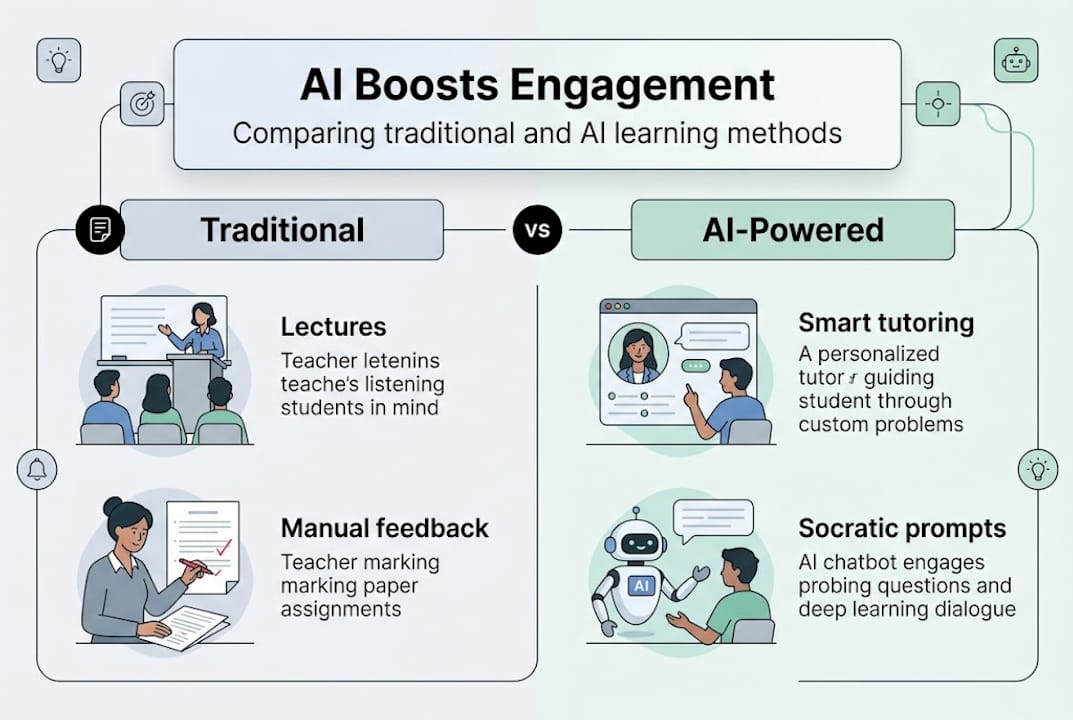
Second, the PMAISE model: AI enhances engagement through pedagogical mediation, meaning AI does not replace the teacher but amplifies the instructional design surrounding it. When educators build AI into deliberate learning sequences, rather than treating it as an add-on, engagement deepens significantly.
Understanding the AI-powered tools impact on learning helps administrators set realistic expectations and design smarter rollouts. Explore broader applications through AI in education to see how these frameworks scale across institutions.
| Factor | Traditional classroom | AI-enhanced classroom |
|---|---|---|
| Feedback speed | Delayed, batch graded | Immediate, adaptive |
| Personalization | Limited by class size | Individualized by design |
| Student pacing | Fixed curriculum pace | Self-directed with guardrails |
| Engagement depth | Passive to active | Active to generative |
| Teacher role | Primary knowledge source | Facilitator and coach |
Key empirical takeaways from current research include:
- Structured AI interventions consistently outperform passive or unguided tool use
- Engagement mediates outcomes, meaning student involvement is the mechanism, not the technology itself
- AI works best when layered into existing pedagogical frameworks, not deployed in isolation
“The question is not whether AI can engage students. The question is whether educators are designing the conditions that allow it to.”
Proven AI strategies for K-12 and higher education
Having explored the foundational principles, let’s get practical with specific AI models and examples that can directly impact classroom engagement.
In K-12 settings, Socratic AI dialogue has shown particularly strong results. K-12: Socratic AI in science improved engagement, with students demonstrating measurable gains in critical thinking, self-efficacy, and cognitive engagement. Rather than presenting answers, Socratic AI prompts students with follow-up questions, pushing them to reason through problems. This mirrors the best practices of skilled teachers but scales across an entire classroom simultaneously.

In higher education, AI course assistants are changing how students interact with course material outside of class. AI course assistants boost grades, and students who used the Spark AI assistant three or more times per week showed significantly higher GPAs than those who used it less frequently. Frequency of use matters, which means institutions need to design for habitual engagement, not just access.
| Technique | Education level | Engagement outcome |
|---|---|---|
| Socratic AI dialogue | K-12 | Higher critical thinking and self-efficacy |
| Adaptive tutoring systems | K-12 and higher ed | Doubled learning gains in RCT settings |
| AI course assistants | Higher education | Significantly higher GPA with frequent use |
| Personalized prompt feedback | Both levels | Increased motivation and task completion |
For teachers ready to act, here are three tactics that consistently produce results:
- Introduce AI in structured sequences. Pair AI tools with clear learning objectives so students know what they are working toward, not just interacting with.
- Build in reflection checkpoints. After AI-assisted tasks, ask students to summarize what they learned in their own words. This closes the feedback loop and reinforces retention.
- Track engagement metrics, not just grades. Frequency of AI interaction, time on task, and revision behavior reveal more about learning momentum than test scores alone.
Pro Tip: When first introducing AI tools, avoid open-ended free exploration. Students who receive a structured prompt or scenario to work through show higher initial engagement and are more likely to return to the tool voluntarily.
For deeper guidance, review these AI teaching tips and explore assessment tools for teachers that integrate well with AI-driven instruction.
Personalization and prompt engineering: Unlocking individual student motivation
Beyond general strategies, personalizing the AI experience presents unique opportunities for engaging every learner.
Prompt engineering enables individualized learning, with research confirming that students who interact with AI through personalized, well-structured prompts report significantly higher engagement than those using generic inputs. Prompt engineering is the practice of designing the inputs students give to AI systems so that the outputs are more relevant, more challenging, and better aligned with individual learning goals.
This matters especially for differentiated learning. Students who struggle with traditional pacing often thrive when AI responds to their specific questions at their own level. Advanced learners, on the other hand, can be pushed further through prompts that require synthesis and evaluation rather than recall.
Here are the top ways to customize AI interactions for your classroom:
- Set role-based prompts. Instruct the AI to respond as a tutor, a debate partner, or a peer reviewer depending on the learning goal
- Adjust complexity through prompt framing. Use phrases like “explain this as if I’m new to the topic” or “challenge my reasoning” to calibrate depth
- Incorporate student context. Encourage students to share their current understanding before asking a question, so AI responses build on prior knowledge
- Use iterative prompting. Teach students to refine their questions after each AI response, building metacognitive habits alongside content knowledge
- Align prompts to assessment criteria. When students know their prompts should help them meet specific rubric standards, engagement becomes purposeful
Pro Tip: Share a sample prompt template at the start of each unit. Something as simple as “I am trying to understand [concept]. Here is what I already know: [student input]. What am I missing?” dramatically improves the quality of AI interactions and keeps students actively thinking.
Learn how to personalize learning with AI at scale, and use the AI education checklist to evaluate which tools align best with your personalization goals.
Engagement matters: Why structure, feedback, and guardrails define AI outcomes
It’s essential to understand not just how to use AI, but why the way it’s structured makes or breaks student progress.
Engagement is not a byproduct of good AI tools. It is the mechanism through which AI produces learning gains. Structured AI interventions boost engagement vs. unguided use, and the data consistently shows that students in unstructured AI environments show lower performance improvement even when using the same platforms as their structured-learning peers.
Feedback is another area where structure changes everything. Unguided AI feedback vs. teacher feedback research reveals a nuanced picture: AI feedback is often technically higher quality, but students revise their work less frequently after receiving it compared to teacher feedback. The reason is relational. Students trust and respond to human feedback differently. This means AI feedback works best as a first-pass tool, with teacher feedback reserved for the revisions that matter most.
Essential safeguards every institution should build into AI deployment:
- Establish clear usage policies that define when and how students may use AI during assignments
- Pair AI tools with authentic assessments that require original thinking, such as oral defenses or project presentations
- Monitor engagement data regularly and intervene when students disengage or over-rely on AI outputs
- Train teachers to interpret AI-generated feedback alongside student work, not as a replacement for their own assessment
“The skeptic vs. optimist views on AI in education converge on one point: without teacher presence and structured design, AI risks producing cognitive atrophy rather than cognitive growth.”
Review the full AI implementation steps and consider how AI implementation in education best practices apply to your institution’s specific context.
Our perspective: What most educators miss when adopting AI for engagement
With these insights in mind, let’s cut through the hype and share what our experience reveals about putting AI into action.
Most AI initiatives in education stall not because the technology fails, but because the strategy does. Institutions that treat AI as a silver bullet, expecting the platform to do the pedagogical heavy lifting, consistently see weaker results than those that layer AI into active, teacher-led instruction. The biggest return on investment comes from intentional design: pairing AI-driven motivation boosts with substantive teacher feedback, clear learning goals, and authentic assessment.
Staff training and student trust-building are just as important as platform selection. Teachers who understand why a tool works are far more effective at deploying it than those who simply follow a vendor tutorial. Students who understand how AI supports their learning, rather than replaces their thinking, engage more deeply and more honestly.
Explore generative AI engagement strategies to see how these principles translate into scalable institutional programs.
Pro Tip: Test new AI interventions with a small cohort of 20 to 30 students first. Collect open feedback after two weeks, adjust your approach, then scale. Fast iteration beats perfect planning every time.
Connect with innovative AI solutions for student engagement
Ready to move from theory to practice? Airitual works directly with K-12 institutions and higher education partners to build customized AI engagement strategies grounded in evidence, not experimentation. Whether you are starting your first pilot or scaling an existing program, our team helps you design the structure, select the right tools, and measure what matters. Explore our full range of AI solutions for education and review AI integration best practices to identify your next step. For a clear implementation roadmap, the AI education implementation guide gives you a practical framework to follow from day one. Schedule a FREE Strategy Session with our team today.
Frequently asked questions
What is the most effective way to use AI for student engagement?
Structured AI interventions significantly boost student engagement and performance, making deliberate, goal-aligned use far more effective than open-ended or passive tool access. Adaptive tutoring and personalized prompts are among the highest-impact starting points.
Does AI benefit all students equally?
Not equally, but broadly. The PMAISE model: AI enhances engagement research indicates that lower-achieving students tend to benefit most from structured AI interventions, though outcomes depend heavily on how well the implementation is supported.
What risks or drawbacks come with using AI for engagement?
The primary risks include cognitive atrophy and reduced revision behavior, since unguided AI feedback vs. teacher feedback studies show students act on AI feedback less often. Authentic assessments and teacher oversight are essential counterbalances.
How can teachers start integrating AI tools for better engagement?
Begin with a focused pilot using adaptive tutoring or Socratic dialogue tools, since K-12: Socratic AI in science improved engagement in measurable ways. Collect outcome data early and use it to refine your approach before broader rollout.
Recommended
- 10 AI-powered teaching tips that boost results in 2026 | Artificial Intelligence
- How to Personalize Learning With AI for Student Success | Artificial Intelligence
- 7 Key Types of AI Strategies for Educational Success | Artificial Intelligence
- AI in Careers Education: Empowering Student Success | Artificial Intelligence
- How technology transforms trading education with AI
Recent Comments