

TL;DR:
- Intelligent workflows coordinate AI, automation, and human oversight for seamless end-to-end processes.
- Success depends on strong integration, governance, adaptability, and structured implementation steps.
- Implementing intelligent workflows yields significant efficiency gains, such as up to 90% dev time reduction.
Many business leaders assume that adding AI tools to existing processes is enough to achieve real operational gains. It is not. McKinsey estimates gen AI automates 60 to 70% of employee activities, yet most organizations capture only a fraction of that potential because they confuse isolated automation with something far more powerful: intelligent workflow. An intelligent workflow is the seamless orchestration of tasks across AI systems, automation tools, and human expertise, designed to adapt, learn, and produce measurable outcomes. This guide defines the concept clearly, shows you the evidence behind its business impact, and walks you through a practical path to adoption.
Table of Contents
- Defining intelligent workflow: More than just automation
- How intelligent workflows drive measurable business impact
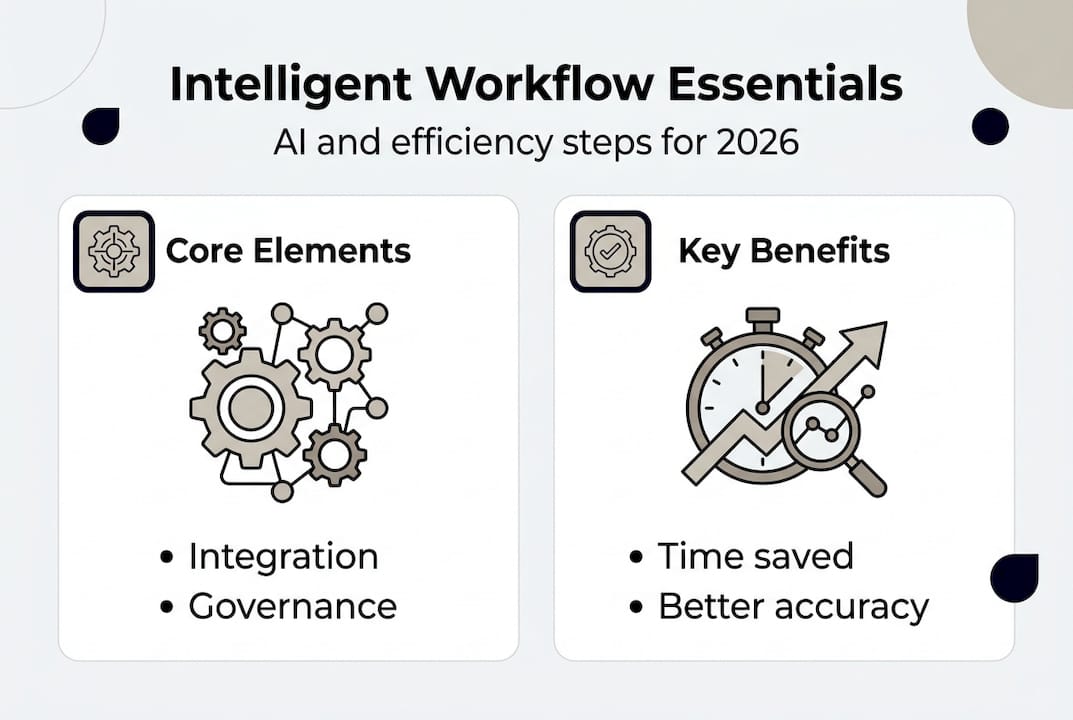
- The essential building blocks: Integration, governance, and hybrid models
- Steps to implementing intelligent workflows in your organization
- Our take: What most experts miss about intelligent workflows
- Ready to transform your operations with intelligent workflows?
- Frequently asked questions
Key Takeaways
| Point | Details |
|---|---|
| Intelligent workflow defined | It orchestrates AI, automation, and human roles for end-to-end process improvement. |
| Integration is critical | Building foundational integration and governance prevents siloed failures. |
| Proven business impact | Companies see up to 90% faster development and dramatic efficiency gains. |
| Adoption steps matter | A structured approach from assessment to iteration is key for success. |
Defining intelligent workflow: More than just automation
Automation, on its own, handles a single task. It triggers an email when a form is submitted, or routes a support ticket to the right queue. Useful, yes. But it operates in isolation, with no awareness of what came before or what comes next. An intelligent workflow is different in a fundamental way.
An intelligent workflow connects those isolated actions into a coordinated, end-to-end process. It uses AI to interpret data, automation to execute tasks, and human judgment to handle exceptions and strategic decisions. The result is a system that can adapt to new inputs, flag anomalies, and continuously improve based on feedback. You can explore what this looks like in practice through AI workflow optimization strategies built for modern organizations.
The four core elements that define an intelligent workflow are:
- Integration: All systems, data sources, and tools communicate with each other in real time.
- Orchestration: A central layer coordinates task sequencing across people, bots, and AI models.
- Adaptability: The workflow adjusts based on new data, exceptions, or changing business rules.
- Governance: Clear oversight mechanisms ensure accountability, compliance, and quality control.
Without these four elements working together, you do not have an intelligent workflow. You have a patchwork of disconnected automations that create new inefficiencies rather than eliminating old ones.
“70% of digital transformations fail due to organizational silos, where systems, teams, and processes operate independently without effective coordination.”
This failure rate is not a technology problem. It is an architecture problem. When you automate business workflows without first addressing integration and orchestration, you are automating dysfunction rather than eliminating it. The key capabilities that intelligent workflows unlock include faster decision cycles, reduced manual handoffs, real-time visibility into process performance, and the ability to scale operations without proportional headcount increases. These are not incremental improvements. They are structural advantages.
How intelligent workflows drive measurable business impact
Understanding what makes a workflow intelligent sets up the next key question: why does it matter for your bottom line? The evidence is compelling and growing.
Consider what organizations are already achieving. The AI orchestration market was valued at $3.8 billion in 2024 and is projected to grow at a 47% compound annual growth rate, according to Gartner. That growth is not speculative. It reflects real investment by organizations that are seeing returns.
| Use case | Efficiency gain | Source |
|---|---|---|
| Software development automation | Up to 90% dev time reduction | IBM CUGA pilot |
| Workflow execution speed | 151x faster processing | n8n automation case |
| Employee task automation | 60 to 70% of activities automatable | McKinsey research |
| Digital transformation success | 30% higher when silos are removed | Industry analysis |
The IBM CUGA pilot is particularly striking. By applying intelligent workflow principles to software development, IBM achieved up to a 90% reduction in development time. That is not a marginal gain. It is a fundamental shift in how work gets done.
The n8n automation case is equally instructive. By replacing a manual, multi-step process with an orchestrated workflow, execution time dropped by a factor of 151. Tasks that took hours were completed in minutes. You can see similar patterns in process automation workflow implementations across industries.
Pro Tip: Before launching any intelligent workflow initiative, establish your baseline metrics. Measure current process cycle times, error rates, and labor costs. Without a baseline, you cannot calculate ROI, and without ROI data, you cannot secure ongoing investment for scaling.
The business automation workflow gains compound over time. Each improvement generates data that trains the AI layer to perform better, which drives further efficiency, which creates more data. Organizations that start early build a structural advantage that becomes harder for competitors to close.
The essential building blocks: Integration, governance, and hybrid models
To convert those benefits into reality, you need to assemble the right foundation. Here is what successful organizations prioritize.

Intelligent workflows demand foundational integration layers and hybrid human-AI models for sustainable transformation. This is not optional architecture. It is the difference between a workflow that scales and one that breaks under pressure.
| Factor | Isolated automation | Intelligent workflow |
|---|---|---|
| System connectivity | Siloed, point-to-point | Unified integration layer |
| Decision making | Rule-based only | AI-assisted with human oversight |
| Adaptability | Static rules | Dynamic, learning-enabled |
| Governance | Minimal | Structured, auditable |
| Scalability | Limited | Designed to scale |
Here are the four foundational steps every organization must complete before deploying intelligent workflows at scale:
- Build your integration layer. Connect your core systems, including CRM, ERP, communication tools, and data platforms, through APIs or middleware. Without this, orchestration is impossible. Review AI integration best practices to understand the technical requirements.
- Define your governance model. Establish who owns each workflow, how exceptions are escalated, and how compliance is maintained. Governance is not bureaucracy. It is the mechanism that keeps intelligent workflows trustworthy.
- Design hybrid human-AI handoffs. Identify which decisions require human judgment and build those handoff points explicitly into the workflow. AI handles volume and speed. Humans handle nuance and accountability.
- Set domain-specific KPIs. Generic metrics like “efficiency” are not measurable. Define specific indicators such as processing time per transaction, error rate per 1,000 cases, or cost per resolved ticket.
Pro Tip: Avoid “AI pilot purgatory,” the state where a proof of concept succeeds but never scales. The reason pilots stall is almost always governance, not technology. Define your scaling criteria before you launch the pilot, not after. Organizations that understand the AI advantages for SMEs and larger enterprises alike recognize that governance is what separates pilots from production systems.
Steps to implementing intelligent workflows in your organization
Once foundational elements are in place, here is how to move from concept to deployed, optimized workflow.
Foundational integration and domain-aligned metrics are the two variables most consistently linked to successful deployment. Keep both at the center of every implementation decision.
- Conduct a process audit. Map your highest-volume, highest-friction processes. Look for tasks with clear inputs and outputs, high repetition, and measurable outcomes. These are your best candidates for intelligent workflow deployment.
- Prioritize and sequence. Do not try to transform everything at once. Select two or three processes where the ROI case is strongest and the integration complexity is manageable. Sequence them by business impact.
- Build and connect your integration layer. Use the AI automation platforms best suited to your technology stack. Ensure data flows cleanly between systems before adding AI components.
- Run a governed pilot. Deploy the workflow in a controlled environment with defined success metrics. Collect data on performance, exceptions, and user feedback. Adjust before scaling.
- Review, iterate, and scale. Use pilot data to refine the workflow, then expand to additional processes. Build a regular review cadence into your operations so the workflow continues to improve.
Common pitfalls to avoid during implementation:
- Skipping the process audit and automating broken processes as-is
- Underinvesting in change management and user training
- Setting vague success metrics that cannot be measured objectively
- Neglecting governance until something goes wrong
- Treating deployment as a finish line rather than a starting point
Applying AI integration best practices at each stage reduces the risk of these pitfalls significantly. The organizations that succeed treat implementation as a discipline, not a project.
Our take: What most experts miss about intelligent workflows
Most of the conversation around intelligent workflows focuses on tools: which AI platform, which automation engine, which integration middleware. That focus is understandable, but it misses the real driver of success.
In our experience working with organizations across sectors, the initiatives that stall do so because of culture and governance failures, not technology gaps. Leaders invest in sophisticated AI systems, then underinvest in the human structures needed to sustain them. There is no AI model that compensates for unclear ownership, inconsistent data quality, or a workforce that does not trust the system.
The organizations that generate lasting value from intelligent workflows treat them as living systems. They build AI governance models into the design from day one, not as an afterthought. They measure incremental ROI at every stage rather than waiting for a transformational moment that may never arrive. And they recognize that hybrid human-AI collaboration is not a transitional phase. It is the permanent operating model. The technology will keep improving. The discipline of managing it well is what separates high-performing organizations from those perpetually chasing the next tool.
Ready to transform your operations with intelligent workflows?
If this guide has clarified what intelligent workflows actually require, the next step is applying that clarity to your specific operations. At Airitual, we work directly with business leaders to assess current processes, identify high-impact automation opportunities, and build the integration and governance foundations that make intelligent workflows sustainable.
You can start by exploring our resources on best practices for AI integration or reviewing how leading organizations automate workflows efficiently at scale. For a more tailored starting point, our business automation workflow guides walk through real implementation scenarios. Schedule a FREE Strategy Session with our team to map your path forward.
Frequently asked questions
How is intelligent workflow different from regular automation?
Intelligent workflow integrates AI, automation, and human expertise into seamless, adaptive end-to-end processes, while regular automation handles only isolated, rule-based tasks without coordination across systems.
What is the biggest challenge in deploying intelligent workflows?
The biggest challenge is overcoming organizational silos. 70% of digital transformations fail because systems, teams, and processes operate independently, making integration and governance the critical success factors.
What measurable ROI can businesses expect from intelligent workflows?
Real-world results include up to 90% dev time reduction in IBM’s CUGA pilot and a 151x faster process execution rate in documented n8n automation cases, demonstrating significant, quantifiable gains.
What first steps should leaders take toward intelligent workflow adoption?
Begin with a structured process audit to identify high-friction, high-volume workflows, then build foundational integration and governance capabilities before deploying any AI components at scale.
Recommended
- AI workflow optimization: 2026 strategies for success | Artificial Intelligence
- How to Automate Workflows for Efficient Business Operations | Artificial Intelligence
- Implement Process Automation Workflow for Seamless Efficiency | Artificial Intelligence
- What is workforce automation? A 2026 guide for leaders | Artificial Intelligence
- Automation best practices for efficient multi-cloud ops
- AI interview assistance: boost job success in 2026 – MeetAssist | MeetAssist
Recent Comments