

Government officials often struggle to translate data into actionable policy, despite having access to more information than ever before. Data analytics enables evidence-based policymaking through predictive modeling, machine learning, digital twins, and IoT for policy simulation, evaluation, and resource allocation in governance. This article reveals how modern analytics transform governance outcomes, addresses common implementation challenges, and provides expert strategies to enhance public service delivery through responsible AI integration.
Table of Contents
- Key takeaways
- How data analytics empowers evidence-based policymaking
- Empirical benchmarks: real-world AI efficiencies in government
- Navigating the ethical, operational, and governance challenges
- Expert best practices for responsible and effective analytics integration
- Discover AI services to enhance governance analytics
- Frequently asked questions about data analytics in governance
Key Takeaways
| Point | Details |
|---|---|
| Evidence based policymaking | Data analytics replaces intuition with evidence based decision making, enabling officials to predict outcomes, compare options, and allocate resources more effectively. |
| Human in the loop | Maintaining human oversight and transparent decision processes helps build trust and ensures responsible AI deployment. |
| Real world benchmarks | Real world benchmarks show 86 percent accuracy in urban planning decisions, a 78 percent reduction in document search time, and 66 percent faster analysis of planning applications. |
| Prescriptive analytics | Prescriptive analytics move beyond prediction by recommending specific actions and optimal timing based on scenarios. |
How data analytics empowers evidence-based policymaking
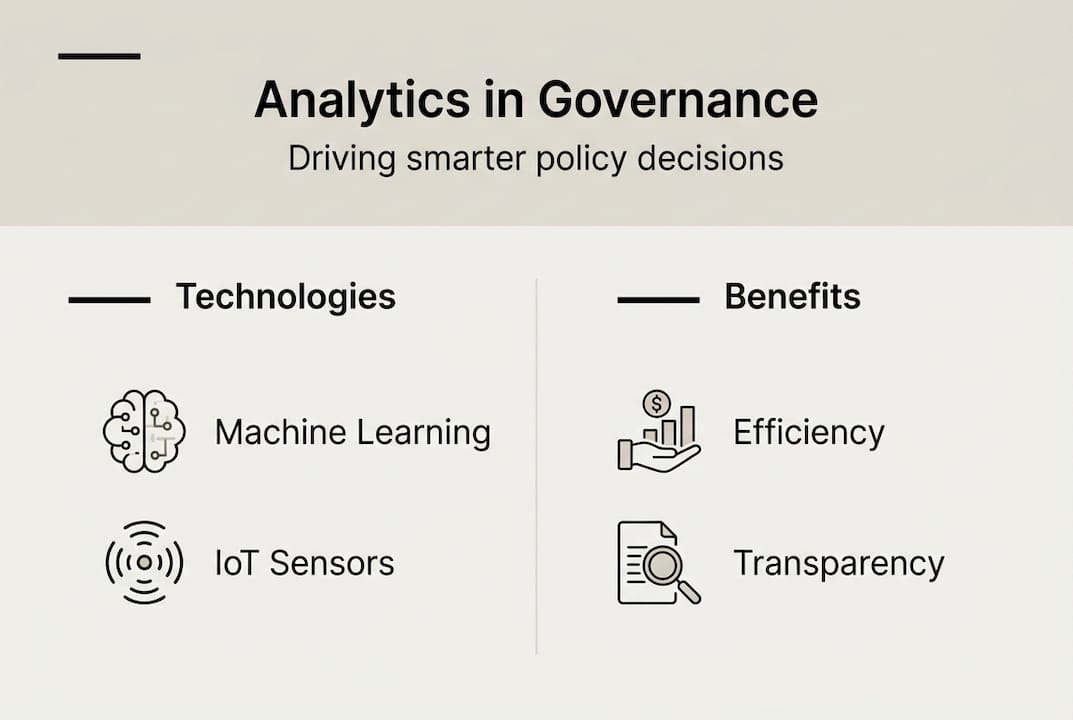
Data analytics transforms governance by replacing intuition-based decisions with evidence-driven strategies. Machine learning algorithms analyze historical data to identify patterns and predict future trends, enabling officials to anticipate challenges before they escalate. Digital twins create virtual replicas of cities or systems, allowing policymakers to test interventions in a risk-free environment before real-world implementation.
IoT sensors collect real-time data from infrastructure, traffic systems, and public facilities, feeding continuous insights into analytics platforms. This constant stream of information enables dynamic policy adjustments based on actual conditions rather than outdated assumptions. Prescriptive analytics goes beyond prediction by recommending specific actions, such as optimal budget allocations or intervention timing, based on multiple scenarios and constraints.
The combination of these technologies creates a powerful ecosystem for types of AI for government applications. Predictive models forecast demand for public services, helping agencies staff appropriately and allocate resources efficiently. Policy simulation tools test regulatory changes virtually, revealing unintended consequences before enactment. Resource optimization algorithms identify waste and suggest reallocation strategies that maximize public value.
Pro Tip: Start with a single high-impact use case like traffic management or permit processing to demonstrate value before scaling analytics across departments.
The analytics impact on public policy extends beyond efficiency to fundamentally improve decision quality. Officials can quantify trade-offs between policy options, assess equity impacts across demographics, and measure outcomes against objectives with unprecedented precision. This evidence-based approach strengthens accountability and builds public confidence in government decisions.
| Technology | Governance Application | Key Benefit |
|---|---|---|
| Machine Learning | Pattern recognition in service data | Predict demand and optimize staffing |
| Digital Twins | Virtual city modeling | Test policies before implementation |
| IoT Sensors | Real-time infrastructure monitoring | Enable dynamic resource allocation |
| Prescriptive Analytics | Action recommendation engines | Suggest optimal interventions |
| Natural Language Processing | Citizen feedback analysis | Understand public sentiment at scale |
These technologies work synergistically to create a comprehensive analytics capability that transforms how governments understand challenges, design solutions, and measure success.
Empirical benchmarks: real-world AI efficiencies in government
Concrete examples demonstrate the transformative potential of analytics in governance. Westminster geospatial intelligence achieves 86% accuracy in urban planning decisions, enabling officials to make land use determinations with confidence. MassDOT’s HEKA AI system reduces document search time by 78%, freeing staff to focus on analysis rather than information retrieval. Plymouth’s AI implementation delivers 66% faster analysis of planning applications, dramatically improving service delivery speed.

These benchmarks reveal consistent patterns across implementations. Accuracy improvements typically range from 80-90% compared to manual processes, while time savings cluster around 60-80% for routine tasks. The efficiency gains compound over time as systems learn from new data and officials become more skilled at leveraging insights.
| Implementation | Primary Metric | Improvement | Secondary Benefit |
|---|---|---|---|
| Westminster GeoAI | Decision accuracy | 86% | Reduced appeals and disputes |
| MassDOT HEKA | Search time reduction | 78% | Staff capacity for complex work |
| Plymouth Planning AI | Analysis speed | 66% faster | Improved citizen satisfaction |
| Singapore Traffic Prediction | Congestion forecast accuracy | 85% | Optimized signal timing |
The AI for government efficiency gains extend beyond headline metrics to operational transformation. Westminster’s system handles 10,000+ planning queries annually with minimal staff intervention. MassDOT processes twice the volume of infrastructure projects with the same team size. Plymouth reduced average application processing time from 8 weeks to 3 weeks, significantly improving the citizen experience.
Pro Tip: Establish baseline metrics before implementation to quantify improvements and justify continued investment in analytics capabilities.
Success factors emerge consistently across these cases. Clear executive sponsorship ensures resources and removes bureaucratic obstacles. Focused initial scope prevents overwhelming teams with complexity. Integration with existing workflows minimizes disruption and accelerates adoption. Continuous training helps staff transition from data consumers to analytics partners.
The Plymouth AI case study reveals an often-overlooked benefit: improved staff satisfaction. Automating routine analysis freed planners to engage in higher-value work requiring judgment and creativity. This human-centered approach to automation reduces resistance and builds internal champions for further innovation.
Scaling from pilot to enterprise requires careful change management. Start with volunteer departments eager for innovation rather than mandating adoption. Document quick wins and share success stories to build momentum. Invest in user-friendly interfaces that reduce technical barriers. Create cross-functional teams combining domain experts with data specialists to ensure solutions address real needs.
Navigating the ethical, operational, and governance challenges
While analytics offers tremendous potential, implementation faces significant obstacles. Algorithmic bias represents a critical risk, as models trained on historical data perpetuate existing inequities. Privacy concerns arise when governments collect and analyze citizen information at scale. Over-reliance on AI recommendations can erode human judgment and accountability. Institutional inertia and resistance to change slow adoption even when benefits are clear.
Ethical concerns and institutional inertia require integrated governance approaches combining collaborative and data-driven models. Organizations must balance technological capability with ethical oversight, ensuring AI serves public interest rather than efficiency alone.
Operational challenges compound these ethical concerns:
- Data quality issues undermine model accuracy when information is incomplete, outdated, or inconsistent
- Legacy system integration requires significant technical investment and creates temporary disruptions
- Skills gaps prevent staff from effectively using analytics tools or interpreting results
- Vendor lock-in limits flexibility and increases long-term costs
- Cybersecurity vulnerabilities expose sensitive information to malicious actors
Governance frameworks must evolve to address these challenges. Five integrated relationship types between government and technology providers shape successful implementations:
- Collaborative partnerships where agencies and vendors co-develop solutions
- Data-driven contracts with performance metrics tied to outcomes
- Transparent procurement emphasizing explainability and auditability
- Adaptive governance allowing iterative refinement based on results
- Citizen-centered design ensuring technology serves public needs
Responsible AI governance requires continuous monitoring, transparent decision processes, and meaningful human oversight at critical junctures. Technology should augment rather than replace human judgment in matters affecting citizen rights and welfare.
The data privacy in AI debate highlights tensions between analytical power and individual rights. Anonymization techniques reduce but don’t eliminate re-identification risks. Consent mechanisms struggle to keep pace with data usage evolution. Regulatory frameworks vary across jurisdictions, complicating multi-agency initiatives.
Building public trust requires transparency about data collection, usage, and decision processes. Citizens need clear explanations of how algorithms affect them and meaningful recourse when errors occur. Regular audits by independent parties verify fairness and accuracy. Public reporting on AI performance builds accountability and enables informed debate about appropriate technology use.
The analytics impact on public policy depends ultimately on organizational culture. Technical capability means little without leadership commitment to evidence-based decision making. Success requires shifting mindsets from defending existing practices to continuously improving based on data insights.
Expert best practices for responsible and effective analytics integration
Implementing analytics responsibly requires deliberate strategies that balance innovation with accountability. Human-in-loop oversight, ethical AI frameworks, and reskilling form the foundation of sustainable adoption. Human oversight ensures algorithms serve as decision support rather than autonomous actors, maintaining accountability and enabling contextual judgment that pure data analysis misses.
Ethical AI frameworks establish clear principles guiding technology deployment. These frameworks typically address fairness, ensuring algorithms don’t discriminate against protected groups. Transparency requirements mandate explainable models rather than black-box systems. Accountability mechanisms assign responsibility for AI decisions to specific individuals. Privacy protections limit data collection and usage to legitimate purposes. Regular audits verify ongoing compliance with ethical standards.
Workforce reskilling represents a critical success factor often underestimated in planning. Officials need statistical literacy to interpret model outputs correctly. Technical staff require domain knowledge to build relevant solutions. Leaders must understand analytics capabilities and limitations to make informed investment decisions. Training programs should emphasize practical application rather than theoretical concepts, using real scenarios from daily work.
Transparency practices build trust internally and externally:
- Document model assumptions, data sources, and limitations clearly
- Explain algorithmic decisions in plain language accessible to non-technical stakeholders
- Publish performance metrics showing accuracy, bias indicators, and error rates
- Provide appeal mechanisms when citizens disagree with automated decisions
- Share code and methodologies with peer agencies to enable scrutiny and improvement
Hybrid approaches combining machine learning with natural language processing enhance explainability. These systems generate human-readable justifications for recommendations, enabling officials to understand reasoning and identify potential errors. Interpretable models sacrifice some predictive power for transparency, a worthwhile trade-off in high-stakes governance contexts.
Pro Tip: Establish an AI ethics board with diverse membership including technical experts, legal counsel, community representatives, and subject matter specialists to review major implementations before deployment.
Future governance will emphasize model interpretability, integrated data ecosystems, and AI for adaptive policy cycles. Interpretability tools will enable officials to probe model behavior and understand decision factors. Integrated ecosystems will break down data silos, enabling holistic analysis across agencies. Adaptive policy cycles will use real-time feedback to continuously refine interventions based on actual outcomes.
The role of AI in policy making will expand from analysis to active participation in governance processes. AI systems will monitor policy implementation, flag emerging issues, and suggest course corrections. This requires robust governance to ensure technology enhances rather than supplants democratic deliberation and human judgment.
Successful analytics integration balances technological capability with strong governance structures. Technology provides tools, but organizational culture, leadership commitment, and ethical frameworks determine whether those tools serve public interest effectively. The most sophisticated algorithms fail without skilled people, clear processes, and accountability mechanisms ensuring responsible use.
Discover AI services to enhance governance analytics
Transforming governance through analytics requires more than technology. It demands strategic planning, workforce development, and ongoing support to navigate implementation challenges successfully. Airitual partners with government agencies to accelerate AI adoption while maintaining ethical standards and public trust.
Our essential AI integration tips help officials avoid common pitfalls and establish foundations for sustainable analytics capabilities. We emphasize starting small with high-impact use cases, building internal champions, and scaling based on demonstrated value rather than theoretical potential.
Customized AI training services develop the skills your team needs to leverage analytics effectively. Programs cover statistical literacy for decision makers, technical implementation for IT staff, and change management for leaders guiding organizational transformation. Training uses real scenarios from your agency to ensure immediate practical application.
Explore our AI for public services solutions designed specifically for government contexts. These tools address common challenges like permit processing, resource allocation, citizen engagement, and performance monitoring while maintaining transparency and accountability standards essential for public sector applications.
Successful AI adoption in governance requires partnership between technology providers who understand public sector constraints and agencies committed to evidence-based decision making. Together, we build capabilities that enhance public service delivery while maintaining democratic values and citizen trust.
Frequently asked questions about data analytics in governance
How does data analytics improve public policy outcomes?
Data analytics enables predictive modeling that forecasts policy impacts before implementation, allowing officials to refine interventions and avoid unintended consequences. It optimizes resource allocation by identifying highest-need areas and most effective programs. Analytics also provides continuous feedback loops measuring actual outcomes against objectives, enabling adaptive refinement based on evidence rather than assumptions.
What are the biggest risks of AI in governance?
Algorithmic bias represents the primary risk, as models trained on historical data perpetuate existing inequities unless carefully monitored and corrected. Privacy violations occur when data privacy in AI protections fail to prevent unauthorized access or misuse. Over-reliance on AI recommendations can erode human judgment and accountability. Lack of transparency creates black-box decision making that undermines public trust and prevents meaningful oversight.
How can governments ensure AI transparency and fairness?
Governments should mandate explainable AI models that provide human-readable justifications for recommendations. Regular audits by independent parties verify accuracy and detect bias across demographic groups. Publish performance metrics including error rates and fairness indicators publicly. Establish appeal mechanisms allowing citizens to challenge automated decisions. Diverse development teams reduce blind spots and ensure multiple perspectives shape system design.
What skills do officials need to manage AI systems?
Officials need statistical literacy to interpret model outputs, understand confidence intervals, and recognize limitations. Domain expertise ensures analytics address real problems rather than technically interesting but irrelevant questions. Critical thinking skills enable officials to question algorithmic recommendations and apply contextual judgment. Change management capabilities help leaders guide organizational transformation. The types of AI for government vary widely, so familiarity with different approaches helps match tools to needs.
Where can I find training for AI in public services?
Airitual offers customized training programs designed specifically for government contexts, covering technical implementation, strategic planning, and ethical governance. Programs adapt to your agency’s maturity level and specific use cases. University partnerships provide academic credentials for officials seeking formal education. Industry conferences and peer networks enable knowledge sharing across agencies. Online platforms offer self-paced courses covering foundational concepts and emerging techniques.
Recent Comments