

Manual, repetitive tasks can drain valuable resources and slow growth for mid-sized enterprises, especially when business leaders need agility and precision. Automating workflows is not just about technology, it is about transforming how work gets done with purpose and clarity. This guide reveals how a strategic, step-by-step approach to automation—including a focus on process assessment and clear success metrics—can propel operational efficiency through smart AI integration, helping you stay competitive and responsive in a rapidly evolving market.
Table of Contents
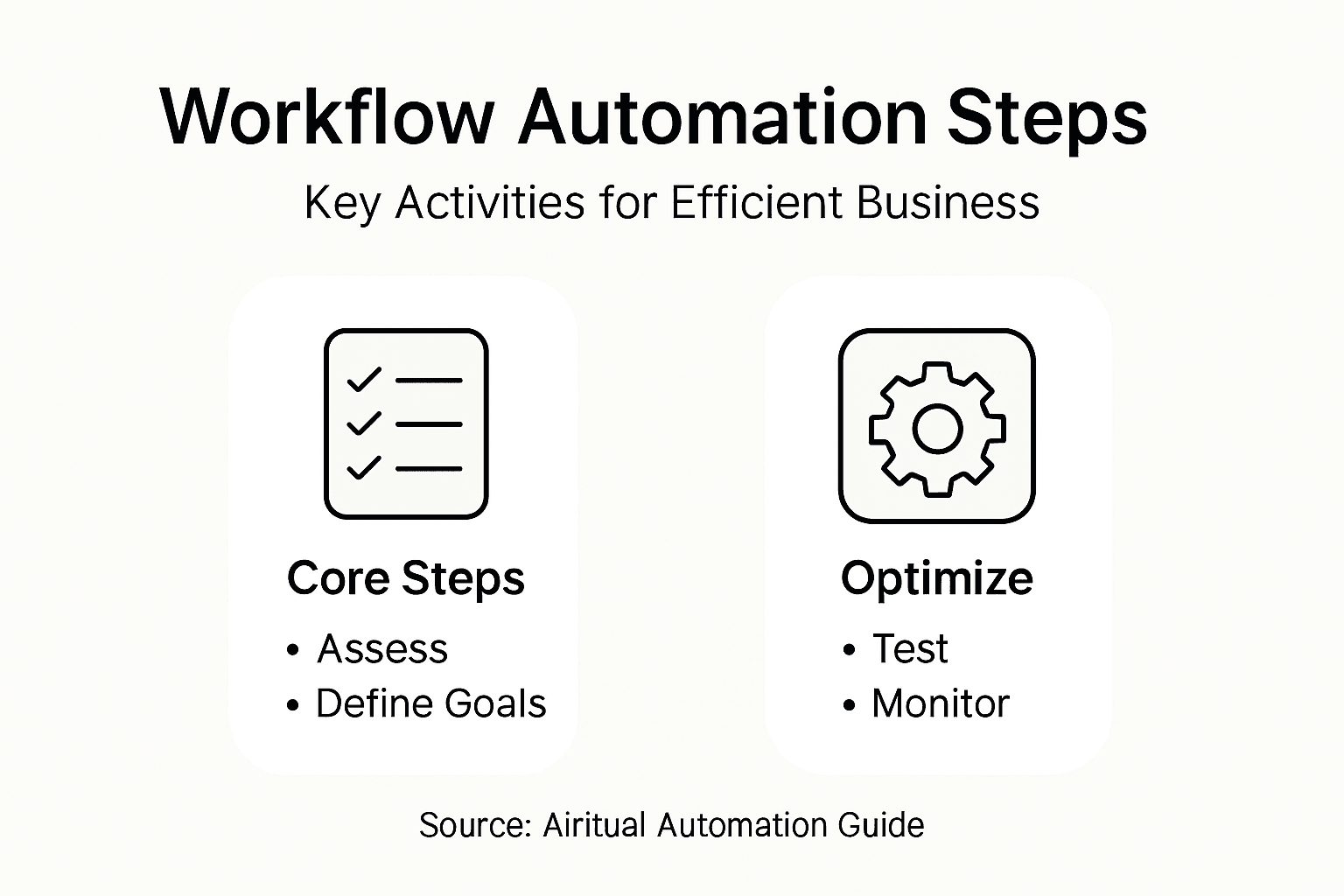
- Step 1: Assess Existing Processes for Automation
- Step 2: Define Automation Goals and Success Metrics
- Step 3: Select AI Tools Suited to Workflow Needs
- Step 4: Customize Automation Workflows for Your Sector
- Step 5: Test and Validate Automated Processes
- Step 6: Monitor Performance and Optimize Continuously
Quick Summary
| Main Insight | Detailed Explanation |
|---|---|
| 1. Assess Processes for Automation | Start by identifying task candidates for automation based on their repetitive nature and low human judgment. |
| 2. Define Clear Automation Goals | Establish specific and measurable objectives that align with your business strategy to drive automation success. |
| 3. Select Appropriate AI Tools | Carefully evaluate AI platforms that meet your operational needs, focusing on integration and scalability. |
| 4. Customize Workflows for Your Sector | Tailor automation processes to fit your industry’s specific requirements to maximize efficiency and compliance. |
| 5. Monitor and Optimize Continuously | Implement ongoing performance tracking and make iterative adjustments to ensure enduring process effectiveness. |
Step 1: Assess Existing Processes for Automation
Automating your business workflows begins with a strategic evaluation of your current operational processes. In this critical first step, you’ll systematically identify which tasks are prime candidates for technological optimization.
Effective process assessment requires a comprehensive review of your organization’s workflows. Start by analyzing rule-based business processes that involve repetitive, structured tasks. Look for activities characterized by:
- High transaction volumes
- Consistent, predictable steps
- Minimal human judgment requirements
- Frequent manual data entry
- Standardized input and output formats
The goal is to pinpoint processes that can be seamlessly transformed through automation. Organizations typically start with straightforward, repetitive tasks before progressing to more complex workflow integrations. Document each process meticulously, capturing:
- Current workflow steps
- Time spent on each task
- Error rates
- Resource allocation
- Potential bottlenecks
Successful automation begins with understanding exactly what you’re currently doing.
Quantitative analysis is key. Track metrics like task completion time, error frequency, and resource expenditure to objectively evaluate automation potential. Some processes might require partial automation, while others could be fully digitized.

Pro tip: Create a detailed process inventory spreadsheet, ranking tasks by their automation feasibility and potential efficiency gains.
Step 2: Define Automation Goals and Success Metrics
Transforming your business workflows requires setting crystal-clear objectives that align with your strategic vision. In this crucial step, you’ll establish precise goals and quantifiable metrics that will guide your automation journey and demonstrate tangible value.
Strategic leadership demands defining specific automation objectives that extend beyond mere technological implementation. Your goals should encompass multiple dimensions of organizational performance, including:
- Operational efficiency improvements
- Cost reduction targets
- Error rate minimization
- Employee productivity enhancement
- Customer experience optimization
When establishing success metrics, focus on creating SMART objectives that are:
- Specific
- Measurable
- Achievable
- Relevant
- Time-bound
Effective automation goals transform technological potential into measurable business value.
Consider developing a comprehensive measurement framework that tracks both quantitative and qualitative outcomes. Quantitative metrics might include time saved, error reduction percentages, and cost savings, while qualitative assessments could involve employee satisfaction and process flexibility improvements.
Continuous monitoring is essential. Regularly review your automation performance against predefined metrics, allowing for iterative refinements and strategic adjustments.
Pro tip: Create a dedicated dashboard that visualizes your automation goals and real-time progress, enabling immediate insights and data-driven decision making.
Step 3: Select AI Tools Suited to Workflow Needs
Selecting the right AI tools is a critical decision that can make or break your automation strategy. This step will help you navigate the complex landscape of technological solutions to find the perfect fit for your specific business workflows.
Comprehensive criteria for selecting AI automation technologies involve understanding your organization’s unique operational requirements. Your selection process should focus on matching technological capabilities with workflow complexity, considering factors such as:
- Scalability of the tool
- Integration capabilities
- Complexity of your existing processes
- Technical readiness of your team
- Budget constraints
- Potential for future expansion
When evaluating potential AI automation platforms, consider a systematic assessment approach:
- Map your current workflow intricacies
- Identify specific automation requirements
- Research potential AI tools
- Conduct thorough compatibility testing
- Evaluate total cost of implementation
The right AI tool transforms operational challenges into strategic opportunities.
Prioritize tools that offer flexible configuration options and robust integration capabilities. Look for solutions that can adapt to your unique business processes rather than forcing your workflows to conform to rigid technological constraints.
Vendor evaluation is crucial. Request detailed demonstrations, explore case studies, and seek references from organizations with similar operational profiles. Pay close attention to the tool’s ability to handle nuanced tasks and provide seamless workflow integration.
Pro tip: Create a detailed scoring matrix that objectively ranks potential AI tools against your specific operational requirements, ensuring a data-driven selection process.
Step 4: Customize Automation Workflows for Your Sector
Customizing automation workflows requires a nuanced approach that goes beyond generic solutions. Your goal is to design workflows that align precisely with your industry’s unique operational landscape and specific business requirements.
Tailoring automation workflows demands deep sector-specific analysis to ensure maximum efficiency and minimal disruption. Understanding your sector’s distinctive characteristics is crucial for successful implementation, which involves examining:
- Regulatory compliance requirements
- Unique process complexities
- Industry-specific data handling protocols
- Organizational technology maturity
- Specific performance benchmarks
- Existing technological infrastructure
When customizing workflows, focus on these strategic customization elements:
- Analyze current manual processes
- Identify sector-specific bottlenecks
- Map precise automation opportunities
- Design flexible workflow configurations
- Develop sector-specific performance metrics
Successful workflow customization transforms technological potential into operational excellence.
Prioritize adaptive automation strategies that can evolve with your sector’s changing dynamics. This means selecting tools and approaches that offer configuration flexibility, allowing your workflows to adjust as business needs transform.
Carefully document each customization decision, creating a comprehensive reference that captures your unique implementation approach. This documentation will prove invaluable for future scaling and refinement efforts.
Pro tip: Establish a cross-functional team representing different operational domains to ensure your automation workflows capture nuanced organizational requirements.
Step 5: Test and Validate Automated Processes
Ensuring the reliability and effectiveness of your automated workflows requires a systematic and comprehensive testing approach. This critical step will help you validate your automation strategy before full-scale implementation.
Rigorous testing methodologies validate workflow performance by establishing robust benchmarks and monitoring key operational indicators. Your validation process should encompass multiple evaluation strategies:
- Pilot testing in controlled environments
- Comprehensive error rate monitoring
- Performance comparison with manual processes
- Stakeholder feedback collection
- Compliance and security verification
- Scalability assessment
Implement a detailed validation framework that includes:
- Define precise testing objectives
- Create controlled test scenarios
- Establish baseline performance metrics
- Conduct incremental testing phases
- Document and analyze test results
Effective validation transforms potential risks into measurable improvements.
Focus on developing comprehensive testing protocols that simulate real-world operational conditions. This approach allows you to identify potential issues, performance bottlenecks, and areas requiring refinement before full deployment.
Maintain a detailed log of all testing activities, capturing granular insights about system performance, error rates, and improvement opportunities. This documentation will serve as a critical resource for continuous process optimization.
Pro tip: Develop a dedicated testing environment that mirrors your actual operational infrastructure, enabling realistic and low-risk validation of automated workflows.
Step 6: Monitor Performance and Optimize Continuously
Sustaining the effectiveness of your automated workflows requires ongoing performance monitoring and strategic optimization. This critical phase ensures your automation strategy remains agile and responsive to evolving business needs.
Continuous performance monitoring identifies improvement opportunities through sophisticated analytics and systematic evaluation. Your monitoring approach should encompass comprehensive tracking mechanisms:
- Real-time performance metrics
- Efficiency rate comparisons
- Error rate tracking
- Resource utilization analysis
- Predictive bottleneck detection
- Cost-performance correlations
Develop a robust monitoring framework that includes:
- Establish baseline performance indicators
- Configure automated reporting systems
- Set threshold alerts for performance deviations
- Conduct periodic comprehensive reviews
- Implement iterative optimization cycles
Continuous optimization transforms automated workflows from static solutions into dynamic business assets.
Utilize advanced analytics dashboards that provide granular insights into your workflow performance. These tools enable you to identify subtle inefficiencies, predict potential issues, and make data-driven optimization decisions.
Maintain a culture of continuous improvement by treating your automated workflows as living systems that require regular assessment and strategic refinement. This approach ensures your automation strategy remains aligned with your organization’s evolving objectives.
Pro tip: Create a dedicated optimization schedule that includes monthly performance reviews and quarterly systemic assessments to ensure sustained workflow efficiency.
The following table highlights common automation success metrics and how they drive organizational value:
| Metric | How It’s Measured | Business Value |
|---|---|---|
| Task Completion Time | Minutes per task | Faster output, cost savings |
| Error Rate | Defect percentage | Improved quality, fewer reworks |
| Resource Utilization | % of capacity used | Reduced overhead, lean operations |
| Employee Productivity | Output per staff hour | Greater results, higher retention |
| Customer Satisfaction | Survey scores/NPS | Enhanced loyalty, positive feedback |
Here’s a compact summary comparing key automation steps and their primary business outcomes:
| Step | Main Activity | Expected Business Impact |
|---|---|---|
| Assess Processes | Identify automation opportunities | Higher efficiency, reduced manual errors |
| Define Goals | Set clear objectives and metrics | Measurable progress, focused improvements |
| Select AI Tools | Choose platforms and vendors | Improved scalability, better technology fit |
| Customize Workflows | Tailor automation to sector needs | Increased relevance, compliance adherence |
| Test & Validate | Conduct thorough testing | Reliable performance, minimized disruption |
| Monitor & Optimize | Track and improve processes | Sustained gains, agility in automation |
Unlock Seamless Business Efficiency with Tailored AI Automation Solutions
Are you facing challenges in assessing workflows, defining clear automation goals, or selecting the right AI tools for your unique business needs? This article highlights crucial steps like customizing workflows for specific sectors and continuous optimization—all key pain points for companies aiming to transform operations successfully. Many organizations struggle with making automation efforts measurable and scalable, often seeking solutions that offer flexibility and strategic partnership rather than one-size-fits-all technology.
At Airitual, we specialize in guiding businesses through every stage of the automation journey—from assessing processes to deploying AI-powered tools tailored specifically to your operational challenges. Explore our Uncategorized | Artificial Intelligence resources for insights, deepen your expertise through our Classes | Artificial Intelligence designed for proactive learners, or engage with our community via Webinars | Artificial Intelligence. Start your path to measurable operational excellence today with a free strategy session and transform your workflows into dynamic assets that drive real results.
Frequently Asked Questions
How can I assess my existing processes for automation?
To assess your existing processes for automation, start by documenting your current workflows and identifying repetitive, rule-based tasks. Focus on tasks with high transaction volumes and minimal human judgment requirements, and create a process inventory that ranks tasks by their automation feasibility.
What are the key goals to set when automating workflows?
When automating workflows, set clear goals such as improving operational efficiency, reducing costs, and minimizing error rates. Utilize the SMART criteria to create specific, measurable, achievable, relevant, and time-bound objectives to guide your automation journey.
How do I select the right AI tools for my business workflows?
To select the right AI tools, match their capabilities with your specific workflow needs. Map your current processes, identify automation requirements, and research potential tools to ensure they integrate well with your existing systems and fit your budget constraints.
What should I consider when customizing automation workflows?
When customizing automation workflows, consider your industry’s regulatory requirements, unique process complexities, and existing technology maturity. Focus on designing workflows that are flexible and adaptable to your organization’s specific operational needs.
How can I effectively test and validate my automated processes?
To effectively test and validate automated processes, conduct pilot testing in controlled environments and monitor key performance indicators. Establish baseline metrics and document all results to identify any performance issues before full deployment.
What ongoing steps should I take to monitor and optimize automated workflows?
To monitor and optimize automated workflows, develop a robust framework that includes real-time performance tracking and regular evaluation. Set up automated reporting systems and conduct periodic reviews to identify areas for improvement, aiming to enhance efficiency consistently.
Recommended
- Implement Process Automation Workflow for Seamless Efficiency | Artificial Intelligence
- 7 Essential Steps for an Effective AI Automation Checklist | Artificial Intelligence
- Role of AI in Operations – Transforming Efficiency for SMEs | Artificial Intelligence
- AI Strategy Guide for SMEs: Boost Efficiency Step-by-Step | Artificial Intelligence
- 7 Essential Types of Business Automation for SMB Success – BizDev Strategy
Recent Comments