

Council meetings often end with the same question: how can public services become more efficient without straining limited budgets or leaving communities behind? Artificial Intelligence is no longer just a concept for Silicon Valley startups—governments worldwide use it to automate tasks, improve decision-making, and provide tailored digital support for citizens. This overview explains how AI can address local priorities, highlights practical applications, and examines the steps needed to build trust as councils adopt new technology.
Table of Contents
- What Is AI in Public Services?
- Major Types and Key Applications
- How AI Improves Service Efficiency
- Balancing Transparency, Security, and Trust
- Cost, Risk, and Change Management Concerns
Key Takeaways
| Point | Details |
|---|---|
| AI Enhances Efficiency | AI automates and optimizes public sector tasks, leading to faster service delivery and more informed decision-making. |
| Citizen Trust is Essential | Transparency and ethical AI practices are crucial for achieving public acceptance and confidence in AI applications. |
| Strategic AI Implementation | Agencies should adopt a phased approach to integrate AI, focusing on low-risk, high-volume processes to build organizational confidence. |
| Comprehensive Risk Management | Addressing financial, organizational, and technical challenges with clear strategies is vital for successful AI adoption in government. |
What Is AI in Public Services?
Artificial Intelligence (AI) is rapidly transforming how local governments operate and deliver services, representing a sophisticated technological approach to enhancing public sector efficiency. AI use in government functions spans multiple critical areas, from administrative processes to complex decision-making systems.
At its core, AI in public services involves using advanced computational algorithms and machine learning techniques to automate, optimize, and personalize government operations. These technologies enable public sector organizations to process large volumes of data, identify patterns, and generate insights far more quickly and accurately than traditional manual methods. Key applications include:
- Automating routine administrative tasks
- Improving fraud detection mechanisms
- Enhancing public service delivery
- Supporting more informed policy-making
- Predicting and managing resource allocation
Public service AI goes beyond simple automation. Intelligent systems can analyze complex scenarios, recommend strategic interventions, and continuously learn from previous interactions. For instance, AI can help local councils predict maintenance needs for public infrastructure, optimize transportation routes, or streamline citizen support services with intelligent chatbots and automated response systems.
Citizen acceptance remains crucial in AI implementation. Research indicates that transparency, fairness, and demonstrable benefits are key factors in building public trust with these technological solutions. Government agencies must prioritize ethical AI development that respects privacy, ensures data security, and maintains human oversight.
Pro Tip: Start small with AI integration by identifying repetitive, data-intensive processes where automation can provide immediate, measurable efficiency gains.
Major Types and Key Applications
Governments are increasingly leveraging AI across multiple public service domains to transform traditional administrative processes. The landscape of AI applications in public services is diverse and rapidly evolving, encompassing strategic interventions that go far beyond simple task automation.
Public sector AI technologies can be categorized into several key application types:
- Administrative Automation
- Document processing and sorting
- Automated eligibility checks
- Routine task management
- Predictive Analytics
- Urban planning forecasting
- Resource allocation optimization
- Infrastructure maintenance prediction
- Citizen Engagement
- Multilingual chatbots
- Personalized service recommendations
- 24/7 digital support systems
Moreover, intelligent systems are revolutionizing specific government functions. Local councils can now utilize AI for complex tasks like traffic flow analysis, urban development planning, and even environmental monitoring. These technologies enable more precise, data-driven decision-making processes that were previously impossible with traditional methods.
The depth of AI’s potential extends into nuanced areas like employment services, where intelligent algorithms can perform sophisticated tasks such as job matching, skills assessment, and personalized career guidance. By analyzing vast datasets, these systems can identify patterns and generate insights that help government agencies provide more targeted, efficient services.
Pro Tip: Conduct a comprehensive internal audit to identify repetitive, data-rich processes where AI can deliver immediate operational improvements and cost savings.
Here’s a comparison of major AI application areas in public services and their unique benefits:
| Application Area | Example Use Case | Benefit to Citizens |
|---|---|---|
| Administrative Tasks | Automated permit approval | Faster service response |
| Predictive Analytics | Infrastructure forecasting | Reliable public amenities |
| Citizen Engagement | AI-powered support chatbots | 24/7 access to information |
| Employment Services | Personalized job matching | Improved employment outcomes |
| Urban Planning | Traffic flow optimization | Safer, less congested streets |
How AI Improves Service Efficiency
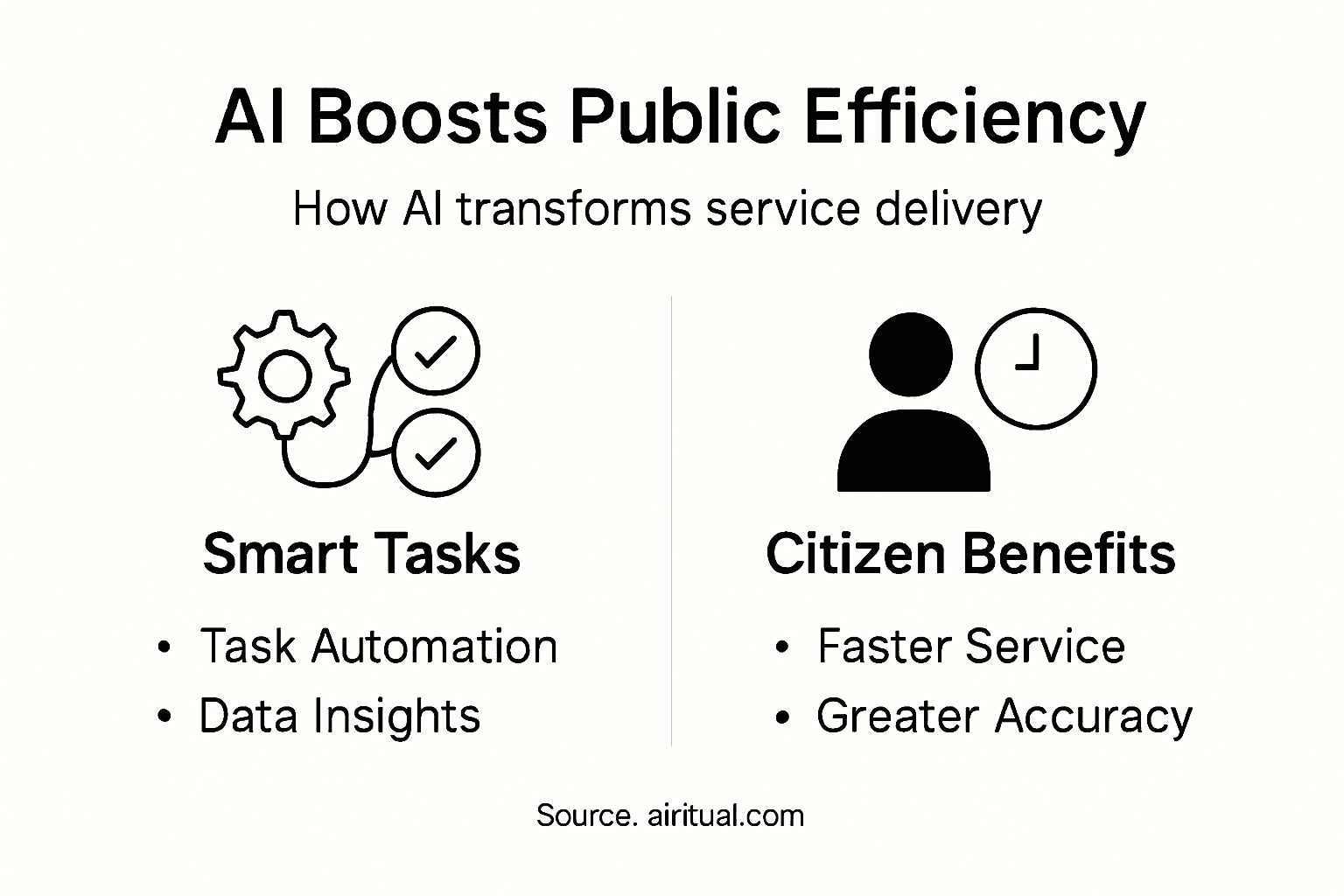
AI is fundamentally transforming public service delivery by creating remarkable productivity partnerships between intelligent technologies and human workers. This innovative approach allows government agencies to dramatically enhance operational efficiency, reduce administrative burdens, and create more responsive citizen services.
The efficiency improvements driven by AI technologies manifest across several critical dimensions:
- Operational Speed
- Instant document processing
- Rapid data analysis
- Accelerated decision-making workflows
- Resource Optimization
- Automated routine task management
- Intelligent resource allocation
- Predictive maintenance scheduling
- Error Reduction
- Consistent data processing
- Minimized human error
- Enhanced accuracy in complex calculations
Intelligent automation enables public servants to focus on more strategic, high-value tasks that require nuanced human judgment. By handling repetitive administrative functions, AI systems free up professional time and mental energy for complex problem-solving, policy development, and direct citizen interactions.

Moreover, AI-driven efficiency extends beyond mere task automation. These technologies provide sophisticated analytical capabilities that transform raw data into actionable insights. Government agencies can now predict service demands, identify potential inefficiencies, and proactively address community needs with unprecedented precision and speed.
Pro Tip: Implement a phased AI integration strategy that starts with low-risk, high-volume administrative processes to build organizational confidence and demonstrate tangible efficiency gains.
Balancing Transparency, Security, and Trust
Achieving public confidence in AI requires a delicate balance, as government AI systems navigate complex trust dynamics. Successful implementation demands robust governance frameworks that prioritize ethical considerations, data protection, and transparent decision-making processes.
Key strategies for maintaining public trust in AI-driven government services include:
- Ethical Governance
- Clear algorithmic accountability
- Regular independent audits
- Documented decision-making processes
- Data Protection
- Strict privacy safeguards
- Secure data management protocols
- Transparent data usage policies
- Citizen Engagement
- Open communication channels
- Public consultation mechanisms
- Accessible AI explanation resources
Algorithmic transparency becomes crucial in building public confidence. Citizens must understand how AI systems make decisions, what data they use, and the potential implications of automated processes. This means developing clear, accessible explanations of AI mechanisms that demystify complex technological processes without overwhelming non-technical audiences.
Moreover, security is not just about protecting data, but also about protecting the integrity of public service delivery. Government agencies must implement rigorous security measures that prevent unauthorized access, detect potential vulnerabilities, and ensure that AI systems cannot be manipulated or compromised.
Pro Tip: Develop a comprehensive AI ethics framework that includes citizen feedback mechanisms, regular algorithmic audits, and transparent reporting on AI system performance and potential biases.
Cost, Risk, and Change Management Concerns
Navigating the complex landscape of AI implementation requires a strategic approach to managing institutional transformation challenges. Government agencies must carefully balance technological potential with organizational readiness, addressing both financial implications and human adaptation requirements.
Key risk mitigation and cost management strategies include:
- Financial Considerations
- Phased implementation budgeting
- Comprehensive cost-benefit analysis
- Scalable technology investments
- Organizational Risks
- Workforce skills assessment
- Change management training
- Cultural adaptation programs
- Technical Challenges
- Cybersecurity vulnerability assessments
- Robust AI governance frameworks
- Ongoing system performance monitoring
Technological disruption demands more than financial investment. Successful AI integration requires a holistic approach that addresses workforce concerns, retrains existing personnel, and creates a culture of continuous learning and adaptation. This means developing comprehensive strategies that view AI not as a replacement for human workers, but as a collaborative tool that enhances their capabilities.
Risk management in AI adoption goes beyond technical implementation. Government agencies must develop transparent mechanisms for addressing potential algorithmic biases, ensuring ethical use of AI technologies, and maintaining public trust throughout the transformation process.
To help agencies manage AI adoption, consider this summary of cost, risk, and change management concerns:
| Challenge Type | Common Pitfall | Recommended Solution |
|---|---|---|
| Financial | Underestimating long-term costs | Use phased, scalable investment |
| Organizational | Employee resistance to change | Provide targeted retraining |
| Technical | Security vulnerabilities | Conduct regular system audits |
| Cultural | Lack of AI understanding | Initiate ongoing public engagement |
Pro Tip: Create a dedicated AI transition team with representatives from IT, human resources, and frontline service departments to ensure comprehensive and inclusive technology implementation.
Unlock Greater Efficiency in Public Services with AI Solutions
The challenge of enhancing operational efficiency while maintaining transparency and trust in public services is a pressing concern for governments worldwide. This article highlights critical pain points such as automating routine tasks, predictive analytics for resource management, and improving citizen engagement through intelligent systems. These goals align directly with overcoming administrative burdens and building more responsive government services by leveraging AI technology responsibly and effectively.
At airitual.com, we specialize in assisting local governments and public institutions to navigate this transformation. Our tailored AI solutions focus on strategic partnerships, customization, and measurable efficiency gains. Explore our Classes | Artificial Intelligence to deepen your understanding of AI implementation, or visit our GEO | Artificial Intelligence category for location-based innovations applicable to urban planning and infrastructure predictions.
Are you ready to take the next step toward streamlined, data-driven public services? Contact us today at airitual.com for a free strategy session and start unlocking the full potential of AI to improve efficiency, reduce risk, and build stronger community trust.
Frequently Asked Questions
What are the main benefits of using AI in public services?
AI enhances efficiency by automating routine tasks, improving fraud detection, streamlining service delivery, supporting informed policy-making, and optimizing resource allocation.
How can AI improve citizen engagement in public services?
AI can improve citizen engagement by utilizing multilingual chatbots, providing personalized service recommendations, and offering 24/7 digital support systems to assist citizens anytime.
What are some specific applications of AI in public service delivery?
AI applications in public services include administrative automation, predictive analytics for urban planning, and intelligent systems for employment services and resource management.
How can government agencies ensure public trust in AI systems?
Government agencies can build public trust by ensuring ethical governance, implementing robust data protection measures, and maintaining transparency about AI decision-making processes.
Recent Comments