

Choosing how to guide students through career exploration is no longer just about handing out job lists and personality quizzes. Today’s education technology coordinators face the challenge of preparing diverse learners for a workforce transformed by artificial intelligence. When static resources cannot keep up with shifting job trends and skills demand, AI-supported career guidance bridges the gap between student strengths and real labor market opportunities. This guide shows how integrating AI into your careers curriculum can personalize pathways, increase engagement, and equip students to thrive in a rapidly evolving environment.
Table of Contents
- Defining AI’s Role In Careers Education
- Key AI Technologies For Career Guidance
- Implementing AI Tools In School Curriculum
- Ethical And Privacy Concerns In AI Use
- Challenges And Best Practices For Schools
Key Takeaways
| Point | Details |
|---|---|
| AI Enhances Career Education | AI systems analyze real-time student data to connect learners with job market opportunities and personalize guidance. |
| Dynamic Labor Market Analysis | AI continuously monitors industry trends, providing counselors with current insights instead of outdated resources. |
| Scalability of Guidance | AI enables personalized career guidance for a larger number of students without significantly increasing counselors’ workload. |
| Addressing Ethical Concerns | Institutions must implement frameworks for fairness, transparency, and accountability in AI systems to protect student data. |
Defining AI’s Role in Careers Education
AI in careers education serves a fundamentally different purpose than traditional career counseling tools. Rather than offering generic interest inventories or static job databases, artificial intelligence systems actively analyze student data, recognize emerging skills, and connect learners with labor market opportunities in real time. For education technology coordinators, this means moving beyond passive information delivery to dynamic, responsive guidance systems that evolve as the job market shifts. AI-supported career guidance now includes learning analytics that identify student strengths before students themselves recognize them, adaptive recommendations that personalize pathways based on individual learning patterns, and automated early warning systems that flag students at risk of disengagement from their chosen trajectories.
The specific role AI plays depends on what problems you’re trying to solve in your institution. For many schools, the primary challenge is helping students understand how their current skills translate to actual job market demand. AI addresses this by analyzing job postings, industry trends, and skill requirements across thousands of positions, then matching those insights against individual student profiles. Your technology stack can now surface meaningful connections a human counselor might miss, revealing that a student’s programming experience combined with their communication skills opens doors in product management, technical writing, or developer relations. Beyond skill recognition, AI handles the labor market intelligence burden that overwhelms traditional career educators. It continuously monitors which skills are in demand, which industries are expanding, and which roles face automation, providing counselors with current context instead of textbooks from three years ago. This is particularly important because careers education must help individuals navigate evolving job markets and technological disruptions, and static resources simply cannot keep pace with workplace transformation.
What makes AI particularly valuable for your institution is its ability to scale personalized guidance without proportionally scaling your counselor workload. A single counselor working with 300 students cannot possibly conduct monthly skill assessments and labor market matching sessions with each student individually. AI systems eliminate this constraint by continuously monitoring progress, flagging changes in career interests, and proactively suggesting new opportunities or alternative pathways. When a student’s strengths shift or a new industry emerges, the system adapts without requiring human intervention to update processes. However, this technological capability only matters if it serves your actual institutional goals. Some schools prioritize early skill identification to improve course recommendations. Others focus on increasing college and career readiness through better awareness of post-secondary options. Still others aim to reduce equity gaps by ensuring underrepresented students receive the same quality guidance as their peers. Your AI implementation should directly address which of these challenges matter most to your community.
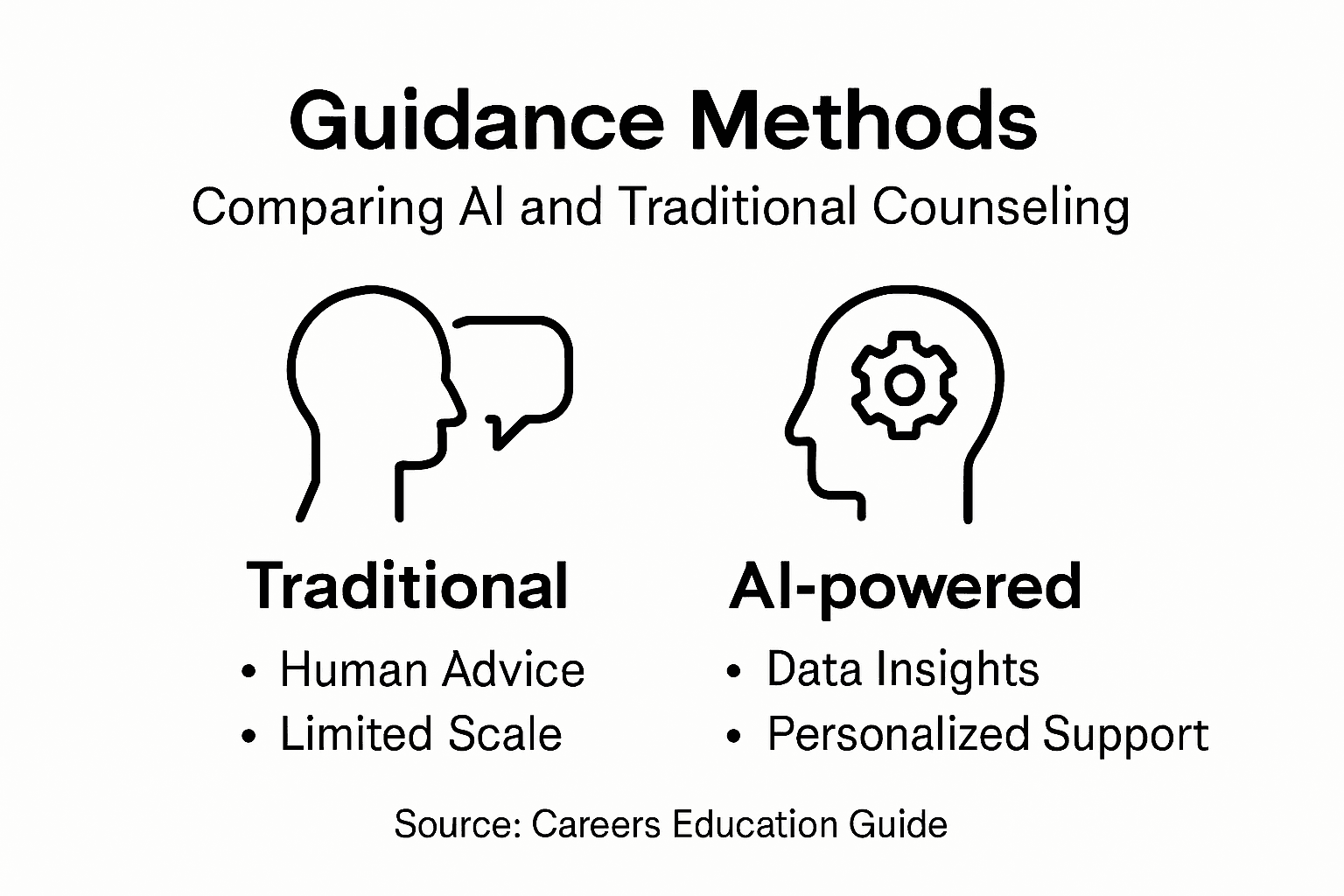
Here’s a comparison of traditional career counseling methods and AI-powered career guidance systems:
| Aspect | Traditional Counseling | AI-Powered Guidance | Hybrid Approach |
|---|---|---|---|
| Data Use | Relies on static inventories | Analyzes real-time student/labor data | Combines counselor observations with analytics |
| Personalization | Generic advice, limited tailoring | Adaptive, customized recommendations | Context-aware recommendations with counselor input |
| Scalability | Limited by counselor workload | Scales to support hundreds of students | Efficient initial screening, human-led follow-up |
| Labor Market Updates | Based on old resources | Immediate trend detection | Constant data refresh, validated by staff |
Pro tip: Before selecting or building any AI system for careers education, conduct a specific audit of what your current counselors spend time on each week. The highest-impact AI implementations typically automate the repetitive information-delivery tasks (like answering “what jobs exist for biology majors?”) so your human counselors can focus on the relationship-based, nuanced conversations that require genuine expertise and empathy.
Key AI Technologies for Career Guidance
Three core technologies power effective AI-driven career guidance systems, and understanding how each one works helps you evaluate solutions for your institution. Machine learning algorithms form the backbone of personalized career recommendations. These systems analyze patterns in student data, past career outcomes, and labor market information to identify which skills matter most for specific pathways. Rather than applying generic rules, machine learning continuously improves by learning from successful student placements, skill development timelines, and career transitions within your own student population. For example, an algorithm might discover that students with certain combinations of coursework, extracurricular involvement, and soft skills tend to succeed in competitive internships. This insight allows your system to flag similar students early and suggest targeted skill-building activities. Natural language processing (NLP) enables your systems to understand student conversations, resume content, and job descriptions in human terms. NLP technology powers chatbots that conduct meaningful skill assessments through dialogue rather than requiring students to click through rigid questionnaires. When a student writes about their experience managing a group project, NLP can recognize relevant leadership and communication skills they may not have explicitly labeled. Machine learning and natural language processing together create predictive models that identify skill gaps and build recommender systems, helping your institution guide students toward optimal career paths without requiring manual intervention for every student interaction.
Conversational AI and chatbots represent the practical implementation layer that students actually interact with daily. These systems provide immediate responses to career questions 24/7, eliminating the frustration students feel when counselor availability doesn’t match their needs. A well-designed chatbot can conduct skill inventories, suggest compatible career pathways, explain labor market trends, and even help students refine their resumes or practice interview responses. The key distinction between basic chatbots and AI-powered guidance is learning capability. Standard chatbots follow decision trees and deliver pre-written responses. AI chatbots understand context, learn from previous conversations, and adapt recommendations based on how individual students respond. This matters because career exploration is rarely linear. A student might ask about engineering careers, learn about the high demand for environmental engineering, then discover they care more about sustainability than traditional engineering. Your chatbot needs to follow that mental journey and adjust its guidance accordingly, not restart from the beginning.
Implementing these technologies requires thinking beyond individual tools to how they work together in your specific environment. Machine learning algorithms, natural language processing, and chatbots provide personalized career advice, skill assessments, and job recommendations while bridging your educational services with employment market realities. The most successful institutions combine these technologies with your existing infrastructure. Your student information system becomes more valuable when AI analyzes what courses actually lead to career success for your graduate profile. Your counseling appointments become more strategic when chatbots handle initial skill assessments and pathway questions, freeing counselors for deeper conversations about values, motivation, and long-term fulfillment. Your academic advising improves when predictive models show which early skill signals indicate readiness for advanced coursework or specific majors. Start by mapping which gaps currently exist in your career guidance workflow. Are students waiting weeks for counselor appointments just to learn what jobs exist in their field of interest? Is your skill assessment process so time-consuming that only motivated students complete it? Do your counselors repeat the same information-delivery conversations repeatedly? These friction points are where AI technologies create genuine value.
Pro tip: When evaluating AI career guidance platforms, ask vendors specifically how their machine learning models were trained and whether they can adapt to your institution’s unique strengths and outcomes, rather than forcing students into generic national workforce trends that may not match your community or graduate profile.
Implementing AI Tools in School Curriculum
Integrating AI into your careers education curriculum rarely follows a smooth linear path. Institutions that have succeeded recognize that adoption moves through distinct psychological and practical stages, starting with legitimate concerns about technology, moving through periods where staff worry about skill loss, and eventually reaching points where AI genuinely enhances learning outcomes. The challenge you face isn’t technical complexity but rather human readiness. Your career counselors and academic advisors may fear that AI will replace their expertise or that students will use these tools as shortcuts instead of engaging in real learning. These concerns are valid entry points for conversation, not obstacles to dismiss. Navigating the four stages of AI integration in education requires acknowledging fear as a natural response before moving toward productive innovation. Start by reframing AI not as a replacement for counselor judgment but as a highly efficient research assistant that surfaces opportunities counselors would need hours to find manually. When a student meets with a counselor, the AI has already conducted labor market analysis, identified skill gaps, and suggested three career pathways worth exploring. Your counselor’s expertise now focuses on understanding why a particular pathway resonates emotionally, what trade-offs matter to this specific student, and how their values align with different career options. This is higher-value work than answering “What jobs can I get with a biology degree.”
Implementing AI tools effectively requires connecting them to clear learning objectives rather than treating them as add-ons to existing processes. Your institution should define what competencies you want students to develop through AI-enhanced career education. UNESCO’s AI Competency Framework for Students outlines twelve competencies across four dimensions including human mindset, ethics, AI techniques, and system design, with progression levels from basic understanding to creation. While this framework addresses general AI literacy, you can adapt its structure to careers education specifically. For instance, under the human mindset dimension, students should develop comfort with AI as a tool for discovery rather than fearing it as a threat to job security. Under ethics, they should understand how AI might introduce bias in career recommendations and develop critical thinking about which suggestions make sense for their specific situation. These competencies transform AI from a transactional tool into a genuine learning experience. Your students aren’t just receiving recommendations; they’re learning how algorithms think, where data comes from, and how to evaluate whether an AI-suggested pathway aligns with their actual priorities.

The implementation architecture matters significantly. You cannot simply purchase a career guidance AI platform and expect it to integrate seamlessly with your counselor workflows, existing advising processes, and curriculum standards. Start with a specific problem you want to solve. Is your barrier that students lack access to initial skill assessments and pathway exploration? Implement a conversational AI chatbot that handles those discovery conversations, freeing counselors from repetitive intake work. Is your barrier that counselors lack current labor market data? Implement an analytics dashboard that surfaces real-time skill demand, industry growth projections, and alumni placement data by major and concentration. Is your barrier that your academic advising doesn’t connect to career outcomes? Implement predictive analytics that show which early course selections and skill developments correlate with successful placements in specific career fields. Each implementation decision should ladder back to an institutional goal, not just a vendor’s feature list. Build your rollout intentionally: pilot with one grade level or one counselor, gather specific feedback about what actually changed in how students explore careers, then expand based on evidence rather than enthusiasm.
One critical element often overlooked is preventing skill degradation while introducing AI tools. Your staff might begin outsourcing all career research to AI systems, assuming the tools will catch everything important. Instead, your institution should establish clear protocols about when and how AI adds value versus when human expertise matters most. For example, an AI system excels at identifying which skills are in highest demand and which industries are growing fastest. A human counselor excels at understanding a student’s risk tolerance, family circumstances, and non-monetary values that influence meaningful career choices. The institution that thrives uses AI to automate information research so counselors can focus on the irreplaceable human work of motivation and meaning-making. Your staff training should emphasize this distinction explicitly, showing examples of how AI recommendations surface options that counselors then enrich with context about work environment, culture fit, compensation realities, and advancement trajectories.
Pro tip: Identify one specific, measurable friction point in your current career guidance process (like “students wait an average of three weeks for their first counselor meeting”), implement AI to address that exact problem, measure whether the friction actually decreased and whether counselor time reallocated to higher-value conversations, and use that success story to build stakeholder buy-in before expanding to broader curriculum integration.
Ethical and Privacy Concerns in AI Use
When you implement AI into careers education, you are collecting and analyzing sensitive student data. This isn’t theoretical risk; it’s an immediate responsibility that demands careful thinking before deployment. Your AI system will process information about student interests, academic performance, test scores, extracurricular activities, socioeconomic background, and potentially family circumstances or mental health flags from counselor notes. The moment this data enters an AI system, you face genuine privacy vulnerabilities. AI systems are only as reliable as their training data, which means biased or incomplete data produces biased recommendations that directly harm real students. Consider a concrete example: if your training data historically overrepresents affluent students pursuing four-year universities while underrepresenting working-class students pursuing trade certifications and apprenticeships, your algorithm will reinforce that same bias by suggesting fewer alternative pathways to lower-income students. This isn’t malicious intent; it’s a structural failure that your institution must actively prevent. Privacy and data governance frameworks require international cooperation to align privacy principles with AI ethics, ensuring that AI development respects individual privacy and protects student data from unauthorized access, misuse, or inappropriate retention.
Your institution faces three interconnected ethical challenges. First is algorithmic bias and fairness. An AI system trained on historical placement data will perpetuate historical inequities unless you actively identify and correct for them. If women have historically been steered toward certain career paths, your algorithm will likely recommend the same paths to female students unless you implement explicit fairness constraints. This requires auditing your training data deliberately, asking hard questions about who appears in your historical records and who is missing, and potentially balancing your dataset to ensure underrepresented groups receive equitable recommendations. Second is transparency and explainability. When a student receives a career recommendation from an AI system, they deserve to understand why. If the system suggests a particular pathway because students with similar profiles succeeded there, that’s explainable. If it suggests something for reasons buried in mathematical processes even data scientists cannot fully interpret, you have an ethical problem. Students should be able to ask your system “Why are you recommending environmental engineering?” and receive a coherent answer, not “Our algorithm determined this probability score.” Third is accountability and recourse. What happens when a student disputes a recommendation or identifies that the AI system overlooked important factors about their situation? Your institution needs clear processes for human review, appeals, and correction. This cannot be automated away.
Before implementing any AI tool, establish governance frameworks that make these ethical commitments concrete. Start by documenting what data you collect, why you collect it, how long you retain it, and who can access it. Create policies about what you will never do with student data, such as selling it to third parties, using it for purposes beyond career guidance, or retaining it after students graduate. Develop specific protocols for regular bias audits, where you systematically check whether AI recommendations vary in statistically significant ways across demographic groups, and what you will do if you find disparities. Establish clear processes for students to understand, question, and dispute AI recommendations. Perhaps most importantly, communicate openly with students, families, and staff about how AI systems work, what data powers them, and what safeguards you have built in. Frameworks for responsible AI in decision-making help organizations establish awareness among leaders about managing legal, reputational, and societal risks. Your staff need training on ethical AI principles so they can recognize when recommendations seem biased, when the system appears to be disadvantaging particular students, or when a recommendation lacks adequate explanation. Your technology coordinator role includes becoming conversant in these ethical dimensions, not because you need to program the algorithms, but because you need to ask vendors and your internal teams the right questions about bias testing, data protection, transparency mechanisms, and accountability procedures.
The table below summarizes major ethical concerns and recommended actions for AI in careers education:
| Ethical Concern | Practical Risk | Recommended Action |
|---|---|---|
| Bias in Algorithms | Reinforces inequitable access | Regular dataset audits and fairness testing |
| Transparency | Opaque recommendations | Require plain-language explanations for students |
| Privacy Protection | Unauthorized student data use | Strict data governance and limited retention |
| Student Recourse | Inaccurate guidance | Enable appeals and human review channels |
Pro tip: Before purchasing or implementing any AI career guidance system, require the vendor to provide evidence of bias testing across demographic groups (gender, race, socioeconomic status, first generation status), demonstrate how their system explains recommendations to students in plain language, and clearly document what data they collect, how long they retain it, and who can access it, then build these safeguards into your procurement contract with specific penalties for non-compliance.
Challenges and Best Practices for Schools
Your institution faces real obstacles when implementing AI into careers education, and acknowledging them directly matters more than pretending they do not exist. The first barrier is staff resistance rooted in legitimate concerns. Your counselors and advisors may fear job displacement, worry they lack technical skills to work alongside AI systems, or feel skeptical that algorithms can understand nuanced career decisions that require human judgment. This resistance is not irrational pushback to dismiss; it reflects genuine uncertainty about their role in an AI-enhanced environment. Teachers and counselors also report insufficient training opportunities that leave them uncertain how to use new tools effectively. When training consists of a two-hour vendor demonstration followed by immediate deployment, staff naturally default to old workflows instead of leveraging the system’s capabilities. Beyond staff readiness, your institution faces technical integration challenges. Your student information system, career counseling platform, academic advising tools, and data storage systems probably were not designed to work together seamlessly. Retrofitting AI into this fractured infrastructure requires careful planning about data flows, system compatibility, and technical support capacity. Many institutions discover too late that their existing technology stack cannot provide the clean student data AI systems require, or that their infrastructure cannot securely handle the computational demands of running AI models. Finally, schools struggle with equity and access concerns. If your AI implementation only reaches students with reliable devices and stable internet, or if it only works well for students comfortable with technology-mediated conversations, you have inadvertently widened rather than narrowed opportunity gaps.
Successful schools address these challenges through deliberate strategies grounded in human needs. Start with customized, motivating training programs designed specifically for your staff rather than generic vendor training. Effective training emphasizes hands on experience with AI tools integrated into real workflows that staff members care about. Instead of abstract lectures about machine learning, show your counselors exactly how the chatbot will handle their most common repetitive questions, freeing them for complex conversations. Demonstrate how the skills recognition tool works on actual student profiles, then ask counselors to use it and discuss whether the recommendations make sense. Allow staff to experience the tools in low-stakes environments before expecting them to use them with students. Include time for staff to articulate concerns and questions without judgment. The institutions that achieve highest adoption rates treat staff as partners in implementation rather than subjects to be trained upon. Beyond training, establish clear role definitions that explicitly describe what AI will and will not do in your institution. Your marketing materials, staff handbook, and counselor job descriptions should all reflect this clarity. An AI system handles initial skill assessment and pathway exploration but does not make final recommendations. A chatbot answers factual questions about career fields and skill requirements but does not advise students about personal decisions. A predictive analytics system flags students at risk of disengagement but does not replace a counselor’s judgment about interventions. When roles remain ambiguous, staff either over rely on AI systems in ways that undermine human judgment, or under utilize them because they remain uncertain about appropriate use.
Equity demands specific attention. Strategic AI integration must involve policymakers, educators, and technologists to ensure equitable benefits and safeguard students rather than concentrating advantages among already privileged groups. This means deliberately designing your implementation to reach all students, not just the most tech comfortable or most engaged. Provide multiple access pathways: some students benefit from conversational chatbots, others from written dashboards, others from in-person counselor conversations informed by AI insights. Actively monitor whether different demographic groups of students engage with your AI tools at different rates, receive different types of recommendations, or report different satisfaction levels. If you discover disparities, investigate whether the system itself is biased, whether particular student populations lack adequate training or access to use the tools, or whether some counselors are over relying on AI recommendations while others continue traditional approaches. Design your rollout intentionally rather than assuming schools in affluent neighborhoods will adopt faster and therefore should pilot first. Consider piloting in schools serving students with greatest career guidance needs, then use those successes to build broader adoption. Most importantly, measure impact equitably. Do not just track whether recommendations were well received; track whether different groups of students moved into different types of careers after using the system, and whether equity gaps narrowed or widened.
Three practical elements define successful implementation. First, start small with measurable goals. Choose one specific problem your institution will solve, implement AI focused on that problem, measure whether you actually solved it, then expand based on evidence. Second, build sustainable support structures. Designate clear responsibility for ongoing system monitoring, bias audits, staff training, and technical maintenance rather than treating implementation as a one-time project. Third, involve your community in governance. Create oversight committees including counselors, academic advisors, students, and families to regularly assess whether the AI system is working as intended and serving students fairly. These structures require institutional commitment beyond the technology purchase itself.
Pro tip: Conduct a detailed audit of your current career guidance workflow before implementing any AI system, documenting exactly how counselors spend their time, what conversations are repetitive versus complex, and which student populations currently receive less counselor attention, then evaluate AI tools based on whether they specifically address your identified gaps rather than implementing features that look impressive but do not solve your actual problems.
Unlock the Power of AI to Transform Careers Education
The article highlights a critical challenge faced by educational institutions today: the need to scale personalized, data-driven career guidance while preserving the human touch that empowers student success. AI technologies like machine learning, natural language processing, and conversational chatbots can analyze real-time labor market trends and student skill profiles to offer adaptive recommendations. Yet, the complexity of integrating these solutions demands strategic partnership and customization to align AI capabilities with your institution’s unique goals and ethical standards.
At Airitual, we understand that effective AI implementation is not about replacing counselors but enhancing their impact by automating repetitive tasks and providing actionable insights. Our specialized consultancy and AI-powered tools are designed to help schools navigate the intricacies of AI adoption, address equity concerns, ensure transparency, and optimize student outcomes. If your goal is to elevate career guidance through responsible and scalable AI solutions start with a free strategy session today and discover how tailored AI integration can reshape your student success story. Learn more at Airitual’s main site and begin your journey toward impactful digital transformation.
Frequently Asked Questions
What is the role of AI in careers education?
AI in careers education actively analyzes student data to personalize career guidance, recognize emerging skills, and connect learners with real-time labor market opportunities.
How does AI improve traditional career counseling methods?
AI improves traditional methods by providing adaptive, customized recommendations and analyzing real-time labor market data, allowing for better alignment between students’ skills and job demands.
What key technologies are used in AI-driven career guidance systems?
The key technologies include machine learning algorithms for personalized recommendations, natural language processing for understanding student interactions, and conversational AI for meaningful engagement.
How can schools address ethical concerns related to AI in education?
Schools can address ethical concerns by establishing data governance frameworks, conducting regular bias audits, ensuring transparency in AI recommendations, and creating processes for student recourse and accountability.
Recent Comments